
Best Spread Betting Platform UK 2026
 Available in US
A spread bet is not a fixed-odds wager with a bigger headline. The stake is a *unit*, and the result is multiplied by the size of the bettor’s miss or the size of their edge against the level they chose. A £5 stake at 50 units is not a £5 risk: it is £250 of exposure, every punter’s “win” or “loss” scaled by the gap between result and level. Spread betting losses can exceed the deposit, and that single sentence is the entire reason this page leads with cost rather than with odds. Welcome money, free bets and “free to play” promos are written around that fact; the offers in this market are built on the assumption that the customer reads the marketing first.
In Great Britain, sports spread betting offered by a bookmaker is licensed by the Gambling Commission under the Gambling Act 2005. Financial spread betting on shares, indices, FX and commodities is a separate activity, regulated by the Financial Conduct Authority. The two regimes look alike and use the same name, which is where most of the search-intent confusion lives. This page is about *sports* spread betting — the cricket, football and racing markets offered by sportsbook-style operators alongside fixed-odds markets — and the cost of running an account there. Every operator in the ranking below is a GB-licensed remote operator on the Commission’s public register.
The page works in this order: how a sports spread bet is built and how a bankroll handles one; what the bet types look like in practice; which sports and tournaments actually carry a quoted spread; the mechanical walkthrough from picking a market to settling a winner; the top-10 shortlist of GB-licensed platforms; the legality frame around the offer market; and where to get help if the maths stops working for the player. Cost comes first by design — the page closes only on platforms where the terms page has been read alongside the welcome line.
*Current as of 27 October 2026. Licence claims checked against the Gambling Commission’s public register.*
What “Cost” Means in a Spread Bet
A £5 stake at 1.90 returns £9.50 in a fixed-odds wager. A £5-per-point unit stake on a Total Goals spread of 2.7–2.9 at, say, 2.8 can return nothing, or several hundred pounds, or nothing at all. The stake is the per-unit number; the moment the result lands the bettor collects or pays on every unit of difference between result and level. That is the mechanic, and it is also the cost. Anyone comparing platforms on price alone is comparing the wrong number.

Three costs sit underneath every spread-bet quote a platform publishes. The first is the spread width: the gap between the buy and sell level quoted around the bookmaker’s estimate. Buy at 2.8, sell at 2.7, the market-maker’s edge is built into the 0.1 between them. The second is the stake cap per market: how much per unit a single account can have running on a Total Goals or Winning Favourites quote. The third is the settlement frequency: how often positions are marked or closed, which decides how long a losing position can sit before the platform does anything with it. None of those numbers appear on the front page of a sportsbook; all three decide what the platform will cost on a normal-sized account.
The offer market adds a fourth cost that is rarely on the marketing page: turnover, minimum-odds rules, the seven-day or twenty-eight-day expiry on free bets, the conditions under which a qualifying bet can be cashed out or placed in play. A platform that hands out £60 in free bets against a £10 trigger has written the rest of the cost into the qualifying rules. A platform that gives £40 in free bets with seven-day expiry has written it into the time pressure. Read both, and read the offer as the bettor will use it: a deadline, a minimum, and a forced choice of market.
The rest of this page is the search for a platform where those four costs can be made legible before the first deposit, and where the rest of the terms page matches what the welcome page implied. Most do not, and the differences are large. Where two platforms look interchangeable from the welcome line, the rollover, expiry and qualifying rules almost always decide between them.
Strategies and Bankrolls That Spread Betting Can Handle
Sports spread betting is not a market for short-horizon, all-or-nothing picks. The accounts that last in it are running a bankroll against a small number of points per unit, across a range of sports, with a stop that closes the position before it costs more than a fixed percentage of the bank. The strategies on the search-intent side — picks against the spread, tipsters, “best bets today” — assume that the reader treats the spread as a flat bet, which collapses under the first multi-unit loss. The strategies that actually work inside this product look more like position-sizing rules from financial spread betting than anything from a fixed-odds coupon.

A bankroll rule that transfers cleanly: the per-unit stake is set so that a one-unit move on the chosen market costs less than 1% of bank. On a £500 bank that is £5 per unit. On a £2,000 bank it is £20. The point of the rule is not to constrain winnings — the per-unit return scales with the size of the edge — but to keep a losing streak from eating into the next month’s budget. A spread-betting account that lets the per-unit stake drift to the maximum the platform allows is no longer being run; it is being run at the platform’s risk limit, which is not the bettor’s.
The strategies that the search results point to — picking favourites against the spread, taking football unders on Total Goals, holding a cricket runs spread to the innings break — work if the staking rules behind them are right. The same picks fail with a 10-unit per-unit default. Punters moving from fixed odds to spread betting tend to copy their old “stake £10 on the nose” habit into a £10-per-unit stake, then meet the first 10-unit swing and discover what a 1-unit £5 fixed bet never could do. Spread-betting tips exist for every sport covered here; what they rarely cover is the per-unit sizing that makes them survivable.
The other strategy mistake the offer market encourages is to chase the sign-up bonus with the whole bank. A free-bet package is built around a qualifying wager, a minimum odds level and a time window, and a punter who funnels bank into the qualifying bet on the first day wastes a month of bankroll on the offer itself. Better to size the qualifying wager to the offer the way it is written, run the bank separately, and treat the bonus money as a refund on the cost of opening the account rather than as a return on it.
The strategies below are the ones that work in spread betting specifically — *because* the cost of a unit is its own decision, and the strategy decision is what to do with it.
Sizing per Unit Against the Bank
A flat per-unit stake of 2% of bank survives most months. A flat per-unit stake of 5% does not. The choice looks conservative in writing and it is the difference between running an account through a bad week and withdrawing it. The punter who uses 5% to chase a bonus has decided, without saying it, that the bonus is the strategy. It is not.
Diversification Across Markets
Spread-betting cost is highest when the bettor concentrates on one quoted market at one level. Total Goals, Winning Favourites, Race Index, Supremacy and a cricket runs spread are quoted on different books with different timing, and a portfolio that runs small positions on several handles a bad week in one of them. A single-product account is the spread-betting equivalent of an all-or-nothing coupon.
Closing the Position Versus Letting It Settle
A spread bet does not have to run to a result. Many of the platforms below let the bettor close the position mid-event at the next quoted level. The cost of closing is the next spread itself: the gap between bid and offer, taken a second time. The cost of letting it settle is the open exposure overnight. The choice depends on the bettor’s view of the market, not on the platform’s terms; but the platform is what makes the choice available, and the ones that mark positions continuously make a routine mid-week trading style possible.
The Bet Types and How Each One Settles
Spread-betting sportsbooks vary less in their offer than the welcome pages imply. The mechanical types below are the ones the marketing terms assume the punter understands, and the few that aren’t are the ones that decide between platforms.
Sports spread betting is the umbrella term in the search market. Under it sit Total Goals, Winning Favourites, Supremacy, Race Index, and a long tail of sport-specific quotes. The mechanic is the same across all of them: a level, two directions, a per-unit stake, and a settlement that multiplies by distance.
Buying versus selling is the directional choice. Buying at the higher quoted level wins by the difference between result and level if the result is higher, and loses by that same difference if it is lower. Selling is the mirror. The buy/sell spread is the market-maker’s cut. A quoted Total Goals spread of 2.7–2.9 is a 0.2-unit gap; the platform takes it on every buy and every sell, the same way a fixed-odds bookmaker takes the overround.
Total Goals spread betting quotes a number of goals for a football match. The bettor picks over or under, the per-unit stake determines the payout, and the gap between result and level multiplies out. A 4–1 result at a 2.7–2.9 line settles at five goals; a buy at 2.9 wins 2.1 units per unit stake. The punter who has never run a Total Goals position can use this as the test market — it is the most quoted, the most settled, and the easiest to read against the live result.
Winning Favourites spread betting quotes a number of favourites that win on a day’s racing card. Buy more favourites, win more if the favourites oblige; sell less, win if the outsiders land. The number of runners on the card and the state of the going decide the line, and the line moves through the morning as prices firm. A spread-betting account that lets a position run into the first race without a stop can be hit twice in an afternoon.
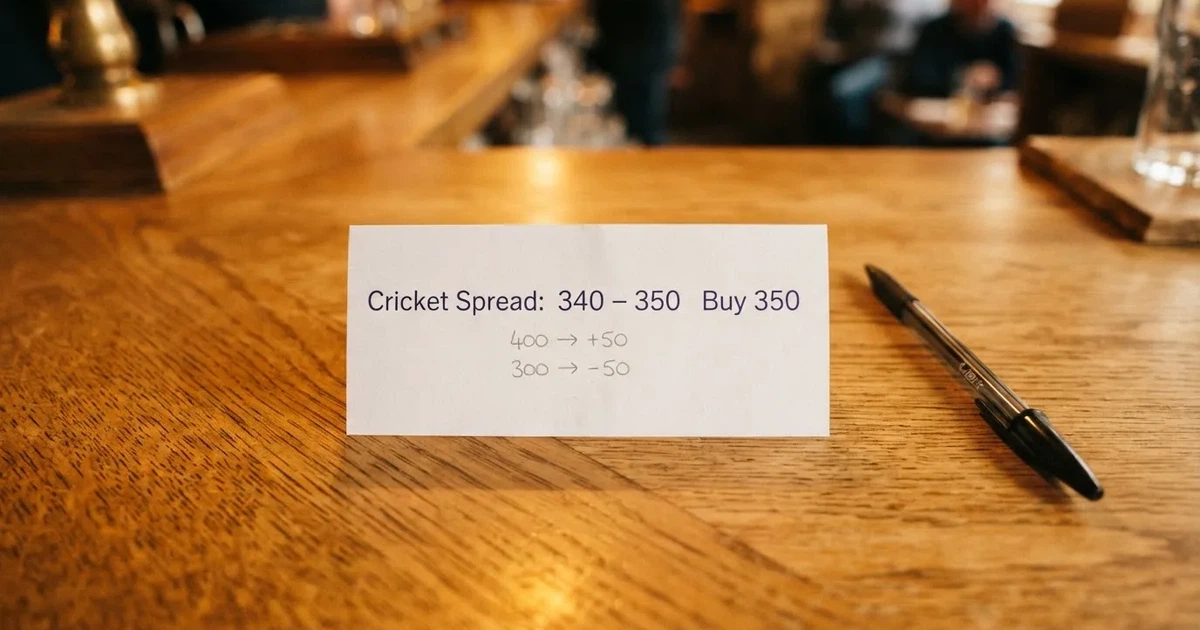
Cricket spread betting quotes a runs total per innings or per match. The example in the trade is a 340–350 line with a buy at 350. A team score of 400 settles at +50 units; a score of 300 settles at –50 units. The result is the same arithmetic as football or racing, but the gap between runs scored and runs quoted is the bigger number, and the per-unit stake that looks fine at 5p can be unmanageable at £1 per run. This is the bet the offer market quietly assumes the punter understands.
Point spread betting is the North American form, where the spread is a handicap applied to one team and the price is the bookmaker’s ten-eleven standard. A push returns the stake. The form is widely understood and widely quoted; it is not the British sports-spread product the rest of this page is about, but it shows up inside the same platforms and settles at the same account.
Spread betting football looks like Total Goals from the outside but quotes a Supremacy line on top of it. The favorite is given a goal handicap, the platform quotes the spread, and the punter takes a position. A 2.5-goal favourite at –0.5 Supremacy settles at +2 units if they win by three or more, and at –2 units if they win by one.
Quoted Sports and Tournaments
The sports books at GB-licensed platforms fall into three groups. The first is the daily-quoted core: football (Premier League, Championship, Scottish Premiership, Champions League, Europa League), horse racing (every meeting the day cards), greyhound racing, and cricket (internationals, the Hundred, the County Championship). These move through the trading day and settle on the same night. The second is the weekly-quoted schedule: rugby union (Six Nations, autumn internationals, Premiership), rugby league (Super League), tennis majors and ATP/WTA events, golf majors and PGA/DP World Tour events, snooker majors, darts majors and boxing cards. The third is the event-specific book: World Cup football, European Championship, the Ashes, the Grand National meeting, the Masters and the Open, the Cheltenham Festival.
The depth of the book is what distinguishes one platform from another in this market. The wider the daily quote, the smaller the spread width tends to run on the busy markets — competition between platforms is most visible where they all have to make a price every morning. The thinner markets — rugby union props, mid-tier golf, lower-division football — are where one platform’s book runs and another’s does not.
Three tournament points worth knowing:
- Premier League, Champions League and the Scottish top flight are the everyday football core. Any GB-licensed sportsbook offers Total Goals, Supremacy, Winning Favourites or Match Total on the visible matches.
- The Ashes, the Hundred, the T20 World Cup and international one-dayers are the cricket core. Runs Total, Runs Innings, Player Performance and a long tail of prop markets sit on top.
- The Grand National, the Cheltenham Festival, the Derby meeting, the Royal Ascot week and the Champion Hurdle day are the racing core. Race Index, Race Supremacy, Time of Winner and Winning Distances are quoted across them.
The mid-tier events — Heineken Champions Cup rugby, the ATP 1000 events, the PGA Tour playoffs, the women’s football European Championship — are where quote depth drops. The punter who builds a portfolio across sports should look at the second-tier books first, since the platform that runs those markets has a wider net than the one that doesn’t.
How a Spread Bet Reaches Settlement
The walkthrough below is the same at every platform in the ranking. The differences — what the platform quotes, how wide the spread runs, how the position can be closed mid-event — come out in the operator section.
Pick the market. A Total Goals line is quoted on a Premier League match between two named teams. The platform shows two numbers, e.g. 2.7–2.9, that are the spread. To “buy” (back the higher total) the punter clicks the right-hand number; to “sell” (back the lower total) the left-hand number.
Set the per-unit stake. A platform default may be £1 per unit or £5 per unit; the punter should override either to a known sizing rule. On a £500 bank and a 2% rule, a £10 per-unit stake is the ceiling. The platform shows the per-unit maximum for the market on the slip, and many spread-bet books will refuse a stake beyond it.
Place the wager. The bettor confirms. The platform records the position, the level and the per-unit stake. No further stake is taken.
Watch the position. Some platforms mark the position to the live market, refreshing the running profit or loss as the quote moves. Others only mark at the end. The differece decides whether mid-event trading is possible.
Close or run to settlement. The punter can close the position early at the next quoted level, paying the next spread as the cost. Or the position runs to the result and settles at the difference between result and level multiplied by per-unit stake.
Settle. Winning Favourites settle on the day’s card as soon as the last race finishes. Total Goals and Supremacy settle at full-time, including extra time where the platform’s rules specify it. Cricket runs settle when the innings closes — or, on innings-runner quotes, when the innings reaches a quoted mark. Race Index quotes settle on the day’s race time over the standard course.
The cost per round is the spread width on entry, plus the spread width on close if the position is closed early, plus any stake-rule breach penalty. A round with no early close costs exactly the entry spread.
Why the Spread Width Is the Real Price
The buy-sell spread is the per-unit cost that the platform earns on every round. At a quoted 0.2 spread on Total Goals, a round that opens and closes at the same level nets the platform 0.2 units per unit stake. A round that opens, runs ten units against the punter, and closes costs the punter 10.2 units (10 unit loss + 0.2 entry cost + 0.2 close cost on a 0-wide market). The punter who treats the spread width as a service-charge line item rather than as a price is the punter who reads the quote correctly.
The Top-10 GB-Licensed Platforms
The ranking below is built on the *cost* test: which platform makes the welcome line, the rollover, the expiry, the staking rules and the licence terms legible to a punter who is opening a first spread-bet account. The list follows the GB public register. Every brand listed is a remote general betting (real events) licence holder; verification of these claims is the reader’s first job, since a brand can move licence across the year. Offers are stated only in the qualitative form the operator’s own terms use.
| Brand | Gambling Commission account | Licence holder | What the operator’s own terms state |
|---|---|---|---|
| Spreadex | 8835 | Spreadex Limited | FCA-regulated for spread betting; GC for fixed-odds; sign-up offer £60 in free bets on a £10 fixed-odds trigger; qualifying bet window 28 days |
| Sporting Index | 27343 | Sporting Index Limited | Welcome package spanning fixed-odds free bets and Total Goals, Winning Favourites and Race Index spread bets; qualifying bet cannot be placed in play or cashed out |
| Coral | 54743 | LC International Limited | £40 in free bets after a £20+ sports bet at minimum odds 2.0; free bets expire 7 days after issue |
| Sky Bet | 67370 | SBG Sports Limited | £30 in free bets after a £5+ deposit and a 5p+ single at 1/1 or greater; issued as three tokens |
| Dabble | 65677 | Dabble Sports UK Ltd | £10 in free bets on a £10 first bet; minimum odds apply; 7-day expiry; stake not returned |
| Swifty Sports | 58957 | Swifty Global (UK) Ltd | Best Odds Guaranteed, Cash Out on horse racing and football, daily price boosts, live streaming and in-play; Bet Builder listed as coming soon |
| Betfred | 39544 | Petfre (Gibraltar) Limited | Bet Builder, Sub Switch, Racing Post data, Extra Places, plus a casino and bingo vertical on the same account |
| Lottoland | 38991 | EU Lotto Limited | Sports betting plus lottery, scratchcards and casino under one GB-licensed account |
| 888sport | 39028 | 888 UK Limited | Pre-match and in-play, Cash Out, Bet Builder, racing streams, BetFinder form tools and daily boosted odds |
| VBet | 44662 | SCGO Limited | Bet Builder, pre-match and in-play, live streaming and a live calendar with results and stats |
Spreadex and Sporting Index are the two whose welcome packages are *built around* spread betting — the others are fixed-odds sportsbooks that occasionally quote a Total Goals or Supremacy line. A first-time punter building a spread-betting book will read the Spreadex and Sporting Index pages first. A punter whose primary account is a fixed-odds sportsbook with a side interest in spreads will read the rest. Either way the table is the place to compare welcome terms against licence status, since the licence is what the rest of the page is built around.
Spreadex
Spreadex is the only platform in the table where financial spread betting and sports betting sit on the same brand. The site states it is FCA-regulated for spread betting and Gambling Commission-licensed for fixed-odds betting, and the offer is built across both. A £60 free-bet package triggers on a £10 fixed-odds wager within 28 days, with the free bets usable across fixed-odds and spread markets. A first-time spread punter gets the FCA disclosure — the page that warns of large losses and of collateral requirements — alongside the welcome page, and that disclosure is one of the cheaper features of the account.
The welcome page makes the cost legible in a way the others do not. A punter who wants the package to come out as the marketing suggests will use a £10 fixed-odds trigger at minimum odds and let the free bets expire unused; a punter who wants the spread offers to work will keep them on a watchlist for the next cricket or football quote. The downside is the licence position: the spread-betting side runs under the FCA, not the Commission, so the Commission’s safer-gambling rails (deposit limits, vulnerability checks, GAMSTOP) apply to the fixed-odds arm of the account and only the platform’s own rules carry it on the spread-betting arm. Worth it for the punter who actually wants spread betting on the account. Those needing a fixed-odds primary account with a small side-exposure to Total Goals, however, will likely find other platforms more suitable.
Sporting Index
Sporting Index’s welcome package is the only one in the ranking whose free bets are denominated in the spread-betting markets themselves — three £5 Total Goals, three £5 Winning Favourites, and a £1 Race Index spread bet sit alongside three £10 fixed-odds free bets. A first-time spread punter who takes the package on its own terms will know what a Total Goals line settles like before staking any of their own bank. The downside is the same as Spreadex’s on the licensing side: spread betting is the brand’s identity, but the regulator on the financial-spread side is the FCA rather than the Commission. The qualifying bet cannot be placed in play and cannot be cashed out — both are stated in the offer page and both narrow what counts as a qualifying trigger.
For the punter who wants a taste of spread betting at a small per-unit size, this is the cheapest learning path in the table. For the punter whose day-to-day account is fixed-odds betting with an occasional Total Goals bet, the welcome package will sit unused.
Coral
Coral is a fixed-odds sportsbook first. The welcome offer on Coral is built around a £20+ qualifying bet at 2.0 minimum odds, which converts to £40 in free bets that expire seven days after issue. Spread betting is available on the platform’s sportsbook, but the brand’s identity is the fixed-odds coupon, the live streaming and the racing products. The licence is held by LC International Limited, which also runs Ladbrokes across the Commission’s register, so the same compliance and self-exclusion rails cover both brands.
A punter whose primary account is a fixed-odds book with a side interest in spreads will find Coral’s spread markets convenient but not deep. The daily quote on football and racing covers Total Goals and Supremacy on the main events; the welcome line is the cost the punter should read first, since the seven-day expiry on the free bets is short by market standards and the £20 minimum trigger is the largest in the table.
Sky Bet
Sky Bet is the second of the fixed-odds sportsbooks in the table whose welcome offer is built around a minimum first bet rather than a minimum deposit. A £5+ deposit unlocks £30 in free bets once a first 5p+ single or each-way bet at 1/1 or greater has settled. The free bets come as three £10 tokens, which the customer uses across fixed-odds markets; spread betting is offered on the platform but does not feature on the welcome page. The licence holder is SBG Sports Limited, which sits in Flutter Entertainment alongside Paddy Power and Betfair; the safer-gambling rails and the parent-group compliance apply.
A punter who wants a fixed-odds account with a Commission licence and full self-exclusion coverage will find Sky Bet’s terms clear and the cost of opening the account small — the 5p minimum stake is the lowest in the table. A punter whose need is a spread-betting book will look further down.
Dabble
Dabble is a smaller fixed-odds sportsbook with a peer-betting identity, and the welcome offer is the simplest in the table: a £10 first bet unlocks £10 in free bets, with minimum odds, a seven-day expiry and the stake not returned on the free bet. The licence holder is Dabble Sports UK Ltd. Spread markets are limited; the brand’s offer is built around the social side, and the welcome money is the read on cost.
The bettor who wants a small fixed-odds account and is happy with thin spread-betting coverage can use Dabble for the book. Casual exposure is easily managed here, but the depth is not designed for dedicated spread-market players.
Swifty Sports
Swifty Sports is the spread-bet-friendly fixed-odds sportsbook in the table. The app lists Best Odds Guaranteed, Cash Out on horse racing and football, daily price boosts, live streaming and in-play, with a Bet Builder listed as coming soon. The licence holder is Swifty Global (UK) Ltd. Spread markets are quoted but are not the brand’s identity; the offer belongs to the fixed-odds side. A punter who wants the spread markets and the fixed-odds books on one app will find this the closest fit in the fixed-odds cluster. It is an option for the hybrid punter who prioritises fixed-odds markets.
Betfred
Betfred is the deepest fixed-odds sportsbook in the table. The brand’s app features Bet Builder, Sub Switch, Racing Post data and Extra Places on the racing side, with a casino and bingo vertical running on the same account. The licence holder is Petfre (Gibraltar) Limited. Spread markets are quoted on the platform’s sportsbook but the brand’s identity is fixed odds. A punter whose primary need is racing and football fixed odds with a side line in spread betting will find Betfred’s product wide and the safer-gambling rails full-strength. Dedicated spread-betting specialists, however, should seek out more focused alternatives.
Lottoland
Lottoland is the gambling-vertical store in the table: lottery betting, scratchcards, sports betting and casino all under one GB-licensed account. The licence holder is EU Lotto Limited. Spread markets are quoted, but the brand’s identity is the lottery and scratchcard verticals. A punter who wants a single account across multiple verticals will find Lottoland’s licence position as good as any. For the player primarily focused on liquid spread markets, though, this is not the most suitable platform.
888sport
888sport is the second fixed-odds brand in the table with a full product spread: pre-match and in-play, Cash Out, Bet Builder, racing streams, BetFinder form tools, live bet feed and daily boosted odds. The licence holder is 888 UK Limited. Spread markets are quoted on the platform. A punter who wants a full-feature fixed-odds book with a Commission licence and some spread-bet coverage will find 888sport’s terms familiar.
VBet
VBet is the third fixed-odds brand in the table with a full product spread: Bet Builder, pre-match and in-play, live streaming and a live calendar with results and stats. The licence holder is SCGO Limited. Spread markets are quoted on the platform. A punter whose primary need is a full-feature sportsbook with a Commission licence will find VBet’s product complete. Traders seeking consistent, deep liquidity across spread markets will generally prefer dedicated exchanges.
How the Welcome Costs Compare
Three numbers decide the welcome cost across this list. The first is the qualifying minimum: a £5 deposit at Sky Bet, a £10 stake at Spreadex, a £10 fixed-odds trigger at Sporting Index, a £20 bet at Coral. Lower means a smaller pull on bankroll to access the offer. The second is the expiry window: seven days on Coral and Dabble, twenty-eight days at Spreadex, longer windows on others. Shorter means more pressure to use the free bets within the offer’s terms. The third is the free-bet stake rule: free bets typically return winnings only, not stake. The “stake not returned” line at the top of every welcome page is the line that decides the offer’s real value.
Margin: What the Bookmaker Keeps
A spread betting book’s edge is the buy-sell gap on every quote. A fixed-odds book’s edge is the overround across all outcomes of a market — the sum of 1 ÷ odds across the runners, taken from 100%. The arithmetic is what a margin is and what the bookmaker keeps in either form.
Take an illustrative two-way market priced at decimal odds 1.90 / 1.90 — quoted for example only, not a market in the table. The payout share to the bettor on either outcome is 1 ÷ (1/1.90 + 1/1.90) = 0.5, or 50% of every unit staked. The bookmaker keeps 100% − 50% = 50% as the margin on the market.
That 50% is an *illustrative upper-bound figure*, not a quoted market price. Real two-way sportsbook markets trade at decimal odds around 1.91 / 1.91, where the overround is 4.7% and the implied margin is closer to 4.5%. The 50% band is the result of pricing both sides of the example at 1.90, which is a perfectly even overround but an unusually high one for a balanced event. The figure is only useful as a worked example of how the margin arises from the odds — not as a price the punter will see on a match.
The practical move for the punter: take a quoted two-way market on any event in the platform, add the implied probabilities (1 ÷ odds) for both sides, and subtract from 100%. The result is the bookmaker’s margin on that market. Total Goals, Winning Favourites and Race Index quotes don’t map to overround in the same way — the spread width is the analogue, and a tighter spread means a lower per-round cost. The two are different metrics of the same thing — what the platform keeps of every unit the punter puts through the book.
What the Licence Frame Looks Like in Great Britain
The Gambling Commission licenses the entire commercial GB betting market under the Gambling Act 2005. Northern Ireland is outside the Act, which is why every licence in the table is described as a GB licence and not a UK one. Since the Gambling (Licensing and Advertising) Act 2014, an operator whose remote facilities are used in Great Britain needs a Commission licence wherever it is based. A Curaçao, Maltese or Gibraltar licence is not a substitute; offshore brands that serve GB customers without a Commission licence are not licensed for that activity, and the page that surfaces in GB for an unlicensed brand carries no British consumer redress, no GAMSTOP coverage and no Commission complaints route.
The Commission’s public register is searchable by business name, trading name, domain or account number. Every brand in the ranking above is on it as a remote general betting (real events) licence holder, with a licence number on the operator’s own terms page that matches the Commission’s record. Verifying the licence is a one-page check, takes under a minute, and answers the question the rest of the page assumes the punter has answered.
Financial spread betting — on shares, indices, FX, commodities — is regulated by the Financial Conduct Authority, not the Commission. The two regulators’ regimes look alike, use the same vocabulary and sit on the same brand in several cases (Spreadex and Sporting Index both run dual-regulated businesses). A punter reading the FCA’s disclosure at sign-up is signing up to a different regulatory contract than a Commission-licensed punters; the FCA’s regime assumes a customer who understands leveraged products and is registered as such.
Who Can Place Bets
The minimum age for betting in Great Britain is 18. The Commission’s anti-money-laundering rules have required name, address and date of birth verification since 7 May 2019, including on a free-bet or bonus, which means there is no anonymous play at a licensed site. A financial vulnerability check applies since 30 August 2024 to remote betting customers whose deposits-minus-withdrawals exceed £150 in a rolling 30 days (in force since 28 February 2025). The check is a public-record one — bankruptcy or county court judgments — not an income check, and operators have built the workflow into their onboarding. There is no statutory cap on stakes in sports betting. Operators set their own maximum stakes and may restrict individual customers.
What May Be Bet On
There is no statutory list of permitted bets or markets. An operator holds a licence for a category — remote general betting (real events) for the brands in this ranking — and offers markets under its own rules and the Commission’s Licence Conditions and Codes of Practice. In-play betting is offered by every GB bookmaker in the table; the controls are the operator’s licence conditions and customer-protection duties, not a statute. Esports are treated like any other event under the same licence. Virtual events are a separate licence category. Bets on politics, TV shows and novelty markets are offered by GB bookmakers; no statutory prohibition was found.
Bonuses, Promotion and the 10x Cap
The marketing of any bonus or free bet falls outside the Commission’s licensing frame. The Commission sets wagering-cap and mixed-product rules; the advertising content is policed by the ASA under the CAP Code (non-broadcast) and the BCAP Code (broadcast), with socially responsible content required and no marketing of strong appeal to under-18s. From 19 January 2026, wagering requirements on bonuses are capped at 10x — a £10 bonus at 50x, requiring £500 of bets, will no longer be possible under the cap. Mixed-product promotions — an offer that requires gambling on two or more product types — are banned. The cap applies to bonuses; whether it applies to free bets with no wagering condition, and any cap on the money value of a bonus, are not established by the rules.
“Whistle-to-whistle” is an industry code, not law: betting advertisements are not shown on TV from five minutes before a live sporting event to five minutes after it, before the 9pm watershed (horse and greyhound racing excluded). The Premier League clubs’ withdrawal of gambling sponsorship from the front of matchday shirts from 2026/27 is voluntary, not law. Operators are responsible for marketing by their affiliates. Promo codes are not printed on this page; the offer-cost row is qualitative.
Tax
Bettors pay no tax on betting winnings in Great Britain. General Betting Duty is the operator’s tax on gross profits — currently 15% — and from 1 April 2027 a new remote betting rate of 25% applies within it while remote bets on UK horse racing, SSBTs in licensed premises, pool betting and in-person betting stay at 15%. Spread betting carries its own rates of 3% (financial) and 10% (other), and these are the operator’s tax, not the player’s. The Commission’s statutory levy is a separate charge and not a tax. A professional gambler should ask HMRC or an adviser; general information is not tax advice.
Offshore Brands and the Loss of Protection
A GB licence is compulsory at the point of consumption. Providing gambling facilities in Great Britain without the licence the Act requires is an offence aimed at the operator. The offence aimed at a *customer* who merely bets on an unlicensed site is not established; the cost of doing so is the loss of protection — no GAMSTOP coverage, no Commission complaints route, no approved dispute-resolution body, no British consumer redress if funds are withheld, and the 10x bonus cap and the £150 vulnerability check do not bind the operator. Enforcement runs through cease-and-desist notices, search-engine referrals, work with registrars and hosts, and payment-provider interruption; the Commission has been given or is about to receive court-order DNS blocking powers. The framing here is honest: licensed = checks, limits, GAMSTOP, bonus cap; unlicensed = none of these protections, plus possible loss of funds. Neither is “the safe choice” by default.
Where Help Is Available
Safer-gambling rails at every brand in the table cover GAMSTOP, deposit limits on a fixed time frame, time-out and self-exclusion, reality checks and access to support. National Gambling Helpline (0808 8020 133) is run by GamCare. GambleAware publishes materials on harm minimisation. NHS gambling clinics run multi-disciplinary treatment for gambling-related harm in the regions. Gamblers Anonymous runs peer meetings for those who prefer the format.
A punter who is running an account past the bankroll rule is past the point at which a feature on the platform will solve it. The safer-gambling tool is the deposit cap set in advance, the GAMSTOP exclusion taken in advance, and the conversation with the helpline taken before the loss rather than after.
Frequently Asked Questions
What is sports spread betting?
Sports spread betting is a form of wagering where the payoff depends on how right or wrong the wager is, rather than on a simple win-or-lose result. The bookmaker quotes a spread — buy at one level, sell at the other — and the punters’ profit or loss is the difference between the result and the level they chose, multiplied by their stake per unit. The stake is a per-unit figure, not a fixed amount, and a losing position can be larger than the deposit.
How to spread bet football?
Pick a football spread — Total Goals, Supremacy, Match Total — on the fixture of your choice. Decide whether you want to buy (back the higher level) or sell (back the lower level). Set a per-unit stake sized to your bankroll rule, placing only the unit figure and not a fixed amount. The position settles at the result of the match, or you can close it early at the next quoted level. Confirm whether the platform settles on full-time only or includes extra time.
What is sport spread betting?
Sport spread betting is the same product under another name — the wagering form used at British sportsbooks alongside fixed odds, distinct from financial spread betting (which the FCA regulates). The mechanic is identical: a quoted spread around an estimate, a per-unit stake, settlement by distance. Sports spread betting is offered under a Gambling Commission remote general betting (real events) licence, while financial spread betting sits on an FCA authorisation.
How can it be checked that a bookmaker holds a Gambling Commission licence?
Visit the Commission’s public register, which is searchable by business name, trading name, domain and account number. Cross-check the licence number the operator’s terms page lists against the register record: the licence holder, the operating address, the licence categories and the licence status should all match. If a brand’s site is reachable in Great Britain but the licence record does not show a remote general betting standard (real events) category, the brand is not licensed for GB betting.
How is the return on a bet worked out from the stake and the odds?
The return on a winning single fixed-odds bet is the stake multiplied by the decimal odds. For a £10 stake at decimal odds 3.75, the return is £37.50 and the profit is £27.50. For a combination bet the odds of the legs multiply into one price — three legs at 2.00, 3.00 and 4.00 give combined odds of 24.00, and a £10 stake returns £240 on a win. The formula is the same at every bookmaker: stake × odds = gross return; stake × (odds − 1) = net profit.
Betting sites & exchanges – Basketball betting
Content created by the «Basketball betting» team
