
Online volleyball betting: how the markets, the margins and the licences actually work
 Available in US
Volleyball sits in a strange place in the British betting market. It is one of the few sports where the casual fan has heard of the FIVB and the Superstars, where the Olympic tournament draws a real audience every four years, and where, on a Tuesday night in November, finding a single in-play market can take longer than it should. That gap between the global sport and the local menu is the most useful thing this page can explain. The markets exist. The bookmakers are licensed. The odds are mostly thin, the in-play coverage is patchy, and the difference between a bettor who knows which competition their book lists and one who does not is most of the value in their account.

What follows is built around that gap. It works through what betting on volleyball actually involves — the bet types, the tournaments, the ten bookmakers on the Commission’s register that this page reviews, and the surrounding law, before settling on bonuses, live betting and the tipster economy. The page is descriptive rather than predictive. Nobody can name who wins the next set, and a guide that pretends to is one a reader loses money on.
All operator and licence information was checked against the Gambling Commission’s public register on 27 October 2026.
How volleyball betting works: the markets and the prices
A volleyball match is unusual among team sports in that one specific fact about it decides almost every market on the betting board: the match is the best of five sets. A 3–0 sweep finishes in three; a 3–2 grind finishes in five. That single structural choice cascades through the odds in a way that becomes visible the moment a bettor compares bookmakers.

The 1X2 and its limits
Football’s 1X2 — home win, draw, away win — is the model many readers will know. Volleyball has no draws, so the equivalent is home win, away win. There is no equivalent third column to fill, which means a two-outcome market is the spine of every bookmaker’s volleyball coupon. The shorter the price on either side, the closer the match is priced to a coin flip in the bookmaker’s view, and the closer it is to a margin that punishes anyone trying to make a long-term edge from that market alone.
The two-outcome shape also explains why so many volleyball markets look like derivatives of that one line. A “set score” market asks which scoreline the match finishes at — 3–0, 3–1, 3–2 for the winner, and the corresponding scores for the loser. A “set winner” market on a single set looks like a 1X2 in two-team form. A “total sets” market asks whether the match ends in three sets or stretches to four or five. Each is a different way of slicing the same two-team outcome, and each carries its own margin because each is priced separately by the trading team.
Spread and handicap lines
Volleyball handicaps work on whole sets, because the sport is scored in sets rather than points. A line of −1.5 sets on the favourite asks whether that team wins by two sets or more — that is, 3–0 or 3–1 rather than 3–2. A line of +1.5 sets on the underdog asks the same thing from the other side: can this team keep it to within one set, including a five-set loss? The margin on these lines is usually tighter than on the straight home/away market because the bookmaker has both teams’ relative strength to triangulate against, and because most recreational money sits on the moneyline rather than the handicap.
Totals and team totals
Total points markets exist but are not the centre of gravity the way they are in basketball or American football. Volleyball’s scoring structure — points per set are capped in effect by the two-point lead rule, with regular sets ending around 25 and the deciding set at 15 — means a totals line falls inside a narrower band than in a sport where scores drift up and down the court. Where bookmakers do offer totals, the line is often set inside a few points of the bookmaker’s model. Set totals — over or under a line of 3.5 sets — are the more common version and track whether the match ends in three or stretches.
Outright and futures markets
Outright markets ask who wins a competition rather than a single match: the Olympic gold, the World Championship, the FIVB Nations League, a continental championship. These markets open weeks or months ahead of the event and settle on the final outcome. Liquidity is thin compared with football’s equivalent; the prices offered to a bettor in October on a tournament that finishes the following summer are mostly the bookmaker’s own forecast, with the usual vig built in. Outright markets are also where the longshot bias is most pronounced — a 100/1 shot on a national team in a wide-open draw has the same margin baked in as the favourite’s 6/4, even though the bettor’s chance of winning is much smaller.
The settlement question: void, push, dead heat
Volleyball’s scoring is mostly clean to settle, but a small number of markets need a note. Walkovers and retirements — a team forfeiting a match that has already started, a tournament pulling a side mid-event — settle under the bookmaker’s own rules. The standard answer is that the market is voided and the stake returned, but a small print line will say otherwise for outright futures. Each of the ten bookmakers on this page has its own settlement terms; the safest habit is to read them before staking on a market whose rules are unfamiliar.
What the margin looks like in the prices
A bookmaker’s margin is the cut taken from every unit bet on a market. The arithmetic is simple: for a market with a payout share of 95%, the margin is 5%; for 90%, it is 10%. The payout share is the share of every pound bet that the market returns in winning stakes, and on a perfect two-outcome market it is 1 ÷ (1/odds₁ + 1/odds₂) where each odds figure is in decimal form.
Take a notional two-way market at decimal odds of 1.90 / 1.90 (the fractional 9/10). The two reciprocal prices are 1 ÷ 1.90 = 0.5263... and the same on the other side; summed they are 1.0526. Divide one by that sum and the payout share comes out at 0.9501, or 95.0%, leaving a margin in the band of 5.0%. That is the band’s midpoint. At slightly longer prices — 1.95 / 1.95 — the margin drops to roughly 2.5%. At shorter favourites — 1.80 / 1.80 — it climbs above 11%. The same two-outcome math governs set-winner and totals markets, just with different lines.
What follows for a bettor is that a market priced close to evens on both sides is structurally cheap; a market priced with a clear favourite is structurally expensive on the favourite, and the underdog’s price carries less margin than its length suggests. The two-outcome shape of volleyball makes this comparison unusually clean to see, because there is no third column to obscure where the margin lives.
The volleyball calendar and where the volume sits
Volleyball is a year-round sport at the international level, but the volume of meaningful betting markets clusters around a handful of competitions. Knowing which competitions a bookmaker lists — and how far in advance — is the difference between a market that exists at a usable line and a market that does not exist at all.
The FIVB tournaments and the Olympic cycle
The FIVB is the governing body of the sport and runs the principal national-team competitions: the World Championship, the Nations League, the World Cup, and the Olympic tournament. The Olympic tournament in particular is the event where a British bookmaker’s volleyball menu is most likely to fill out, both because the audience is there and because the data feeds are richest. Volleyball has been part of the Summer Olympics since Tokyo in 1964, with beach volleyball added in Atlanta in 1996, and both codes are listed by every major bookmaker when the Games are on.
The World Championship and the Nations League run on a four-yearly and annual rhythm respectively and tend to be the next-best-covered competitions on the major bookmakers’ volleyball coupons. The Nations League’s six-week summer window, with weekly round-robin fixtures and finals, gives a bookmaker a sustained in-play product rather than a one-off peak.
Club volleyball and the European competitions
At club level, volleyball has a small but well-organised European scene. The CEV Champions League, the CEV Cup and the CEV Challenge Cup run each season with clubs from Italy, Poland, Russia, Turkey, Brazil and the wider European league. These are the competitions where a bettor who knows the clubs — and the difference between an Italian Serie A1 side and a Polish PlusLiga side — can find a market that a recreational fan will not.
Domestic club leagues are mostly listed only on bookmakers who carry the local feed. The Italian SuperLega, the Polish PlusLiga, the Brazilian Superliga, the Russian Superliga and the Turkish Sultanlar Ligi are the deepest pools of club volleyball, and a few of the bookmakers on this page list one or more of them. British bookmakers tend to add these competitions seasonally rather than as a permanent fixture, and the in-play coverage on a Wednesday-night Serie A1 match is often the test of how serious a bookmaker’s volleyball product actually is.
Beach volleyball
Beach volleyball sits beside the indoor code on most major bookmakers. The professional circuit runs through FIVB World Tour events and culminates in a World Championship and the Olympic tournament. Two-person teams rather than six change the prop markets available — the player markets bookmakers offer in beach volleyball are different from those in the indoor code, because there is no team structure beyond the pair — but the underlying match-winner and set-score markets are similar.
The British beach volleyball market is mostly an Olympic market: it expands into something in the year of the Games and contracts back to a thin menu outside it. A bettor who wants a sustained beach volleyball product should plan around that cycle rather than expecting the menus to look the same all year.
What the calendar means for the menu
A bookmaker’s volleyball menu is seasonal in a way that football and horse racing are not. The shape of the menu on the day of a Champions League final is different from the shape on the first Tuesday of January. The odds on a meaningful match the day before are different from the odds on the morning of. A bettor who treats the volleyball menu as a static thing will miss the moments when it is at its widest and deepest, which is also when the prices tend to be at their most efficient.
The bookmakers on this list
The ten bookmakers reviewed on this page are the brands whose details appear on the Gambling Commission’s public register against a licensee holding a remote general betting standard (real events) licence for Great Britain. A place on this list is not a recommendation: every GB-licensed remote operator is on the register, the register is much longer than ten, and the question is which bookmaker’s volleyball product fits the reader’s habits.
What the ranking compares
Each write-up carries the licence account number, the licence holder, and the volleyball-relevant specifications carried in the operator’s own documents. A single bookmaker is never “the only” licensed one. Several of the brands run under a single licence-holder company — that is permitted under the Commission’s regime, and it is normal — but the sites, the apps and the welcome offers are operated as separate brands.
The landscape at a glance
| Brand | Gambling Commission remote licence (account number) | Licence holder | What the operator’s own terms state on volleyball |
|---|---|---|---|
| BetTom | 064959-R-339314-003 (64959) | Bet Tom Limited | Sports welcome offer of 50% back as a free bet up to £50, plus a parallel free slot funds offer; full terms apply |
| BetGoodwin | 002927-R-327985-008 (2927) | Goodwin Racing Limited | “Bet £10 & Get £15 in Free Bets” split into a £5 sports bet, a £5 acca and a £5 Sub-Cover bet |
| Tote | 054779-R-331321-008 (54779) | TDCO Limited | Pool-betting heritage; the brand identity rests on pool products rather than fixed-odds coupons |
| Betfred | 039544-R-319290-010 (39544) | Petfre (Gibraltar) Limited | Sports, casino and games under one app; covers 21 sports and over 2,000 casino-style games |
| BetMGM | 039198-R-319450-029 (39198) | LeoVegas Gaming PLC | Four £10 free bets on deposit of £10+ with a qualifying sports bet within 7 days; minimum odds and opt-in required |
| Kwiff | 044448-R-323408-017 (44448) | Eaton Gate Gaming Limited | Trademark operated by Spryme Ltd; 17+ App Store age rating |
| Bet600 | 044731-R-323941-016 (44731) | Tyche Tech Limited | Best Odds Guaranteed on horse racing with SP-based upgrade |
| QuinnBet | 061011-R-335683-004 (61011) | QuinnBet (Gibraltar) Limited | Best Odds Guaranteed on UK and Irish racing from 10:00am; maximum benefit of £150 per customer per race |
| Spreadex | 008835-R-104580-022 (8835) | Spreadex Limited | Combines fixed-odds and spread betting; spread losses can exceed the deposit (FCA-regulated for the spread side) |
| Sky Bet | 067370-R-341330-005 (67370) | SBG Sports Limited | Free bets expire 30 days after crediting; singles and each-way only, not multiples; stake not returned with winnings |
The brands cover most of the structural shapes a British bettor is likely to meet: fixed-odds specialists, pool-betting heritage, a spread-betting hybrid, and an operator that runs sports and casino together. None of these details are recommendations; read them as the operator’s own terms state them.
BetTom
BetTom’s offering is small and tightly priced around the welcome. The 50% back-as-free-bet structure is the kind of offer that rewards a reader who is happy to convert a sportsbook bonus into casino play in parallel; the casino half is a free slot funds credit of the same size. The licence is held by Bet Tom Limited, account 64959. The product is plain — a sportsbook, a casino, and the welcome offer on the landing page — and the appeal is the clarity of what a new customer is signing up to. A reader looking for a small welcome credit and a straightforward coupon will find what they expect; a reader looking for in-play depth or a long list of volleyball-specific markets should look elsewhere, because nothing in the operator’s own documents suggests volleyball is a featured sport.
BetGoodwin
BetGoodwin is a racing-led brand whose welcome offer is shaped around a £10 stake producing £15 in free bets split across three tokens: a £5 sports single, a £5 accumulator and a £5 Sub-Cover bet. Goodwin Racing Limited holds the licence, account 2927. The brand’s racing heritage shows in the welcome structure; the sports side is a smaller part of the proposition. A reader whose volleyball interest is occasional and who places most of their bets on racing will recognise the shape of the welcome immediately; a reader whose betting is mostly sports-only may find the racing-shaped structure awkward to convert. As with every welcome offer described here, the rules around minimum odds, qualifying-bet settlement and expiry are in the operator’s own terms and should be checked before staking.
Tote
Tote is a different shape from the rest of the list. The brand is built on pool betting — bets are pooled rather than set against the bookmaker’s own margin — and the GB-licensed operation is held by TDCO Limited under account 54779. A reader used to fixed-odds coupons will find the Tote product unfamiliar; a reader who knows the difference between a pool dividend and a fixed-odds return will already know what they are buying. Volleyball coverage on a pool-betting platform is structurally narrower than on a fixed-odds bookmaker, because pool products need a critical mass of bettors in the same pool to pay out at useful prices. The brand’s appeal is the pool dividend structure itself, and that is the feature it competes on.
Betfred
Betfred’s product is a wide sportsbook plus a casino, run by Petfre (Gibraltar) Limited under account 39544. The app carries 21 sports and over 2,000 casino-style games, which puts it among the larger products on this list. The sports welcome offer was not part of the materials verified for this page; readers should check the operator’s own terms for the current shape. A reader who wants one account for sport and casino under a well-known high-street name finds that here. The breadth of the sportsbook is the headline feature, and volleyball is part of that breadth rather than a featured sport in its own right.
BetMGM
BetMGM runs under LeoVegas Gaming PLC, account 39198, with a sports welcome that delivers four £10 free bets after a £10+ deposit and a qualifying sports bet within 7 days. The four tokens split into two football accumulators of 4+ selections and two sports multiples of 2+, with minimum odds and opt-in required on each. The structure suits a reader who wants to place a small qualifying bet and convert the bonus into acca play across the sportsbook. Volleyball is one of many sports in the coupon rather than a featured market. A reader who places most of their bets as accumulators will find the welcome easy to clear; a reader who places singles may find the structure awkward.
Kwiff
Kwiff is operated by Spryme Ltd, with the licence held by Eaton Gate Gaming Limited under account 44448. The brand is best known for “supercharged” odds — a feature where the bookmaker randomly boosts a customer’s odds — and the app carries a 17+ age rating in the UK App Store. The product is a sportsbook and casino combined, with the headline feature being the surprise boost rather than a deep volleyball product. A reader who likes the surprise of a randomly boosted price will find the structure compelling; a reader who plans a stake in advance will sometimes find their bet boosted and sometimes not.
Bet600
Bet600’s headline feature is Best Odds Guaranteed on horse racing: if the starting price is bigger than the price taken, the bet is paid at the SP. Tyche Tech Limited holds the licence under account 44731. The shape is a sportsbook where racing is the central product and other sports sit around it; the volleyball market is unlikely to be a featured vertical. A racing-led reader who occasionally bets on volleyball will find a serviceable product; a volleyball-led reader will not find a volleyball-first bookmaker here.
QuinnBet
QuinnBet’s Best Odds Guaranteed runs from 10:00am daily on UK and Irish racing, covering singles, multiples and system bets, with a maximum benefit of £150 per customer per race. QuinnBet (Gibraltar) Limited holds the licence under account 61011. The product is a sportsbook with a racing-shaped welcome structure and a £150 cap that matters for any reader who places large singles on racing. Volleyball is part of the wider coupon. The £150 cap is a real constraint: a racing bettor who would otherwise back a 25/1 shot at full stakes loses the upside beyond £150 of extra returns. For a volleyball-only reader, the cap does not bite, because the BOG applies to racing only.
Spreadex
Spreadex is the hybrid on this list. The operator runs fixed-odds and spread betting in one app, with cash out in one-click, auto and partial forms, a Bet Builder that crosses fixed-odds and spread markets, and live streaming of UK and Irish racing, greyhounds, tennis, NFL and selected football. Spreadex Limited holds the licence under account 8835. The spread side is regulated by the Financial Conduct Authority, not the Gambling Commission, and the operator’s own terms state that spread betting losses can exceed the deposit — that is the standard risk warning on any financial spread book and it is worth reading before opening a spread side. A reader who wants a single account for fixed-odds and spread will find the hybrid convenient; a reader who wants a sportsbook only will find the spread side a complication to ignore. Volleyball appears on the fixed-odds side under the standard sportsbook structure.
Sky Bet
Sky Bet’s welcome offer is in free bets that expire 30 days after crediting, are restricted to singles and each-way markets (not multiples), exclude virtuals, are non-withdrawable and do not return the stake with winnings. SBG Sports Limited holds the licence under account 67370. The product is a large sportsbook with strong football and racing coverage; volleyball is one of many sports in the coupon. A reader who places singles and each-way bets will clear the bonus easily; a reader who places accumulators as their default will find the singles-and-each-way restriction rules most of their staking out of the bonus. The 30-day expiry is also a real deadline, and a reader who leaves the bonus unused loses it.
The legal frame: the Gambling Commission, the public register and what a licence actually buys
The legal frame around volleyball betting in Great Britain is the same legal frame around every other form of remote betting, and it is worth setting it out before any decision is made. The market is licensed by the Gambling Commission, the register is public, and the consequences of holding a licence — and of not holding one — follow from the Gambling Act 2005.
The Gambling Commission and the Gambling Act 2005
The Gambling Commission is a non-departmental public body sponsored by the Department for Culture, Media and Sport. It regulates commercial gambling in Great Britain — England, Scotland and Wales — under the Gambling Act 2005. Northern Ireland is outside the Act and runs under older legislation, so the rest of this page refers to “Great Britain” or “GB-licensed” rather than “UK-licensed”. Since the Gambling (Licensing and Advertising) Act 2014, an operator whose services are consumed in Great Britain needs a Commission licence wherever it is based, and a Curaçao, Maltese or Gibraltar licence is not a substitute.
The public register and how to use it
The Commission’s public register is the only place to check whether a brand holds a GB licence. It can be searched by business name, trading name, domain or account number, and the licence categories, the trading names under the licence, and the domains registered to the licence are listed. The register is updated as licences are issued, varied, surrendered or revoked, and a check takes a few minutes for any reader who wants to confirm a brand’s status before signing up.
A GB-licensed brand is permitted to use either a .com or a .co.uk domain, which means the domain alone proves nothing. The licence status does.
The categories of licence that touch a sportsbook
A remote general betting standard (real events) licence is what every bookmaker on this list holds. Other categories exist — pool betting, betting intermediary (exchanges), general betting standard (virtual events), general betting limited — but for the bookmakers reviewed on this page, the relevant category is real events. The categories determine what an operator is allowed to offer; a real-events licence does not by itself entitle the operator to run an exchange, a casino or a pool product.
Identity verification and the loss of anonymous play
GB-licensed remote operators must verify name, address and date of birth before a customer can deposit or gamble. The verification requirement has been in force since 7 May 2019 and applies to free bets and bonuses as well as to real-money play. A reader who wants to remain anonymous cannot do so at a GB-licensed bookmaker. This is one of the central trade-offs the licence brings: the protections are real, and the loss of anonymity is also real.
The minimum age
The minimum age for gambling in Great Britain is 18. That is the floor; some products set a higher minimum, and the licence-holder companies are responsible for enforcing it. A reader who is under 18 cannot open an account at any of the bookmakers on this page.
What a GB licence does not cover
A GB licence does not guarantee payouts. The Commission is a regulator, not an insurer. A reader who is owed a winning bet from a GB-licensed bookmaker has the dispute routes the operator provides, the Commission’s complaints process where the operator has failed to resolve the dispute, and the approved alternative dispute resolution (ADR) bodies the Commission designates. None of those is a guarantee of payout; they are the routes to pursue one.
A GB licence also does not cover an operator’s marketing affiliates. The Commission holds the operator responsible for affiliate marketing under the LCCP, but the affiliate itself is not the licensee. A reader who clicks an affiliate link is dealing with the operator on the other end of it, not with the affiliate. That is the structural reason affiliate marketing exists at all.
Player protection: GAMSTOP, the checks and the limits
The player-protection regime in Great Britain is built on a small number of mandatory pieces, and a reader who understands the pieces understands what a GB licence actually buys.
GAMSTOP and self-exclusion
GAMSTOP is the national multi-operator online self-exclusion scheme, and a GB-licensed remote operator has been required to take part since 31 March 2020. A customer who registers with GAMSTOP is excluded from every GB-licensed online operator for the chosen period — six months, one year, five years, or five years with auto-renewal. After the minimum period the exclusion stays in place for a further seven years unless the customer asks GAMSTOP to remove it. The scheme covers online sites and apps; betting shops run a separate self-exclusion scheme.
The financial vulnerability check
A financial vulnerability check is mandatory under LCCP condition 3.4.4, in force since 30 August 2024. The check applies to licensed remote betting when a customer’s deposits minus withdrawals exceed £150 in a rolling 30 days, since 28 February 2025. It is a public-record check — for example, bankruptcy or county court judgments — not an income check and not a credit reference check. A reader whose deposits pass the £150 threshold in a rolling 30-day window will be asked the relevant questions by the operator.
Financial risk assessments: announced, staged, no start date
The Commission has announced a staged plan for financial risk assessments — what the press calls affordability checks — with thresholds at higher deposit levels. The plan was published in a Commission article of 7 July 2026, and no start date has been set. A reader who sees coverage describing affordability checks as “in force” is reading older material or material that has skipped a step; the present position is announced, staged, no start date.
Deposit limits
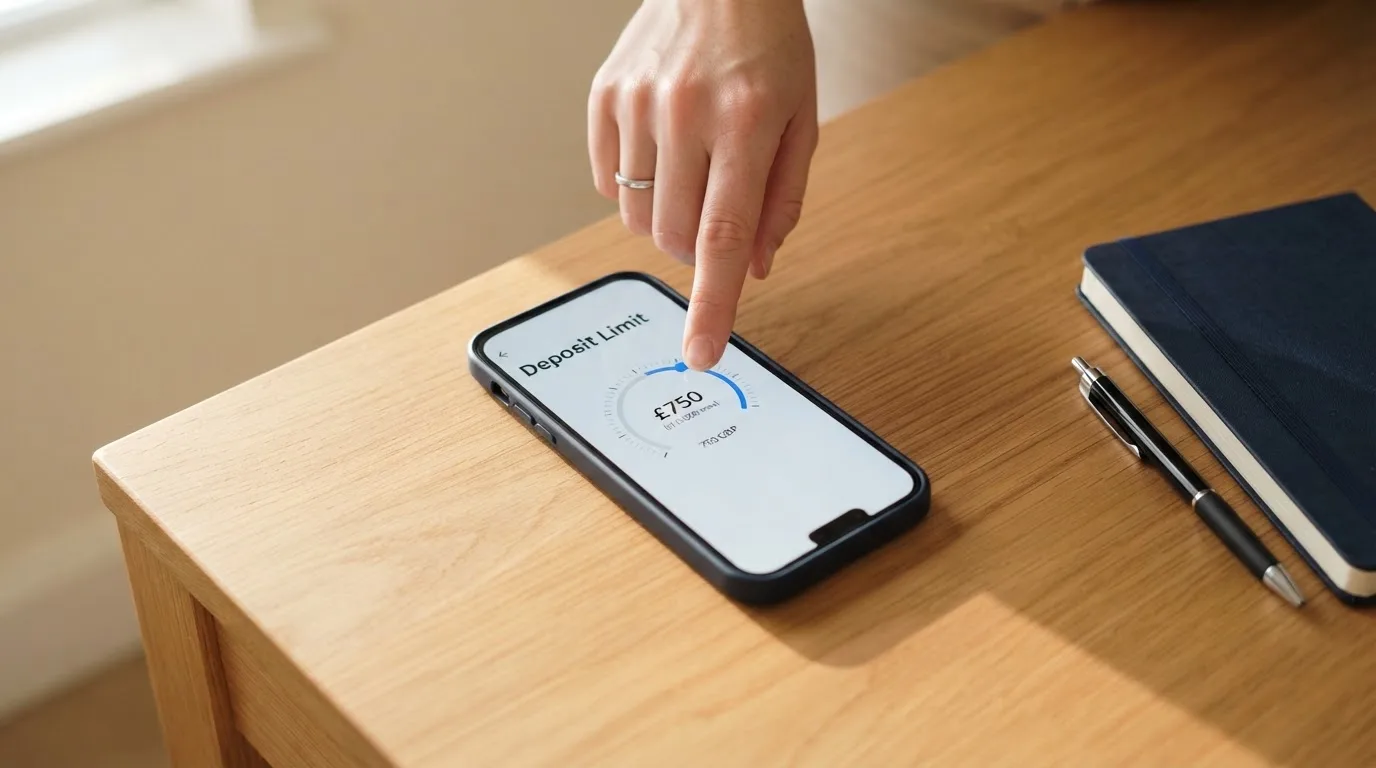
Deposit limits are set by the customer, not by the state. There is no statutory ceiling on deposits or losses on sports betting in Great Britain; the customer’s chosen limit is the binding number. Operators must offer a gross deposit limit on a fixed time frame under the Remote Technical Standards. The first changes have applied since 31 October 2025; a second phase was postponed to 30 September 2026, and whether it is in force at the moment of reading is not established for this page. The reader’s own deposit limit, set in their account, is the binding number either way.
Help
GamCare runs the National Gambling Helpline. GambleAware funds treatment and support. NHS gambling clinics provide specialist treatment. Gamblers Anonymous runs peer support meetings. Every GB-licensed operator links to these services in their safer-gambling pages, and the Commission’s public register of licensees carries a link to GamCare at the foot of every entry.
Crypto, anonymity and the offshore question
Volleyball betting with bitcoin, crypto betting on volleyball, blockchain volleyball betting — these are real searches, and the underlying question is the same one a reader asks about any sport: can a bettor stay anonymous, and can a bettor pay in cryptocurrency?
The identity check is the central fact
GB-licensed operators verify identity before the first deposit or first bet. The verification requirement applies regardless of payment method, and a reader who pays in cryptocurrency still goes through the same name, address and date-of-birth checks. There is no anonymous play at a GB-licensed site.
Cryptocurrency at licensed operators
Whether a GB-licensed operator accepts cryptocurrency deposits is a question the operator’s own payment pages answer. The Commission’s regime does not list permitted payment methods and does not prohibit them either; the operator sets the policy. A reader who wants to pay in bitcoin needs to check the operator’s deposit page before signing up. The licensed operators on this page do not, in the materials verified for this page, list cryptocurrency among their accepted payment methods; that absence is an editorial observation, not a statement about the broader market.
The offshore alternative and what is lost
An operator licensed outside Great Britain — Curaçao, Malta, Gibraltar, Anjouan — may accept cryptocurrency, may verify less, and is not on the Commission’s register. The consumer-facing consequences of using such an operator follow from the absence of the GB licence: no GAMSTOP coverage, no Commission complaints route, no approved ADR body, no British consumer redress if funds are withheld, no application of the 10x bonus cap, no application of the £150 financial vulnerability check. The bettor’s bet is, in a structural sense, unprotected.
Enforcement against unlicensed operators offering into Great Britain is disruption rather than blocking: cease-and-desist notices, search-engine referrals, work with registrars, hosts and payment providers. The Commission has been given, or is about to receive, court-order DNS blocking powers; ISP blocking as a general state of affairs is not in operation. A reader who considers an offshore operator should treat the absence of the protections listed above as a real cost, not a footnote.
The honest framing is that licensed means checks, limits, GAMSTOP, the bonus cap, and verification before the first bet; unlicensed means none of those protections and possible loss of funds. Neither is “the safe choice” by default; the choice is between a regulated market with its trade-offs and an unregulated one with its own.
Bonuses and free bets on volleyball: what they cost
Bonuses are where the gap between marketing and arithmetic widens furthest. The offers described below are drawn from the operators’ own pages; the costs that follow come from the market’s mechanics.
What the welcome offers on this list look like
BetTom’s sports welcome is 50% back as a free bet of up to £50, with a parallel 50% back as free slot funds up to £50 for casino play. BetGoodwin’s welcome is “Bet £10 & Get £15 in Free Bets” split across three tokens. BetMGM’s welcome delivers four £10 free bets after a £10 deposit and a qualifying bet within 7 days. Sky Bet’s free bets expire after 30 days, are restricted to singles and each-way markets, exclude virtuals, are non-withdrawable and do not return the stake with winnings. The other brands run their own welcome structures; the materials verified for this page did not detail each.
What the wagering cap means
Wagering requirements on bonuses are capped at 10x as of 19 January 2026. A £10 bonus at 50x wagering needed £500 of bets to clear; under the cap, no bonus can require more than £100 of bets to clear. The cap applies to bonuses; whether it applies to free bets with no wagering condition is not established. Mixed-product promotions — an offer that requires gambling on two or more product types such as betting and casino in a single promotion — are banned. The specifics matter because the cap reshapes which welcome offers are economically interesting.
The cost of clearing a bonus in volleyball markets
A bonus is cleared by placing bets until the required turnover is met. The turnover is the bonus amount multiplied by the wagering factor (or a multiple of it under the operator’s specific terms). The cost of clearing the bonus to the venue is the turnover multiplied by the margin of the market the bonus is cleared in. Take a £50 bonus cleared in a market with a 5% margin: 50 × 5% = £2.50 of expected cost per pound of turnover. The total cost depends on the turnover. A small wagering factor at a small margin is a cheap bonus to clear; a high factor at a high margin is expensive.
The reader who looks at a “free bet” offer should ask three questions. What is the wagering factor, if any? What is the minimum price for a qualifying bet? What is the deadline? Each of these turns a marketing line into an arithmetic problem, and the answer is what determines whether the bonus is worth claiming.
Free bets, stake-not-returned
A free bet whose stake is not returned pays out the winnings only. A £10 free bet at decimal odds of 3.000 pays £20 in winnings on a win, not £30. That is the structural difference between a free bet and a cash bonus. The Sky Bet free bets described above are stake-not-returned; the bettor’s upside is the winnings alone.
The deadline and the qualifying bet
Most welcome offers include a deadline — typically 7 or 30 days from credit. A free bet that expires before the bettor has had a chance to use it is wasted. The qualifying bet is also a small-print trap: a £10 qualifying bet at minimum odds of 1.50 is a different bet from a £10 qualifying bet at minimum odds of 2.00, and the higher the minimum odds, the more the qualifying stake costs the bettor in expected margin. A reader who skims past the qualifying-bet rules reads the offer wrong.
Live betting and cash out
Live betting is the most price-sensitive part of a sportsbook, and volleyball is one of the more price-sensitive sports to live-bet, because the markets are thinner.
In-play on volleyball
GB bookmakers offer in-play betting on volleyball, and the controls around it are the operator’s licence conditions and customer-protection duties under the LCCP. There is no statutory prohibition; the market’s depth depends on the data feed and the trading team’s interest in the sport. A bookmaker that lists a Champions League volleyball match pre-match will usually keep the match live through the first set; whether the bookmaker keeps it live through the second and third sets depends on the volume of bets and the speed of the data.
What cash out adds
Cash out lets the bettor settle a bet before the event ends, at a price set by the bookmaker. Spreadex describes cash out in one-click, auto and partial forms. The price the bookmaker offers is the bookmaker’s price, with the bookmaker’s margin built in; cash out is not a way to lock in a fair price, it is a way to lock in the bookmaker’s price at that moment. For a bettor who wants to take a guaranteed small profit rather than risk a swing, that is the value. For a bettor who expects the swing to go their way, cash out is a way to give the swing back to the bookmaker.
Live streaming and what it adds to in-play
Live streaming of volleyball is rare among British bookmakers; the streams on offer are typically for racing, greyhounds, tennis, NFL and selected football. A bettor who wants to watch the match they have bet on is usually relying on a separate stream. The bet-tracking tools — the in-app graphics that show the match state, the score, the next serve — are a more universal feature, and a bettor who uses them well is closer to a working in-play product than one who relies on a stream.
The momentum trap
Volleyball is streaky in a way that draws the eye of a live bettor. A team that wins the first set 25–18 is not necessarily going to win the second; the swing in a best-of-five is built into the structure of the sport. A live bettor who reads a first-set blowout as a predictor of a sweep often finds the swing the other way. The trap is the assumption that momentum carries across sets; the data says it does not, and the bookmaker’s price after a blowout set usually reflects the data.
Predictions, tips and the tipster economy
Volleyball betting tips, predictions, strategy, stats software — these are real searches, and the economy around them is real too. The honest framing is that a tip is somebody’s opinion, the word “strategy” is doing work the underlying picks are not, and no software makes a prediction that the data feed did not already imply.
What a tip is and what it is not
A tip is a recommendation to back one side at a stated price. The tipster’s record, if published, is a record of past recommendations. A record of past recommendations does not predict future performance; a record of past recommendations is the past. A reader who follows a tip is following the tipster’s view, not their own, and the reader’s edge is the difference between the tipster’s view and the bookmaker’s price. That edge exists sometimes and does not exist other times, and the reader does not know in advance which is which.
What stats software adds
Beach volleyball betting stats software, and volleyball betting stats software in general, are products that aggregate match-level data — serve percentages, attack efficiency, block rates, side-out percentages — and present them to the bettor. The data is real; the predictive value of the data is a separate question. A bettor who uses a feed of stats to identify a mispriced side has a real edge when the bookmaker has mispriced the side and does not have one when the bookmaker has priced it correctly. The data does the work of finding the mispricing; the bettor decides whether to act.
What bankroll management adds
Bankroll management — staking a fixed percentage of a bank rather than a flat stake — is the practice of smoothing variance. It does not predict outcomes; it manages the consequences of outcomes. A bettor who stakes 2% of bank on each selection and loses the first five in a row has lost 10% of bank and still has 90% to bet with. A bettor who stakes 10% on each selection and loses the first five has lost half. Bankroll management is not a prediction, and it does not change the long-run expectation, but it changes the path.
What no service can do
No tip, no software, no model can name the winner of a match that has not been played. The reader who pays for a “sure” pick is paying for a tipster’s confidence, and a tipster’s confidence is not a probability. A reader who treats predictions as inputs to their own reasoning is using the predictions as they should be used; a reader who treats predictions as instructions is not.
The mechanics of a bet: stake, odds, return
A reader who knows the mechanics of a bet is not surprised by the arithmetic, and a reader who is not surprised by the arithmetic is harder to confuse.
Stake and odds
The stake is the amount risked. The odds are the price. In decimal odds, a stake of £10 at odds of 2.500 returns £25 on a win — £10 stake plus £15 profit — and returns £0 on a loss. In fractional odds, the same bet is priced at 6/4 (six to four): the return is the stake plus the stake multiplied by 6/4, so £10 returns £25 on a win. The conversion between the two is straightforward: fractional a/b is decimal a ÷ b + 1, so 6/4 is 6 ÷ 4 + 1 = 2.50.
Combination bets
A combination bet (an accumulator or acca) multiplies the odds of each leg. Two selections at 1.80 and 2.00 produce a combined price of 1.80 × 2.00 = 3.60. The stake is at risk on every leg, and the bet loses if any leg loses. The margin on a combination bet is the margin on each leg compounded; a market with a 5% margin compounded over four legs produces a margin higher than 5% on the combination. That is the structural reason accas are an expensive way to bet: the bettor is paying margin on margin on margin.
Single and each-way
A single is one bet on one selection. An each-way bet is two bets of equal stake: one on the selection to win, one on the selection to place. The stake doubles. The place terms depend on the sport and the operator; in volleyball, where place markets are not the central product, each-way bets are mostly a horse-racing feature, but the structure generalises to any sport where a place market exists.
The return on a winning bet
The arithmetic is straightforward: return = stake × odds. Profit = stake × (odds − 1). For a combination bet, return = stake × (odds₁ × odds₂ × … × oddsₙ). On a winning £10 acca of three legs at 1.80, 2.00 and 1.50, the return is £10 × 5.40 = £54 and the profit is £44. On a losing leg, the return is £0.
Frequently asked questions
How do you bet on volleyball?
Choose a GB-licensed bookmaker and open an account. Verify identity, deposit (debit card or bank transfer; credit cards are banned for gambling), find a volleyball match under the bookmaker’s sports menu, and choose a market — match winner, set score, handicap, total sets, or an outright on a tournament. Add the selection to the bet slip, enter the stake, confirm. The bet settles when the match is over or when the market settles under the bookmaker’s rules.
Is it legal to bet on volleyball online?
Yes, at a GB-licensed bookmaker. The Gambling Commission regulates commercial gambling in Great Britain under the Gambling Act 2005, and every remote bookmaker offering into Great Britain needs a Commission licence. An unlicensed offshore brand is not illegal for the customer, but offers none of the GB protections — no GAMSTOP coverage, no Commission complaints route, no ADR body, no recourse if funds are withheld.
Can you check that a bookmaker holds a Gambling Commission licence?
Yes. The Commission’s public register can be searched by business name, trading name, domain or account number. The licence categories, the trading names under the licence and the registered domains are listed. The register is the whole test of whether a brand holds a licence, and a check takes a few minutes.
How is the return on a bet worked out from the stake and the odds?
In decimal odds, return = stake × odds and profit = stake × (odds − 1). A £10 stake at 2.50 returns £25 — £10 stake plus £15 profit. In fractional odds, the return is the stake plus the stake multiplied by the fractional odds, so 6/4 returns £25 on a £10 stake. For a combination bet, the odds of each leg multiply into one price, and the stake is at risk on every leg.
What is the bookmaker’s margin and how can it be seen in the odds?
The margin is the cut the bookmaker takes from every unit bet on a market. The payout share is the share of every pound that returns to bettors, and on a two-outcome market it is 1 ÷ (1/odds₁ + 1/odds₂) in decimal form; the margin is 1 − payout share. A market priced at 1.90 / 1.90 on both sides carries a margin of about 5%; a market priced at 1.95 / 1.95 carries about 2.6%; a market priced at 1.80 / 1.80 carries above 11%. The shorter the favourite’s price, the higher the margin, and the longer the underdog’s price, the lower the margin on that side.
US & other team sports – Basketball betting
Content created by the «Basketball betting» team
