
Field hockey betting tips 2026 — value, margin, licence
 Available in US
Snapshot of the data behind this page: 27 October 2026 · figures cross-checked against the Gambling Commission’s public register and the operators’ own current terms pages.

Field hockey rarely tops a sportsbook’s homepage, and that is the first clue a punter can use. Markets are thinner, fixtures are clustered and form guides come from fewer outlets, so the prices that do appear carry more margin than a Premier League match would. A guide built for that market is mostly a guide to reading prices carefully when there is less outside information to lean on. What follows is the equipment: how a field hockey match is actually played, how a bookmaker builds a price, where the licence is checked, what a “free bet” really pays out and what no tipster — including this one — can honestly promise.
What this guide is, and is not
This is a guide, not a tip sheet. The topic suggests tips and predictions, and there is money to be made from a careful read of a fixture — but the read is yours to do, not something a paragraph of text can hand you, because no outcome of a match that has not been played is knowable from this side of it. Treat every specific tip, posted anywhere, as one person’s read at one moment. Place value on the method, not on the pick, and read on for the method.

The thing a bettor can actually own is the framework: a sense of when a price on offer is generous, when it is thin, when the bonus behind it costs more than the headline, and when a bookmaker is licensed to take the bet at all. Those four questions sit underneath every market in every sport, and field hockey wears them more visibly because the market is small.
The fundamentals the odds rest on
A field hockey side fields ten outfield players and one goalkeeper, so eleven players on the pitch for each team. That detail matters because penalty corners and short corners — the set-piece that produces a large share of goals at the top level — turn on specialist routines that are easier to disrupt with a settled defence than with casual marking. Teams that don’t concede short corners usually don’t concede goals.
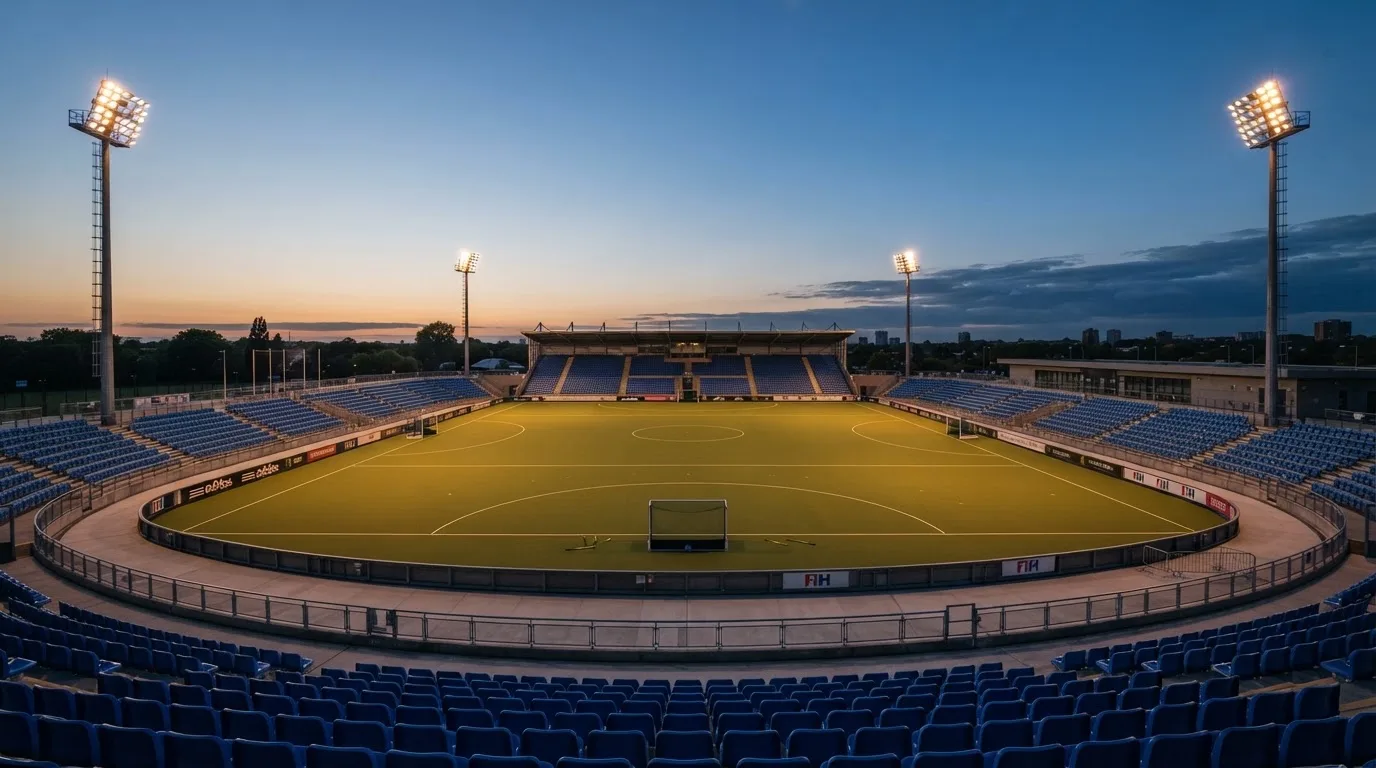
Matches have been played in four quarters of fifteen minutes since 2017, with a two-minute break between periods and a fifteen-minute half-time. A bettor watching a fourth quarter has the whole shape of the game in front of them and very little time for the in-play market to settle. That is part of why live field hockey betting reads differently from live football: the game is shorter, the breaks are longer and the scoring windows are narrower.
The pitch measures 91.4 metres by 55 metres, with goals 2.14 metres high and 3.66 metres wide. Goals are smaller than they look at most grounds in television, which is why deflection and rebounds are a regular source of goals — and why prices on under 2.5 total goals sometimes sit on the edge of fair.
A tied match may stand, go to extra time, or be settled by a shoot-out depending on the competition. Since March 2013 FIH rules send tied classification matches straight to a shoot-out. Most bookmakers settle the draw line on regulation time, but a small handful will offer a “lifted” draw that includes extra time or a shoot-out. The difference matters for outright winner prices and for accumulators strung across the knockout rounds.
The sport’s international history is mostly its Olympic history: men’s hockey featured in 1908 and 1920, was dropped for 1924 and reinstated in 1928; the women’s event was added in 1980. India’s run through the early tournaments is the sport’s outlier in any dataset: they won every match at the 1928 Olympics without conceding a goal, and took gold again in 1932–1956, 1964 and 1980. For a modern punter that history is a reminder that the favourites are not always England, the Netherlands or Germany — international hockey has a longer tail than most betting models expect.
The landscape a UK bettor faces
Field hockey is a familiar background sport for British punters even when it isn’t a daily market. Coverage clusters around the FIH Pro League, the Hockey World Cup, the Olympics and EuroHockey championships, with the English Premier League and the Dutch Hoofdklasse filling the year between. The Indian Premier League and Pakistani domestic league sit slightly off the main British feed but show up at the bigger bookmakers during their seasons.
The shape of the market is what decides how useful a tip really is. Smaller markets draw fewer bettors, fewer bettors means sharper prices on the favourite and softer prices on the underdog, and softer prices are where a careful read earns its edge. Bigger events — India versus Australia in a World Cup semi-final, for instance — will look more like a Premier League coupon: tight margins, frequent price boosts, and a quiet value line.
Two further UK-specific points are worth carrying through the rest of this guide. First, every bookmaker serving customers in Great Britain needs a Gambling Commission licence, and the Commission’s public register lists the entire legal market — there is no extra step to identifying who is licensed. Second, the customer pays no tax on winnings in Great Britain, so a quoted price is a quoted net price, with one exception worth remembering (spread betting, where the firm’s losses can run beyond the deposit ).
A licence is the floor, not the ceiling
A bookmaker’s licence is not a quality mark — it is a permission. It tells a punter that the firm is bound by the Gambling Commission’s licence conditions, that complaints can go to an approved dispute-resolution service and that GAMSTOP self-exclusion is in force. It does not tell a punter the margins are tight, the offers are fair, or the limits won’t bite.
The rule in Great Britain is the point-of-consumption rule. Since the Gambling (Licensing and Advertising) Act 2014, an operator needs a Commission licence wherever it is based if its remote facilities are used in Great Britain — a Curaçao, Maltese or Gibraltar licence is not a substitute. The Act covers England, Scotland and Wales; Northern Ireland runs on an older regime, and a GB licence is not what regulates a customer in Belfast. The Commission’s public register is the whole test: searchable by name, trading name, domain or account number, and any brand a punter considers should be checked by name before money moves.
The featured operators later in this page are all on that register under their own licensee. Several run their sportsbook and casino under a single Commission account; Spreadex, by contrast, runs its fixed-odds sportsbook under the Commission and its financial spread betting under the Financial Conduct Authority. That is the only consumer-facing split on the register worth flagging — financial spread betting can leave a customer owing the firm, and that risk travels separately from a fixed-odds punt on, say, a Pro League match.
Quick licence checks before a deposit
A punter who has ten minutes and a smartphone can lift a brand’s licence status off the register in three steps: search the Commission’s public register by the trading name that appears on the betting slip, confirm the licence category covers remote general betting standard (real events), and note the account number and licence holder — neither needs to be memorised, but the holder name is the entity that has to pay out winnings. Two brands with the same colour scheme and similar names are not the same licence.
Identity verification is part of living with a licensed bookmaker. Since 7 May 2019 every remote operator has to verify name, address and date of birth before a customer can deposit or gamble, including with a bonus or free bet. That is why a customer’s first withdrawal looks slower than later ones, and it is also why an anonymous play option does not exist at any GB-licensed site — a feature marketed as friction is, in this market, a regulatory floor.
What a licence does, and does not, require of the bookmaker
A GB-licensed bookmaker has to enrol customers in GAMSTOP when a customer self-excludes, has to offer safer-gambling tools, has to follow the bonus cap, and has to apply the financial vulnerability check at the threshold set by the licence conditions. None of that makes a bookmaker’s price fair, and a punter should still read the price before reading the offer.
The boundary that catches readers is this: a licensed bookmaker can still restrict a customer’s account, can still close a winning account, can still change the price after the bet is struck only in narrow circumstances, and can still pay less generously than its competitor. A licence is the price of entry; everything beyond it has to be judged.
Responsible gambling, and the tools that come with a real licence
Safer gambling is a regulatory duty, not a marketing line. GAMSTOP is the multi-operator self-exclusion scheme and a mandatory licence condition for remote operators since 31 March 2020, with periods of six months, one year, five years, or five years with auto-renewal — once a minimum period is set, the exclusion stays in place for a further seven years unless the customer asks GAMSTOP to remove it. It covers sites and apps; high-street betting shops use a separate service.
Each licensed operator also has to offer its own safer-gambling tools. Unibet’s UK site lists deposit limits, a Player Profile test, product restrictions, self-exclusion, live chat, and direct links to BeGambleAware, GamCare, GAMSTOP, Gambling Therapy and the Betting and Gaming Council. The pattern is consistent across the licensed set, though each brand wires the tools differently.
A more recent layer is the financial vulnerability check. A licensed remote bookmaker has to run a public-record check — not an income or credit check — when a customer’s deposits minus withdrawals exceed £150 in any rolling 30 days (since 28 February 2025). Beyond the public-record check, the Commission has announced staged financial risk assessments (“affordability checks” in the press) on a plan published in July 2026, with no start date; the right phrasing is *announced, staged, no start date*. A punter should expect more prompts at higher spend, and should not mistake a soft prompt for an accusation.
Help outside the firm is also part of the framework. GamCare runs the National Gambling Helpline, GambleAware funds treatment and education, the NHS runs gambling clinics in several cities, and Gamblers Anonymous runs peer-support meetings. A licensed bookmaker’s safer-gambling page will point a customer to all of these.
Bonus and free-bet offers on field hockey — what they cost the punter
Field hockey rarely headlines a sportsbook’s offer page. Most welcome offers and free-bet bundles are built around football, horse racing and the occasional in-play football price boost, and a field hockey bettor finds the offer at the back of the coupon, not the front. That suits this guide’s angle: what an offer is *worth*, not what its banner claims, is what matters when the sport is a sideshow.
The headline shapes are familiar. A welcome offer such as Sky Bet’s £30 in free bets, paid as three £10 tokens after a qualifying bet of 5p at odds of 1/1 or greater and a deposit of at least £5. A free-bet bundle such as Spreadex’s £60 in free bets for a £10 fixed-odds qualifying bet, valid across fixed-odds and spread markets, and usable only after the qualifying bet has been settled. None of these are bad offers; none of them are gifts. A free bet’s stake is usually not returned with a win, and the value of a free-bet token is the winnings you can take away.
How a free bet is actually valued
Take a free bet whose stake is not returned. If the token is worth £10 at odds of 6/1 (decimal 7.00), a winning bet pays £10 × (7.00 − 1) = £60 in profit, but the £10 stake is gone. The free bet is worth £60 to the backer on a win and £0 on a loss, which is why a tipster pricing up a free bet never quotes it at stake + winnings. The right way to read it is the average value over a large number of uses at roughly fair prices: token × (odds − 1) ÷ odds × payout share, where the payout share is the inverse of the market’s margin. A free bet at short odds is worth less than its face value even at a “fair” market, because the winnings are small and the stake is forfeit.
The wagering cap and why mixed offers are gone
Since 19 January 2026, wagering requirements on bonuses at GB-licensed bookmakers are capped at 10x. A £10 bonus at 50x wagering needs £500 of qualifying bets; under the cap, no more than £100 of qualifying bets, and that changes the calculus for almost every multi-stage bonus on the market.
Mixed-product promotions are banned outright under the same rules. An offer that requires a customer to bet on football to receive free casino spins, for instance, cannot legally be sold by a GB-licensed firm. That removes a noisy class of headline promotion from the front of every coupon and concentrates what is left into single-product offers — easier to read, harder to mistake.
A couple of headline offers, the terms behind them
A few offers useful as worked examples.
Sky Bet welcome offer. New customers get £30 in free bets after a first single or each-way bet of at least 5p at odds of 1/1 or greater, and a deposit of at least £5. Each £10 token expires, cannot be cashed out, and the stake is not returned with a win. The qualifying bet is a true 5p minimum at a substantial price floor — there is no “small bet at huge odds” trick in the terms.
Spreadex £60 free bets. A £10 fixed-odds qualifying bet earns £60 in free bets usable across the firm’s fixed-odds and spread products, with the qualifying bet placed within 28 days of account opening. Spreadex is the only featured brand offering this combined fixed-odds and spread option, and the qualifying window is one of the most generous in the set.
BoyleSports Acca Insurance. A minimum stake of £5, minimum odds of 1/2 on an accumulator, opt-in required, and a maximum refund of £20 as a free bet that expires in seven days; the qualifying bets must be placed and settled on the same day. This is a niche feature whose real value sits in the maximum — a customer staking £5 on a five-fold acca can claim back £20 once if one leg lets them down. Read the condition: only one leg needs to lose, and the rest of the bet is paid as a winner; that is how the refund is built.
The bonus terms a punter must read before claiming
Five lines appear on every offer the featured set runs, and the variations between firms are mostly in the small print.
- Minimum odds on the qualifying bet. 1/2 (1.50) is the common floor. A bet at 1/3 (1.33) won’t qualify, and “minimum odds” does not mean “any short price” — it means *this price or longer*. Check the price, not the round number.
- Minimum deposit and qualifying stake. A £5 deposit and a 5p qualifying bet is the bottom of the market; a £10 deposit and a £10 qualifying bet is a more typical welcome cost. The £5 floor is a real deal; the £10 floor is the standard.
- Expiry windows. Free-bet tokens typically expire in seven, fourteen or thirty days. A £10 free bet is worthless on the day after it expired. Set a calendar reminder when claiming.
- Payment-method exclusions. Some offers skip deposits via Skrill or Neteller. Whether a specific e-wallet disqualifies is in the small print, and it surprises customers every season.
- Wagering requirements. Where the offer carries a wagering multiple, the new 10x cap is the rule. Anything above that is a misprint, an offshore brand or a stalled terms page.
A reader who runs through those five lines before clicking *Claim* saves more money than any tip in this guide.
Live betting and cash out on field hockey
Field hockey’s structure — four quarters of fifteen minutes, with short breaks between them and a longer half-time — opens a small but useful live market. Quarter markets, half-time lines, and “next goal” markets sit on the coupon at most major bookmakers during a Pro League match or a World Cup fixture. The in-play product is offered by the bigger brands (bet365 leads the segment with in-play and live streaming, plus trackers like Bet Track and Match Live ) and by challengers (Vbet pre-match and in-play, plus live streaming and a results-plus-stats calendar; Midnite with in-play alongside an acca builder and price boosts ).
What live field hockey pricing looks like
In-play prices move faster than pre-match and lag the live picture by a measurable second or two — long enough for a sharper customer to spot a price that has not caught up with the on-pitch action. The risk is the same as in any live market: the bookmaker’s margin is wider than on the pre-match price, because the firm is exposed to a stream of bets it has had less time to balance. A bettor who watches the stream and bets when the price lags the truth has the edge in theory; the same bettor in practice places six out of ten live bets at worse prices than they would have taken pre-match, because the in-play line on a quiet market gets stale and the bettor mistakes staleness for value.
Cash out is the second live product on most coupons. The bookmaker offers a settlement value before the bet has run; the customer accepts and walks away with a smaller win or a smaller loss. Cash out looks like a courtesy and reads like a margin: the firm is quoting a price on its own book and pocketing the spread. There is no rule against using it, but the maths is unfavourable over a sample of bets — a customer who lets the bet run and loses pays the same as one who cashes out, and a customer who wins usually wins less. Treat cash out as a tool of last resort and not as a feature.
Best odds guaranteed, and why it isn’t the same as value
Best Odds Guaranteed (BOG) is offered by several of the bigger horse-racing bookmakers — BetGoodwin on all UK and Irish horse and greyhound racing up to £1,000, Copybet on UK and Irish racing “all day, every day”, BetVictor on UK and Irish horse racing. BOG pays out at the higher of the price at bet placement and the starting price, which protects the customer from drift. It does not exist on field hockey, where prices are set by the bookmaker at bet placement and do not move towards a “starting price” the way racing does. That is the only reason football and horse-racing punters sometimes pair BOG with their other bets; a field hockey bettor gets no such insurance.
Predictions and strategy: how a tip is actually built
No tip is certain, and no guide that promises certainty is honest. What a careful tipster is doing is shaping probability — laying out the form, the line-up, the venue, the head-to-head, the recent goals per game and the opposition’s recent goals conceded — and arriving at a number the bookmaker’s price either beats or does not. The page does not know which matches are being played next; it does know the four moves a punter makes to turn form into a price worth taking.
Reading form in a small market
Three data points matter more than the rest. Goals per match, because the line set at over/under 2.5 is often the thin market’s cleanest bet. Goals conceded per match, because a defence that gives up two per game against mid-table opposition is not a defence that gives up two per game against a top-six side. Head-to-head, because the four or five matches a year between national sides dominate the international calendar and tell you more about a fixture than recent league form does.
Beyond those, watch the line-up news. International teams rotate around club commitments and injuries; a side missing two of its central defenders is a different side in field hockey from the one on the team sheet a fortnight ago. Bookmakers are slower to price line-up news in field hockey than in football, which is one of the consistent edges.
Where value actually sits in a price
The “value” word is doing a precise job. A price is value when it is bigger than the true probability of the outcome would justify — the difference between the bookmaker’s probability implied by the price and your own estimate. If India is offered at 2.20 (about a 45% chance) and your model says 55%, there is value. If India is offered at 1.45 and you agree with 70%, there is no value, even though the bet probably wins. Most field hockey markets that look like value are value at decimal prices of 2.50 or longer; shorter prices are usually well priced because sharper customers have already attacked them.
Two rules of thumb follow. First, prices below 1.20 are almost never value on a single bet at a major bookmaker; the margin eats the price. Second, accumulators across three or more short-priced legs are where the bookmaker earns the most — the multiplied margin across three legs of 1.20 each is roughly 13% on the combined price, and the bet looks like value to a customer who has not done the arithmetic.
Staking and bankroll discipline
A unit stake, set at 1% to 3% of the bank and applied consistently across bets, is what most professional tipsters settle on. A punter who goes 5% on the “sure” bet and 0.5% on the speculative one is a punter who has already blown their edge — most tips lose, and the rare win has to be big enough to recover the streak. Field hockey, with its thinner markets, is more susceptible to losing streaks than football because the value picks fail more often; a 1% unit is the right size for that volatility.
Staking plans that recommend doubling the stake after a loss — Martingale and its cousins — do not work in markets with a stake ceiling. Most UK bookmakers cap the maximum stake on a market well below what a Martingale recovery would require after five consecutive losses, and the recovery stake becomes a theoretical number that can’t actually be placed. A flat or modestly variable staking plan survives this market; a doubling plan does not.
Why no tipster can promise a winner
The honest closer: outcomes are not knowable in advance, every tip — including any punter’s best read — is a probability statement, and a tipster with a hit rate above the implied probability of their prices over a sample of a thousand bets is more interesting than one who picked yesterday’s winner. The aim of a guide like this is not to give the reader a tip — it cannot — but to give the reader the gear to read their own.
Bet types and odds: what a price actually means
Field hockey’s bet types map closely onto football’s: full-time result (1X2), over/under on total goals, both teams to score, handicap lines, player markets, outrights and tournament specials. Each is a different market on the same fixture, and each carries its own margin. Most bet builders at larger bookmakers now offer a same-game multi on a featured hockey match — ten legs across the result, the total, the first scorer and the next corner are typical.
The bet types explained
A single is a bet on one outcome. A double is two outcomes, both of which must win, with the two prices multiplied into one. A treble is three. An accumulator (“acca”) is four or more, with the chain multiplying with every leg — and the margin compounding on every leg at the same time.
Each-way bets sit only on outright and tournament markets at most bookmakers. An each-way bet is two bets of equal stake: one on the win, one on the place, so the stake doubles and the win-or-place terms depend on the field size. Field hockey tournaments use similar place terms to racing — typically a quarter of the field pays, with a third paying in larger fields — but the terms are the operator’s and have to be checked on the bet slip.
Bet builder, also called a same-game multi, lets a customer combine several outcomes from one match — usually the result, total, first scorer, handicap and a corners line — into one price. The bet builder at one firm is not the bet builder at another. Some books quote a combined price; others quote a base price and stack legs as boosts; the combined margin can vary from 4% to 12% across the segment.
Fractional, decimal and the conversion
Odds appear in two formats in Great Britain. Fractional odds (5/1, 11/4, evens) show the profit per unit stake: a £10 bet at 5/1 returns £60 in profit, plus the £10 stake, total £70. Decimal odds (6.00, 3.75, 2.00) show the total return per unit stake: a £10 bet at 6.00 returns £60, stake included. The conversion is decimal = (numerator ÷ denominator) + 1, so 5/1 → 6.00, 11/4 → 3.75, and evens → 2.00.
Both formats show the same number, just differently. A punter who only knows one format should stick to it; mixing them when reading a coupon is where mistakes happen. Decimal prices at the bigger bookmakers are usually two decimal places (6.50, 3.25), and the second decimal is the firm’s room to move the price without rewriting the whole column.
What a margin looks like in the prices
Take an illustrative two-way market priced at 1.90 / 1.90 — the kind of symmetric book a bookmaker would offer on, say, the over/under 2.5 line at an even contest. The implied probabilities are 1 ÷ 1.90 = 52.63% each, summed 105.26%. The margin is the excess above 100%, so 5.26%, and the payout share is 1 − 5.26% = 94.74%. In rough terms the bookmaker keeps about 5p of every pound staked on this market.
That is the band a major operator will run on a sharp Pro League match: 4% to 6% margin on the headline 1X2, with totals and handicaps a touch wider. On a smaller market — a Dutch Hoofdklasse fixture midweek, for instance — the margin can stretch past 10%, and a single leg of an acca across several field hockey matches will compound that margin with every leg added.
The sports and tournaments field hockey betting covers
Field hockey’s calendar clusters. Major international tournaments sit in summer and late autumn, with the Hockey World Cup and the Olympics bookending the years between; the FIH Pro League runs a tour-style series across the calendar; EuroHockey championships cycle in even years and odd years depending on the gender. Domestically the English Premier League runs autumn to spring, with the Indian Premier League and the Dutch Hoofdklasse taking the baton in spring and summer. A punter who follows one of those leagues can find a market most weeks of the year.
The international calendar
The Hockey World Cup runs every four years and is the headline event for betting interest; the next edition falls in 2026, with India and the Netherlands traditionally the back-favourites at most majors. The FIH Pro League sits between World Cups and runs a home-and-away series across several months, with promotion and relegation around the edges. The Olympics has men’s and women’s events in the same year as the Summer Games; the next Olympic field hockey tournament sits with the 2028 Games in Los Angeles. EuroHockey championships run between world cycles and produce competitive groups that feed into the world stage.
Smaller tournaments matter too: the FIH Hockey Women’s Junior World Cup, the Sultan of Johor Cup, the Champions Trophy (now defunct but a useful historical reference), and the Commonwealth Games when they fall on a hockey year. Each will be priced at the bigger bookmakers, with margins varying by event.
Domestic leagues worth following
The English Premier League runs with promotion and relegation and feeds the England set-up. The Dutch Hoofdklasse is the strongest domestic league in the world and the most-covered in continental Europe; coverage at UK bookmakers is patchy outside the top teams. The Indian Premier League is high-scoring and televised, with growing coverage in the UK. The Australian Hockey League and Germany’s Bundesliga fill the rest of the calendar; both are priced, both thinly covered, and both are best read with a calculator open rather than from memory.
Tournaments the punter should read first
Two pieces of advice for any punter new to the sport. First, follow one league well — the men’s or women’s Premier League, the men’s Hoofdklasse, or the Pro League — until you know the teams, the form, and the names of the managers. Second, do not handicap a tournament you have never watched; the betting industry on tournament specials is tighter than on league matches and the edge belongs to the sharper books, not the sharper punter.
The featured operators, ranked by what they offer field hockey
Ten bookmakers carry a Gambling Commission remote licence and accept bets on field hockey. They are presented in alphabetical order, not as a ranking — and not as a guide to which one a reader should open first. The licence column shows the Commission’s account number and the licence holder, both of which can be checked against the Commission’s public register. The terms column reflects what the operator’s own terms page or app store entry says at the snapshot date; the snapshot date matters because every offer and feature on this list is subject to change.
| Operator | Gambling Commission remote licence number and licence holder | What the operator’s own terms state |
|---|---|---|
| BetGoodwin | 002927-R-327985-008 (Goodwin Racing Limited) | Best Odds Guaranteed on UK/Irish horse/greyhound racing, £1,000 cap |
| Sky Bet | 067370-R-341330-005 (SBG Sports Limited) | £30 welcome offer, paid as three £10 free bet tokens |
| 10bet | 043173-R-322899-023 (Blue Star Planet Limited) | Features Cash out, Bet Builder and live streaming on select events |
| bet365 | 055148-R-331498-002 (Hillside (UK Sports) ENC) | Deep in-play suite with Bet Track and live match streaming |
| Copybet | 053774-R-330743-010 (Copybet UK Limited) | BOG on all UK and Irish racing, pays first past the post |
| BoyleSports | 039469-R-319383-025 (Boylesports Enterprise) | Acca Insurance: £5 stake, 1/2 odds, £20 free bet refund (7-day expiry) |
| Betmaster | 065699-R-339929-002 (BM Solutions GB Ltd) | Licensed operator focused on European league coverage and outrights |
| VBet | 044662-R-324273-022 (SCGO Limited) | In-play, live streaming and a results-plus-stats calendar |
| BetVictor | 039576-R-319370-028 (BV Gaming Limited) | BOG on UK and Irish horse racing, BetFinder and Smart Stats |
| Spreadex | 008835-R-104580-022 (Spreadex Limited) | £60 free bets for £10 fixed-odds bet; offers spread betting |
Frequently asked questions
What is a value bet, and why is no tip ever certain?
A value bet is one whose price is bigger than the true probability of the outcome would justify, with the bookmaker’s margin stripped out. No tip is ever certain because outcomes are not knowable in advance; the closest a tipster gets is a sustained edge in their favour over a large sample of bets, and even that is statistical, not guaranteed.
What is the bookmaker’s margin, and how can it be seen in the odds?
The margin is the share of every unit staked that the bookmaker keeps on average across a market. It shows as the sum of the implied probabilities of every outcome being above 100% — symmetric odds at 1.90 each imply roughly 5% margin, for example — and it widens on smaller markets such as next corner or first goalscorer, where the line of 6% to 10% is normal.
How is the return on a bet worked out from the stake and the odds?
Decimal odds multiply directly into the stake to give the total return, so a £10 bet at 6.00 returns £60; fractional odds show the profit per unit stake, so £10 at 5/1 returns £60 in profit plus the £10 stake, total £70. Both are the same number, just shown differently, and the conversion is decimal = (numerator ÷ denominator) + 1.
How can it be checked that a bookmaker holds a Gambling Commission licence?
The Commission’s public register is searchable by name, trading name, domain or account number and is the whole test of who is licensed. A licensed remote bookmaker must hold a remote general betting standard (real events) licence under the Gambling Act 2005; the categories listed on the register entry tell a punter whether the firm is licensed to take bets in Great Britain at all.
Which tools for controlling play does a licensed bookmaker have to offer?
A GB-licensed remote bookmaker must enrol customers in GAMSTOP self-exclusion when asked and must offer deposit limits, product restrictions, time-outs and self-exclusion on the customer’s account. Beyond those, the financial vulnerability check applies at deposits minus withdrawals above £150 in any rolling 30 days, with staged financial risk assessments announced for the future, and every safer-gambling page links to GamCare, GambleAware and the NHS clinics.
US & other team sports – Basketball betting
Content created by the «Basketball betting» team
