
Water polo odds in 2026: what the price is really saying
 Available in US
The British licensed market for water polo betting in 2026 is small but structured. This page compares the ten bookmakers that price the sport, breaks down what the welcome offers actually clear, and explains how to read the margin in the odds.

Last verified against the Gambling Commission public register and individual operator terms on 27 October 2026.
The ten bookmakers that price water polo in 2026
Ten brands hold a Gambling Commission remote general betting licence and show water polo markets in 2026. None of them is a “best” bookmaker in any absolute sense — that is not what a licence says, and it is not what a shortlist can show. What follows is the working comparison: who they are, what they let the punter do, and what each brand’s own terms state about the offer a new customer gets.

The verdicts at the end of each block are this page’s own, not the operator’s. A brand that looks well-priced on paper may impose a condition that quietly erases the edge, and a brand with a thinner offer may serve a particular punter better. The point of writing ten of them is that ten different bets call for ten different books.
| Brand | Gambling Commission remote licence and holder | What the operator’s own terms state on the welcome offer |
|---|---|---|
| Midnite | Account 101839; remote general betting standard (real events); Midnite Limited | New customers who bet £5 or more on pre-match odds of EVS (2.0) or greater within 14 days of sign-up receive £25 in free bets and 50 free spins, valid for 7 days. |
| Tote | Account 54779; remote general betting standard (real events); TDCO Limited | Pool-betting product; tote-style dividends settle on the field. |
| 10bet | Account 43173; remote general betting standard (real events); Blue Star Planet Limited | Sportsbook covering football, tennis and horse racing with Cash Out, Bet Builder and Live Streaming. |
| BetMGM | Account 39198; remote general betting standard (real events); LeoVegas Gaming PLC | New UK customers depositing £10 or more and placing a sports bet within 7 days receive four £10 free bets (two football accumulators of 4+ selections and two sports multiples of 2+), valid for 7 days; minimum odds and opt-in apply. |
| LiveScore Bet | Account 56859; remote general betting standard (real events); LiveScore Betting and Gaming (Gibraltar) Limited | Bet Builder allows up to 10 selections across match result, both teams to score, corners, total goals, player scoring and cards. |
| Spreadex | Account 8835; remote general betting standard (real events); Spreadex Limited | Combines fixed-odds and spread betting in one app; FCA-regulated for financial spread betting. |
| Bet600 | Account 44731; remote general betting standard (real events); Tyche Tech Limited | Best Odds Guaranteed on horse racing: bets paid at the starting price if the SP exceeds the price taken. |
| DragonBet | Account 64908; remote general betting standard (real events); DragonBet Ltd | Welsh football, rugby, racing, American football, in-play betting and bet builder markets. |
| London Bet | Account 66162; remote general betting standard (real events); Thistle Bet Limited | Football, tennis, horse racing, greyhounds, darts, golf, cricket, NFL, NBA, MLB, snooker with in-play betting. |
| Betway | Account 39372; remote general betting standard (real events); Betway Limited | Free Bet Club: up to £10 in free bets each week after opt-in for customers spending £25 or more on sports. |
A word on the licence line. Every brand above appears on the Gambling Commission’s public register against the account number given. The register is the only place to check it, and it can be searched by trading name, business name, domain or account number. Do not trust the splash page — verify there. The domains are the address the punter uses to open an account, not the licence, and the licence is the licence, not the splash page.
Water polo odds: reading the price before paying the stake
A bookmaker does not put a sport on its site for the love of the game. It lists water polo because a market can be priced, a margin can be earned and a customer can be made to feel they have a chance. Whether they do, and what their chance costs them, is the question the rest of this page is built around. The sport itself is small in betting terms — there is no Premier League of water polo, no Saturday accumulator built around the Hungarian league — but it is priced, and priced badly if the bettor does not know what they are looking at.
This page covers the licensed British market for water polo betting in 2026: which bookmakers take bets on it, which markets they price, what an odds line really contains, and what the bonus offers on a sportsbook cost once the headline number is unpicked. It is written for the punter who already knows the difference between a stake and a return, and who wants to know why one set of odds pays them less than another at the same apparent price.
Last verified against the Gambling Commission public register and individual operator terms on 27 October 2026.
Midnite
Midnite is a Commission-licensed sportsbook and casino with a British app and a clean welcome structure. The free-bet offer is one of the easier ones to clear on this list: bet £5 at EVS (2.0) or bigger within 14 days of opening, and the account is credited with £25 in free bets and 50 free spins, all of which expire 7 days after credit. The minimum odds rule kills the qualifying bet as a free shot — anything shorter than evens does not trigger the offer — and the seven-day clock on the free bets is the part the small print rarely mentions. Free bets at Midnite are free-bet-credit stakes, not refunds: a winning free bet pays the profit only, the £25 stake is not returned.
The site carries in-play events, an acca builder, popular accas and price boosts with maximum-stake limits. The price boosts are the feature to watch: the boost may push a price over a tempting line, but it sits inside a stake ceiling, and the cap is what stops a sharp punter turning the boost into a meaningful edge.
Verdict. A solid fit for a punter who wants a small-stake welcome, in-play depth and a casino attached. Not the right home for someone planning to grind accumulators at high stakes, where the maximum-stake rule on boosted prices will cost more than the welcome bonus ever pays.
Tote
Tote is the pool-betting product: a bettor picks a horse or, in this market, a side, and the dividend is set by the pool of stakes after the operator’s take. On water polo the tote’s offering is narrower than a fixed-odds book: fewer markets, and the price is unknown until the dividend is declared. That is the structural difference, not a defect. Pool betting is its own licence category on the Commission register, and Tote runs under that category for racing; for sports, the markets it carries sit under the general betting standard held by TDCO Limited.
For a water polo punter, Tote is the option when the bettor wants to back a side without taking a fixed price, and is comfortable waiting for the dividend. It is not the option for a same-game multi or a price comparison across outcomes — the price is the pool, not a posted line.
Verdict. Right for the bettor who understands pool mechanics and is happy with a stake-priced product. Wrong for the punter who wants to know what the bet pays before the event starts.
10bet
10bet’s sportsbook covers the British staples: football, tennis, horse racing, and a long tail of secondary sports. Cash Out, Bet Builder and Live Streaming are listed on the platform. Water polo is a secondary sport on a bookmaker of this size — the market depth is real but rarely the focus of the front page, and a major tournament will pull more lines than a friendly.
The 10bet welcome is a separate question from the sportsbook’s depth, and the terms are the only place to read it. As a rule of thumb for a bookmaker in this slot: a free bet, if offered, is a free-bet-credit stake, the qualifying bet needs minimum odds, and a deadline applies. Read the small print; it is where the offer becomes the offer.
Verdict. A reasonable second account for a punter who already has a primary bookmaker and wants a second in-play line to compare. Not the place to start if the priority is depth on water polo specifically.
BetMGM
BetMGM’s UK welcome for new customers is a £10 deposit and a qualifying bet within 7 days unlocking four £10 free bets — two football accumulators with 4+ selections and two sports multiples with 2+. Minimum odds apply, opt-in is required, and the free bets are valid 7 days from credit. The structure is more granular than a single free-bet-credit token: the four bets are tied to bet types, not just sports.
That detail matters. A punter whose natural stake is an acca gets two of the four free bets; a punter who bets singles or doubles gets only the “sports multiples” pair. The headline is “£40 in free bets”, and what the punter actually clears is whatever shape their betting already takes. Free-bet stakes are not returned on a win.
The bookmaker sits under LeoVegas Gaming PLC on the Commission register; the licence is LeoVegas’s, the trading name is BetMGM. The brand carries a casino and a sportsbook, and the welcome sits on the sports side. Geo-wise, the £10 deposit is the entry — small enough for a cautious punter to test the platform without committing a meaningful bank.
Verdict. Useful for a punter whose natural bet is a small acca or sports multiple, less useful for a singles-only bettor who would forfeit half the welcome. The 7-day expiry is the trap: punt the free bets inside the week, or lose them.
LiveScore Bet
LiveScore Bet’s Bet Builder allows up to 10 selections across match result, both teams to score, corners, total goals, player scoring and cards. That is a deep builder for a bookmaker of this size, and it is the platform’s calling card. On water polo the builder is thinner than on football, but the structure is there: a punter can combine match result with handicap and totals lines where the book has priced them.
The bet builder is the feature, not the welcome — LiveScore Bet is the bookmaker a punter opens specifically to combine legs of a single event into a same-game multi. The punter who uses it for that purpose gets a tool; the punter who does not gets a thin reason to keep the account open.
Verdict. A second account for a punter who builds same-game multis on football and wants the same tool available on a smaller sport. The welcome offer is best read on the operator’s own page before claiming.
Spreadex
Spreadex is the only bookmaker on this list that combines fixed-odds betting with spread betting in one app, and the only one whose offer includes a FCA-regulated line as well as a Gambling Commission line. The two products are different in kind: a fixed-odds bet pays a return at the price taken, a spread bet settles on the difference between the spread and the realised outcome. Spread betting losses can exceed the deposit — that is the FCA line, the spread line, not the fixed-odds line.
For a water polo punter, the fixed-odds side of Spreadex is the only place the page can speak to with confidence: markets, prices, the same set of risks as any other fixed-odds bookmaker on the Commission register. The spread side is a different product, governed by the FCA on the financial side and the Commission on the spread-bet side, and it is a different conversation.
The app offers one-click, auto and partial cash out, Bet Builder across fixed odds or spreads, and live streaming of UK and Irish horse racing, greyhounds, tennis, NFL and selected football. The live-stream list does not name water polo; the in-play lines are what they are when this page is being written.
Verdict. A good fit for a punter who already understands spread betting and wants both products in one app. A bad fit for a fixed-odds-only bettor who walks into the spread product by accident — the loss profile is not the same, and the small print will not save them after the bet has been struck.
Bet600
Bet600’s headline feature is Best Odds Guaranteed on horse racing: if the starting price exceeds the early or show price taken, the bet is paid at the SP. That is the racing line. For a water polo punter, BOG is not the relevant feature, because the same product is not standard on water polo; the offer is a horse-racing mechanism, applied race by race.
The bookmaker’s general sportsbook is the more relevant piece for a water polo bettor — the standard markets, the cash-out tool, the in-play lines where they are priced. Read BOG for what it is: a horse-racing concession with a clear scope. Apply it to a sport outside its scope, and the bet settles at the price taken.
Verdict. A reasonable choice for a punter whose betting centres on British and Irish racing and who wants a second bookmaker for water polo markets. The sportsbook does not need BOG to be useful, and the welcome offer is best read on the operator’s own page before claiming.
DragonBet
DragonBet is a Welsh-focused bookmaker: Welsh football and rugby, racing, American football, in-play betting and bet builder markets. The brand is published by DragonBet Ltd, which is also the licence holder on the Commission register. For a punter whose interest is in Welsh sport, this is a niche fit. For a water polo punter with no Welsh connection, the relevance is the operator’s general sportsbook and the in-play and builder tools that come with it.
The bet builder is the structural feature: a punter can combine legs of a single event where the bookmaker has priced them, and on water polo the builder follows whatever the bookmaker has decided to offer. A small bookmaker like DragonBet is not going to lead the market on water polo depth; what it offers is a clean app, a builder that works, and a brand that holds a Commission licence under its own name.
Verdict. A right fit for a punter who wants a clean, builder-led second account. A less obvious fit for a punter chasing the deepest water polo price line, which is on a different bookmaker.
London Bet
London Bet’s app covers football, tennis, horse racing, greyhounds, darts, golf, cricket, NFL, NBA, MLB and snooker, with in-play betting. Water polo is not on the front page of that list, and the markets, when they are priced, sit on the secondary-sports rail. The bookmaker is held by Thistle Bet Limited, which is also the licence holder on the Commission register.
The welcome offer, where it applies, follows the standard pattern: a minimum deposit, a qualifying bet, a free-bet credit, a deadline. None of this is a reason to pick London Bet over a heavier-hitting bookmaker on water polo depth; it is the general-sports bookmaker offer, applied to a smaller sport.
Verdict. A second account for a punter who already bets across multiple sports and wants a clean app to do it in. The water polo offering is best checked on the operator’s own page before claiming, because secondary sports are the place small bookmakers add and remove markets most freely.
Betway
Betway’s Free Bet Club is the running offer: opt in, spend £25 or more on sports during the week, and earn two £5 free bets. The free bets are weekly, and the structure rewards a punter who places a steady volume of qualifying bets rather than one big weekend stake. The £5 free bet is a free-bet-credit stake — the stake is not returned on a win.
For a water polo punter, the Free Bet Club is one of the simpler running promotions on the British market, and the threshold — £25 in qualifying bets a week — is the kind of line a regular punter will clear without altering their betting pattern. A punter who bets only on water polo will not clear it on water polo alone, because the qualifying bets cover sports betting generally, not a specific sport.
Verdict. A long-term fit for a punter whose weekly sports betting is steady enough to clear £25 in qualifying bets. A weak fit for a water polo-only punter who will not hit the threshold without betting on something else.
Water polo: what the sport looks like to a price
Water polo is one of the oldest team sports at the modern Olympic Games: men’s water polo was on the programme in 1900, women’s water polo joined in 2000 at the Sydney Games. The international body is World Aquatics, which has run a men’s World Championship since 1973 within the World Aquatics Championships, with women’s competition added in 1986. A team fields seven players in the water — six field players and one goalkeeper — with up to six substitutes on the bench, and a match is divided into four quarters played in a pool deep enough that the players cannot touch the bottom.
What that means for a punter is that the sport has a clear competitive structure: club leagues, continental club competitions, national-team championships, and the World Championships and Olympics at the top. The British bookmaker’s water polo offering tracks the international calendar — World Championships, European Championships, the Olympics, the World Cup — with national-team leagues taking a smaller share of the line.
The sport’s marginal position in British betting is the structural fact behind the rest of this page. Water polo is not a Saturday-afternoon sport. There is no Sky Sports coverage driving casual betting interest. The market is small, the prices are written by a handful of traders, and the margin is higher than on football or horse racing. That is the cost the punter pays for betting on a niche sport at a mainstream bookmaker, and it is the reason the rest of the page spends time on the margin and the welcome offers rather than on the teams.
The law: a Great Britain licence is the entry ticket
A bookmaker that takes bets from customers in Great Britain needs a Gambling Commission licence, wherever it is based. The Gambling Act 2005 sets the framework, the Gambling (Licensing and Advertising) Act 2014 closed the offshore loophole, and the Commission’s public register is the only place a licence can be checked. The register can be searched by business name, trading name, domain or account number, and the entry shows the licence categories, the holder, the trading names and the sites the licence covers. If a brand is not on the register, it is not licensed for Great Britain.
There is no statutory list of sports that can be bet on. A licensed bookmaker offers markets under its own licence conditions and the Commission’s Licence Conditions and Codes of Practice; the markets themselves are the operator’s call. In-play betting is offered by GB-licensed bookmakers under the operator’s licence conditions — it is not “unrestricted” as a legal conclusion, and the conditions in force are the operator’s, not the punter’s.
Northern Ireland is outside the Gambling Act 2005; a GB licence does not regulate Northern Ireland. A punter in Northern Ireland is betting under a separate regime, and a bookmaker that holds only a GB licence is not licensed to take bets from there. The page is written for a British punter; the same brands may not be licensed in every jurisdiction.
For a financial product, the regulator is the Financial Conduct Authority, not the Gambling Commission. Spread betting on a financial market — an index, a currency pair, a commodity — is FCA-regulated, and a brand that offers both fixed-odds betting and financial spread betting (Spreadex on this list is the only example) runs two regulatory regimes at once. A punter who walks into the FCA side of a brand by accident is on a different product with a different loss profile.
A licence is the entry ticket, not a quality mark. Every brand on this list holds one; the brands that do not hold one are not on this list. The licence does not tell the punter which bookmaker pays fastest, prices most accurately, or offers the best welcome — only that the operator is regulated, the products are under Commission oversight, and the customer-protection regime applies.
Stakes, ages, identity: the conditions a licensed bookmaker imposes
A licensed remote bookmaker in Great Britain is not anonymous. The minimum age is 18, and since 7 May 2019 the operator has to verify the customer’s name, address and date of birth before the first deposit — including for a free bet or a bonus. Verification uses public records, not a credit check; the requirement is “are you who you say you are”, not “can you afford to bet”. A punter who cannot pass that check does not get an account.
The financial vulnerability check, in force since 30 August 2024 and operating from 28 February 2025, applies when a customer’s deposits minus withdrawals exceed £150 in a rolling 30 days. It is a public-record check — bankruptcies, county court judgments, the kind of record a credit check would not produce — and it is not an affordability check. The “financial risk assessment” is a separate, staged Commission plan announced in July 2026, with no start date. Write it as “announced, staged, no start date”, and not as “in force”. The punter will meet the vulnerability check before the financial risk assessment, if the assessment ever comes in.
GAMSTOP is the national multi-operator online self-exclusion scheme, and a licence condition for online operators since 31 March 2020. The periods are six months, one year, five years, or five years with auto-renewal; after the minimum period, the exclusion stays in place for a further seven years unless the customer asks GAMSTOP to remove it. It covers online sites and apps. Betting shops use a separate service. A punter who has registered with GAMSTOP will be blocked from opening an account with any GB-licensed online bookmaker for the chosen period; an offshore brand is not bound by GAMSTOP and will accept the registration regardless.
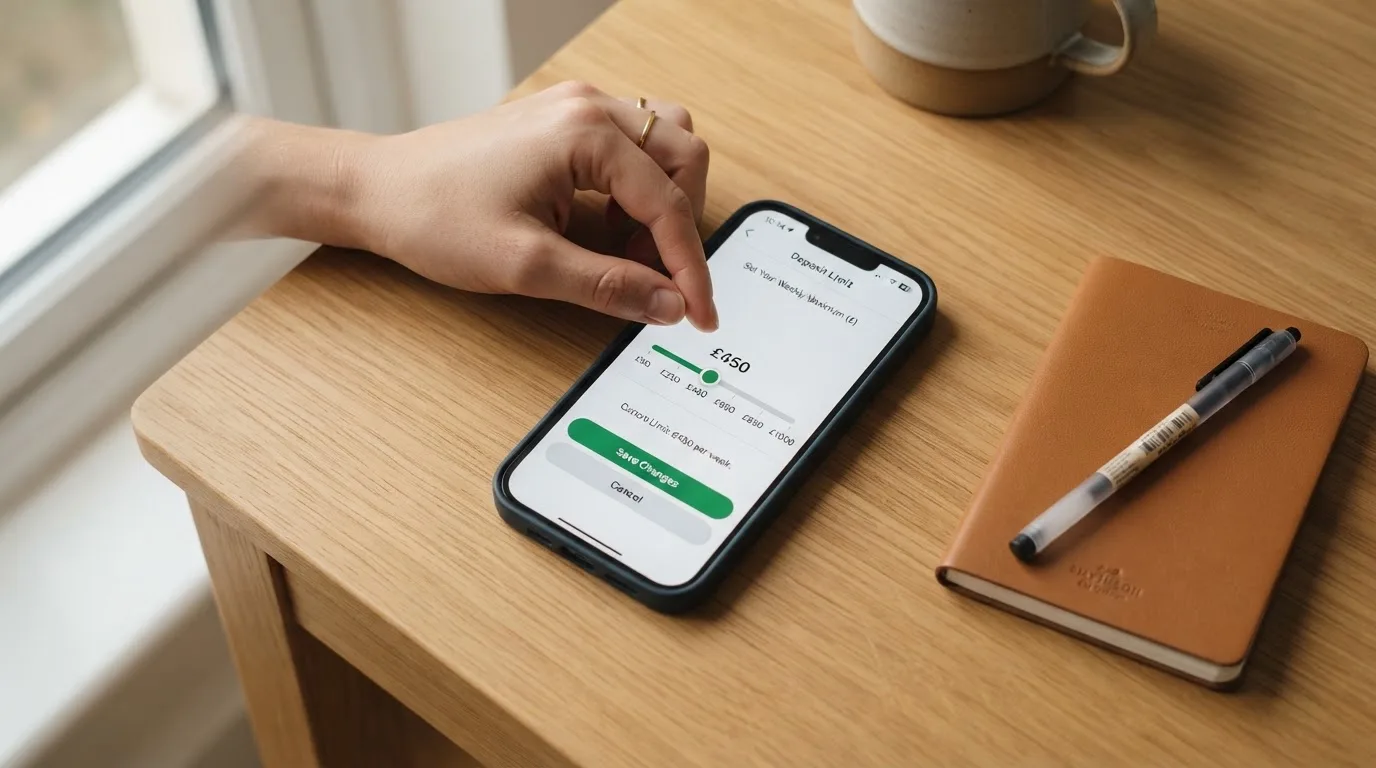
Deposit limits are a Commission requirement: a remote operator has to offer the customer a gross deposit limit on a fixed time frame. The first changes under the new Remote Technical Standards have applied since 31 October 2025, a second phase was postponed to 30 September 2026, and whether that second phase is live is not established. There is no state-set deposit ceiling for betting — the limit is the customer’s choice, set inside the operator’s product. A punter who sets a £100-a-week limit and hits it has hit their own ceiling, not the regulator’s.
The help line for a punter who has lost the run of their betting is GamCare’s National Gambling Helpline, with the further routes through GambleAware, the NHS gambling clinics and Gamblers Anonymous. Every brand on this list links to at least one of those services; a brand that did not would be failing its licence conditions. The links are not a marketing line — they are a licence obligation.
Bonuses and free bets: what the headline number actually costs
A welcome offer is a marketing line. The cost of clearing it is the actual product, and the cost is buried in the small print. The audit below reads the offers on this list against the same Commission rule and the same clearing math.
The Commission’s promotion rules, in force since 19 January 2026, cap wagering requirements on bonuses at 10x. A £10 bonus with a 50x requirement would need £500 of qualifying bets to clear; under the cap, no more than £100. Mixed-product promotions — an offer that asks the punter to bet on football to get free spins, for example — are banned. The cap covers bonus wagering, not free bets without a wagering condition, and the position of a free-bet welcome with no rollover attached is not pinned down by the cap itself.
How a free bet is worked out
A free bet is a free-bet-credit stake, not a refund. The stake is not returned on a win. A £25 free bet at 3.00 pays £50 profit, not £75. The bookmaker has given the punter the chance to win without risking the stake, and the stake is the price of the gift.
A £5 qualifying bet at 1.91 does not unlock a free bet. The minimum-odds rule on most welcome offers is 1.50, 1.91 or 2.00 (EVS) — anything shorter than the named line does not trigger the credit. The line is set high enough to push the qualifying bet away from a near-certain outcome, and the punter who backs a heavy favourite at 1.10 will not unlock the offer.
The deadline matters. A 7-day free bet expires on day 8; a 14-day qualifying window closes on day 15. The punter who reads the headline and skips the small print loses the offer through inaction, not through the bet going down.
Reading a welcome offer the way the small print writes it
Take a £10 deposit and a £10 qualifying bet at minimum odds of 1.50, unlocking four £10 free bets valid 7 days. The qualifying bet costs £10 of the punter’s money and pays only the minimum stake, so the qualifying bet is a real-money bet, not a free shot. The four free bets are £40 in face value, but free-bet stakes are not returned, so the punter’s actual win is the four profits, not the four returns. A punter who uses all four free bets at 3.00 wins £80 profit, the qualifying bet has settled at whatever the qualifying bet’s outcome was, and the welcome has cost the punter the qualifying stake and the qualifying bet’s variance.
That is the cleared value of a “£40 in free bets” welcome on a £10 deposit. The headline is the face value; the cleared value is the profit, and the profit is what the punter actually takes out.
What the rollover does to a bonus
A bonus with a 10x wagering requirement on the bonus amount means a £10 bonus needs £100 of qualifying bets to clear. The bets have to be at or above the minimum price, the stake is real money, and the bonus is paid out only after the rollover is complete. A punter with a small bank will clear the rollover on small stakes, and the cost of clearing is the margin on the bets they place; a punter who places the rollover on a high-margin market pays more for the same bonus than one who clears it on a low-margin one.
The 10x cap, in force since 19 January 2026, is the upper end of what a licensed bookmaker can demand. An offer with a 20x rollover is either pre-cap, offshore, or read wrong; a punter who meets a 20x rollover at a licensed book has hit a term that is no longer lawful under the in-force rules.
What the price is actually saying: the margin
Every odds line on a bookmaker’s site carries a margin: the cut the bookmaker takes of every unit staked on that market. The margin is not a fee, not a surcharge, not a “tax” the punter pays on top of the bet — it is built into the prices themselves, and it is the structural reason a £10 stake at 2.00 does not return £20 of value to the betting public.
A two-way market at 1.90 and 1.90 illustrates the point. The price is 1.90 (decimal), or 9/10 (fractional). The reciprocal of 1.90 is 0.5263, and the sum of the reciprocals of the two outcomes is 1.0526. The “payout share” — the fraction of every unit staked that is returned to the betting public in the long run — is the reciprocal of that sum, or about 0.95. The margin, which is what the bookmaker keeps, is one minus the payout share: about 5%.
A 5% margin on a single event is a fair line for a major sport. On a niche sport like water polo, where the price is written by a handful of traders and the betting volume is small, the margin is higher — 7%, 8%, 10% are not unusual on a small event, and a margin above 10% on a heavily priced event is the punters’ share dropping into the high eighties. The margin is the answer to “why does my winning bet pay less than the headline price implied”; it is also the answer to “why does the same fixture price differently on two bookmakers”.
The example below uses a single illustrative pair of prices, not a quoted market:
- Market: a two-way water polo fixture, decimal odds 1.90 / 1.90 (fractional 9/10).
- Payout share: 1 ÷ (1 ÷ 1.90 + 1 ÷ 1.90) = 1 ÷ 1.0526 ≈ 0.950, or about 95%.
- Margin: 1 − 0.950 ≈ 0.050, or about 5%.
The band a real bookmaker charges is wider than 5% on a small event, and the band a real punter meets is more like 5% to 10% on a well-priced line and above 10% on a thin one. The math above illustrates the point: the formula, the inputs and the result in one example, and the band as the honest framing for a real fixture.
Why the margin matters more than the headline price
Two bookmakers can show 1.91 and 1.95 on the same fixture, and the punter who takes 1.95 is not getting a 2% better bet — they are getting a market with a different margin, and the difference compounds across the bet’s expected value. A punter who prices a market at 2.00 and the bookmaker has priced it at 1.95 has a 2.5% margin against them, and a long-run losing rate of 2.5% on every unit staked.
That is the cost of betting with a bookmaker who runs a higher margin. It is the cost that does not appear on the betting slip, and it is the cost that the welcome offer’s headline number never offsets. A punter who takes a £10 free bet on a 1.91 line and wins gets £9.10 of profit, less the cost of the margin; a punter who takes the same free bet on a 1.85 line gets £8.50 of profit, and the lower headline price is the higher margin at work.
Settling: how a return is worked out
A return is the stake plus the winnings. A £10 bet at 3.00 pays £30: £10 stake returned, £20 profit. A £10 bet at 1.50 pays £15: £10 stake, £5 profit. A £10 each-way bet on a horse race is two £10 bets, so the stake is £20 in total, and the place terms depend on the race and the operator. Each-way betting is a racing feature; water polo is settled on the outright result, with handicaps and totals priced separately.
A combination bet multiplies the legs into a single price. A double at 2.00 and 3.00 is a 6.00 line; a treble at 2.00, 3.00 and 1.50 is a 9.00 line. The punter wins all three legs or loses the bet; the all-up price is the product of the legs, and the margin on a combination bet is the combined margin of the legs, not the margin of the headline price.
Fractional odds convert to decimal by dividing the numerator by the denominator and adding one. 5/1 in fractions is 5 ÷ 1 + 1 = 6.00 in decimals. 11/4 is 11 ÷ 4 + 1 = 3.75. Evens (1/1) is 2.00. The punter who reads in fractions and the punter who reads in decimals are reading the same prices; the form does not change the return.
Where the markets sit: what gets priced
A water polo market on a British bookmaker is built around the international calendar. The World Championships sit at the top: a men’s event has been held since 1973 within the World Aquatics Championships, a women’s event since 1986. The European Championships run on their own cycle, and the Olympic tournament is the four-year peak. National-team leagues — the Hungarian league, the Serbian league, the Spanish league — sit underneath, and club competitions round out the calendar.
The market depth follows the event. A World Championship semi-final will pull match result, handicap and totals lines from a bookmaker serious about the sport; a friendly between two club sides may pull only the match result. The bettor who turns up for the World Championship and the bettor who turns up for a Tuesday-night friendly are looking at different books, even on the same site.
The bet builder on a water polo event is a smaller version of the football builder. Match result, handicap, totals and, where the bookmaker has priced them, player markets are the legs. A 10-selection builder on water polo is rare; a 4- or 5-selection builder is the realistic ceiling, and the bookmaker’s price on the multi is the combined margin of the legs.
How to compare the bookmakers on a single fixture
A punter with one eye on a water polo fixture and one eye on the bookmaker list above will run a short comparison. The fixture is on three or four of the ten sites, the prices differ, and the welcome offer is a separate question. The shape of the comparison is the same on every fixture, and the steps are the same on every site:
- The price: which bookmaker is showing 1.91 and which is showing 1.85. The lower margin is the better long-run bet.
- The market depth: which bookmaker is offering match result, handicap and totals, and which is offering match result only. The deeper bookmaker is the more useful account for a serious punter.
- The in-play offering: which bookmaker is pricing the match in-play, and which has shut the book. The in-play book is the one to use after the teams have been announced.
- The welcome offer: which bookmaker is offering a welcome that the punter will actually clear, and which is offering one whose terms they will trip over. The cleared value is the profit, not the face value.
- The free-bet stake: which bookmaker returns the free-bet stake on a win and which keeps it. The free-bet-credit structure is the norm, the stake-returned structure is the exception.
The comparison is not a single answer. A punter who values a small-stake welcome picks one bookmaker; a punter who values in-play depth picks another. The verdict at the end of each block above is the page’s reading of the trade-off; the punter’s reading of the same trade-off is theirs.
What an unlicensed bookmaker costs the bettor
A bookmaker without a Gambling Commission licence is offering bets from outside the British regime. The bet is not “illegal to place” as a matter of criminal law aimed at the customer — the offence under section 33 of the Gambling Act 2005 is the operator’s, not the punter’s. The cost is the loss of the British consumer-protection regime, and the cost is real.
A bettor at an unlicensed brand does not have GAMSTOP coverage, so a self-exclusion registered with the British scheme does not stop the offshore account. The punter does not have a Commission complaints route, so a dispute over a settled bet goes to the offshore operator’s own customer service, with the small print they wrote. The punter does not have an approved British alternative dispute resolution body, so the dispute ends where the operator decides it ends. The 10x bonus cap does not apply; the £150 vulnerability check does not apply; the operator’s stake limits and withdrawal rules are the operator’s, not the Commission’s.
A punter who can place a bet at a licensed bookmaker — and every fixture priced in this market is priced by at least one of the ten brands on this list — does not need an unlicensed bookmaker. The licensed route is the one with a regulator behind the offer, an ombudsman route if the punter needs one, and a self-exclusion scheme that actually excludes.
Picking the right one for a water polo bettor
The ten bookmakers on this list are not interchangeable. A punter whose betting centres on water polo specifically, with a small bank and a long view, will weight the list differently from a punter whose water polo bet is one of twenty across a busy Saturday.
- The deepest water polo line on a major event is not always at the bookmaker with the heaviest welcome. A bookmaker like 10bet or Betway carries the secondary sport with a working in-play line; the welcome is the cost of opening the account, not the price of the bet.
- The free-bet-credit welcome is the norm, and a punter who treats it as a real-money refund will be disappointed on the first settlement. The cleared value is the profit, and the profit is what the welcome is worth.
- The bet builder is the structural advantage on a bookmaker like LiveScore Bet, and the bettor whose natural stake is a same-game multi gets the most out of that bookmaker.
- The spread betting product on Spreadex is a different product, regulated by the FCA on the financial side, and the punter who wants fixed-odds betting only should stay on the fixed-odds side of the app.
- The horse-racing features — Best Odds Guaranteed, the SP, the place terms — are not portable to water polo. A bookmaker whose racing offer is generous is not automatically a better water polo bookmaker; the offer is scoped, the markets are separate.
The verdict at the end of each block is the page’s reading. The punter’s reading of the same list will land elsewhere, because the bet they want to place and the bank they want to place it with are not the page’s.
The small print on a water polo bet
A water polo bettor reads the same small print as a football bettor, and the same small print as a racing bettor — the licence is the licence, the regulator is the regulator, the rules are the operator’s. A few details are specific to the sport, and they shape the price.
A match is four quarters; a handicap line is set around the goal-difference expectation. A total goals line is set around the expected score; water polo scores run higher than football per quarter, and a totals line on a major fixture is set accordingly. A team has six field players and a goalkeeper; a player market is set on the players the bookmaker has decided to price, and the list is shorter than a football player list.
A bookmaker’s withdrawal times are the same on a water polo bet as on a football bet. A punter who has cleared a free bet on a winning water polo accumulator waits the same hours for the withdrawal as a punter who has cleared the same free bet on football. The sport does not change the operator’s plumbing; the licence, the customer service and the regulator are the same on every bet.
Frequently asked questions about water polo betting odds in 2026
The questions below are the ones a British punter is most likely to ask before opening a water polo market for the first time. The answers are short, drawn from the Commission register, the small print and the arithmetic above, and not from any individual bookmaker’s marketing.
How can it be checked that a bookmaker holds a Gambling Commission licence?
Search the Commission’s public register by business name, trading name, domain or account number, and confirm that the entry matches the brand at the splash page. The register shows the licence categories, the holder and the sites the licence covers. A brand that does not appear on the register is not licensed for Great Britain.
How is the return on a bet worked out from the stake and the odds?
Multiply the stake by the decimal odds. A £10 bet at 3.00 returns £30: the £10 stake plus £20 of profit. A £10 bet at 1.50 returns £15: the £10 stake plus £5 of profit. A combination bet multiplies the legs into a single price, and the return is the stake times the product.
What is the bookmaker’s margin and how can it be seen in the odds?
The margin is the cut the bookmaker keeps of every unit staked. On a two-way market at 1.90 and 1.90, the reciprocal of the sum of the reciprocals is the payout share, about 95%, and the margin is 1 minus that share, about 5%. A higher margin means a lower long-run return to the punter; a lower margin means a higher one. The margin is hidden in the price, not added on top of it.
How do fractional odds such as 5/1 convert to decimal odds such as 6.00?
Divide the numerator by the denominator and add one. 5/1 becomes 5 ÷ 1 + 1 = 6.00. 11/4 becomes 11 ÷ 4 + 1 = 3.75. Evens (1/1) becomes 2.00. The decimal form is the stake-inclusive return; the fractional form is the profit-only return. Both are the same price, written differently.
Which tools for controlling play does a licensed bookmaker have to offer?
The minimum is GAMSTOP registration, a deposit limit the customer can set, timeouts, self-exclusion, and links to GamCare, GambleAware and the National Gambling Helpline. The financial vulnerability check applies once a customer’s deposits minus withdrawals exceed £150 in a rolling 30 days. The tools are a licence condition, not a customer-service line, and a licensed bookmaker has to offer them by default.
US & other team sports – Basketball betting
Content created by the «Basketball betting» team
