
What floorball betting actually costs the bettor in 2026
 Available in US
Anyone searching for “floorball betting tips” usually wants a list of picks. The harder question is what the price on a tip is really worth, and what the act of betting on a niche sport costs in fees, in the bookmaker’s margin, and in the conditions attached to a free bet. This page works through the building blocks of a floorball bet — form, statistics, line-ups, the margin baked into the odds, and the licensing and player-protection rules that frame a bet with a GB-licensed bookmaker — and closes with ten UK-licensed operators and what each one asks of the customer. No picks, no predicted results, no guaranteed winners. A guide, not a tip sheet.

Current as of 27 October 2026, checked against the Gambling Commission’s public register of Great Britain licence holders.
The ten floorball bookmakers on the shortlist
Floorball is a niche market. The number of GB-licensed bookmakers that price a World Floorball Championship fixture is small, the number that price a Swedish Superligan regular-season game smaller still, and most of the operators below run floorball as a seasonal in-play line around the IFF calendar. The table lists each brand’s Gambling Commission account, the licence holder named on the register, and the line in the operator’s own terms that matters most for a floorball punter. A “— ” in a cell means that the operator’s own terms do not address the point in a way the page can carry; the reader checks the brand’s sports rules before staking.
| Brand | Gambling Commission remote licence | Licence holder | What the operator’s own terms say on floorball |
|---|---|---|---|
| Bet600 | 44731 (044731-R-323941-016) | Tyche Tech Limited | Best Odds Guaranteed on horse racing; floorball priced seasonally as part of the in-play feed |
| Sky Bet | 67370 (067370-R-341330-005) | SBG Sports Limited | Free bets limited to single or each-way markets, expiring 30 days after crediting |
| Bet Ahoy | 100094 (100094-R-341742-003) | Bet Ahoy Ltd | Welcome offer split into a sports single and an acca token, each with its own use rules |
| Star Sports | 9177 (009177-R-104555-019) | Star Racing Limited | Trader-assisted account opening and bet placement by phone and email |
| Betfred | 39544 (039544-R-319290-010) | Petfre (Gibraltar) Limited | 21 sports covered in-app; floorball availability varies with the tournament calendar |
| Dabble | 65677 (065677-R-340363-005) | Dabble Sports UK Ltd | Free bets expiring 7 days after crediting, stake not returned with winnings |
| Coral | 54743 (054743-R-330863-014) | LC International Limited | Welcome free bets expiring 7 days after issue, min odds 2.0 on the qualifying bet |
| Geoff Banks | 54095 (054095-R-330366-010) | GB Sports Advisors Limited | In-play and ante-post pricing on future events; floorball sits under ante-post during the World Championship |
| Matchbook | 39504 (039504-R-319407-024) | Triplebet Limited | A betting exchange — back and lay against other users, not the bookmaker |
| Betway | 39372 (039372-R-319367-029) | Betway Limited | Weekly Free Bet Club on settled sports spend; floorball counts where the operator prices it |
Bet600 — price-tracker feel, BOG on the racing side
Bet600’s edge in the wider market is Best Odds Guaranteed on horse racing, where the starting price beats the early or show price, the bet is paid at the SP. On floorball, the picture is leaner: floorball is one line in a wider in-play feed and the price depth depends on which tournament round the bookmaker has priced. For a bettor who already has a Bet600 login, the floorball market is convenient. For someone picking a bookmaker specifically to follow the World Championship, the floorball-specific depth at the other end of this list is more useful.

Sky Bet — deep sportsbook, strict free-bet window
Sky Bet is one of the largest sportsbooks in Great Britain and one of the few that posts a floorball outright market before the World Championship. The free bet terms are tight: 30 days from crediting, single or each-way only, no multiples, no virtuals, the stake is not returned with winnings. A bettor who lets a free bet drift past 30 days has given it back. Plan the use of the token before claiming it.
Bet Ahoy — small offer, short fuse
Bet Ahoy runs a smaller welcome offer — a £5 sports token and a £5 acca token — on a £10 qualifying bet. The split means two expiry windows rather than one, and a punter who only uses the sports token leaves the acca half on the table. A modest offer, but a clean fit for someone who already bets accas on the Swedish Superligan or the IFF events.
Star Sports — a human on the other end of the line
Star Sports runs a UK trading desk and gives customers a phone number (08000 521 321) and a support inbox to open accounts, place bets and ask questions. In a niche market like floorball, where a price is sometimes pulled mid-game and the line on the app looks thin, a trader who can take a bet over the phone has a real edge. Less useful for a bettor who only wants a few pre-match singles and never picks up the phone.
Betfred — high street familiarity, sportsbook breadth
Betfred is a recognisable high-street name and the app covers 21 sports plus a casino. Floorball is not its headline market. The brand is a reasonable home for a bettor who keeps one wallet across sports and casino and who only wagers on floorball two or three times a year around the World Championship.
Dabble — quick turnover, tight expiry
Dabble’s free bets come with a 7-day expiry and a stake that does not return with winnings, so the headline value of a free bet is the winnings only, never the stake plus the winnings. For a bettor who places bets daily, the 7-day window is workable. For a once-a-month punter, the offer expires between tournaments.
Coral — established sportsbook, standard promo conditions
Coral is one of the older names in British betting and the welcome offer is a £40 free-bet bundle on a £20 qualifying bet at minimum odds of 2.0. The free bets issue within 7 days and expire 7 days after issue, so the whole cycle is two weeks. The floorball market at Coral is a single outright line during the World Championship, with limited in-play depth.
Geoff Banks — ante-post specialist for the slow markets
Geoff Banks focuses on in-play and ante-post pricing for events the rest of the market skips. Floorball is a natural fit during the World Floorball Championship window: ante-post outrights on the tournament winner, division winners, and the top-scorer markets sit on the app for weeks before the event. Less useful for a bettor who only wants same-day singles.
Matchbook — a betting exchange, not a sportsbook
Matchbook is a betting exchange. The punter backs or lays against other users, the platform takes a commission on net winnings, and the price on a market is the depth of the book the other side has posted. For a niche market like floorball, an exchange is sometimes the only place to find a lay price on a favourites-only event. The catch: the price the screen shows is the price a counterparty is willing to take, and a thin market means wider spreads than a sportsbook.
Betway — weekly free bet club, settled spend
Betway’s Free Bet Club credits up to £10 in free bets each week after opt-in: spend £25 on settled sports bets, take 2 × £5 tokens. Floorball counts where the operator prices it, and the recurring structure suits a punter who bets on a sport every week. A bettor who signs up, takes the weekly tokens once, and stops betting has missed the point of the offer.
What a floorball bet actually is
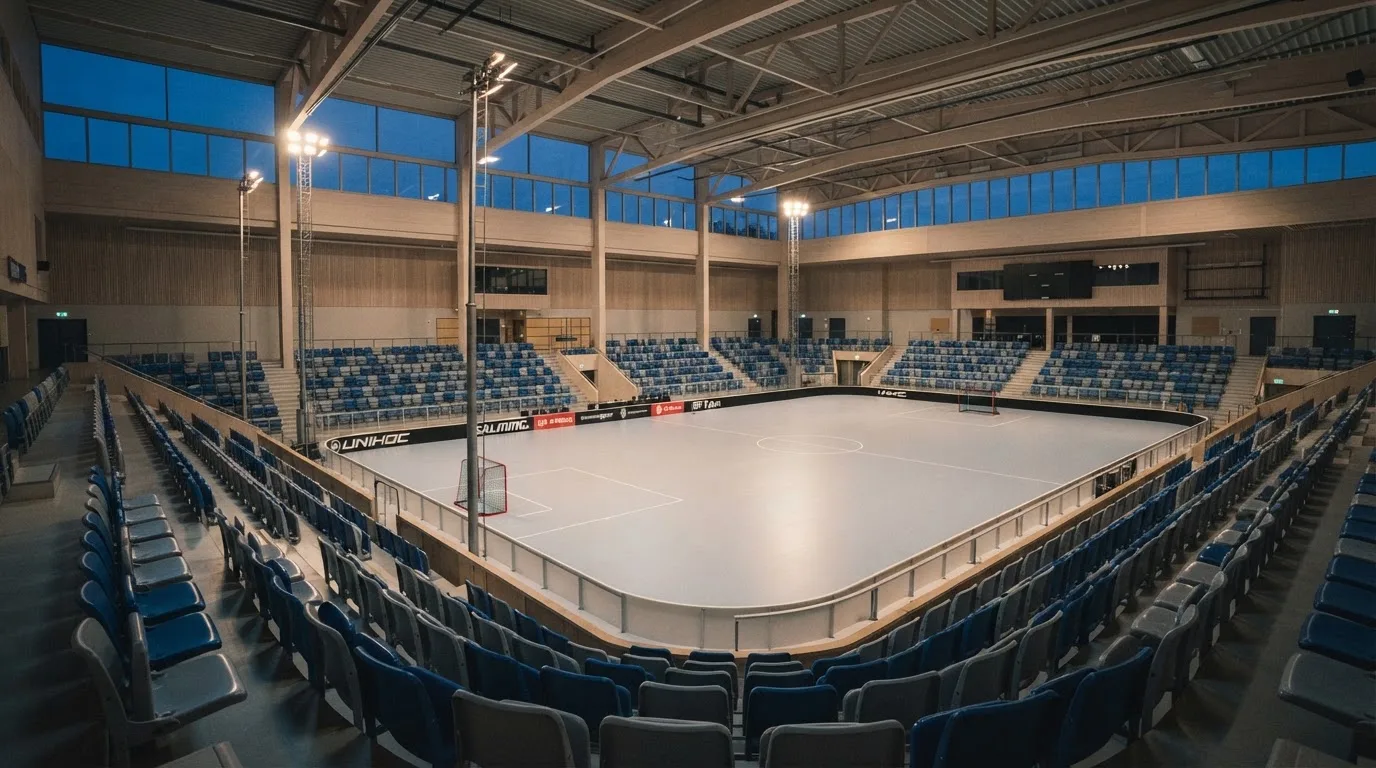
Floorball is an indoor stick-and-ball sport played with five outfield players and a goalkeeper on each side, over three 20-minute periods. A tied game goes to sudden-death overtime, with no extra time before overtime. A full floorball season for a top-flight European league runs roughly September to April, and the IFF runs the international calendar around it. The Men’s World Floorball Championship is held every December in even-numbered years, the 2026 edition scheduled for 4 to 13 December 2026 in Tampere, Finland, with 16 national teams.
A bet on floorball is structured like a bet on any other team sport: the 1X2 market (home win, draw, away win — draws are possible in regulation because floorball has no shootout before overtime), the match-winner market after overtime, the totals markets (over/under a stated goal line, usually 8.5, 9.5 or 10.5), the handicap lines (a goal handicap to flatten mismatched teams), and the team totals. Outright markets cover the World Championship, league champions, and top-scorer across a tournament. The bookmaker’s depth on a given fixture is the key constraint: a top-tier World Championship semi-final may have twenty-plus markets; a Swedish Superligan midweek game may have six.
Building a “tip” without the tip sheet
A “tip” is shorthand for an opinion about the probability of an outcome. To be useful, it has to be a number a punter can compare to a bookmaker’s price, and the comparison has to come out positive on the punter’s side of the bookmaker’s margin. The mechanics are simple. The work is in doing them honestly.
Form, fixtures and the calendar
Form is the result of a team’s last five to ten games, weighted by opponent quality. In floorball, the league calendar is dense in mid-season (two to three games a week for top clubs) and a hot streak can flip a price in a day. The IFF international window stops domestic play for two to three weeks twice a season, and a club missing five national-team players during a window can lose a market-leading price overnight. The fix is to check line-ups the day before a bet, not the morning of.
Statistics that move a floorball price
Goals scored and conceded per 60 minutes, shots on goal, power-play efficiency and penalty-kill rate are the four statistics that move a floorball market the most. Special teams matter: a top-flight floorball team spends 8 to 12 minutes per game on the man advantage, and a power-play percentage above 30% is a top-quartile number. Saves percentage is the goaltending indicator. A punt on a heavy favourite without checking the goalie is a punt on a missing variable.
The line-up check
Floorball is a tight rotation sport. A starting five in a top European league plays 18 to 22 minutes of the 60, with the bench running on a rolling shift. Injuries are reported in the local press in Sweden, Finland and Switzerland, and the IFF posts line-ups the day before international fixtures. The bettor who does not check the line-up bets on the wrong roster.
What a value bet is, in one sentence
A value bet is a price the bookmaker is offering that is higher than the true probability of the outcome, once the margin is taken out. The bookmaker’s margin is the percentage of every pound staked that the bookmaker keeps over the long run. Find a price higher than the true probability plus the margin, and the bet is value. The arithmetic is in the next section.
Why no tip is ever certain
A floorball fixture is decided by 60 minutes of fast indoor play, with bounces, deflections and goaltending variance. Even a 90% favourite loses one in ten. The bookmaker’s margin sits on top of every price, so the true probability the bettor is comparing against is lower than the implied probability of the odds alone. A tip is a probability estimate. The market is the test. A run of bad results at the start of a season is the bookmaker’s margin taking its cut, not the tip going wrong.
What the bookmaker’s margin costs
The margin is the easiest number on the page to compute and the easiest to forget when reading a tip. It is built into every price, and the price a tipster quotes is the price that already includes it.
For an illustrative two-way market priced at 1.90 on each side (fractional 9/10), the calculation runs as follows. The implied probability of one side at 1.90 is 1 ÷ 1.90 = 52.63%. Two sides, both at 1.90, give 105.26%. The 5.26 percentage points above 100% is the margin — the slice of every pound staked the bookmaker keeps on this market in the long run. As a band, a margin between 4% and 6% is the typical shape of a tight pre-match two-way floorball market with two evenly priced teams; an outsider-heavy three-way 1X2 market at 1.40 / 4.50 / 7.00 runs closer to 7% to 9%.
The condition behind the band matters more than the band itself. A margin of 5% on a market the bookmaker has priced in depth, with a healthy book on both sides, costs the bettor the same 5p in the pound. A margin of 5% on a market priced thin, with a stale line, costs the bettor more — because the bettor’s stake is the only new information, and the bookmaker widens to protect the position. The reader’s check, before taking a price, is the same check they would do on a horse race: compare the margin across two or three bookmakers on the same selection, and back the tighter book. The bookmaker’s price is only ever as good as the second-best price.
The legal frame for a floorball bet in Great Britain
A floorball bet in Great Britain is a bet on a sporting event under a remote general betting standard licence. The framework is the Gambling Act 2005 and the Gambling Commission is the regulator. Since the Gambling (Licensing and Advertising) Act 2014, an operator whose remote facilities are used in Great Britain needs a Commission licence wherever it is based — a Curaçao, Maltese or Gibraltar licence is not a substitute. The Commission’s public register is the test of who holds one: a brand, a trading name, a domain or an account number can all be searched, and the register is the only source to trust on whether a brand is licensed in GB. The domain is no proof either way: licensed operators use .com as well as .co.uk, and a .co.uk is not a licence.
Northern Ireland sits outside the 2005 Act, so a GB licence regulates Great Britain, not the United Kingdom. A bettor in Northern Ireland uses a brand whose terms address Northern Ireland separately. The spread-betting part of the market is regulated by the Financial Conduct Authority, not the Commission — Spreadex, for instance, holds an FCA licence for spread betting and a Commission licence for fixed-odds. The two are separate permissions with separate protections.
There is no statutory list of permitted markets and no statutory cap on stakes. The bookmaker’s licence conditions and the LCCP set the rules on what an operator may offer, and the operator sets the maximum stake. Minimum age 18, identity verified before the first deposit, and a name, address and date-of-birth check before any wager — including a free bet — have been the rule since 7 May 2019. A bettor who cannot pass the check cannot deposit or bet with a licensed operator.
What a licensed bookmaker has to offer a punter
Player-protection rules are licence conditions, not a brand’s voluntary add-on. The five tools below are the ones a GB-licensed floorball bookmaker has to put in front of a customer, and the ones a bettor should know how to use before staking.
GAMSTOP, the national self-exclusion register
GAMSTOP is the multi-operator online self-exclusion scheme and a mandatory licence condition for every online operator in Great Britain since 31 March 2020. The self-exclusion periods are six months, one year, five years, or five years with auto-renewal; after the chosen period, the exclusion stays in place for a further seven years unless the customer asks GAMSTOP to remove it. The scheme covers online sites and apps. Betting shops run on a separate service.
The £150 financial vulnerability check
A financial vulnerability check has applied to licensed remote betting since 30 August 2024 and the £150 trigger has applied since 28 February 2025. The test is a public-record check — bankruptcy, county court judgments, IVAs — not an income check and not a credit reference check. The check kicks in when a customer’s deposits minus withdrawals cross £150 in a rolling 30 days. A bettor who crosses the line is asked the question; the bettor answers or stops betting with that brand.
Deposit limits and the announcement on affordability
A gross deposit limit on a fixed time frame has been a licence condition since 31 October 2025 (Remote Technical Standards 12); a second phase of the rules was postponed to 30 September 2026, and the live status of the second phase is not established. A bettor can set their own ceiling. The wider “affordability checks” plan in the press is a Commission announcement of 7 July 2026: staged, no start date. The honest framing is “announced, staged, no start date”, not “in force”.
Help: who takes the call
GamCare runs the National Gambling Helpline. GambleAware funds treatment and education. The NHS runs gambling clinics. Gamblers Anonymous runs peer-support meetings. The bettor who feels the bet is no longer a bet, but a bill, calls the helpline before the next deposit.
The credit-card ban
Credit cards have been banned for gambling in Great Britain since 14 April 2020 (LCCP condition 6.1.2), including credit-card-funded payments through an e-wallet. Debit cards and bank-based payments are not covered by the ban. A bettor who only has a credit card in their wallet cannot deposit with a licensed operator.
Bonuses and free bets on floorball
The word “free” in a sportsbook promotion is the word that costs the punter the most. The promotion rules in force since 19 January 2026 cap wagering requirements on bonuses at 10x — a £10 bonus at 50x needed £500 of qualifying bets; under the cap, no more than £100 — and ban mixed-product promotions that ask the customer to bet on two or more product types to claim an offer. The cap covers bonuses with a wagering condition. Whether it applies to free bets with no wagering condition, and any cap on the money value of a bonus, are not established.
The cost of a free bet to the customer is the same on every floorball bookmaker. A token that does not return the stake pays the winnings only, not the stake plus the winnings, so a £10 free bet at 3.0 pays £20 in returns (£10 stake, £20 profit on the price — but only the £20 profit is credited, not the £30 the price would return on a cash stake). A token that expires in 7 days costs the customer the full token if it is not used. A token restricted to single or each-way markets excludes the acca the punter would have built.
The read on a floorball welcome offer is the read on any welcome offer: what is the qualifying bet, what is the minimum odds, how long does the free bet live, is the stake returned, and can the bonus be used on the sport the punter wants to bet on. Floorball is a thin market outside the World Championship window, and a free bet that expires inside a fortnight of issue may sit on the account with no usable floorball price. The punter checks the floorball calendar before claiming.
Bet types and how a price settles
A floorball bet is structured like a bet on ice hockey, with one quirk: the draw is a real outcome in regulation, because overtime only happens after a tie. A 1X2 market is the standard match result; a “including overtime” market is the post-overtime match winner. The 1X2 prices the regulation result, which is the market that drives most of the volume.
The single
A single is one bet, one selection, one outcome. The stake is the stake; the return is the stake multiplied by the decimal odds. A £10 single at 2.50 returns £25 (£10 stake, £15 profit). This is the building block of every other bet on the page.
The accumulator
An accumulator — an “acca” — combines two or more selections into one bet, and the odds multiply into one price. A £10 acca on three selections at 1.80, 2.10 and 1.95 returns £10 × 1.80 × 2.10 × 1.95 = £73.71, with profit £63.71. The catch: the bet loses if any one selection loses. An acca insurance offer refunds the stake as a free bet if one leg lets the punter down; the refund is a free bet, not cash, and the stake on the free bet is not returned with the winnings. The punter’s cost of an acca insurance offer is the time spent working through the wagering of the refunded token.
Each-way
An each-way bet is two bets of equal stake — one on the selection to win, one on the selection to place. The stake doubles. A £10 each-way at 5.0 is £20 staked: £10 on the win, £10 on the place. Place terms vary by event and by operator; the punter reads the place terms on the betting slip before staking. Floorball outrights on the World Championship top-scorer usually pay 1/4 the win odds on the first four places; the punter checks.
Bet Builder and same-game multi
A bet builder — also called a same-game multi — combines markets from one event into a single bet. The odds of the legs multiply. The catch is the bookmaker’s correlation adjustment: the legs are not priced independently, and the multiplied odds carry a margin on top of the margin of each leg. A bet builder on a floorball game with four legs typically runs at a margin of 12% to 18%, against 4% to 6% on the same game’s 1X2 market. The punter pays for the convenience of one screen and one stake.
In-play
In-play betting is offered by GB bookmakers and the controls are the operator’s licence conditions and customer-protection duties. The bookmaker may suspend a market for a goal, an overtime period, a video review, or a technical problem with the data feed. A suspended market means the punter’s stake is held until the market resumes. A bettor who bets in-play on floorball has a faster path to a margin change than on the pre-match market: the bookmaker re-prices on every event, and the bookmaker’s margin is wider for the first thirty seconds after a goal.
The exchange alternative
A betting exchange lets the punter back and lay against other users, and the platform takes a commission on net winnings. The price on an exchange is the price the other side has posted, and a thin market means wider spreads than a sportsbook. For a niche market like floorball, an exchange is sometimes the only place to find a lay price on a favourites-only event. The trade-off: the punter’s counterparty is the other user, not a balance sheet, and a counterparty who walks away mid-game is the punter’s problem.
Cash out
Cash out lets the bookmaker close a bet before the event is settled, at a price the bookmaker sets in real time. The punter takes a smaller certain return for a smaller risk. The cost of cash out is the bookmaker’s margin on the cash-out price, which is wider than the margin on the original bet, and the cash-out price is at the bookmaker’s discretion. A bettor who uses cash out on a winning acca is taking the bookmaker’s price, not the market’s.
The floorball calendar a UK bettor needs to know
The floorball calendar a UK bettor needs to know is short, and most of it is in the Nordic leagues and the IFF international windows. The Swedish Superligan, the Finnish F-liiga and the Swiss NLA are the three top European domestic leagues. The Champions Cup is the European club competition. The Men’s World Floorball Championship is the international showpiece, and the 2026 edition runs 4 to 13 December 2026 in Tampere, Finland, with 16 national teams. Finland qualified automatically as host; Sweden has won the tournament ten times, most recently in 2022.
| Date | Event | What the price covers |
|---|---|---|
| September to April | Swedish Superligan, Finnish F-liiga, Swiss NLA | League matches, outrights on the regular-season and playoff champions |
| October to November | Champions Cup group stage | Group matches and the path to the Final Four |
| 4 to 13 December 2026 | Men’s World Floorball Championship, Tampere | Group matches, playoff bracket, tournament winner, top scorer |
| February and April windows | IFF international windows | Friendlies, EuroFloorball Cup qualifiers, preparation tournaments |
The bookmaker’s depth on a given fixture is the binding constraint. A World Championship semi-final will have twenty-plus markets: 1X2, totals, handicaps, team totals, player props, period markets. A Swedish Superligan midweek game may have six. The punter’s cost of a thin market is wider margins and fewer prices to back and lay against. The reader’s check, before staking on a Swedish Superligan regular-season game, is whether the bookmaker has priced the game at all. Most GB-licensed operators run floorball as a seasonal in-play line, not a year-round pre-match offer.
How a GB-licensed bookmaker is checked
The check is the public register. A brand’s Gambling Commission account number, its licence holder, the categories of remote licence it holds, and the trading names and domains the licence covers are all on the Commission’s website, and a punter can search by business name, trading name, domain or account number. The register is the only source to trust on whether a brand is licensed in GB. Domain is no proof either way: licensed operators use .com as well as .co.uk, and a .co.uk is not a licence.
A brand that is not on the register for the activity the punter is asking it to perform is not licensed for that activity. A brand that is on the register is bound by the LCCP, the Remote Technical Standards, the social responsibility code, the financial vulnerability check, the GAMSTOP condition, the 10x bonus cap, the credit-card ban, and the identity-verification rule. A brand that is not on the register has none of those obligations to a GB customer. The honest framing is the one the Commission uses: licensed = checks, limits, GAMSTOP, bonus cap; unlicensed = none of those protections, possible loss of funds, no British consumer redress.
Enforcement against an unlicensed brand is disruption, not blocking. The Commission issues cease-and-desist notices, refers the brand to search engines, works with registrars, hosts and payment providers, and has been given, or is about to receive, court-order DNS blocking powers. ISP-level blocking is not in operation. No offence aimed at a customer who merely bets on an unlicensed site has been found. The customer loses the protections, not the freedom.
What a tip costs the punter
The marketing word on a tip is “expert”, “professional”, “winning”, “100%”. The arithmetic behind the marketing word is a margin the bookmaker takes on every bet, a free bet whose stake is not returned, a bonus that has to be wagered, and a deadline that the punter has to meet. The cost of a tip is the price the punter pays for it: a subscription, an odds-shortening tipster service, or the time the punter spends building the form, the statistics and the line-up check themselves.
The honest read on a free tip — a tip a punter gets from a tipster with no subscription, posted on social media, offered with no tracked record — is that the tip is the same as the punter’s own guess with no accountability. The honest read on a paid tip is that the tipster is selling probability estimates the punter could build themselves, with a track record the punter can audit. The honest read on the bookmaker’s price is that the price is the price, and the margin is the cost the punter pays in the long run for the convenience of a one-screen bet.
The punter who treats the tip as a probability estimate, the price as a price, the margin as a cost, and the bankroll as a budget that ends at the start of the month is the punter who is still in the game at the end of the month. Everyone else has paid the bookmaker’s margin and the tipster’s subscription, and is wondering where the money went.
Frequently asked questions
What is a value bet?
A value bet is a price the bookmaker offers that is higher than the punter’s estimate of the true probability, once the bookmaker’s margin is taken out. The punter’s estimate of the true probability comes from form, statistics, line-ups, and the rest of the build-up above. The bookmaker’s price is the price on the screen. The comparison is the value. A punter who finds more value bets than the bookmaker’s margin costs over the long run makes a profit; a punter who finds fewer loses to the margin. The value is a number, not a feeling.
What is the bookmaker’s margin?
The bookmaker’s margin — the overround — is the percentage of every pound staked the bookmaker keeps in the long run. It is built into every price: the implied probabilities of all outcomes on a market add up to more than 100%, and the excess is the margin. A 1X2 market at 1.90 / 3.60 / 4.50 has an implied probability sum of 1/1.90 + 1/3.60 + 1/4.50 = 52.6% + 27.8% + 22.2% = 102.6%, so the margin is 2.6 percentage points — the bookmaker keeps 2.6p of every pound staked on this market. A tight pre-match floorball market runs 4% to 6%; a thin in-play market can run 8% to 12%.
How is the return on a bet worked out?
Return = stake × decimal odds. Profit = stake × (decimal odds − 1). For a combination bet, the odds of the legs multiply into one price. A £10 single at 2.50 returns £25 with profit £15. A £10 acca on three selections at 1.80, 2.10 and 1.95 returns £10 × 1.80 × 2.10 × 1.95 = £73.71 with profit £63.71. The same arithmetic works for a free bet whose stake is not returned, except only the profit is credited — £73.71 of profit on a £10 free bet, not the £83.71 a cash stake would have returned.
How is a Gambling Commission licence checked?
The Gambling Commission’s public register is the test. The punter searches the brand’s business name, trading name, domain or account number. The register shows the licence categories the brand holds, the trading names and domains the licence covers, the licence holder, and the licence status. A brand that is not on the register is not licensed for the activity the punter is asking it to perform. A brand that is on the register is bound by the LCCP, GAMSTOP, the 10x bonus cap, the credit-card ban, and the £150 financial vulnerability check. The domain is no proof either way: licensed operators use .com as well as .co.uk, and a .co.uk is not a licence.
Which player-protection tools does a GB-licensed bookmaker have to offer?
A GB-licensed bookmaker has to offer GAMSTOP self-exclusion (six months, one year, five years, or five years with auto-renewal, plus a seven-year tail), the £150 financial vulnerability check on a rolling 30-day basis, deposit limits on a fixed time frame, identity verification before the first deposit, and links to GamCare, GambleAware, the NHS gambling clinics, and Gamblers Anonymous. The punter who feels the bet is no longer a bet, but a bill, calls the National Gambling Helpline on 0808 8020 133 before the next deposit, or registers with GAMSTOP to block every GB-licensed online operator at once.
US & other team sports – Basketball betting
Content created by the «Basketball betting» team
