
Rugby union betting odds in Great Britain: a punt-by-punt cost read
 Available in US
The price the bookmaker prints on a rugby union match is not the same thing as the chance either side wins. It carries the margin the bookmaker keeps on every pound staked, the dead weight a “free” offer places on a withdrawing balance, and the limits, deadlines and identity checks that change what the bettor can actually do. This guide is a cost read of rugby union betting odds for the 2025/26 season: how a price is built from two-way and three-way markets, what the offer language costs the punter who claims it, which of the ten Gambling Commission-licensed brands named below earn their place in a shortlist and which quietly don’t, and where a bettor with a small bankroll should land.

A quick note on currency of the data below: figures were checked on 27 October 2026 against the Gambling Commission’s public register and each operator’s own published terms. Where a brand’s price or promotion was current at that date it is named as such; where it is not it is left out rather than reprinted stale.
What rugby union betting looks like at a GB-licensed bookmaker
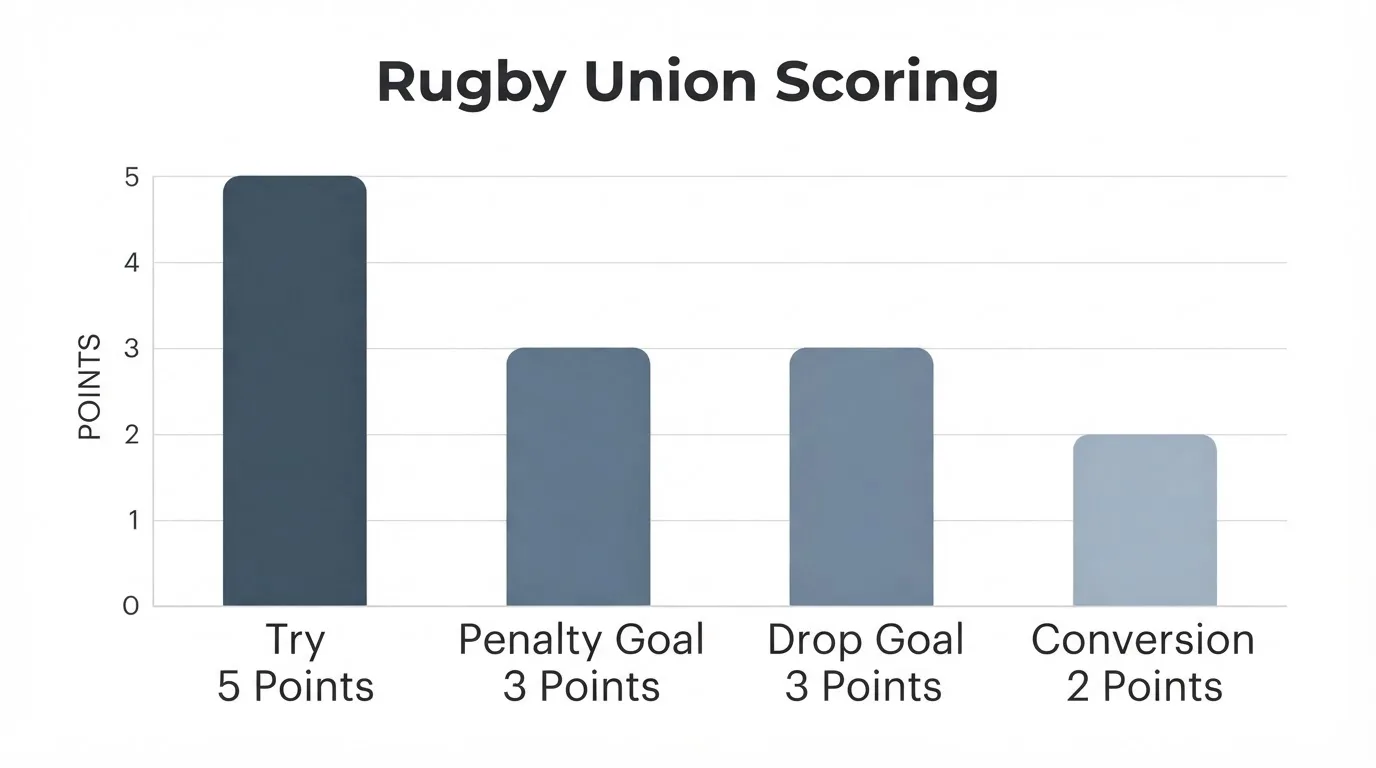
Rugby union is one of the cleaner sports to bet on for a new punter. Fifteen players a side, two halves of forty minutes, stoppages not counted so games typically run past eighty, tries worth five, conversions two, penalties and drop goals three each. World Rugby has run the international game since 1886, and the Rugby World Cup has been held every four years since 1987 in Australia and New Zealand, with South Africa the current holders after the 2023 final. The next men’s tournament is the 2027 Rugby World Cup, hosted by Australia from 1 October to 13 November 2027, twenty-four teams in six pools of four and fifty-two matches in all. Between those poles sits the calendar a GB punter actually bets on: the Premiership in England, the United Rugby Championship and the European Champions Cup in the club game, the Six Nations for the home nations and a small clutch of southern-hemisphere leagues.

What this means in the betting shop is that the in-season menu is thick from late August to mid-June, with international windows bookending the club season. Out of season the menu thins to test matches and the southern-hemisphere competitions (Super Rugby, the Rugby Championship, the Currie Cup), which licensed UK bookmakers continue to price. Two practical consequences follow. First, the price the punter sees on, say, a Sale versus Bristol Premiership fixture in January sits on a smaller betting volume than the same fixture would on a Premier League football match, and that thinner liquidity expresses itself as a wider margin — meaning the punter pays more for the same number of points of edge. Second, the international fixtures that draw genuine betting interest — Six Nations matches, autumn internationals, World Cup pool games — sit on materially tighter prices, because the same customer is betting them at every shop.
The bookmaker’s margin is the only number that matters at first glance
A bookmaker’s margin is what the operator keeps out of every pound staked on a market. It is built into the odds before the punt is even placed, and it is the reason the same match carries different prices at different shops. The arithmetic is plain enough: take every outcome of a market, divide each by one over its decimal odds, and the resulting sum is what the bookmaker pays back to punters per pound wagered. The leftover — one minus that sum — is the margin.
Take an illustrative two-way market priced at 1.90 / 1.90. Each outcome pays one over 1.90, which is 0.5263; the two outcomes together pay 0.5263 plus 0.5263, which is 1.0526 — the bookmaker returning £1.05 per pound staked, keeping £0.05 of margin. Worked in prose rather than in script, that is roughly a 5% margin on this two-way market. Now compare that with a more realistic three-way 1X2 on a rugby union match (home win, draw, away win), where the home favourite might be priced at 1.40, the draw at 22.00 and the away outsider at 4.50. One over 1.40 is 0.7143, one over 22.00 is 0.0455, one over 4.50 is 0.2222 — summed, that is 0.9820, so the margin on this market is around 1.8%. Tighter match, tighter margin, because the favourite’s price is much shorter and the longshot is generous enough to balance. A heavy handicap line (say −13.5 on a heavily favoured side) will carry a margin somewhere between those two numbers; a tournament outright on the Rugby World Cup, with twenty-four possible winners and the favourite typically at 5/1 (6.00 decimal), carries a much bigger margin still, often above 20%, because most of the field is priced long and only the favourite and a handful of rivals carry genuine volume.
The numbers above are a worked example rather than a quoted price. The page repeats that caveat because a price quoted on a date stamps the page with that date: a 5% margin on a particular fixture on a particular Tuesday is a true number for that moment and a false number the following week. Treat any quoted price as a snapshot, not as a number to bet on.
What “odds” actually mean in a British betting shop
GB punters see odds in two formats: fractional (5/1, 11/4, evens) and decimal (6.00, 3.75, 2.00). They describe the same thing from two sides. A fractional price of a/b returns a/b of the stake as profit — so 5/1 returns five pounds for every pound staked, plus the stake back, so six pounds in total — and the decimal price that goes with it is a divided by b plus one, so 6.00. A price of evens (1/1) is decimal 2.00; a price shorter than evens (say 4/6) is decimal 1.67, and “odds-on” the panel means a price shorter than evens, with the favourite carrying the smaller number.
The arithmetic of a winning bet is plain. Return equals stake multiplied by decimal odds, so a £10 stake at 3.75 returns £37.50; net profit equals stake multiplied by (odds minus one), so £27.50 in this case. On a combination bet — an accumulator, the trade calls it an acca — the prices multiply. Three legs at 2.00, 3.00 and 4.00 produce a combined price of 24.00, and a £10 stake returns £240 if all three land, with £230 of profit. The appeal is the multiplication. The trap is that each leg carries its own margin, and the multiplication compounds them. A three-leg acca where each leg carries a 5% margin is not a 5% market any more — the bookmaker’s cut has compounded.
Markets the GB bookmaker prices on a rugby union match
The menu at a typical licensed shop for a Premiership or Six Nations match runs to around twenty to thirty pre-match markets, of which the punter actually uses a handful. Match result (home/draw/away, the 1X2) is the headliner. Handicap lines come in half-point increments (a −7.5 line, a +10.5 line) and let the punter back the favourite to win by more or the outsider to keep it close. Total points sits on a line set by the bookmaker (47.5 points, 52.5 points depending on the match), with the punter taking the over or the under. First try scorer, first try scorer each-way, anytime try scorer and team first try scorer are popular in a try-heavy game. Half-time result and half-time/full-time doubles carry bigger prices and bigger margins. Outright markets on a league winner, on the Six Nations winner, on the Rugby World Cup 2027 winner and on the top try scorer of a series complete the menu through the season.
That menu is not identical at every shop. Some brands are deep in player markets and shallow on handicaps; others carry a thinner outright book and a thicker in-play board. The next section carries that further into the shop itself.
How a licensed GB bookmaker differs from a non-licensed one
There is no statutory list of permitted sports or markets in Great Britain. Any bookmaker serving customers in Great Britain needs a Gambling Commission licence wherever it is based, since the Gambling (Licensing and Advertising) Act 2014 closed that route. A Curaçao, Maltese or Gibraltar business licence is not a substitute for the Commission’s remote general betting licence. The Commission’s public register, searchable by business name, trading name, domain or account number, is the whole test of who holds one. Every brand in the ranking below sits on that register under a current remote general betting standard (real events) licence.
What the licence does and does not buy
A Commission licence buys the punter four things. Identity verification before the first deposit, by law since 7 May 2019 — the bookmaker must check name, address and date of birth before the customer can deposit or gamble, including with a free bet or bonus. GAMSTOP, the national multi-operator online self-exclusion scheme, mandatory for online operators since 31 March 2020 — a punter who self-excludes cannot open an account at any participating brand for the period they choose (six months, one year, five years or five years with auto-renewal, then a further seven years if not actively removed). Dispute resolution through approved alternative dispute resolution bodies, and a Commission complaints route if that route is exhausted. A bonus wagering cap of ten times the bonus amount, in force since 19 January 2026 under the LCCP — so a £10 bonus no longer requires more than £100 of qualifying bets before withdrawal.
It costs the punter two things. Identity verification means no anonymous play at a licensed site: the punter is known before the first £10 hits the account. A financial vulnerability check, in force from 30 August 2024 and effective from 28 February 2025, runs once the customer’s deposits minus withdrawals exceed £150 in a rolling 30 days, and looks at public records (bankruptcy, county court judgments) rather than at the bank statement. A heavier financial risk assessment regime has been announced in a staged plan with no published start date. None of this is discretionary; the licence conditions write it.
Where the unlicensed shop fails
An unlicensed brand running from outside Great Britain carries no Commission oversight, no GAMSTOP coverage and no approved dispute-resolution route. The punter has no British consumer redress if funds are withheld, no access to the Commission’s complaints procedure, and no protection under the bonus cap or the vulnerability check. The Commission has the power to issue cease-and-desist notices, work with search engines, hosts and payment providers, and is moving toward court-ordered DNS blocking — but a punter with money stuck at an unlicensed shop has, in practical terms, lost it. None of this makes betting at an unlicensed shop a criminal offence for the customer; the offence under section 33 of the Gambling Act 2005 is aimed at the operator. But the loss of protection is real, and it is the reason every brand below sits on the Commission’s register rather than on a comparison of “best payout speed”.
Safer gambling tools the punter should set before the first bet
The safer gambling architecture in Great Britain runs through three named bodies. GamCare runs the National Gambling Helpline, free and confidential, on 0808 8020 133. GambleAware funds treatment and education across Great Britain. The NHS runs specialist gambling clinics in several regions. Gamblers Anonymous runs mutual-support meetings. GAMSTOP, named above, is the self-exclusion route for online play, with the periods and the post-period tail set out in the previous section.
What the punter can do at any licensed shop without contacting those bodies. A deposit limit, set against a fixed time frame under the Remote Technical Standards: the first changes have applied since 31 October 2025, a second phase was postponed to 30 September 2026, and whether that second phase is now live is not established from the public register. A session time limit, a reality check that fires at intervals, a cooling-off period, and a one-week to six-week timeout. Each brand implements these slightly differently; the punter should set the deposit limit at the operator level (because it sits at the operator, not at the customer) and a parallel limit at the bank level for any operator not yet enforcing the second phase. Self-exclusion via GAMSTOP if the punter wants the protection to travel across brands.
The honest framing of a licensed shop. Identity verification, a GAMSTOP-registered self-exclusion, a bonus wagering cap and a vulnerability check on heavy spend. None of these are the brand being paternal; they are the licence conditions, written by Parliament and enforced by the Commission. A punter who does not want any of them does not have a UK legal route to bet on rugby union — that is what “licensed for Great Britain” means.
What a “free bet” and a “matched bonus” actually cost
The marketing language of online sportsbooks is a small library of hedges. “Free bet”, “matched bonus”, “risk-free”, “boosted odds”, “best odds guaranteed” — each term names a different deal underneath, and each deal places a different weight on the punter’s withdrawing balance.
A free bet is a one-shot stake the bookmaker credits to a new or existing customer. The stake is usually not paid back with a win — the punter receives the profit only, not the stake. So a £10 free bet at 5.00 returns £40 of profit, not £50. The free bet also has an expiry (commonly seven days from issue), a market restriction (commonly 3+ leg accas, minimum odds 4/1 or 1.80 decimal) and, in many cases, a cap on the winnings derived from the free bet (commonly £30 to £50 for an opening offer). The value of the free bet to the punter is the free-bet amount multiplied by (odds minus one) divided by odds, multiplied again by the payout share of the market the free bet is placed on. A £10 free bet at 4.00 (decimal) on a market with a 95% payout share is worth roughly £7.13 on average — not £40, not the headline number.
A matched deposit bonus credits the punter’s account with a percentage of the deposit, on the condition that the bonus (and sometimes the deposit too) is turned over a stated number of times at a stated minimum price. The Commission cap of ten times the bonus amount is now the ceiling. A £30 bonus at the cap requires £300 of qualifying bets, with each bet at or above the operator’s minimum price (commonly 1.50 or 1.61 decimal) before withdrawal. The expected cost of clearing the bonus is the turnover multiplied by the margin of the market the turnover is run on. A £300 turnover on a market with a 5% margin costs the punter around £15 on average — a £30 bonus that costs £15 to clear is, on average, a £15 net benefit. Less if the punter chooses a market with a bigger margin (shorter favourites, exotic outrights); more if the punter is patient and bets on a market with a sub-2% margin (six-nations 1X2 with full liquidity).
“Best odds guaranteed” is a different animal. It is a concession the bookmaker makes on UK and Irish horse racing, not rugby union — so a punt on the Six Nations will not benefit — and it pays the punter the bigger of the price taken and the starting price if the starting price is bigger. Most rugby union bets do not have a starting price in the racing sense, so the concession rarely fires. The same applies to “boosted odds” on a single match: a price boost is a one-off enhanced price on a particular selection, and the winnings are paid in cash, in free bets, or in some mix. A “risk-free” bet refunded as a free bet is not a refund in money; it is a free bet with all the conditions a free bet carries.
None of this is a reason to avoid offers. The point is to read the offer as the punter would read an ingredients label, and to weigh the bonus against the turnover it requires, the minimum price it imposes, the deadline it carries and the cap on winnings it places.
Why the wagering cap matters
Before 19 January 2026 a £10 bonus at a fifty-times wagering requirement needed £500 of qualifying bets before withdrawal. That was the regime under which the largest headline bonuses on the market were sold. Under the current cap of ten times the bonus amount, the same £10 bonus needs £100 of qualifying bets — five times less in turnover, and roughly five times less in expected margin cost on a normal market. The cap applies to bonuses, not necessarily to free bets whose only condition is settling within a stated window; whether the cap binds those offers has not been resolved by the Commission publicly. Mixed-product promotions — an offer that asks the punter to gamble on two or more product types (betting plus casino, betting plus bingo, betting plus lottery) for a single reward — are banned outright. Each of the brands below runs a sports-only welcome.
In-play rugby union and the cost of cashing out
In-play betting on rugby union is offered at every licensed GB bookmaker and priced by the bookmaker’s own traders, with the controls sitting in the operator’s licence conditions and customer-protection duties rather than in statute. The market runs continuously from kick-off, with the bookmaker suspending pricing while a try is being scored and re-opening it once play resumes, and the margin on the live market tends to be wider than on the pre-match market because the bookmaker has less time to balance the book and is absorbing real-time risk.
The Rugby World Cup and the autumn internationals carry the deepest in-play board, with the same menu available as in the pre-match market plus match-specific markets (next try scorer, next scoring play, half-time result). Premiership and Champions Cup matches carry a thinner but adequate in-play board. Out-of-season matches and the smaller southern-hemisphere leagues carry a basic 1X2 and total points only.
Cash out is a separate offer from in-play. It lets the punter settle a bet before the match has finished, at a price set by the bookmaker in real time, with the bookmaker keeping a margin on the cash-out price itself. A bet that was placed at 2.00 and now sits at 1.50 in the in-play market might cash out at 1.40 or 1.45, with the bookmaker’s spread sitting between those two numbers. Auto cash-out fires when the price crosses a level the punter sets in advance. Partial cash out settles a stated fraction of the stake. Each of these features adds a layer of margin, and the layer is opaque: the punter has no way to know the live market price without cashing out.
For a punter who wants to use in-play rugby union betting seriously, the practical question is the bookmaker’s in-play latency and the depth of the live board. The brands reviewed below carry varying positions on each.
The prediction and strategy frame — what actually works
A quick word on what this section is and is not. There is no algorithm that predicts the outcome of a rugby union match. There is no system of staking that turns the bookmaker’s margin into a punter’s profit. Anyone selling such a system is selling the bookmaker’s edge in a different wrapper. What follows is the framing that serious GB punters use, not a tipster’s preview.
The framing starts with the bookmaker’s margin. A market with a 1.8% margin (a tight Premiership or Six Nations 1X2) is more efficient than a market with a 5% margin (a thin board or a handicap line). The punter’s edge, where one exists, sits on the bigger-margin market, because the bookmaker’s mistake, where the bookmaker misprices, is larger in absolute terms on a market with a wider spread. Conversely, the punter’s expected loss on a normal bet is bigger in absolute terms on the wider-margin market. The trade-off is between the size of the bookmaker’s mistake (when one exists) and the punter’s cost of running the bet. A punter betting a small bankroll on a few selections a season is well-advised to stick to the tight market; a punter betting a large bankroll across many selections is well-advised to hunt the wider market, where the absolute errors are bigger.
The second piece of the frame is the staking plan. Flat staking (the same stake on every selection) is the right plan for a small bankroll, because it caps the variance and the expected loss. Proportional staking (a fixed percentage of bank on every selection) is the right plan for a larger bankroll, because it scales the stake with the bank and limits the damage of a losing run. The Kelly criterion and its fractional variants are the right plan for a punter who has an honest edge and can stomach the variance of the plan; for a punter who does not, the Kelly plan over-bets and is destructive. No staking plan turns a negative expected value into a positive one. The bookmaker’s margin is what it is.
The third piece is information. The market absorbs information quickly on a Six Nations fixture and slowly on a Currie Cup fixture. The punter’s edge, where one exists, comes from information the market has not absorbed: a late injury, a wet pitch, a referee who is card-happy in the first twenty minutes. Most of this information is priced into the market within minutes of becoming public. A punter who is faster than the market has an edge for as long as the edge lasts. A punter who is not is pricing the bet on the same information the bookmaker has already priced in.
The fourth piece is what the punters in the trade call bankroll management. The punter sets a per-season budget before the season starts, and does not exceed it. The punter keeps the betting bank in a separate account, and tops it up only when the budget allows. The punter does not chase losses. The bookmaker’s deposit limit is set before the first bet of the season and held flat, and the operator’s session reality check is turned on at the shortest available interval.
None of the above is a system that wins. It is the framing within which a serious punter places bets knowing the expected cost of doing so. A punter who treats the bookmaker’s margin as a tax and the staking plan as a budget is doing what the system allows. A punter who expects a system to beat the margin is doing what the system does not allow.
Bet types and how they settle
The bet types the GB bookmaker offers on rugby union fall into a small number of shapes. A single is one selection, settled on the outcome of one event. A double is two selections, both of which must win for the bet to win, with the prices multiplied. A treble is three; an acca is four or more. An each-way bet is two bets of equal stake, one on the win and one on the place, with the place terms set by the bookmaker (commonly one-quarter the win odds for the first three places in a league outright, one-fifth the win odds for the first four places in the Six Nations). The each-way stake is double the headline stake because it is two bets, and the punter’s exposure is double the headline figure.
A handicap bet is a single on the outcome adjusted by a line set by the bookmaker. A −7.5 line on the favourite means the favourite must win by eight or more for the bet to win; a +7.5 line on the outsider means the outsider must lose by seven or fewer, or win. A total points bet is on whether the match’s combined score is over or under a line set by the bookmaker. A half-time/full-time double is on the result at half-time combined with the result at full-time, with the price compounding across the two outcomes.
A bet builder is a single bet on multiple selections from one event, with the bookmaker combining the prices into one. A bet builder on a Six Nations match combining the home side to win, the match total to be over 47.5 points and the first try scorer to be a specific winger pays the multiplied price if all three land. The bet builder carries its own margin on the combined book, which is typically wider than the equivalent singles combined, and is part of the appeal to the bookmaker rather than to the punter. An acca insurance refunds the stake (usually as a free bet, sometimes in cash) if one leg of a qualifying acca loses; the refund is capped, and the qualifying acca carries a minimum number of legs at a minimum combined price.
A spread bet, offered at Spreadex and Sporting Index among the brands reviewed below, is a different instrument. The punter buys or sells a stated number (the total points in the match, the difference between the teams’ try counts) at a price the bookmaker quotes per point, and the punter’s profit or loss is the difference between the quote and the outcome multiplied by the stake. A spread bet on the match total at 48 with a £2 stake pays £2 for every point the total is above 48, and costs £2 for every point it is below 48. The same shape on the Six Nations side’s try count carries a quote of (say) 3.8 and the punter buys at 3.8; if the side scores five tries, the punter wins £2.40; if the side scores two, the punter loses £3.60. A spread bet does not cap the punter’s loss at the stake; the loss can exceed the deposit. Spreadex, which is one of the brands below, is regulated by the Financial Conduct Authority for spread betting and by the Gambling Commission for fixed-odds betting, and states on its home page that spread betting losses can exceed the deposit. The distinction between the two regulators matters because a punt that goes wrong on a spread bet is not protected by the Commission’s customer redressability rules in the same way a fixed-odds bet is.
The shop window — tournaments and competitions priced at GB bookmakers
The competition calendar of a GB-licensed rugby union bookmaker runs through three layers.
The top layer is the international game. The Six Nations runs from February to March, with England, Scotland, Wales, Ireland, France and Italy. The Rugby Championship runs from August to October, with New Zealand, Australia, South Africa and Argentina. The autumn internationals run in November, with the southern-hemisphere sides touring the north. The summer tours run in June and July, with northern sides touring south. The Rugby World Cup 2027 is the headline tournament of the cycle, hosted by Australia from 1 October to 13 November 2027, twenty-four teams in six pools of four and fifty-two matches. The market on the Rugby World Cup 2027 winner opens as soon as the previous one concludes and is the largest outright book the bookmaker prices in rugby union.
The middle layer is the club game in the northern hemisphere. The English Premiership runs from September to June, with ten clubs in the top flight and a smaller Championship underneath. The United Rugby Championship runs across Wales, Ireland, Scotland, Italy and South Africa from October to June. The European Champions Cup runs from December to May. The Challenge Cup runs alongside. Each competition carries its own 1X2, handicap, total and outright markets, and the bigger matches carry player markets and half-time markets.
The lower layer is the southern-hemisphere club game. Super Rugby runs from February to June, with sides in New Zealand, Australia, South Africa, Japan, Argentina and Fiji. The Currie Cup runs alongside in South Africa. NPC runs in New Zealand. These are priced at GB bookmakers with a thinner book and a wider margin, and a punter comparing prices across the calendar will find them consistently less efficient than the Six Nations or the Premiership.
Outright markets on each competition’s winner carry a much wider margin than a single match. A 24-runner book on the Rugby World Cup with the favourite at 5/1 (6.00 decimal) carries a margin north of 20%; an 18-runner book on the Six Nations with the favourite at 6/4 (2.50 decimal) and the field carrying 10/1 to 200/1 carries a margin around 30%. The punter pays for the privilege of betting on the eventual winner; the bookmaker keeps the difference across all twenty-four losers.
The ten licensed bookmakers named by this guide
The ten brands below are the featured set. Each sits on the Gambling Commission’s public register under a current remote general betting standard (real events) licence, and each carries the licence categories the Commission’s register records. The order is editorial, not regulatory, and the comparison at the end of this section is a tool for choosing between the set, not a ranking of which is the best.
Tote
The Tote sits on the Commission’s register under account 54779, licensed to TDCO Limited, and runs under the remote general betting standard (real events) category. The Tote is the legacy pool-betting brand of British racing and carries a smaller rugby union book than the major sportsbooks, but it prices the bigger fixtures (Six Nations, autumn internationals) and the major outrights. The Tote’s edge over a conventional sportsbook is its pool structure on selected markets, where the payout share is set by the pool rather than by the bookmaker’s margin; the disadvantage is that the pool takes longer to settle and the headline price is set by the dividend rather than by a published odds line. The Tote is best suited to the punter who wants pool betting on the bigger rugby union fixtures and is comfortable with a different pricing structure from the standard fixed-odds book. For the punter who wants the conventional sportsbook experience on a regular weekly menu, the Tote is a thinner option.
Hollywoodbets
Hollywoodbets sits on the register under account 53028, licensed to Hollywoodbets International UK Limited. The sports welcome is a stake-back offer on the first qualifying losing accumulator: a £10 minimum deposit by card, a £10+ stake on the first acca with 3+ legs at 4/1 (5.00 decimal) or greater, settled within seven days; a free bet of up to £30 is credited if the acca loses, with one free bet per customer. The stake of a losing qualifying acca is returned as a free bet, not as cash; the free bet carries its own minimum odds, its own expiry and its own market restrictions. The offer is best read as a refund on the first bet rather than as a free gift, and the value of the free bet to the punter is the £30 multiplied by (5.00 minus one) divided by 5.00 multiplied by the payout share of the market the free bet lands on, which lands around £20 on average. Hollywoodbets offers a targeted acca-focused welcome that pays out a free bet on the first losing acca, rather than a headline bonus that divides the same value across many smaller bets.
Sporting Index
Sporting Index sits on the register under account 27343, licensed to Sporting Index Limited. The brand runs both fixed-odds and spread betting on rugby union, with the option for the customer to switch between the two at the point of placing a bet. The fixed-odds book is conventional and prices the standard menu on the bigger fixtures; the spread book lets the punter buy and sell on totals, supremacy and try counts at quotes per point. The brand also runs a Bet Builder on football, an auto cash-out feature and Multi-Markets on selected events, with the features listed in the brand’s own app store entry. The mixed offering makes Sporting Index the natural home of the punter who wants spread betting and fixed-odds on rugby union from one account, but the punter who only wants fixed-odds does not need the spread side, and the spread side carries the loss-can-exceed-the-deposit warning that all spread books carry. Sporting Index suits the spread punter first and the fixed-odds punter second.
QuinnBet
QuinnBet sits on the register under account 61011, licensed to QuinnBet (Gibraltar) Limited. The brand runs a Best Odds Guaranteed concession on UK and Irish horse racing from 10:00am daily on singles, multiples and system bets, with a maximum benefit of £150 per customer per race. The concession applies to racing, not rugby union, and the rugby union book is priced conventionally. QuinnBet suits the punter who bets on horse racing and rugby union from one account and wants the Best Odds Guaranteed concession on the racing side; for the punter who only bets on rugby union, the concession does not fire and the brand is one of several conventional sportsbooks.
Betboro
Betboro sits on the register under account 44181, licensed to Webmedia Development N.V. The sports welcome is a 100% matched free bet of up to £25 on the first qualifying wager, requiring a debit card deposit of at least £10 and a first bet of between £5 and £25 with at least three selections each at 3/5 (1.60 decimal) or higher. The free bet is a one-shot stake, the stake is not paid back with a win, and the qualifying bet requires at least three legs. The offer is best read as a smaller free bet than the headline looks: a £25 free bet on a market with a 95% payout share is worth around £17.80 on average, not £25. Betboro is a simple matched-bet offer for the punter looking for a single free-bet stake on a wider range of markets than the headline free-bet offers usually allow.
BetGoodwin
BetGoodwin sits on the register under account 2927, licensed to Goodwin Racing Limited. The brand’s sports welcome is a “Bet £10 & Get £15 in Free Bets” offer, broken into a £5 sports single, a £5 sports acca and a £5 Sub-Cover bet, with the three components paid as separate free bets. The Sub-Cover is a contingency on a stated match outcome; if the bet does not land, the £5 is refunded as a further free bet. The combined value of the three free bets to the punter, weighted by the payout share of the markets the free bets land on, is roughly £10 to £11 on average — smaller than the £15 headline suggests. BetGoodwin offers a split-welcome structure across three different bet types, providing more variety for the punter than a conventional single-market match.
Fitzwilliam Sports
Fitzwilliam Sports sits on the register under account 48760, licensed to SBKI Limited. The brand describes itself as a Dublin bookmaker with capped membership, and its welcome is a “High Stakes Welcome” subject to compliance criteria, with the brand’s home page stating that the welcome is offered on terms that vary by customer and that the criteria are not published in full. The brand’s site lists instant deposits, fast withdrawals, timeouts and deposit limits, and links to GambleAware, GamStop and Gamblers Anonymous. The capped membership and the unpublished welcome criteria make Fitzwilliam Sports a bookmaker for the punter who actively seeks the brand out and accepts the qualifying process, rather than for the punter looking for a quick welcome on a larger menu. The book on rugby union is conventional.
Betfair Sportsbook
Betfair sits on the register under account 39439, licensed to PPB Counterparty Services Limited. The sportsbook is separate from the betting exchange: the sportsbook runs a conventional fixed-odds book under a remote general betting standard (real events) licence, while the exchange runs under a remote betting intermediary licence on the same licensee. The sportsbook offers in-play betting, Bet Builder, free live streaming of events such as UK and Irish horse racing and football within the app, and a 90 Minute Payout market on football (a refund on football bets settled as a loss if a goal is scored in injury time). The rugby union book is conventional and well-priced on the bigger fixtures, and the live streaming covers the headline fixtures. Betfair delivers a professional-grade sportsbook where the liquidity on international matches is sufficient to make it a primary destination for serious tournament betting.
Bet Ahoy
Bet Ahoy sits on the register under account 100094, licensed to Bet Ahoy Ltd. The brand’s welcome is “Bet £10 & Get £10 in Free Bets”, broken into a £5 sports single and a £5 sports acca. The offer is one of the simpler welcome structures in the set, and the value of the £10 in free bets to the punter, weighted by the payout share of the markets the free bets land on, is around £7 on average. Bet Ahoy suits the punter who wants a smaller, simpler welcome with a quick turnover rather than a headline-heavy structure with a long wagering requirement.
Kalooki Sportsbook
Kalooki Sportsbook sits on the register under account 57730, licensed by the Gambling Commission under the same account, and is a GAMSTOP member. The brand is operated by Kalooki Sports Book Ltd (company number 12938274), and runs a conventional sportsbook with a rugby union book on the bigger fixtures. The brand’s positioning is on the smaller end of the set and the welcome is a standard matched offer rather than a headline-heavy one. Kalooki suits the punter who wants a smaller brand with a conventional book and is comfortable with a thinner in-play board on the smaller fixtures.
Comparison across the set
| Brand | Commission licence (account) | Licence holder | What the operator’s own terms state on the key’s subject |
|---|---|---|---|
| Tote | 54779 | TDCO Limited | Pool betting on the bigger rugby union fixtures, with a smaller fixed-odds book and a dividend-based pricing model on selected markets |
| Hollywoodbets | 53028 | Hollywoodbets International UK Limited | Stake-back on the first qualifying losing acca, £10+ deposit, £10+ acca, 3+ legs, 4/1 minimum, settled within 7 days, up to £30 free bet |
| Sporting Index | 27343 | Sporting Index Limited | Switchable fixed-odds and spread betting on rugby union, plus Bet Builder on football, auto cash-out and Multi-Markets |
| QuinnBet | 61011 | QuinnBet (Gibraltar) Limited | Best Odds Guaranteed on UK and Irish racing from 10:00 daily, up to £150 benefit per race; rugby union is conventional |
| Betboro | 44181 | Webmedia Development N.V. | 100% matched free bet up to £25 on the first qualifying wager, £10 debit card deposit, £5–£25 stake, 3+ legs, 3/5 (1.60) minimum each |
| BetGoodwin | 2927 | Goodwin Racing Limited | “Bet £10 & Get £15 in Free Bets” split across a £5 single, a £5 acca and a £5 Sub-Cover |
| Fitzwilliam Sports | 48760 | SBKI Limited | Capped membership Dublin bookmaker, “High Stakes Welcome” subject to unpublished compliance criteria, instant deposits and fast withdrawals |
| Betfair | 39439 | PPB Counterparty Services Limited | In-play, Bet Builder, free live streaming of UK and Irish racing and football, 90 Minute Payout market on football |
| Bet Ahoy | 100094 | Bet Ahoy Ltd | “Bet £10 & Get £10 in Free Bets” split across a £5 single and a £5 acca |
| Kalooki Sportsbook | 57730 | Kalooki Sportsbook Limited | Conventional sportsbook, GAMSTOP member, standard matched welcome |
The licensed set does not end at ten. The register lists hundreds of remote general betting standard (real events) licensees, and the punter comparing options should always confirm the current licence on the Commission’s public register before staking, because licences change hands, lapse and renew, and a brand that was licensed last season is not necessarily licensed this one. The headline price of a brand is a brand-side fact; the licence is a Commission-side fact, and it is the test the punter applies first.
The bookmaker’s margin, in one worked example
The number that decides the cost of a bet is the bookmaker’s margin, and the margin is sitting inside every odds line the bookmaker prints. The arithmetic, in prose.
Take an illustrative two-way market priced at 1.90 / 1.90. The bookmaker pays back to punters one over 1.90, which is 0.5263, on each outcome; for two outcomes that is 0.5263 plus 0.5263, which is 1.0526. The bookmaker is paying back £1.05 per pound staked, keeping £0.05 of margin — roughly a 5% margin. Now take a more realistic three-way 1X2 on a rugby union match at 1.40 / 22.00 / 4.50. One over 1.40 is 0.7143, one over 22.00 is 0.0455, one over 4.50 is 0.2222 — 0.9820 in total. The bookmaker is paying back £0.98 per pound staked, keeping £0.02 of margin — roughly a 1.8% margin. Tighter match, tighter margin, because the favourite is much shorter and the longshot is generous enough to balance.
The two worked numbers are an illustrative band, not a quoted price. The band is what the punter should expect at a licensed GB bookmaker on a rugby union match: a sub-2% margin on a tight Six Nations 1X2, a 3% to 6% margin on a Premiership or Champions Cup 1X2, a 5% to 8% margin on handicap and total points lines, and a 15% to 30% margin on outright books and exotic markets. The margin is set by the bookmaker, varies by event and market, and is the cost of doing business with the bookmaker. A punter comparing two bookmakers on the same fixture will find a smaller edge on the bigger fixture (because every shop is pricing it efficiently) and a larger edge on the smaller fixture (because the same book is not priced efficiently at every shop).
The condition attached to the band. The arithmetic assumes every outcome is priced exactly as published, with no late odds movement between placement and settlement, and assumes the punter bets on a market that includes every quoted outcome (no missing lines, no suspended prices). A market with one outcome suspended at placement carries a wider effective margin than the arithmetic suggests, because the punter’s bet is sitting on the remaining outcomes only. The bookmaker has the right to suspend and re-open pricing; the punter has no equivalent right.
The cost read in one paragraph
A rugby union punter betting £10 a week through the season is staking roughly £500 in the year. At a typical 4% blended margin across the markets actually bet on, the expected cost of that betting is £20 — the bookmaker keeps £20 of every £500 wagered across the season. A punter betting £10 an acca, with each acca carrying a compounded 5% margin, is staking the same £500 but the expected cost on the acca book is higher, because each acca leg compounds the margin. A punter claiming a £30 matched bonus and clearing it on a 10x wagering requirement is running £300 of qualifying turnover at a 4% margin, expected cost £12, against a £30 headline bonus — net expected benefit around £18, before considering the cap on free-bet winnings, the minimum price on each qualifying bet and the deadline for clearing. A punter cashing out half the book in-play pays the cash-out spread on top of the original margin. None of these costs is hidden; all of them sit in the price, the offer terms and the cash-out window. The punter who knows the cost before the bet is the punter who comes out even at the margin.
Frequently asked questions about rugby union betting odds
How does rugby union betting work in the UK?
A licensed GB bookmaker prices rugby union markets from a season-long fixture list (Premiership, URC, Champions Cup, Six Nations, autumn internationals, World Cup 2027), with the punter betting against the bookmaker on a fixed-odds line. The bookmaker keeps a margin inside every price; the punter backs or lays outcomes through single, combination and exotic bets, settles on the outcome of the event and either withdraws or rolls the winnings into the next bet.
How do you place a bet on rugby union?
Pick a licensed GB bookmaker, complete identity verification (name, address, date of birth), fund the account by debit card or bank transfer, browse the rugby union menu for the fixture and market you want, set the stake, confirm the bet at the price displayed and wait for settlement. The price displayed at confirmation is the price the bet settles at; the bookmaker can suspend and re-open pricing but cannot change a price on a bet you have already confirmed.
How can a punter check that a bookmaker holds a Gambling Commission licence?
Use the Commission’s public register, searchable by business name, trading name, domain or account number. The register is the whole test of who holds a licence; a brand listed under a current remote general betting standard (real events) licence with the licence holder named in the register entry is licensed for the period the entry covers. A brand not on the register, or with a lapsed entry, is not licensed.
How is the return on a bet worked out from the stake and the odds?
Return equals stake multiplied by decimal odds. Net profit equals stake multiplied by (odds minus one). On a combination bet the prices multiply into a single price; a three-leg acca at 2.00, 3.00 and 4.00 produces a combined price of 24.00, and a £10 stake returns £240 if all three legs land. The arithmetic assumes decimal odds; the equivalent on fractional odds is stake multiplied by (a divided by b) plus stake, so a £10 stake at 5/1 returns £60 in total (£50 of profit plus the £10 stake).
What is the bookmaker’s margin and how does it sit inside the odds?
The margin is what the bookmaker keeps out of every pound staked on a market, calculated as one minus the sum of one over each decimal odds across every outcome of that market. On a two-way market at 1.90 / 1.90 the margin is roughly 5%; on a three-way 1X2 at 1.40 / 22.00 / 4.50 the margin is roughly 1.8%. The margin is the cost of doing business with the bookmaker and is the first number a serious punter compares across bookmakers and markets.
How do fractional odds convert to decimal odds?
Fractional odds of a/b convert to decimal odds of (a divided by b) plus one. A 5/1 price converts to 6.00 decimal, an 11/4 price converts to 3.75, and an evens (1/1) price converts to 2.00. The punter can do the conversion in one step: 5 divided by 1 plus one equals 6, 11 divided by 4 plus one equals 3.75, 1 divided by 1 plus one equals 2. The arithmetic works for prices shorter than evens (odds-on) too: 4/6 converts to 1.67 decimal, with the punter receiving £1.67 per pound staked on a win.
Rugby, cricket & Gaelic – Basketball betting
Content created by the «Basketball betting» team
