
Online badminton betting in Great Britain: what it costs, what it pays
 Available in US
Online badminton betting in Great Britain sits inside the same framework as every other sport a licensed bookmaker quotes. The Commission licenses the operator, the operator decides what to offer, and the punter decides whether the price is worth it. This guide walks through that frame: how a GB licence is checked, how odds and margins work, what a free bet really pays back, where live betting and accumulators are useful and where they bite, and which of the reviewed bookmakers earn a place on a shortlist for badminton.

The angle throughout is cost — what each mechanism, market and offer takes out of the bankroll, and what the bettor gets in return. Where the marketing says “free” or “guaranteed”, the arithmetic says otherwise.
*Current as of 27 October 2026. Verified against the Gambling Commission’s public register of operating licences and each operator’s published terms.*
The state of badminton betting in Great Britain
Badminton is a niche line on a GB bookmaker’s site. Football, horse racing and tennis dominate, and a major operator may carry only a handful of BWF tournaments at any moment. That thinness has practical consequences for the punter: fewer markets per event, longer gaps between fixtures, and bigger swings in available liquidity than on a heavily traded sport.

The governing body is the Badminton World Federation (BWF), founded in 1934 as the International Badminton Federation. The BWF runs the World Tour, the World Championships (since 1977), the Thomas and Uber Cups (men’s and women’s team events, every two years), the Sudirman Cup (mixed teams, since 1989, every two years) and the All England Open (since 1900). Badminton has been an official Olympic sport since 1992, with mixed doubles added in 1996. Five disciplines are played at the elite level: men’s singles, women’s singles, men’s doubles, women’s doubles and mixed doubles.
For the bettor, the calendar matters more than the rule book. The All England, the World Championships and the Olympic Games pull in the deepest fields, the most televised matches and, in turn, the widest range of markets and the tightest prices at the big operators. Outside those windows, even a Thomas Cup tie can appear only as match winner on a smaller bookmaker’s site, with no totals, no handicaps and no set-by-set lines.
That seasonality is one reason price comparisons are hard on this sport. The market that exists at the All England is not the market that exists in March. A bettor who wants consistent value needs to know which operators keep the sport up year-round and which drop it between tournaments.
A second reason is technical. Badminton is rally-point scored to 21, with a two-point margin needed at 20–20 and a sudden-death finish at 29–29; a match is the best of three games. That structure gives the bookmaker a tidy two-way or three-way frame for match winner, game handicap and total games, but it leaves little room for the half-time and player-prop markets that football offers. The market set is shallow by design, not by neglect.
The BWF itself is not a betting body and publishes no odds. Pricing on a BWF event comes from each operator’s own traders, and where two bookmakers quote the same match they will not usually quote the same margin. The punter’s edge, where one exists, comes from comparing those prices event by event rather than from a single bookmaker being “best”.
How a GB licence is read
A bookmaker offering remote betting to customers in Great Britain needs a Gambling Commission licence wherever the operator is based. The Commission is the non-departmental public body that licenses the whole commercial market under the Gambling Act 2005, and the Gambling (Licensing and Advertising) Act 2014 closed the previous loophole where an overseas licence could serve GB customers.
The Commission’s public register is the whole test of who holds a licence. It can be searched by business name, trading name, domain or account number. Each entry lists the licence categories a brand is authorised for; for sports betting the relevant categories are remote general betting standard (real events) and, separately, remote general betting standard (virtual events). A betting exchange runs under a remote betting intermediary licence, not a general betting one. The Commission’s register gives the access date alongside any number of licensed brands, and any quote of that number without the date is a quote that ages badly.
Two cautions. First, a domain ending in .co.uk does not prove a GB licence; licensed operators also use .com, and an unlicensed operator can register any domain it likes. The register is the check, not the URL bar. Second, several brands can run under a single licence holder. Ladbrokes and Coral, for instance, sit under one; Paddy Power and Betfair sit under another. A name on the register is the licensee; the brands are its trading names.
Spread betting needs its own note. Financial spread betting is regulated by the Financial Conduct Authority, not the Commission; spread betting on sports that is not a financial product sits inside General Betting Duty and falls under the Commission. A brand that offers both — Sporting Index in the reviewed set — states that on its homepage and runs both regimes side by side. The relevant FCA and Commission licences are listed separately on the register, and a bettor looking at spread betting should check both.
There is no statutory list of permitted bets or markets in Great Britain. The Commission’s licence conditions and codes of practice — the LCCP — control what a licensee can do, but the menu of sports, the in-play offering and the politics and novelty markets are all matters of operator choice. The Commission licenses the operator; it does not prescribe the sport.
The legal framing of “the only licensed brand” never fits. Many more brands hold a Commission licence than any article can feature, and a featured set is a comparison, not a register. No brand is the only licensed one, and a brand licensed today is licensed only as at the day the register was checked.
Identity, age and what verification actually means
Three Commission rules shape what a customer meets at a licensed site before a bet is placed. The minimum age is 18. Name, address and date of birth are verified before the customer can deposit or gamble, and that verification has applied since 7 May 2019, including when the stake is a free bet or bonus. In practice, that means a licensed site is not anonymous: there is a sign-up, an identity check, and a record on the operator’s system.
A second rule, the financial vulnerability check (LCCP condition 3.4.4, in force since 30 August 2024), applies once a customer’s deposits minus withdrawals cross £150 in a rolling 30-day window, with the catch threshold live since 28 February 2025. It is a public-record check — bankruptcy, county court judgments — not an income check and not a credit reference check. A bettor who drifts past the threshold will be asked to confirm details that show up on the public record; that is the rule, not the operator being difficult.
A third rule, the financial risk assessment, has been announced in a staged plan. The Commission’s article of 7 July 2026 sets out the staged approach without a start date. Until that date is published, the right description is “announced, staged, no start date” — not “in force”.
Beyond those three, a licensed site must offer a gross deposit limit on a fixed time frame. The first changes applied since 31 October 2025; a second phase was postponed to 30 September 2026 and whether it is live has not been established. There is no state-set ceiling on deposits or losses; limits are the customer’s choice within the framework.
Responsible gambling: what a licensed site actually has to offer
GAMSTOP is the national multi-operator online self-exclusion scheme and a mandatory licence condition for every online operator since 31 March 2020. A customer who signs up is excluded from every GB-licensed online site and app for six months, one year, five years, or five years with auto-renewal. After the minimum period, the exclusion stays in place for a further seven years unless the customer asks GAMSTOP to remove it. Betting shops run a separate service.
Help is available through GamCare, which runs the National Gambling Helpline, GambleAware, the NHS gambling clinics and Gamblers Anonymous. A licensed operator links to those organisations from its safer-gambling pages; an unlicensed one is under no such duty.
The player protection regime is the trade a GB-licensed punter makes for giving up anonymity: identity is verified before the first deposit, GAMSTOP exclusion covers the whole licensed market, deposit limits are required and the bonus wagering cap (10x) and the £150 vulnerability check both apply. A bettor on an unlicensed offshore site gives up those protections in exchange for, in most cases, no obvious gain.
A bettor’s own checklist, where the operator’s safer-gambling page leaves a gap, is short: confirm GAMSTOP membership on the site’s safer-gambling footer, check the deposit-limit tool is reachable from the cashier, confirm the National Gambling Helpline number is on the page, and check whether time-out and self-exclusion run on the same account. Most do; the exceptions are worth knowing.
Offers, free bets and what they really cost
The marketing word on a sports welcome offer is “free”. The arithmetic is rarely so. A free bet whose stake is not returned with a winning payout has a real value below its face value, and that value depends on the odds the bet is placed at and on the margin the operator keeps. The same arithmetic applies to enhanced odds, price boosts, acca insurance and cashback — each is a discounted version of a real-money bet, and each carries its own terms.
The current rule of thumb on a welcome offer is to read the small print in this order: the qualifying bet, the minimum odds, the wagering requirement, the expiry, and what happens to free-bet stakes. A bonus with a 10x wagering requirement is now the maximum the Commission’s rules allow; a £10 bonus at that cap needs £100 of qualifying bets before any winnings can be withdrawn. Any offer that requires betting on two or more product types — “bet on football to get free spins”, for example — is banned under the same rule, in force since 19 January 2026.
A worked example. A free £10 bet at decimal odds 2.00 (1/1) on a market with a 5% margin returns, on average, £10 × (2.00 − 1) ÷ 2.00 × 0.95 ≈ £4.75 in profit, with the £10 stake not returned. That is the expected value of the free bet, not what it wins; the punter who places it short collects less, the punter who places it long collects more. The £10 face value is a ceiling the punter will never reach in expected terms.
For an accumulator insurance — “money back as a free bet if one leg lets you down” — the same arithmetic applies to the refunded stake. The refund is a free bet, not cash, and its expected value is discounted by the same factor. A punter who treats an acca insurance as a safety net is paying for it through the smaller expected payout on the legs they do win.
Cashback offers sit closer to real money. Where the operator returns net losses in cash with no wagering requirement, the cost is the margin the operator kept on the bets that produced the loss; where the refund is in free bets or bonus funds, the discount applies on top.
The deeper rule is that no offer changes the underlying edge. The bookmaker’s margin sits in every price; an offer can shift some of that margin from the operator to the punter for a single bet, but it does not eliminate it across a campaign. A punter who claims ten offers in a row is still paying the margin on the bets those offers paid for.
For a deeper look at how welcome offers, free bets and the 10x wagering cap interact, the section on offers and what they cost covers the arithmetic.
Live betting, in-play and the cash-out button
GB-licensed bookmakers offer in-play betting on badminton where they offer the sport at all, and the controls are operator-level licence conditions and customer-protection duties. There is no statutory cap on in-play stake, no statutory ban on in-play markets and no statutory rule that a particular event must or must not be available live. The depth of the offering follows the depth of the market: at the All England, an in-play menu on a men’s singles match can include match winner, next-game winner, total games and game handicap; outside the major tournaments, match winner may be the only line.
Live betting changes the cost in two ways. First, prices move faster than the punter can read them. A 1.85 in-play quote can be 1.70 a second later and 1.95 a second after that, and the operator’s traders reset the margin into each new quote. A punter who reads three books before placing is comparing three different moments of the same match. Second, the cash-out button is the bookmaker’s hedge against the in-play price moving in the punter’s favour. The cash-out price is the operator’s mid-price at that instant, less its own margin; a punter who cashes out a winning position is paying for the certainty.
The auto cash-out feature that some operators offer — close the bet if the price moves by a set amount — does the same thing on a timer. It is a tool for a punter who cannot watch the match, not a tool for a punter who can.
For badminton specifically, the in-play offering is thin enough that a punter comparing two operators on the same fixture may see no in-play market at all on one and a single match-winner line on the other. That asymmetry is part of the cost: the operator with the deeper in-play book is also the operator whose margin is most actively defended by the cash-out button.
For the mechanics of in-play settlement and what a cash-out quote actually contains, the section on bet types and odds covers the calculation.
Predictions, tips and the honest answer
No one can call a badminton match. Anyone offering a “sure” pick, a system that “wins” or a model that beats the closing price is selling certainty the sport does not provide. That is the honest frame for the rest of this section.
What a tipster can sell is information. A service that tracks head-to-head records, recent form, court surface, the conditions on the day and the BWF rankings gives the punter a starting price. Whether that starting price beats the bookmaker’s price on the day is the test; a tipster whose picks beat the closing line at a margin above the operator’s over the long run is producing value, and a tipster who beats it at a margin below is producing noise.
The punters who beat the bookmaker in the long run share three habits. They specialise — one discipline, one tour, one set of conditions. They record every bet, the closing price and the result, so the record can be audited. And they bet at a stake small enough that ten losers in a row do not end the campaign. Those three habits are the prediction strategy; everything else is marketing.
Bankroll management is the other half. A flat unit — the same stake on every bet — keeps the long-run picture readable. A variable stake that scales with confidence produces almost nothing useful, because confidence is what the bookmaker is pricing against.
The legal frame for tipsters in Great Britain: the Gambling Commission does not license tipsters, and there is no statutory definition of what a tipster must disclose. The ASA’s CAP Code applies to tipster advertising in the same way it applies to bookmaker advertising. The honest tipster publishes results, both wins and losses; the dishonest one publishes wins.
The arithmetic on a single bet is the same whether the punter uses a model or a hunch. The bookmaker’s margin sits in the price; the punter’s edge, if any, comes from a better read on the probability than the operator’s. The punter who cannot beat the closing line is paying for the privilege of placing the bet.
For a worked example of what a price implies about probability and what a margin takes out of it, the section on bet types and odds covers the calculation.
Bet types, odds and the calculation a punter can run
Badminton markets at a GB-licensed operator are mostly two-way: match winner, sometimes with the draw as a third outcome at the bigger events, game handicap and total games. Set-by-set markets are rare outside the biggest tournaments. Each market carries its own margin, and the margin is built into the price.
The arithmetic a reader does. Decimal odds are the multiplier on the stake: a £10 bet at 2.50 returns £25 if it wins — the £10 stake and £15 profit. Fractional odds are profit over stake: 3/1 means £3 of profit per £1 staked, which is decimal odds 4.00; a/b converts to a ÷ b + 1. A 5/1 shot is decimal 6.00; 11/4 is 3.75; evens (1/1) is 2.00. An “odds-on” price is shorter than evens.
For a combination bet, the legs multiply into one price. A treble at 2.00, 3.00 and 4.00 has combined odds 24.00; the £10 stake returns £240 if all three win. Each leg carries its own margin and each leg must win for the bet to pay; a loser in any leg collapses the bet to zero.
The margin is the share of every pound bet that the operator keeps. For a market at £10 — two outcomes both at 1.90 — the payout share is 1 ÷ (1 ÷ 1.90 + 1 ÷ 1.90) = 0.95, so the margin is 5%. A market at 1.85 / 1.85 has payout share 0.925 and margin 7.5%. The wider the prices, the bigger the margin; the tighter the prices, the smaller it. A punter who compares the two bookmakers on the same fixture is comparing two margins on the same event.
That is the heart of the calculation. A market quoted at 1.90 / 1.90 pays back, on average, 95p of every £1 staked across both outcomes. The other 5p is the operator’s edge, baked into both prices. The punter who bets on one outcome at 1.90 is paying, on average, 5p per £1 of stake for the privilege of having a stake at all. The punter who bets on both outcomes at 1.90 locks in a 5p loss per £1 — and the punter who finds a tighter pair of prices elsewhere locks in a smaller loss, or a profit if the prices cross.
A worked example with a band rather than a single figure, because margin depends on the specific pair of prices the operator quotes. For the two-way market at 1.90 / 1.90 the margin is exactly 5%. For a tighter pair at 1.95 / 1.95 the margin is roughly 2.5%. For a wider pair at 1.80 / 1.80 the margin is roughly 10%. The band — 2.5% to 10% across a normal book — is the range a punter should expect on a badminton match winner at a GB-licensed operator, with the tight end at the bigger events and the wide end in the gaps between tournaments.
The punter’s job is to compare prices, not to predict outcomes. A bettor who always takes the price the operator offers is paying the margin on every bet. A bettor who reads three books before placing is looking for the book with the smallest margin on that event, and on badminton that often means the biggest book on the day.
What a court, a game and a tournament look like
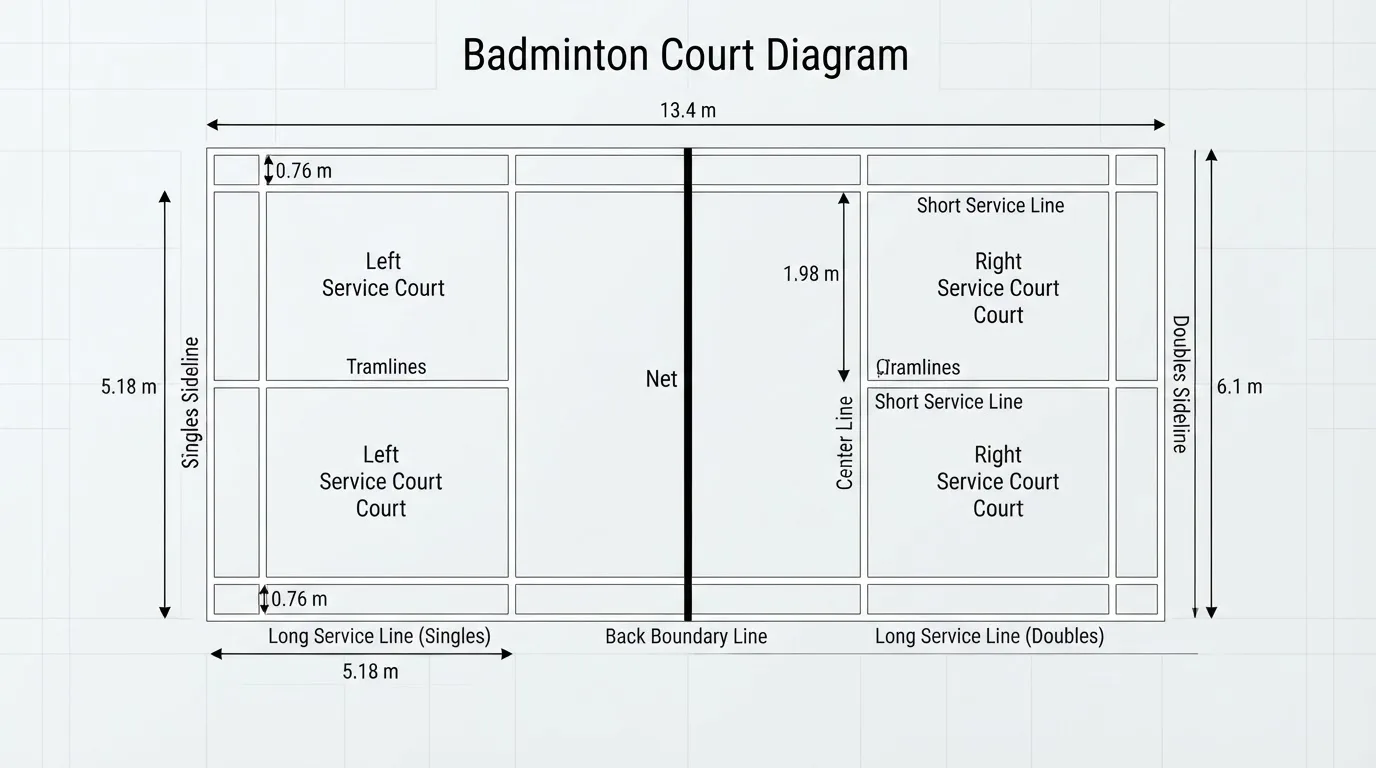
Each badminton game is played to 21 points with rally point scoring. A match is the best of three games. At 20–20, play continues until one side leads by two. At 29–29, the next point wins. A court is 13.4 m long, 6.1 m wide for doubles and 5.18 m wide for singles; the net is 1.55 m high at the edges and 1.524 m at the centre. The five disciplines are men’s singles, women’s singles, men’s doubles, women’s doubles and mixed doubles.
The tournament calendar is the punter’s calendar. The All England Open, the BWF World Championships, the Thomas and Uber Cups, the Sudirman Cup and the Olympic Games are the headline events; the BWF World Tour is the year-round structure that fills the gaps with Super 1000, Super 750, Super 500, Super 300 and Super 100 levels. Each level pulls in different fields and different bookmaker interest. A Super 1000 event will have all the major operators quoting the men’s and women’s singles; a Super 100 event may have none.
Badminton has been an Olympic sport since 1992 (with mixed doubles added in 1996), and the Olympic tournament attracts the most betting interest of any single event for a GB-licensed bookmaker. The next Summer Olympics is the one upcoming; the Olympic badminton tournament runs over the second week with five gold medals on offer. Markets on the Olympic badminton tournament are typically match winner, sometimes with a bronze-medal match market as well.
The Thomas Cup (men’s team) and Uber Cup (women’s team) have run every two years since 1949 and 1957 respectively, and the Sudirman Cup (mixed team) has run every two years since 1989. Each pulls in the deepest team fields outside the Olympics and gives the bookmaker a rare chance to quote team markets as well as the individual matches inside them.
For the punter, the calendar matters more than the discipline. A men’s singles match at the All England pulls in a deeper market than a mixed doubles match at the same event, and either pulls in a deeper market than a men’s singles match at a Super 300 event the week after. A bettor who plans around the calendar is planning around where the prices are tightest.
How the reviewed bookmakers were picked
The reviewed set is the brands licensed in their own right on the Gambling Commission’s public register against a remote general betting standard (real events) licence, with a domain and a current GB-facing product. The set is not the whole register — many more brands hold a Commission licence than any comparison can feature — and a place in the set is not a recommendation.
The angle of the comparison is cost. Each review sets out the licence line, the operator’s own terms on badminton and on the wider market, and the price the customer pays for the things the marketing calls free. The verdict at the end of each review is the page’s own judgement, not a rephrasing of the marketing.
The factors the comparison leans on are licence, badminton coverage, live and in-play coverage, the welcome offer, the wagering and expiry terms, the payment methods, the safer-gambling tools, and the operator’s terms on what happens to a bet when a player retires, when a match is abandoned or when a Rule 4 deduction applies. A bookmaker that does not cover badminton is judged on its wider market, and a bookmaker that covers badminton thinly is judged on what it does offer.
The reviews run in the order the operator set gives. Each carries the brand name and what sets it apart in the shortlist.
BetVictor
BetVictor runs on a Gambling Commission remote licence under BV Gaming Limited (Commission account 39576). Its GB site offers Best Odds Guaranteed on UK and Irish horse racing, enhanced live race streaming and a BetFinder feature for finding racing bets, with Smart Stats alongside. The wider market set is the deepest of the reviewed group on horse racing and one of the deeper ones on football; badminton coverage is present at the headline events and patchy outside them.
The licence line is solid: a long-standing GB licence under a known holder, with a remote general betting standard (real events) category that covers the badminton markets the operator quotes. A bettor who checks the Commission’s public register against the brand name or the account number finds the same entry.
The welcome offer is in line with the wider market, with the key terms — qualifying bet, minimum odds, expiry, free-bet stake treatment — set out on the operator’s terms page. The 10x wagering cap that applies since 19 January 2026 is the ceiling on any bonus term, and BetVor’s offer sits under it.
For badminton specifically, the operator’s offering tracks the calendar: BWF World Tour events, the All England, the World Championships and the Olympic badminton tournament. Set-by-set markets are rare; match winner and a small selection of game totals are typical.
The verdict: a serious horse-racing and football bookmaker that covers badminton at the headline events, with a licence and a terms page a bettor can read. A punter whose campaign is built around the All England and the World Championships will find a competitive product; a punter who wants year-round badminton markets will find the gaps.
Sporting Index
Sporting Index runs on a Gambling Commission remote licence under Sporting Index Limited (Commission account 27343), and is the reviewed operator that also offers financial spread betting under FCA regulation. The site lets a customer switch between fixed odds and spread betting on the same event, with in-play betting, Bet Builder for football, auto cash-out and Multi-Markets alongside. The wider offering is broader than most, with the spread-betting side adding markets the fixed-odds book does not carry.
The licence line is split: a Commission licence for fixed-odds betting and an FCA registration for financial spread betting. The two regimes run side by side and the operator states on its homepage that spread-betting losses can exceed deposits. A bettor looking at the spread-betting side should check both registers.
For badminton, the fixed-odds book covers the headline events and the spread book adds a small set of total-points and player-points markets. The deeper in-play offering is the auto cash-out feature, with the timing set by the punter rather than the operator.
The welcome offer on the fixed-odds side sits inside the 10x cap; the spread side has its own terms and a separate pricing structure. A bettor who wants both should read both sets of terms.
The verdict: the right operator for a punter who wants fixed odds and spread betting on the same event, with a split licence structure that needs checking twice. The badminton offering is thinner than at a pure fixed-odds book, but the in-play and cash-out mechanics are well developed.
Tote
Tote runs on a Gambling Commission remote licence under TDCO Limited (Commission account 54779). The Tote’s GB site combines pool betting on horse racing with a fixed-odds sportsbook, and the pool-betting heritage is the brand’s distinguishing feature. The wider market set is deepest on horse racing — where the pool-betting product sits — and a solid mid-tier offering on football and the other major sports; badminton coverage is present at the headline events.
BetVictor holds a remote general betting licence issued by the Gambling Commission (account 39576). The licence enables the operator to offer the badminton markets featured on its site, and a bettor can verify this status via the Commission’s public register.
The welcome offer on the fixed-odds sportsbook is in line with the market; the pool-betting product has its own dividend structure and its own terms. The 10x cap on wagering applies to the sportsbook offer.
For badminton, the operator’s offering tracks the headline events. The pool-betting side does not run on badminton; the fixed-odds book is the relevant product.
The verdict: a pool-betting specialist with a clean GB licence, where the badminton offering is a side product of the fixed-odds sportsbook. A punter whose campaign is built around horse racing will find the Tote’s strongest product; a punter whose campaign is built around badminton will find a solid mid-tier book.
BetMGM
BetMGM UK holds a Gambling Commission remote betting licence (account 39198), operated by LeoVegas Gaming PLC. The operator’s UK sports welcome offer for new customers who deposit £10 or more and place a sports bet within 7 days is four £10 free bets — two football accumulators of 4+ selections and two sports multiples of 2+ — valid for 7 days, with minimum odds and an opt-in required.
BetMGM operates in the UK under LeoVegas Gaming PLC, which holds a remote general betting licence from the Gambling Commission (account 39198). The status is publicly verifiable through the Commission’s online register.
The welcome offer structure is the kind the 10x cap was written for: free bets, not bonus funds, with the stake not returned with a winning payout. The four free bets are restricted by selection count — two are football accumulators only — and the expiry is tight at 7 days. A bettor who places the first qualifying bet on day 6 has one day to use the four free bets before they expire.
For badminton specifically, BetMGM’s UK site covers the headline events with a thin line. The two free bets restricted to football accumulators cannot be used on badminton at all; the two sports multiples can. A bettor whose campaign is badminton-heavy should weight the offer accordingly.
The verdict: a GB-licensed sportsbook with a welcome offer weighted toward football accumulators, where a badminton-focused punter can use only half the free bets. The licence is clean and the terms are clear; the offer’s structure is the cost.
Betboro
Betboro UK is authorised by a Gambling Commission remote betting licence (account 44181), held by Webmedia Development N.V. The operator’s sports welcome offer is a 100% matched free bet of up to £25 on the first qualifying wager, with a debit-card deposit of at least £10 and a first bet of £5 to £25 with at least three selections each at 3/5 (1.60) or higher.
Betboro is licensed for remote betting in Great Britain by the Gambling Commission (account 44181), with the licensee being Webmedia Development N.V. The regulatory status is active and listed on the Commission’s site.
The welcome offer has three terms a bettor reads in order. First, the minimum odds of 1.60 per selection; second, the three-selection minimum for the qualifying wager; third, the matched free bet of up to £25. A punter who places a £25 first wager at the minimum odds across three legs of 1.60 receives a £25 free bet on settlement of the qualifying bet, with the free bet stake not returned on a win.
For badminton, the 1.60 minimum-odds and three-selection requirement mean a single badminton match does not qualify. The qualifying bet has to be an accumulator of three badminton matches or a mix that reaches three legs. A badminton-heavy campaign can meet the requirement at the headline events but not at the gaps.
The verdict: a GB-licensed sportsbook with a welcome offer that requires a three-leg accumulator to qualify, where a single badminton match is not enough. The licence is clean and the terms are clear; the structure is the cost.
Betmaster
Betmaster UK is registered under a Gambling Commission remote betting licence (account 65699) held by BM Solutions GB Ltd. The Betmaster app, published by BM Solutions GB Limited, covers football, cricket, horse racing, NFL and eSports — League of Legends, Dota 2 — alongside the other sports in the operator’s wider set. Badminton coverage is patchy: the headline events only.
Betmaster’s UK activities are managed by BM Solutions GB Ltd, a company holding a remote betting licence from the Gambling Commission (account 65699). The registration is accessible for public review on the regulator’s portal.
The welcome offer sits inside the 10x cap, with the standard qualifying bet, minimum odds and expiry terms. The wider offering is built around football, cricket, horse racing and American sports; badminton is a side product.
The verdict: a GB-licensed sportsbook with a wide sports offering where badminton is a side product, with a thin line at the headline events and gaps between tournaments. A punter whose campaign is badminton-heavy will find a narrower offering than at the bigger books.
Betfred
Betfred runs on a Gambling Commission remote licence under Petfred (Gibraltar) Limited (Commission account 39544). The Betfred Sports, Casino & Games app covers 21 sports plus over 2,000 casino-style games, and the wider offering is one of the deepest on the high street. Badminton coverage is present at the headline events.
Betfred’s operations in Great Britain are covered by a Gambling Commission remote betting licence (account 39544) held by Petfred (Gibraltar) Limited. The licence details are current and available on the official Commission register.
The welcome offer is in line with the market, with the standard qualifying bet, minimum odds, wagering and expiry terms. The 10x cap applies. The wider product set is broader than most: 21 sports plus a casino arm, with the casino and sportsbook running under separate parts of the same operator.
For badminton, Betfred’s offering tracks the headline events with a thin line. A punter looking for set-by-set or player-prop markets on badminton will find the gaps; a punter looking for match winner and game totals will find the line.
The verdict: a GB-licensed high-street bookmaker with a deep wider offering, where badminton is one of 21 sports and gets the headline-event treatment. The licence is clean and the product is broad; the badminton line is the kind a bettor plans around.
William Hill
William Hill runs on a Gambling Commission remote licence under WHG (International) Limited (Commission account 39225). The operator pays Best Odds Guaranteed on UK and Irish horse racing from 8 AM on the day of the race, on both single and multiple bets; the offer does not apply to ante-post, tote or pari-mutuel bets. The wider offering is one of the deepest of the reviewed group, with a full sportsbook, in-play, a bet builder and a long list of payment methods.
William Hill’s remote betting services in the UK are licensed by the Gambling Commission (account 39225), held by WHG (International) Limited. The license status is verifiable via the regulator’s public database.
The welcome offer is in line with the market, with the standard qualifying bet, minimum odds, wagering and expiry terms. The 10x cap applies.
For badminton, William Hill’s offering tracks the headline events with a thin line. The bet builder is football-led; the in-play offering is one of the deeper ones in the reviewed group.
The verdict: a GB-licensed high-street bookmaker with one of the deeper wider offerings, where badminton gets the headline-event treatment and the in-play product is well developed. The BOG offer is horse-racing-led and does not extend to badminton; a badminton punter does not benefit from it.
VBet
VBet UK operates with a Gambling Commission remote betting licence (account 44662), issued to SCGO Limited. The operator’s sports welcome offer is a £10 free bet if a new, verified customer stakes £10 or more on a first-ever bet that loses.
VBet is a trading name of SCGO Limited, an operator holding a Gambling Commission remote betting licence (account 44662) for the British market. The current licensing information is published on the Commission’s register.
The welcome offer is a one-shot free bet on a losing first wager. The qualifying bet is a single bet of £10 or more; the free bet is £10 on settlement of the losing first bet; the free bet stake is not returned on a win. A punter whose first bet loses receives a £10 free bet with a tight expiry.
For badminton, VBet’s UK site covers the headline events with a thin line. The welcome offer works on any sport, including badminton; a punter who places a first badminton bet of £10 or more and loses receives the £10 free bet.
The verdict: a GB-licensed sportsbook with a single-shot welcome offer that works on any sport, where the qualifying bet is a single wager rather than an accumulator. The licence is clean and the offer is simple; the value is in the simplicity.
Sky Bet
Sky Bet runs on a Gambling Commission remote licence under SBG Sports Limited (Commission account 67370). The operator’s free bets expire 30 days after crediting, can be used only on single or each-way markets (not multiples) excluding virtuals, are non-withdrawable and do not return the stake with winnings. The wider offering is one of the deeper ones of the reviewed group, with a full sportsbook, in-play and a long list of payment methods.
Sky Bet operates under a remote betting licence issued to SBG Sports Limited by the Gambling Commission (account 67370). The licensing data, including operator details, is kept current on the Commission’s official register.
The welcome offer is in line with the market, with the standard qualifying bet, minimum odds, wagering and expiry terms. The 30-day expiry on free bets is on the long side compared with the 7-day expiries common at the reviewed group. The single-and-each-way restriction means a free bet cannot be placed on an accumulator; a punter who plans to use the free bet on a badminton treble has to change the plan.
For badminton, Sky Bet’s offering tracks the headline events with a thin line. The single-and-each-way restriction matches the way most badminton markets are quoted.
The verdict: a GB-licensed sportsbook with a 30-day free-bet expiry and a single-market restriction, where the longer expiry gives a punter more time to find a price. The licence is clean and the offer is well suited to badminton’s single-match structure.
Where this leaves a badminton punter
The reviewed set is ten GB-licensed operators, each with a clean licence on the Commission’s register and each with a badminton offering that tracks the headline events. The welcome offers vary in structure: BetMGM’s four free bets restricted to football accumulators and sports multiples, Betboro’s matched free bet requiring a three-leg accumulator at 1.60 per leg, VBet’s single-shot free bet on a losing first wager, Sky Bet’s free bets restricted to single and each-way markets with a long expiry, and the rest sitting in line with the wider market.
The wider offering varies more than the welcome offers. BetVictor, Betfred, William Hill and Sky Bet have the deepest wider books; Sporting Index adds spread betting and auto cash-out; BetMGM has a long list of payment methods and a casino arm; Tote adds pool betting on horse racing; Betmaster and Betboro have narrower wider books. VBet has a thin wider book with the deepest gates on the welcome.
For a badminton-only campaign, the choice comes down to the calendar. The headline events pull in tight prices at the bigger books and wider prices at the smaller ones. The gaps between tournaments pull in thin lines at the bigger books and no line at the smaller ones. A punter who plans around the calendar picks the bigger book for the headline events and accepts the gaps.
For a multi-sport campaign, the wider book matters more than the badminton line. BetVictor, Betfred, William Hill and Sky Bet are the strongest on the wider market; BetMGM is close behind with the welcome offer’s football accumulator weighting as the cost. Sporting Index is the right choice if spread betting is wanted as well.
For a low-stake or first-time punter, the choice comes down to the welcome offer. VBet’s single-shot free bet on a losing first wager is the simplest; Betboro’s matched free bet is the largest; Sky Bet’s 30-day free-bet expiry is the longest; the rest sit in between.
The honest frame is that no offer changes the underlying edge. The bookmaker’s margin sits in every price, and the punter’s edge, if any, comes from a better read on the probability than the operator. A punter who claims ten offers in a row is still paying the margin on the bets those offers paid for. The reviewed set gives a GB-licensed shortlist; the rest is the punter’s read.
What this page is not
This page is not a tipster. No pick, no model and no system beats the closing line reliably, and any service claiming otherwise is selling a certainty the sport does not provide. The page is also not an audit of the operators’ finances, a regulatory complaint route or a substitute for the Commission’s public register. A bettor who needs to check a brand’s licence does so on the register, by name, trading name, domain or account number.
A bettor who needs help with gambling does so through GamCare, the National Gambling Helpline, GambleAware, the NHS gambling clinics or Gamblers Anonymous. The Commission’s safer-gambling duties cover operators, not customers; the help is outside the licence.
The legal frame for the page is British English and Great Britain. Northern Ireland is outside the Gambling Act 2005 and has its own older law; a “GB licence” regulates Great Britain, not Northern Ireland. The page writes about Great Britain; a punter in Northern Ireland should check the local position.
Glossary of terms a badminton punter meets
Odds (decimal). The multiplier on the stake: a £10 bet at 2.50 returns £25 if it wins — the £10 stake and £15 profit. The British form.
Odds (fractional). Profit over stake: 3/1 means £3 of profit per £1 staked, which is decimal 4.00. An “odds-on” price is shorter than evens; “evens” is 1/1 or decimal 2.00.
Margin. The share of every pound bet that the operator keeps. For a market at 1.90 / 1.90 the margin is 5%; the punter’s expected payout is 95p per £1 across both outcomes.
Free bet. A bet whose stake is not returned with a winning payout. A £10 free bet at 2.00 returns £10 if it wins — the £10 profit — and the £10 stake is not paid back. The expected value of a £10 free bet at 2.00 on a market with a 5% margin is around £4.75.
Wagering requirement. The multiple of a bonus that must be staked before winnings can be withdrawn. A £10 bonus at 10x needs £100 of qualifying bets. The Commission’s cap is 10x, in force since 19 January 2026.
Each-way. Two bets of equal stakes: one on the win, one on the place. The stake doubles. Place terms vary by race and operator; on badminton the term is rare.
Accumulator (acca). A combination bet whose legs multiply into one price. A treble at 2.00, 3.00 and 4.00 has combined odds 24.00; each leg must win.
Cash out. The operator’s offer to close a bet before settlement at a price set by the operator’s mid-market less the operator’s margin. A punter who cashes out a winning position is paying for the certainty.
In-play. A bet placed after the event has started. Prices move faster than the punter can read them.
Spread betting. A bet on whether the outcome will be higher or lower than a range set by the operator; on sports that is not a financial product, the bet is inside General Betting Duty and under the Commission. On a financial product, the bet is under the FCA.
Best Odds Guaranteed (BOG). The operator pays the starting price if it is higher than the price the punter took. William Hill’s BOG applies to UK and Irish horse racing from 8 AM on the day of the race; it does not apply to ante-post, tote or pari-mutuel bets, and it does not extend to badminton.
SP (starting price). The odds set at the start of the event. On horse racing the SP is the basis for BOG comparisons; on badminton the term is rarely used.
Rule 4 deduction. A bookmaker rule that reduces the payout on a winning bet when a competitor withdraws. The deduction depends on the odds of the withdrawn competitor.
Non-runner. A competitor who withdraws before the event starts. On badminton the term is rare; the equivalent is a player who withdraws between the draw and the first serve.
Ante-post. A bet placed before the final field is set. On horse racing the term is standard; on badminton the term is rarely used.
Bet builder / same-game multi. An accumulator whose legs are all on the same event. On badminton the bet builder is rare; on football it is standard.
Betting exchange. A platform that matches back and lay bets between customers, run under a remote betting intermediary licence. The reviewed set does not include an exchange.
Licence (noun). A permission to operate. A GB bookmaker needs a Gambling Commission licence; “license” is the verb form.
Comparing the licensed operators
The table sets out the four matters the comparison leans on: the brand and what it is licensed as, the Gambling Commission licence number and licence holder, and a one-line read of what the operator’s own terms say on the key subject. The “key subject” is badminton: a mention, a thin line or no line in the table, with the operator’s own terms page as the place to confirm.
| Brand | Gambling Commission licence | Licence holder | Operator’s own terms on badminton |
|---|---|---|---|
| BetVictor | 039576-R-319370-028 (Commission account 39576) | BV Gaming Limited | Badminton markets at BWF World Tour, All England, World Championships and the Olympic badminton tournament; set-by-set markets rare |
| Sporting Index | 027343-R-308898-011 (Commission account 27343) | Sporting Index Limited | Fixed-odds badminton at the headline events; spread-betting side adds total-points and player-points markets |
| Tote | 054779-R-331321-008 (Commission account 54779) | TDCO Limited | Badminton markets at the headline events on the fixed-odds sportsbook; the pool-betting product does not run on badminton |
| BetMGM | 039198-R-319450-029 (Commission account 39198) | LeoVegas Gaming PLC | Badminton markets at the headline events; the welcome offer’s four free bets are split two for football accumulators and two for sports multiples |
| Betboro | 044181-R-324363-007 (Commission account 44181) | Webmedia Development N.V. | Badminton markets at the headline events; the welcome offer requires a three-leg accumulator at 1.60 per leg to qualify |
| Betmaster | 065699-R-339929-002 (Commission account 65699) | BM Solutions GB Ltd | Badminton markets at the headline events; the wider offering is built around football, cricket, horse racing, NFL and eSports |
| Betfred | 039544-R-319290-010 (Commission account 39544) | Petfred (Gibraltar) Limited | Badminton markets at the headline events as one of 21 sports; set-by-set markets rare |
| William Hill | 039225-R-319373-015 (Commission account 39225) | WHG (International) Limited | Badminton markets at the headline events; the BOG offer is horse-racing-led and does not extend to badminton |
| VBet | 044662-R-324273-022 (Commission account 44662) | SCGO Limited | Badminton markets at the headline events; the welcome offer is a single-shot free bet on a losing first wager, valid on any sport |
| Sky Bet | 067370-R-341330-005 (Commission account 67370) | SBG Sports Limited | Badminton markets at the headline events; free bets restricted to single and each-way markets with a 30-day expiry |
The table is a snapshot of the operator’s own terms on the day the licence was checked. Each row should be read as a starting point, not a final word. The licence numbers and licence holders are from the Commission’s public register and stand until the register is updated; the operator’s badminton offering stands until the operator’s terms are updated.
The “thin line” reads are honest. Badminton is a side product at most of the reviewed operators and a deeper offering at none. A punter whose campaign is built around badminton needs to plan around the calendar and around which operators carry the sport at the gaps.
How a margin works, worked through
The calculation a punter can run on every quoted price helps to compare the operators. The margin sits inside every price, and the punter who reads three books before placing is comparing three margins on the same event.
The arithmetic. For a market at £10 — two outcomes both at 1.90 — the payout share is 1 ÷ (1 ÷ 1.90 + 1 ÷ 1.90) = 0.95, so the margin is 5%. For a tighter pair at 1.95 / 1.95 the payout share is 1 ÷ (1 ÷ 1.95 + 1 ÷ 1.95) ≈ 0.975, so the margin is around 2.5%. For a wider pair at 1.80 / 1.80 the payout share is 1 ÷ (1 ÷ 1.80 + 1 ÷ 1.80) ≈ 0.90, so the margin is around 10%.
The band — 2.5% to 10% across a normal book — is the range a punter should expect on a badminton match winner at a GB-licensed operator. The tight end sits at the bigger events, where several operators quote the same match and the prices converge. The wide end sits in the gaps between events, where one operator is the only book and the price is whatever it sets.
For a three-way market — match winner, with the draw or retirement as a third outcome at the bigger events — the arithmetic extends. A market at 1.70 / 3.50 / 2.40 has payout share 1 ÷ (1 ÷ 1.70 + 1 ÷ 3.50 + 1 ÷ 2.40) ≈ 0.886, so the margin is around 11.4%. The three-way book carries more margin than the two-way book, and a punter comparing two operators on a three-way market is comparing wider numbers.
The punter’s edge, where one exists, comes from a better read on the probability than the operator. The margin is the operator’s edge; the punter’s edge is the gap between the punter’s probability and the operator’s. A punter who always takes the price the operator offers is paying the margin on every bet. A punter who reads three books is looking for the smallest margin, and on badminton that often means the biggest book on the day.
The calculation is a statistical estimate. It is an average over many bets under the stated assumptions, not a guaranteed outcome for any single bet. A punter who uses the calculation as a guide is using it as a guide; a punter who uses it as a forecast is misusing it.
Frequently asked questions
How does a bet on badminton actually work?
A bettor picks a market — match winner, total games, game handicap — on a BWF event that a GB-licensed operator has priced, places a stake, and waits for settlement. A match winner bet pays the stake multiplied by the decimal odds if the chosen player wins, with the stake returned on top of the profit. A total games bet pays if the total number of games played is over or under the line; a game handicap bet pays if the chosen player wins by more or fewer games than the line. Settlement follows the operator’s terms, with the rule on player retirement and walkover set out in those terms. A punter who has not read the terms is betting blind on those rules.
How can a bookmaker’s GB licence be checked?
The Gambling Commission’s public register can be searched by business name, trading name, domain or account number. Each entry lists the licence categories the brand is authorised for, the licence holder, and the licence number. For sports betting the relevant categories are remote general betting standard (real events), and separately for virtual events. A licence is a snapshot: it stands until the register is updated, and the access date matters. A bare statement that a brand is licensed, without the register entry, is not a check.
What does a bet pay back?
A £10 bet at decimal odds 2.50 returns £25 if it wins — the £10 stake and £15 profit. A £10 bet at 5/1 (decimal 6.00) returns £60 if it wins — the £10 stake and £50 profit. A combination bet multiplies the legs: a treble at 2.00, 3.00 and 4.00 has combined odds 24.00, and a £10 stake returns £240 if all three legs win. A losing leg in any combination collapses the bet to zero; the stake is not returned in part.
What is the bookmaker’s margin, and how does it sit inside the odds?
The margin is the share of every pound bet that the operator keeps. For a two-way market at 1.90 / 1.90 the payout share is 95p per £1 staked across both outcomes, so the margin is 5%. The margin sits inside both prices: each is lower than a “fair” price would be, and the difference is the operator’s edge. A punter who compares two operators on the same event is comparing two margins; the operator with the tighter pair of prices has the smaller margin.
How do fractional odds convert to decimal odds?
A fractional price of a/b converts to decimal by a ÷ b + 1. A 5/1 shot is 5 ÷ 1 + 1 = 6.00; an 11/4 shot is 11 ÷ 4 + 1 = 3.75; evens (1/1) is 1 ÷ 1 + 1 = 2.00. An “odds-on” price — shorter than evens — converts the same way: 4/6 is 4 ÷ 6 + 1 ≈ 1.67. The British form is fractional; the European form is decimal; both name the same bet.
Which tools for controlling play does a licensed bookmaker have to offer?
A GB-licensed bookmaker must offer GAMSTOP registration for multi-operator self-exclusion, deposit limits on a fixed time frame, time-out, self-exclusion on the operator’s own site, and links to GamCare, the National Gambling Helpline, GambleAware and the NHS gambling clinics. A financial vulnerability check applies once deposits minus withdrawals cross £150 in a rolling 30 days. The financial risk assessment has been announced in a staged plan without a start date. An unlicensed operator is under no such duty, and a punter on an unlicensed site gives up those protections in exchange for no obvious gain.
Tennis, darts & cue sports – Basketball betting
Content created by the «Basketball betting» team
