
Horse racing betting tips 2026: reading form, value and price
 Available in US
No tipster — professional or otherwise — knows a winner before the stalls open. Anyone who promises otherwise is selling certainty that does not exist. The useful version of a “tip” is not a name on a sheet; it is the chain of reasoning behind a name, the price at which that name becomes worth backing, and the bankroll discipline that keeps the reader solvent when the chain breaks. That is the subject of this page: how a prediction is built, what a value bet is, how the bookmaker’s margin sits inside every price, and what each welcome offer and free bet actually pays out once the small print is read.

The figures and licence details below are checked against the Gambling Commission’s public register and the operator’s own pages as of 27 October 2026.
Banking on the move: horse racing apps and the case for the second screen
The racecourse crowd has moved. Most UK racing bets now pass through a phone or a tablet — the tote boards at Cheltenham still get read by the eye, but the slip in the pocket is digital, and the cash-out button is the back of the hand. Racing lends itself to the format: meetings are dense, fields are small, and the in-running market is fast enough that a desktop is too slow.
What a racing app actually has to do
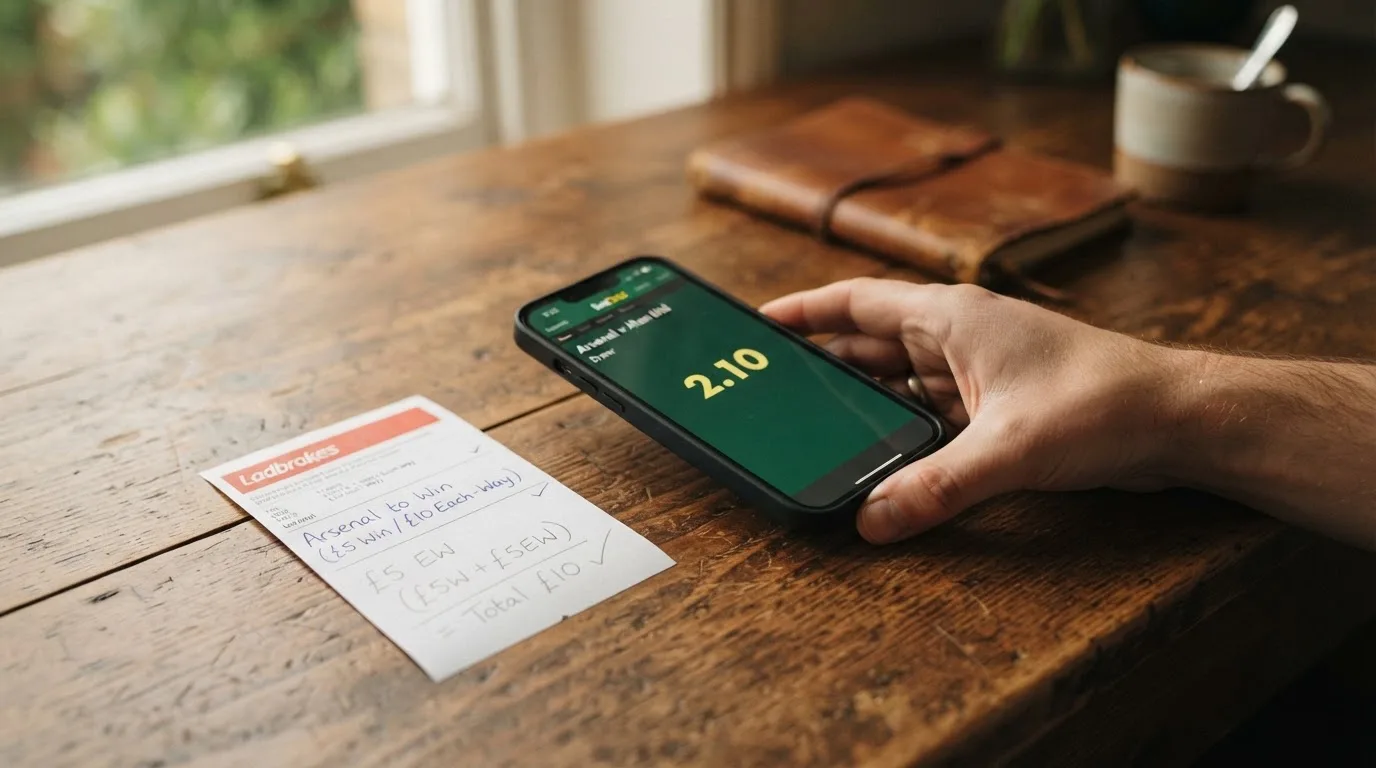
The best horse racing betting app is not the one with the loudest welcome page. It is the one that does three quiet things well. First, it prices up every UK and Irish meeting, ante-post and on the day, with a Best Odds Guaranteed concession that pays the bigger of the price taken and the starting price. Second, it settles a bet, settles it fast, and shows the cash-out figure in pounds and pence before the horse has crossed the line. Third, it lets the reader build an each-way or an accumulator from a touchscreen without mis-keying the stake — a £10 each-way that the reader meant as a £10 single is a £20 bet, and the slip shows it clearly before it is confirmed.
Horse racing betting apps vary widely on those three counts. The big names — bet365, William Hill, Ladbrokes — cover every meeting and stream races live from the UK and Ireland. Smaller independents concentrate on a single angle: Spreadex runs spread betting alongside fixed-odds and is regulated separately for each, or Fitzdares leans into premium markets and specials at the top end of the card.
Live picture, live price
In-play coverage of horse racing sits between football and tennis in difficulty. The race itself lasts under five minutes, the field is small enough to watch on a single camera, and the favourite’s price collapses the moment the stalls open. A useful live picture on the app is therefore a window onto something the reader can already see on Racing TV — the value the app adds is the cash-out slider, not the stream. The slider is where the reader locks profit or stops loss without waiting for the judge’s enquiry.
Ante-post and the long wait
Ante-post markets open weeks or months before a race. The price on offer is generous because the bookmaker does not yet know the going, the field, the jockey booking or whether the horse stays in training. That generosity is the punters’ edge when the cards fall the right way, and the trap when they do not: an ante-post stake is forfeit if the horse does not run, and most operators do not refund the stake in that case. The honest framing is that an ante-post price is a discount for accepting the risk of a non-runner, and the discount is the difference between the ante-post price and the day-of-race price that follows once the final declarations are known.
Watching the race unfold: live betting, cash out and the value of leaving a bet open
Live horse racing betting is a different trade to the pre-race market. Pre-race, the price is set by a model and a market; live, the price is set by what the eye can see. A fancied horse that stalls slowly and gets crowded at the first flight is a different proposition to the one the morning paper tipped.
In-play as an information game
The odds on a horse in running depend on what has happened in the last ten seconds, and the bookmaker’s screen is a model reacting to that information in milliseconds. The punter’s screen is the same model with a human brain attached. The edge — when there is one — comes from seeing something the model has not yet priced in: a horse travelling smoother than its odds suggest at the top of the home straight, or one being niggled along earlier than a horse of that profile should need. The edge evaporates as soon as the model re-prices, which is often before the punter’s finger reaches the cash-out button.
For that reason, in-play betting on horse racing is rarely a trading opportunity for the small-stake reader. It is a tool for closing a position the reader already had open — the cash-out that turns a pre-race bet into a smaller, certain return rather than a larger, uncertain one.
Cash out as a number on the screen
Cash out is a price the bookmaker offers to buy the bet back before settlement. It is calculated from the current in-running price, the original stake and the bookmaker’s own margin on the cash-out itself. A reader who took 6.0 on a horse and now sees it travelling well at the furlong pole may be offered 4.2 to cash out; the difference between 6.0 and the implied live price is the bookmaker’s fee for taking the bet off its book. The fee is opaque by design, but it is real, and it is the price the reader pays for certainty before the judge.
A bet that cannot be cashed out — usually because of a non-runner rule, a market suspension or an in-play technicality — is one to read about before betting on it, not after.
Live shows and the schedule
Live betting shows horse racing on most bookmaker apps during the major meetings, with the picture and the prices running side by side. Racing’s own broadcasters — Racing TV in the UK, At The Races in Ireland — hold most of the rights, so a bookmaker app that streams a meeting is one that has paid for the feed, and that cost shows up in the margin somewhere. The stream is convenient. The picture on a free-to-air channel is just as good and costs nothing.
How a tip is built: form, statistics, pace and the punter’s own edge
The most honest sentence in tipster copy is the one that says a tip is a probability, not a prediction. Every name on a tipping sheet sits on top of a chain of reasoning, and the reasoning — not the name — is what is being sold.
Reading a racecard
A British racecard carries more information than almost any other betting market: the horse’s recent form figures, the course and distance record, the going, the draw, the jockey’s strike rate at the meeting, the trainer’s record in similar conditions, the weight carried, the headgear, the breeding. No single column predicts a winner; the picture the columns paint together is the tip.
Form figures are the most read and the most misread. A line of “1-2-3-13” does not say the horse is in form. It says the horse won, placed, placed and then finished out of the frame last time out — the 13 may be a bad trip, an unsuitable going, or a step up in class. Reading form is reading the why behind each number, not the numbers themselves.
The pace map
The pace map is the part of the form that few casual readers look at and almost every professional does. A race with one front-runner, no other pace and a strong stayer is a race the front-runner struggles to win: it gets pressured early, sets the tempo, and gets caught. A race with three front-runners and a closer is a race the closer wins, because the front-runners burn each other out. The pace map is the reader’s forecast of how the race will be run before a yard of grass has been covered.
Going and distance
Going matters more in jump racing than in flat, and distance matters more on the flat than over jumps. A horse that wants soft ground and is being asked to run on good to firm is a horse whose price is too short; a horse that wants a strongly-run mile and is being asked to step up to a slowly-run ten furlongs is similarly mispriced. The punter’s edge, when it exists, is the gap between what the market has priced and what the conditions say.
Statistics, samples and confidence
A trainer’s 22% strike rate at a course over five years is a real number, but it is built on hundreds of runners, and the variance around 22% in any single meeting is wide. A jockey’s 30% at the meeting this week is a sample too small to mean anything. Reading statistics honestly is reading the sample size with the percentage, and discounting the small sample when the two disagree.
Bet types and odds: from single to spread, why each-way is two bets
Horse racing has a richer menu of bet types than any other sport, and the menu exists because the race itself is short, the field small, and the outcomes discrete: a horse either wins, places, or runs out of the frame.
Single, each-way, accumulator
A single is one horse, win or each-way. An each-way bet is two bets of equal stake — one on the horse to win, one on the horse to place — so the stake doubles. A £5 each-way on a 10/1 shot costs £10, and the place part is paid at a fraction of the win odds determined by the race type and the number of runners (the place terms). An accumulator is several selections, all of which must win, with the odds multiplying into one larger price.
The place terms matter because they decide what each-way is worth. In a 16-runner handicap the place part pays at one-quarter of the win odds for four places; in a five-runner non-handicap the place part pays at one-quarter of the win odds for two places; in a race with fewer than five runners there is no place part at all and an each-way bet becomes a single. The table on the bookmaker’s site lists the terms by race type, and it is the one part of the racecard the punter reads before placing the bet.
Bet builder and same-race multiples
A bet builder is a request to the bookmaker to combine several markets within one race — the winner, the distance by which the winner wins, whether the favourite finishes in the first three, and so on — into one price. The odds multiply, but the builder’s margin is set per market and then stacked, so the combined price is less generous than the markets priced separately. A bet builder is a tool for the punter who has a strong view on several aspects of a single race; it is rarely a value play because the margin stack is the bookmaker’s hedge against the combination.
Spread betting on horse racing
Spread betting is a different product to fixed-odds betting. The punter does not back or lay a price; the punter buys or sells a spread — for example, the number of lengths by which the winner beats the second, or the total finishing positions of a named set of runners — and the result is settled to the spread by how the race is actually run. Losses can exceed the deposit. Spreadex is regulated by the Financial Conduct Authority for spread betting and by the Gambling Commission for fixed-odds betting, and the two licences sit on the same account but cover different products.
Reading odds in fractional and decimal form
UK bookmakers quote odds in fractions: 5/1, evens (1/1), 6/4 (the favourite is “odds-on” when the right-hand number is smaller than the left). The decimal form, used across Europe, is the fractional odds plus one — 5/1 is 6.00, evens is 2.00, 6/4 is 2.50. The return on a winning bet is stake × decimal odds, and the profit is stake × (decimal odds − 1). A £10 single at 6/2 (7.00) returns £70; profit is £60.
The shape of the sport: flat, jump, handicaps and the British Triple Crown
Horse racing in Great Britain is two sports under one name. Flat racing runs from spring to autumn on level tracks, mostly over distances from five to twelve furlongs (1.0 to 2.4 km); jump racing — National Hunt — runs from autumn to spring over obstacles, from two miles to more than four. The two seasons overlap at either end of the calendar, and the bookmaker’s racecard treats them as separate meetings on the same day.
Flat racing
Flat races range from five furlongs — sharp, sprint, speed — to two and a half miles — stamina, patient, gallop. Five to twelve furlongs is the common middle. The Classic distances sit at one mile (2000 Guineas), one and a half miles (the Derby, the Oaks), and one mile and three quarters (the St Leger). The British Triple Crown is the 2000 Guineas at Newmarket, the Derby at Epsom and the St Leger at Doncaster — three races for a three-year-old colt or filly across five months, and a series only four horses have completed since 1970.
Flat form reads on speed figures, sectional times and the pace of the race; the distance and the going matter, and the draw at courses with tight home turns (Chester, Epsom) can be decisive.
Jump racing
Jump racing — National Hunt — is steeplechase and hurdle racing over fences and brush hurdles. The shortest is just over two miles; the longest, the Grand National at Aintree, is four miles and two and a half furlongs with thirty fences. Jump form reads differently to flat: the horse’s ability to jump round, the trainer’s record with the horse over similar courses, the going (soft or heavy going changes the race more than any other variable), and the horse’s record at the trip.
Handicap races are the bread and butter of the British jump calendar: each horse carries a weight assigned by the handicapper based on past form, and the weights equalise the field on paper. Conditions races — non-handicaps — give horses of the same age and sex the same weight, with allowances for younger horses and for fillies against colts.
Handicaps and conditions races
In a handicap the better the horse, the more weight it carries; in a conditions race, weights are set by the race conditions rather than the horse’s form. The two race types produce different markets: the handicap is a puzzle of weights and class, the conditions race is a puzzle of form against a smaller field. A bookmaker’s market for a handicap may carry thirty runners; for a conditions race, fewer than ten.
The British Triple Crown and other series
The Triple Crown is the headline flat series. Other series include the Fillies’ Triple (1000 Guineas, Oaks, St Leger) and the sprint series built around the July Cup, the Nunthorpe and the Sprint Cup. On the jump side, the head-to-head between Constitution Hill and State Man over three seasons built the modern Champion Hurdle market; the Gold Cup at Cheltenham is the championship of staying chasers. The series shape the ante-post market months before the season opens.
The ranking: ten bookmakers for horse racing in 2026
The bookmakers below all hold a Gambling Commission remote licence for general betting on real events, and all offer horse racing on the UK and Irish fixture list. The order is the order research carried them in — not a quality ranking, and not a guarantee of suitability for any one reader. Each review closes on the question that fits the brand.
Tote
Tote is the pool-betting brand held by TDCO Limited under Commission account 54779, with a remote general betting standard licence for the tote.co.uk site. Its offer is the pool itself — bets are struck into a pool with other punters and dividends are declared after the race — and the pricing model is therefore different from a fixed-odds bookmaker. There is no Best Odds Guaranteed in the fixed-odds sense because the price is not set until the pool closes, but the dividend can beat the fixed-odds starting price on popular markets. The Tote’s welcome page sits alongside its pool product rather than above it.
The Tote suits a reader who wants the dividend mechanic and is comfortable with pool pricing. It does not suit a reader who wants a guaranteed price at the time of betting.
Bar One Racing
Bar One Racing has rebranded as BAR 1 Betting — an Irish independent bookmaker with shops across Ireland and horse racing sponsorships at Dundalk, Fairyhouse, Navan, The Curragh, Curraheen Park and Cork. The remote licence sits under Commission account 56516 against Bar-One Racing Limited. Its draw for the GB punter is the Irish racing focus — Dundalk all-weather, the Curragh flat, the Leopardstown Christmas meeting — and pricing on those meetings is the brand’s strongest suit.
BAR 1 Betting suits a reader who follows Irish racing closely and wants an independent bookmaker on the day-of-race markets. It is less useful for a reader who bets mostly on the big British festivals.
Fitzdares
Fitzdares is a premium bookmaker held by Fitzdares Limited under Commission account 400. The Fitzdares app carries cash out, accumulators, Lucky 15s, specials and antepost markets on horse racing, football, tennis, rugby, cricket, golf and American football, with in-play live odds. The brand’s framing is high-end: larger stakes, more personal service, a smaller welcome offer than the high-street names. Pricing on the headline meetings is competitive; pricing on lower-tier meetings can be thin.
Fitzdares suits a higher-stake punter who wants a personal relationship with the bookmaker and is happy to pay for it. This is not the platform for a reader who prioritises maximum bonus value or price-sensitive betting on minor meetings.
bet365
bet365 is the largest of the high-street names in the online market and is held by Hillside (UK Sports) ENC under Commission account 55148. The app carries in-play betting and live streaming of events worldwide, plus Bet Track, Match Live and a Live Golf Tracker for following bets in play. Pricing on horse racing is tight on the major meetings, with Best Odds Guaranteed on UK and Irish racing and a deep in-play product.
The scale is the bet365 advantage — the feed, the markets, the in-play product — and the scale is also where a reader has to be careful: a generic welcome offer is not the highest in the market, and the responsible-gambling tools sit behind the size of the account rather than at the front of it.
Dabble
Dabble is the newer face on this list, held by Dabble Sports UK Ltd under Commission account 65677. Its welcome offer is a first-deposit matched fixed-amount free bet, with minimum odds applying, a 7-day free bet expiry and the stake not returned. The free bet is a credit to the wallet rather than a stake refund, so a winning free bet pays profit only.
Dabble suits a small-stake reader who wants a quick, low-friction app and is comfortable with the credit-not-stake mechanic on the welcome offer. Those who prefer a standard matched-cash deposit model might find the mechanics here less intuitive.
BetMGM
BetMGM’s UK sports book is operated under Commission account 39198 by LeoVegas Gaming PLC. The sports welcome offer for new UK customers who deposit and place a first sports bet within seven days is four £10 free bets — two on football accumulators and two on sports multiples — each valid for seven days with minimum odds and opt-in required. The structure rewards accumulators rather than singles, and the credit-not-stake rule applies.
BetMGM suits a reader who wants to bet accumulators across sports and is comfortable with the four-credit structure. It is less suited to a reader whose racing interest is single bets on the big meetings.
BoyleSports
BoyleSports is an Irish-founded bookmaker held by Boylesports Enterprise under Commission account 39469. Its Acca Insurance product refunds a stake as a free bet when one leg of an accumulator lets it down: opt-in, minimum stake £5, minimum odds 1/2, maximum refund £20, free bet expires in seven days, bets must be placed and settled on the same day. The brand also runs Best Odds Guaranteed on UK and Irish racing.
BoyleSports suits a reader who bets accumulators across racing and football and wants the acca-insurance backstop. Casual punters who focus exclusively on single bets without the need for accumulator insurance may not find this platform tailored to their style.
Ladbrokes
Ladbrokes is held by LC International Limited under Commission account 54743, with both a remote general betting standard licence and a remote betting intermediary licence (the latter covers the exchange-style markets). The Ladbrokes sports betting app offers odds boosts on horse and greyhound bets, Best Odds Guaranteed on UK and Irish horse races, in-play betting and Acca Boosts. Pricing on the day-of-race meetings is competitive, and the Acca Boost adds a percentage to the winnings on qualifying accumulators.
Ladbrokes suits a reader who wants a high-street brand, a deep racing product and the Best Odds Guaranteed concession. It is the wrong fit for a reader who wants a small independent bookmaker.
Fafabet
Fafabet is held by Taichi Tech Limited under Commission account 57385. Fafabet pays Best Odds Guaranteed on UK and Irish horse racing win and each-way bets from 9am on race days: if the starting price is bigger than the original price, the bigger odds are paid. The brand’s racing focus is the day-of-race UK and Irish meetings, with a smaller ante-post offering than the high-street names.
Fafabet suits a reader whose racing interest is day-of-race betting on UK and Irish meetings. It is the wrong fit for a reader who bets heavily on ante-post markets or wants a deep in-play product.
Fitzwilliam Sports
Fitzwilliam Sports is an independent bookmaker held by SBKI Limited under Commission account 48760. The brand’s distinctive feature is its phone and live chat service: the office is open 09:00 to 21:00, Monday to Sunday, with messenger replies generally within 90 seconds. The remote betting licence covers the standard real-events markets, and the racing product is concentrated on UK and Irish meetings with a personal-service framing.
Fitzwilliam Sports suits a reader who wants to talk to the bookmaker rather than message through a bot, and is happy to place bets over the phone. It is the wrong fit for a reader who wants a slick app-first product.
The legal frame: who is licensed, what is required, and what offshore means
A bookmaker serving customers in Great Britain needs a Gambling Commission licence. Since the Gambling (Licensing and Advertising) Act 2014 the test is the point of consumption: the licence is required wherever the operator is based if the remote facilities are used in Great Britain. A Curaçao, Maltese or Gibraltar licence is not a substitute, and a brand that holds one of those but not a Commission licence is not licensed to take bets from a reader in London, Manchester or Cardiff.
The Commission’s public register
The Commission’s public register is the whole test of who holds a licence. It can be searched by business name, trading name, domain or account number, and the licence type, the categories covered and the trading names under the licence are all listed. The register is also where the reader checks a brand’s account number against the welcome page; a mismatch is a sign to leave the site.
Every bookmaker reviewed on this page holds a remote general betting standard (real events) licence, and the Commission’s public register is the source for the account numbers above. The register is checked at the date on the currency stamp at the top of this page.
What the licence does and does not mean
A Commission licence means the operator has passed the Commission’s checks on identity, finances, social responsibility and anti-money-laundering controls. It means the operator must offer GAMSTOP self-exclusion, must run a financial vulnerability check when deposits minus withdrawals exceed £150 in a rolling 30 days (since 28 February 2025), and must verify the customer’s name, address and date of birth before the first deposit (since 7 May 2019). It means the operator’s marketing is bound by the LCCP and the CAP Code, and the operator’s bonuses are subject to the 10x wagering cap that took effect on 19 January 2026.
A Commission licence does not mean the operator is “safe” in the consumer sense. It means the operator is regulated, and a regulated operator is one the reader has recourse against if a dispute goes to the Commission or an approved alternative dispute resolution body. It does not mean the operator’s prices are good, its welcome offer is generous, or its app is fast. Those are commercial judgements, and the reader makes them with the licence as a baseline, not a conclusion.
Identity checks and the cost of being licensed
Every Commission-licensed operator verifies a customer’s name, address and date of birth before the first deposit or bet — including with a free bet. Verification is a money-laundering rule, not a marketing one, and it is the reason licensed sites do not accept anonymous play. The reader who wants no identity check has only offshore operators to choose from, and offshore operators do not offer GAMSTOP, do not offer the Commission’s complaints route, and are not bound by the 10x bonus cap or the £150 vulnerability check. There is no legal protection equivalent to the Commission’s framework on the offshore side, and there is no British consumer redress if funds are withheld.
The honest framing is two-sided. Licensed means checks, limits, GAMSTOP, the bonus cap — and also verification before the first bet. Offshore means none of those protections — and also the possibility of a fund being withheld with nowhere to turn.
Northern Ireland
Northern Ireland has its own gambling law, separate from the Gambling Act 2005, and a Gambling Commission licence for Great Britain does not cover a customer in Northern Ireland. A GB-licensed operator is one that holds a Commission licence; a Northern Ireland customer should check the operator’s position on NI customers separately.
The financial vulnerability check
The Commission’s social responsibility code includes a financial vulnerability check at LCCP condition 3.4.4, in force since 30 August 2024 for licensed remote betting. It applies when a customer’s deposits minus withdrawals exceed £150 in a rolling 30 days (since 28 February 2025). It is a public-record check — bankruptcy, county court judgments — not an income check and not a credit reference check. It is a flag for further checks, not a block on betting.
What the betting tax is and is not
The player pays no tax on betting winnings in Great Britain. General Betting Duty is the operator’s tax on gross profits — currently 15%, with a remote rate of 25% from 1 April 2027 on bets outside UK horse racing, self-service betting terminals, pool betting and in-person betting, which stay at 15%. The duty is the operator’s, not the punter’s, and a reader who is told a bookmaker is “passing on” duty is being told something that is not established.
Responsible gambling: tools, registries and where to get help
A betting guide that does not name the help lines is a betting guide that has stopped writing too soon. The British framework for safer gambling is built on the operator’s tools, the multi-operator self-exclusion register, and the help services that sit behind both.
The operator’s safer-gambling tools
A Commission-licensed operator must offer deposit limits (under RTS 12, with the first changes applying since 31 October 2025 and a second phase postponed to 30 September 2026), product restrictions, time-out, and self-exclusion through GAMSTOP. Unibet’s safer gambling tools include deposit limits, a Player Profile test, product restrictions and self-exclusion, with live chat support and links to BeGambleAware, GamCare, GAMSTOP, Gambling Therapy and the BGC — and the same toolkit is on every other brand reviewed above.
A reader who wants to set a deposit limit sets it on the operator’s site or app, with the limit applying from the next deposit. The limit is the reader’s, and the operator cannot raise it without a cooling-off period; the reader can lower it immediately and raise it after a delay the operator sets.
GAMSTOP
GAMSTOP is the national multi-operator online self-exclusion scheme and a mandatory licence condition for online operators since 31 March 2020. Periods are six months, one year, five years, or five years with auto-renewal; after the minimum period the exclusion stays in place for a further seven years unless the customer asks GAMSTOP to remove it. GAMSTOP covers online sites and apps; betting shops use a separate service.
A reader who has registered with GAMSTOP cannot deposit or bet at any Commission-licensed online operator for the period of the exclusion. The exclusion is the reader’s, and the operator must enforce it.
Help services
The help lines are free, confidential and outside the betting industry. GamCare runs the National Gambling Helpline; GambleAware funds treatment and education; the NHS runs gambling clinics across England; Gamblers Anonymous runs peer-support meetings. A reader who finds the betting is no longer fun has somewhere to turn that is not the bookmaker’s customer service.
What “responsible gambling” is not
Responsible gambling is not the bookmaker’s marketing line. It is a set of tools and registries the reader uses voluntarily — a deposit limit the reader sets and respects, a time-out the reader takes when the session has run long, a GAMSTOP registration when the betting has stopped being a choice. The industry code and the regulator’s framework sit behind those choices; the choices themselves are the reader’s.
Crypto and anonymity: what a Commission-licensed site does with cryptocurrency
A British reader who wants to bet on horse racing with cryptocurrency has to read carefully about what the licensed market offers.
What the licensed market does with crypto
A British named-account rule, a state list of permitted payment methods and any rule for or against cryptocurrency deposits at licensed operators are not established. In practice, Commission-licensed operators accept debit cards and bank-based payments; credit cards have been banned for gambling in Great Britain since 14 April 2020 (LCCP condition 6.1.2), including credit-card-funded e-wallet deposits. Crypto is not part of the standard licensed offering.
The licensed route therefore does not give the reader a crypto deposit option. It gives the reader a verified account, a debit card or bank transfer, and a Commission-licensed operator behind it.
What crypto on racing sites actually looks like
Offshore racing sites that accept crypto are a different product. They are not licensed by the Commission, they are not part of GAMSTOP, and they do not verify the customer’s name and address before the first deposit in the way a licensed operator must. The crypto angle is the absence of those checks, and the absence of those checks is also the absence of the protections the reader has on the licensed side.
The trade-off is straightforward. Crypto gives the reader pseudonymous play at a site that has no British regulator behind it. A licensed debit-card deposit gives the reader a verified account at a Commission-licensed site with the full set of British consumer protections. The reader who values one above the other has to read what the trade-off costs in their own situation.
Source-of-funds questions
A Commission-licensed operator can ask the reader where the money comes from at any deposit, and must ask at higher spend under the money-laundering rules. The question is not a barrier; it is a check. A reader who answers it once on a £20 deposit is unlikely to be asked again; a reader who answers it for a £5,000 deposit will be asked more than once.
Bonuses and free bets: what the marketing word means, what the small print says
A welcome offer is the first sentence the reader reads on a bookmaker’s site. The first sentence is rarely the most informative sentence on the page.
“Risk-free” and “free” — what they mean and what they cost
“Risk-free” is the marketing word for a bet that is refunded as a free bet when it loses. A £10 risk-free single at 3.0 that loses returns £10 as a free bet, and the free bet’s stake is not paid back with a win. A winning £10 free bet at 3.0 returns £20 (the profit), not £30 (the profit plus the stake). The word “free” describes the bet on the first loss; the word describes the refund less accurately.
“Free bet” is a credit to the wallet. The stake is not returned with a win. The reader who wants a stake-refund-with-win is looking at enhanced odds or a price boost, which is a different product with different conditions.
Welcome offers as the four £10 free bets
BetMGM’s UK sports welcome offer is four £10 free bets — two on football accumulators of four or more selections and two on sports multiples of two or more — for a new customer who deposits £10 or more and places a sports bet within seven days. Each free bet is valid for seven days, with minimum odds and opt-in required. The structure rewards accumulator betting; a reader whose racing interest is singles will use two of the four free bets at most.
Dabble’s welcome offer is a £10 free bet on a £10 first deposit for new customers, with minimum odds applying, a seven-day free bet expiry and the stake not returned. The single-credit structure suits a reader who bets singles and is comfortable with the credit mechanic.
The wagering cap and what it changes
Wagering requirements on bonuses are capped at 10x since 19 January 2026 — a £10 bonus at 50x would have required £500 of bets; under the cap no more than £100. The cap is on the wagering requirement, not on the bonus amount, and applies to the bonus terms Commission-licensed operators set. Whether the cap applies to free bets with no wagering condition, and any cap on the money value of a bonus, are not established.
Mixed-product promotions — an offer that requires gambling on two or more product types, such as “bet on football to get free spins” — are banned under the same rule.
Best Odds Guaranteed as the long-running concession
Best Odds Guaranteed (BOG) is the concession that pays the bigger of the price taken and the starting price on UK and Irish horse racing. William Hill pays BOG from 8am on the day of the race, on both single and multiple bets; it does not apply to ante-post, tote or pari-mutuel bets. Fafabet pays BOG from 9am on race days on win and each-way bets. Ladbrokes runs BOG alongside its odds boosts and Acca Boosts.
BOG is the closest thing in horse racing to a steady-state value concession, and it is the one product the reader should expect on every UK and Irish meeting from every high-street brand.
How an offer costs the reader
The marketing cost of a welcome offer is the free bet amount; the real cost is the wagering requirement, the minimum odds, the expiry and the stake-not-returned rule. A £10 free bet with no wagering requirement, a 1.50 minimum price, a seven-day expiry and a stake-not-returned rule returns £10 × (3.0 − 1) ÷ 3.0 × 0.95 on a 50% market — about £6.33 in expected value, before the reader’s time and the chance the bet loses. The free bet is worth less than its face value, and the reader who understands the gap is the reader who treats the offer as a small loss leader rather than a windfall.
Reading the bookmaker’s margin: where it sits in the price
Every price on a bookmaker’s site carries the bookmaker’s margin — the cut the bookmaker keeps of every pound wagered. The cut is hidden in the odds, and the reader who understands it understands why the same horse is a different price at every bookmaker.
What the margin is
For a two-way market with one outcome priced at 1.90 and the other at 1.90, the payout share is 1 ÷ (1 ÷ 1.90 + 1 ÷ 1.90), which is about 95%. The margin is the rest — about 5%. The bookmaker keeps 5p of every pound wagered across the market, and pays 95p back in winnings on average. The margin is the bookmaker’s edge on the market, and it is what the bookmaker is selling when it sells the odds.
A 1.91 / 1.91 book would carry a margin of about 4.7%; a 1.95 / 1.95 book about 2.6%. A typical horse-racing book sits between 5% and 12% depending on the meeting, the race and the bet type — the larger the field, the wider the margin, because the bookmaker takes more risk on a race it cannot model as accurately.
Why two-way markets are not the racing market
A two-horse match bet is the cleanest illustration of the margin. Horse racing is not a two-way market: a twelve-runner race is a twelve-way market with a place market on top, and the margin on a twelve-runner race is built into every outcome the bookmaker offers. A 6.0 winner in a twelve-runner race with the rest of the field at 8.0 to 50.0 carries a margin closer to 20% to 25%, because the bookmaker has to price every runner and the longshots carry the bookmaker’s safety margin.
The honest reading is that the margin on a horse race is higher than the margin on a football match, and that the margin on a five-runner non-handicap is lower than on a twenty-runner handicap. The reader who compares the prices of the same horse across bookmakers is comparing the margins, not the prices themselves.
Margin as a band, not a number
The margin on a market varies with the time to the off, the volume of money bet and the bookmaker’s own book. A two-way market at 1.90 / 1.90 is an example, not a quoted price — and a specific margin on a specific market on a specific day is the kind of figure that ages in hours. The reader who wants the current margin on a market reads the prices on the betting slip; the reader who wants a rule of thumb reads a band.
The landscape at a glance
The table below sets out the licence and the racing product angle of each brand reviewed above. The Commission account number is the check on the Commission’s public register; the racing-product column is what the operator’s own pages state on horse racing. Two notes before reading. Several brands run under one licensee — Ladbrokes and Coral under LC International, Paddy Power and Betfair under Flutter — and the licence holder is named on the register, not the trading brand. The trading brands are independent of one another commercially even where the licence is shared.
| Brand | Licence holder | Commission account | What the operator’s own terms state on horse racing |
|---|---|---|---|
| Tote | TDCO Limited | 54779 | Pool betting on UK and Irish racing; dividends declared after the race; no Best Odds Guaranteed in the fixed-odds sense |
| Bar One Racing | Bar-One Racing Limited | 56516 | Irish racing focus; sponsorships at Dundalk, Fairyhouse, Navan, The Curragh, Curraheen Park and Cork |
| Fitzdares | Fitzdares Limited | 400 | Premium framing; cash out, accumulators, Lucky 15s, specials and antepost markets on horse racing and other sports |
| bet365 | Hillside (UK Sports) ENC | 55148 | In-play betting and live streaming worldwide; Bet Track and Match Live; Best Odds Guaranteed on UK and Irish racing |
| Dabble | Dabble Sports UK Ltd | 65677 | First-deposit fixed-amount free bet welcome offer; seven-day free bet expiry; stake not returned |
| BetMGM | LeoVegas Gaming PLC | 39198 | Four £10 free bets on football accumulators and sports multiples for new customers who deposit and bet within seven days |
| BoyleSports | Boylesports Enterprise | 39469 | Acca Insurance refunds up to £20 as a free bet when one leg lets down; Best Odds Guaranteed on UK and Irish racing |
| Ladbrokes | LC International Limited | 54743 | Odds boosts on horse and greyhound bets; Best Odds Guaranteed on UK and Irish horse races; in-play betting; Acca Boosts; betting intermediary licence |
| Fafabet | Taichi Tech Limited | 57385 | Best Odds Guaranteed on UK and Irish horse racing win and each-way bets from 9am on race days |
| Fitzwilliam Sports | SBKI Limited | 48760 | Phone and live chat service 09:00 to 21:00, Monday to Sunday; messenger replies generally within 90 seconds |
Frequently asked questions
How do I bet on horse racing?
Pick a meeting, pick a race, choose a horse and a bet type — win, each-way, accumulator — and confirm the stake on the bookmaker’s slip. Each-way doubles the stake because it is two bets: one on the horse to win and one on the horse to place at the place terms the racecard states. The starting price is set at the off unless Best Odds Guaranteed pays a higher one.
How do I work out what a horse racing bet pays?
Multiply the stake by the decimal odds to get the return. A £10 single at 6.00 returns £60, with £50 of profit and £10 of stake. An each-way bet pays the win part at the full odds and the place part at a fraction of the odds determined by the race type and the number of runners. An accumulator multiplies the odds of each leg together into one price, and all legs must win.
How do betting odds work on horse racing?
UK bookmakers quote fractional odds: 5/1 means a £1 stake returns £6 (£5 profit, £1 stake); 6/4 means a £4 stake returns £10 (£6 profit, £4 stake). The decimal form is the fraction plus one — 5/1 is 6.00, 6/4 is 2.50 — and is the form used in the return calculation. The favourite is “odds-on” when the right-hand number is smaller than the left, and the outsider is “odds-against”.
What is a value bet, and why is no tip ever certain?
A value bet is a price higher than the true probability of the outcome once the bookmaker’s margin is taken out. If the reader’s model says a horse has a 25% chance of winning and the price implies only 20%, the bet has value. No tip is ever certain because every horse’s chance is an estimate, and the estimate is wrong more often than it is right. A value bet is a bet that is worth doing across many bets; it is not a bet that wins the next race.
What is the bookmaker’s margin and how can it be seen in the odds?
The margin is the cut the bookmaker keeps of every pound wagered across a market. For a two-way market at 1.90 / 1.90, the payout share is about 95% and the margin about 5%. The wider the field and the longer the race, the wider the margin. The reader compares margins by adding the implied probabilities of every outcome — a sum of 105% is a 5% margin, a sum of 120% is a 20% margin.
How is the return on a bet worked out from the stake and the odds?
The return is stake multiplied by the decimal odds. For a single at 6.00 with a £10 stake, the return is £60 (profit £50, stake £10). For an each-way at 6.00 with a £10 stake, the total stake is £20 — £10 on the win and £10 on the place — and the place part is paid at a fraction of 6.00 determined by the place terms. For an accumulator, the decimal odds of each leg multiply into one price, and the return is stake multiplied by that combined price.
Horse racing & greyhounds – Basketball betting
Content created by the «Basketball betting» team
