
Netball betting tips in 2026: what a tip is worth, and what it costs
 Available in US
The trouble with “netball betting tips” is the word *tip*. Search it and the first pages look like lists: a predicted score, a predicted winner, a stake to copy. Some are right, some are wrong, and the reader who follows one with a tenner can name a winner on Saturday and still be down by Sunday because the price the bookie paid was tighter than the tipster let on. This page is the slower, more honest read. It walks through what a tip actually is — a price above the true probability once the bookmaker’s margin is taken out — and what it costs a punter to act on one. No predicted results, no locked-in picks, no win promised.
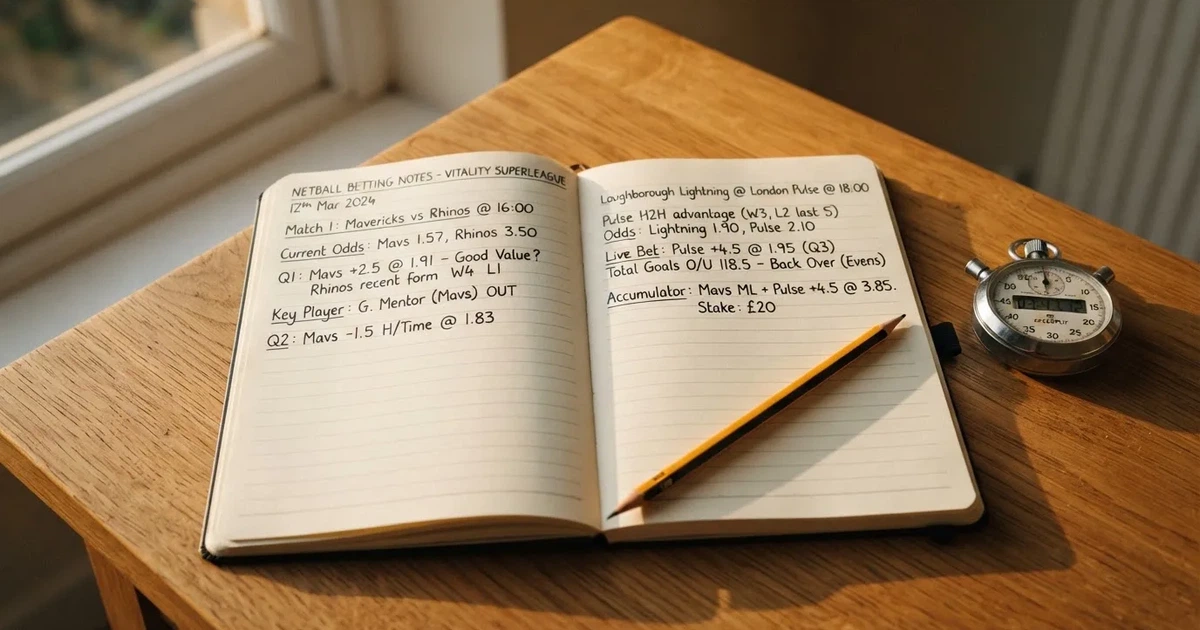
A guide like this is not a tip sheet, and the difference matters. A tip sheet hands you a stake; a guide hands you the apparatus to read what a tipster is selling, to judge whether a price is worth taking, and to keep your bankroll intact when the next losing streak arrives, because it will. The rest of this page covers how a value bet is identified, how a netball game breaks into markets, how the bookmaker’s margin sits inside every quoted price, what licences and safer-gambling rules apply to a UK-licensed bookmaker, and which of ten reviewed brands carry a remote licence from the Gambling Commission. The closing sections add a worked margin calculation on a two-way market, a comparison table, and a short FAQ on the questions that come up first.
Current as of 27 October 2026; licence and safer-gambling claims verified against the Gambling Commission’s public register.
The shape of a netball match and why it matters for a market
Netball looks like basketball and reads like nothing else. Seven players per side on court, four fifteen-minute quarters, no dribbling once a possession is caught, and a shooting circle of 4.9 metres in radius at each end. A netball court is 30.5 m long and 15.25 m wide, with goal posts 3.05 m high. A netball team has seven players on court and a game consists of four fifteen-minute quarters. Those numbers decide what a bookmaker can price, because they decide what can happen in a quarter and what cannot.

Positions are fixed by area, not by rotation. Goal Shooter and Goal Attack live inside the attacking third; Goal Keeper and Goal Defence own the defensive third; Wing Attack, Wing Defence and Centre cover the middle. A Goal Keeper or Goal Defence cannot enter the attacking third to shoot. A Goal Shooter or Goal Attack cannot enter the defensive third. The result is a sport where turnovers happen fast, where a single intercept at the centre pass can flip a quarter, and where the score can run away in five-minute bursts that look unpunishable from the bench. For a bettor this matters in two ways. First, the markets most bookmakers offer on netball are pre-match head-to-head, handicap, and total points; quarter-by-quarter markets and player-prop markets exist but are thinner than on football or basketball. Second, because the score is low — international matches finish around 50 to 65 — totals are tighter, and a goal either way is a bigger percentage of the line than a single basket in an NBA game would be.
The governing body is World Netball, based in Manchester, England. The major competitions a UK bettor will see in the betting list are the Netball World Cup, held every four years (the first edition ran in 1963 at Eastbourne with eleven nations), the Netball Superleague (the British domestic top flight, created in 2005), Australia’s Super Netball, and the ANZ Premiership in New Zealand, both of which replaced the ANZ Championship in 2017. The cadence of the calendar is the first thing a tipster should be honest about: a Superleague regular-season week is one match per side, not three or four, and a team can be on a long international break without a club fixture for two to three weeks. Form stretches are short, and the sample a tipster is working from is often tinier than the confidence of the price would suggest.
How a tip is built, and why the marketing word is “prediction”
A tip is a price plus a conviction. The price is what a bookmaker quotes: 1.85 for the home side, 1.95 for the away side, 1.50 for a handicap, 1.91 for the over. The conviction is a private estimate of how likely each outcome is, worked out from form, line-ups, head-to-heads, injury news, the venue, the quarter the team is more likely to win, and the conditions under which the bookmaker is most likely to have set the price too short or too long. A value bet is the simple comparison between the two: if the price implies a 50% chance and the bettor’s private estimate is 55%, the bet has positive expected value. If the price implies 60% and the bettor thinks 55%, the price is short and the bet is a poor one whatever the result.

The reason no tip is ever certain is that the bookmaker’s price is not the probability of the event. It is the probability of the event adjusted for the margin the bookmaker keeps, plus whatever bias the bookmaker’s trading team has built into the line. A market at 1.90 / 1.90 is not a 50/50 contest in the eyes of the bookie. It is a market in which the bookmaker believes the true probabilities are, say, 53/47 and has adjusted the prices so that whatever the result, the firm keeps around five per cent of every unit staked across the market. A 1.50 / 2.75 line is not a 67/27 contest — it is one in which the bookmaker believes the favourite is closer to 70/30 in the underlying probability and has shaved a touch of margin on top.
A tipster’s job, in the bettor’s interest, is to find prices that look longer than the true probability justifies. The marketing word for that is “prediction” or “lock” or “best bet of the week”. The arithmetic word is edge. The bettor’s job is to be more often right about the true probability than the bookmaker is, and to do it with enough volume that the small edges compound. Almost nobody does it for a living, and the bettor who treats tips as a steady income finds out within a year that the variance is a harder opponent than the bookie. The honest version of a netball betting tip is the part the tipster’s tweet leaves out: the price, the margin, the size of the bankroll, and the staking plan.
Value bets, the margin, and the payout share of one market
A two-way market at decimal odds of 1.90 and 1.90 illustrates the idea without quoting a real price. To work out the bookmaker’s overround, the bettor inverts each price — 1 ÷ 1.90 = 0.5263, and the same again for the other side — adds the two inversions to get 1.0526, and subtracts from 1 to land on an overround of roughly 5.26%. The payout share of the market — the share of every pound staked that the bookmaker returns to winning customers across both outcomes — is therefore about 95.0%, and the bookmaker keeps around 5.0% on every pound of turnover. The numbers are an example of the kind of spread to look for when reading a quote, not a snapshot of a current market.
That margin is the bookmaker’s edge, and it sits inside every price on every market. A 1.85 / 1.95 line implies a margin closer to 5.1% on the underlying book; a 1.50 / 2.75 line implies closer to 6.7%. The smaller the margin, the better the long-term return for a bettor who prices the underlying event accurately; the larger the margin, the harder the bettor has to work to beat it. A bookmaker at 1.90 / 1.90 keeps around 5.3%; the same outcome priced at 1.83 / 1.97 keeps around 5.5%; the same outcome priced at 1.67 / 2.25 keeps closer to 8%. The differences look small. Over a season, on a hundred matched bets, the difference between a 5% margin and an 8% margin is the difference between losing about 5% of turnover and losing about 8% of turnover — and the bettor has to clear that loss on top of the price the model has to beat.
For netball, where the bookmakers’ published margins vary more than on Premier League football, the practical move is to keep an eye on the line the bookmaker is offering and on the price of the same selection at two or three competitors. The bigger the bookmaker’s overround, the bigger the hurdle the tip has to clear. A punter following a tip on a 1.45 favourite has to be right about 1 ÷ 1.45 = 69% of the time, plus the margin, to break even; a punter following a tip on a 1.95 underdog has to be right about 1 ÷ 1.95 = 51.3% of the time, plus the margin. The hurdle is lower and the variance is higher, which is part of why small-stake bettors gravitate to long shots. The other part is that long shots pay, on the rare occasions they land, in a way the bank balance remembers.
Staking and bankroll discipline, and what a tip is worth to a £100 bank
A tip is only ever a fraction of a stake. The stake is set by the bankroll and the size of the price, not by the strength of the bettor’s view. A punter with a £100 bank and a flat £5 stake is running a hundred-bet sample at any given time. A punter with the same £100 bank and a 2% stake — £2 per bet — is running a fifty-bet sample. A punter who raises to £10 on a “best bet of the week” is running a ten-bet sample and putting 10% of the bank on a single outcome. Three of those in a month and the bank is gone. The honest version of staking is unflattering: most bettors stake too big on what they feel strongly about, and too small on what they are slightly less sure of, and the result is the opposite of a staking plan.
A worked illustration: a tip on a netball handicap at 1.91, with a £5 stake, returns £5 × 1.91 = £9.55 if it lands — a net profit of £4.55 — and loses the £5 if it does not. A punter who wins 55% of these bets, which would be a strong long-run record against a 51.3% break-even line, makes £4.55 × 55 − £5 × 45 = £250.25 − £225 = £25.25 per 100 bets, or about 5% of £500 of turnover. That is roughly the kind of edge a sharp bettor runs on, and it is why serious bettors track every bet, every price and every result. Without that record, the punter cannot tell whether a tip is a tip or a guess.
A punter who treats tips as a stream of single bets has no way to know which tips were the profitable ones and which were not. A punter who treats them as a hundred-bet sample starts to see one. The difference is bookkeeping, not insight, and the bookkeeping is the cheaper half of the work. A spreadsheet and a notional £100 bank will tell a punter, within a season, whether they are a long-term winner, a long-term loser, or a long-term lucky streak. Most people never run the test, and the ones who do are often surprised by what the data shows.
The relationship between tips and staking is the part of the page that looks most like a lecture. The reason is the failure mode. A reader who copies a tip without a bankroll plan is, in practical terms, betting on a single game with whatever is in the wallet. A reader who reads the tip, checks the price, sizes the stake as a fraction of the bank, and writes down the bet is in a different game — one in which the variance is borne by a record and not by a wallet. The first punter loses and forgets; the second punter loses and learns.
How a netball bet pays back: stake × odds, net profit on top
A winning bet pays back the stake plus the winnings, and the bettor’s net profit is the winnings alone. A £10 bet at decimal odds of 2.50 returns £10 × 2.50 = £25.00, of which £10 is the stake returned and £15 is the net profit. A £10 each-way bet — two bets of equal stake, one on the win and one on the place — costs £20 in total, returns the win portion at full odds and the place portion at a fraction, and the two stakes are paid back on their respective outcomes. A combination bet multiplies the prices of the legs into one: three legs at 1.80, 2.10 and 1.95 give a combined price of 1.80 × 2.10 × 1.95 = 7.371, so a £10 combination bet returns £73.71 if all three legs win, of which £10 is the stake and £63.71 is the profit. A losing leg voids the whole thing.
A free bet is a stake the bookmaker lends, and the rule to remember is that the free-bet stake is usually not paid back on a win. A £10 free bet at 1.91 returns the winnings of £9.10 only, not £19.10, because the £10 stake is the bookmaker’s, not the bettor’s. A price boost or an enhanced-odds offer is the bookmaker raising the quoted price above the market for a short window; the catch is usually a maximum stake, and the bettor who lands a long-shot boost is paid at the boosted price, with the original stake returned in the normal way. A cashback or “acca insurance” offer refunds a portion of the stake — usually as a free bet, not cash — if one leg of a multiple fails, and the refund is generally capped. Each of these mechanics is built to look like a gift and priced to deliver something a touch less than a gift. The arithmetic of the gift is the part the marketing copy skips, and the bettor who reads the small print knows it.
The legal frame in Great Britain: who can take a netball bet and who cannot
A bookmaker serving customers in Great Britain needs a Gambling Commission licence wherever the operator is based. Since the Gambling (Licensing and Advertising) Act 2014, a Curaçao, Maltese or Gibraltar licence is not a substitute for the Commission’s licence. The Commission is a non-departmental public body sponsored by the Department for Culture, Media and Sport, and it licenses the whole commercial market under the Gambling Act 2005, which covers Great Britain — England, Scotland and Wales. Northern Ireland is outside the Act and runs on older law; a GB licence does not regulate Northern Ireland, and the comparison pages of this guide say “GB-licensed” for that reason. There is no state monopoly and no cap on the number of licences; the test is whether the operator holds the licence the law requires.
The Commission’s public register is searchable by business name, trading name, domain, or account number, and it is the whole test of who holds a licence. The register lists several categories of remote licence: general betting standard (real events), general betting standard (virtual events), general betting limited, pool betting, and betting intermediary (the licence for betting exchanges). A bookmaker that holds a general betting standard (real events) licence can offer pre-match and in-play markets on real-world netball; a bookmaker that holds only a pool betting licence can offer pool products and not singles; a betting exchange runs under the betting intermediary licence. The register does not list market margins, customer limits or bonus terms, and the bettor who wants to know what a brand actually offers on netball still has to read that brand’s own terms.
The minimum age is 18, and the Commission’s rules require name, address and date of birth to be verified before a customer can deposit or gamble — including with a free bet or bonus. There is no anonymous play at a licensed site. Credit cards are banned for gambling in Great Britain (since 14 April 2020), including credit-card-funded payments through an e-wallet; debit cards and bank-based payments are not covered by that ban. The verification process is the same on every licensed brand, and the licensed brands that have friction on first deposit are running the rules, not the friction.
In-play betting is permitted under a GB licence. The controls on in-play — the markets offered, the suspension rules, the cash-out terms — are set by the operator under its licence conditions and customer-protection duties, and no statutory list of in-play restrictions was found. The bettor who wants to know whether a brand offers cash-out on netball, or live streaming, or a bet builder, has to read the brand’s own terms; this guide says which brands carry those features where research is firm, and stays quiet where it is not.
Betting exchanges run under a betting intermediary licence and let a punter back or lay a selection at a chosen price. Rates and rules specific to exchanges are stated only from each exchange’s terms. Spread betting that is a financial product is regulated by the Financial Conduct Authority, not the Commission; spread betting on a sports index that is not a financial product sits inside General Betting Duty and the Commission’s remit. A brand that does both — Spreadex is the one reviewed here — carries a separate FCA authorisation for the spread-betting side, and the customer-facing pages of that brand should be read for the product a punter is actually using. Spread-betting losses can exceed the deposit, which is the line the brand itself states, and the rule is one a punter should read twice before sizing a position.
Bonuses, free bets and what they really cost
A “welcome offer” on a licensed bookmaker is a marketing line dressed as a present. The marketing line is “£30 in free bets” or “bet £10, get £30”; the actual mechanism is a token or a credit that can be used in place of a stake, with conditions on the minimum price, the events the bet can be placed on, the deadline to use it, and whether the stake is paid back on a win. The conditions are the offer. The token is the headline.
Sky Bet’s welcome offer, as the brand’s own support pages state, is £30 in free bets credited as three £10 free bet tokens after a deposit of at least £5 and a first single or each-way bet of at least 5p at odds of 1/1 (2.00 decimal) or greater. The minimum deposit is small; the qualifying bet is small; the price floor is the bit that bites — a free bet at 1.40 is a different shape from a free bet at 2.00, because the breakeven price for a free bet whose stake is not returned is 1 ÷ (1 + 1 ÷ (odds − 1)) of the underlying event. The higher the minimum price, the higher the event’s required true probability, and the harder the bet is to place. The marketing line is the token. The price floor is the value.
Spreadex’s new customer offer is £60 in free bets for a £10 fixed-odds bet, with the free bets usable across fixed odds and spread betting, and the qualifying bet must be placed within 28 days of opening the account. A punter who does not place the qualifying bet inside 28 days loses the free bets. The “deadline to use” rule is the part of the offer most punters miss, and it is the rule that converts a free bet from a real edge into a marketing event.
Hollywoodbets’ sports welcome offer returns the stake as a free bet of up to £30 on the first qualifying losing accumulator — a stake of £10 or more, three or more legs, odds of 4/1 (5.00 decimal) or greater, settled within seven days, one free bet per customer. The “losing accumulator” framing is the cost. A free bet that refunds a losing bet is paid at the end of the run, not the beginning, and the punter has to lose to receive it. The breakeven price is the same as for any other free bet, but the timing means the bankroll has to bear the loss of the qualifying stake first, and only then receive the refund. A punter whose bankroll is tight will feel the difference between a free bet paid up front and a free bet paid after a loss.
The Commission’s rules in force since 19 January 2026 cap wagering requirements on bonuses at 10x — a £10 bonus at 50x would have needed £500 of bets; under the cap no more than £100. Mixed-product promotions — an offer that requires gambling on two or more product types such as betting, casino, bingo and lottery — are banned. Whether the cap applies to free bets with no wagering condition is not established in the public guidance, and any cap on the money value of a bonus is not established. The Commission’s rule book has tightened over the last two years, and a punter who reads the small print of a 2024 offer against a 2026 offer sees the shift. A free bet on a 2024 offer is not the same product as a free bet on a 2026 offer, and the differences sit in the conditions, not the headline.
A promo code, voucher code, or any working redemption token does not appear on this page. The page describes the mechanism and the cost, not how to claim it. The reasons are partly legal and partly editorial: the mechanism is what the bettor needs to know, and the redemption is the marketing layer the bookmaker would rather be writing about.
In-play, cash-out and live netball: what a whistle-to-whistle market looks like
In-play betting is the part of the offer where the bookmaker’s margin often widens. A 1.90 / 1.90 pre-match line on a Superleague fixture might re-open at 1.75 / 2.10 at the end of the first quarter, with the margin closer to 6% on the live book. The reason is liquidity: in-play markets on netball are thinner than in-play markets on Premier League football, and the bookmaker compensates for the lower liquidity with a wider margin. The punter’s defence is the same as on a pre-match market — know the price, know the margin, and walk away from a market where the price is too short. Cash-out is the bookmaker’s offer to settle a position before the final whistle; the cash-out price is the bookmaker’s own price, and the cash-out margin is often wider than the pre-match margin. A punter who takes a cash-out to lock in a profit on a multi-leg accumulator has taken a price the bookmaker set, not a price the market set.
A live netball feed is rare on UK-licensed bookmakers. Netball sits behind football, horse racing and tennis on the list of sports that attract live-streaming investment from bookmakers, and the streamed matches are usually the headline international fixtures and the back end of the Superleague season. The 888sport app, as the App Store listing states, includes racing streams; the Vbet app, as the App Store listing states, includes live streaming and a live calendar with results and stats; the Paddy Power app offers in-play markets with player and ACCA stats. The features vary by brand, and the brands that show netball in-play tend to be the brands that show a wider range of in-play sports. The brands that don’t, don’t.
Live betting is where the bookmaker’s data feed matters more than the bookmaker’s brand. A bettor who wants to read the state of the game has to be watching the live stats: the shooting percentage, the turnover count, the centre pass record, the time the attacking team has spent in the shooting circle. A bookmaker’s in-play price reflects that data, and the bettor who has the data first has the edge. The edge is small, the variance is large, and the bankroll rule is the same: stake as a percentage of the bank, and never let a single in-play bet get large.
Picking a bookmaker for netball: what the licence means and what it does not
A Gambling Commission licence means the brand has passed the fit-and-proper test, the brand’s customer funds are protected under the Commission’s rules, the brand takes part in GAMSTOP, the brand offers the safer-gambling tools the LCCP requires, and the brand is bound by the 10x bonus cap. It does not mean the brand offers the best price on netball, the lowest margin on a handicap market, or the deepest in-play list on a Wednesday-night Superleague fixture. Those are the brand’s commercial decisions, and a punter who picks a brand because it is licensed is making a safety decision, not a price decision. The two are different.
The reviews of ten operators that follow are written for the punter who wants both. Each review sets out the brand’s licence, the safer-gambling tools on the brand’s own pages, the welcome offer’s headline mechanism (not a code, not a redemption route), and one or two distinguishing features from the brand’s app or site. The reviews are not a ranking and not a recommendation: a place in a list is not a licence, several brands can run under one licensee, and a brand’s offer on football does not predict its offer on netball. The verdict at the end of each review is a judgement on the offer, not a tip on the result.
The UK-licensed bookmakers reviewed
Bet600 — a spread-betting-aware brand with best-odds-guaranteed on racing
Bet600 is operated under Gambling Commission remote licence 044731-R-323941-016 (Commission account 44731), held by Tyche Tech Limited. The brand’s app listing states that Bet600 pays Best Odds Guaranteed on horse racing: if the starting price is bigger than the early or show price taken, the bet is paid at the SP. Netball is not horse racing, and the BOG feature does not carry across. The brand’s offer on netball, on the available evidence, is a standard pre-match and in-play book, and the in-play product on netball is not what the brand leads with. A punter whose betting is mostly netball will find the brand a competent second book rather than a primary one, and a punter whose betting is mostly horse racing will find the BOG the standout. The brand’s safer-gambling tools and the Commission’s safer-gambling rules both apply, and the standard deposit-limit, time-out and GAMSTOP routes are available on the brand’s account page.
Bet600 leans on BOG for racing, but its netball offer is functional rather than featured.
Spreadex — a spread-betting brand with a £60 free-bet welcome
Spreadex carries Gambling Commission remote licence 008835-R-104580-022 (Commission account 8835), held by Spreadex Limited. The brand is regulated by the FCA for spread betting and by the Gambling Commission for fixed-odds betting, and the brand’s own pages state that spread-betting losses can exceed the deposit. The new customer offer is £60 in free bets for a £10 fixed-odds bet, with the free bets usable across fixed odds and spread betting; the qualifying bet must be placed within 28 days of opening the account. The offer is large for the qualifying stake, and the deadline is the catch. A punter who places the qualifying bet on day 27 and forgets the offer has lost the £60. A punter who places the qualifying bet on day 1 and uses the free bets inside the 28-day window gets the full £60 in tokens.
The verdict: a strong welcome offer for a punter who reads the deadline, with a fixed-odds product that is fit for purpose and a spread-betting product that is the brand’s edge — and one a punter should read the small print on before sizing a position.
Betboro — boosted odds from £10 stakes and a full safer-gambling suite
Betboro is operated under Gambling Commission remote licence 044181-R-324363-007 (Commission account 44181), held by Webmedia Development N.V. The brand’s site, as the official GB pages state, offers in-play markets and cash-out on football, racing and tennis, boosted odds on selected singles from £10 stakes, and responsible gambling tools (deposit limits, reality checks, self-exclusion). The in-play and cash-out list does not name netball, and a punter who wants those features on netball will need to check the live list on the day. The brand’s safer-gambling suite is the standard LCCP set. A punter who plans to use boosted odds should check the maximum stake and the eligible events, because the offer is selective.
Betboro’s boosted odds are a strong point for the punter who prioritizes a competent safer-gambling suite, with netball covered at a standard pre-match level.
Hollywoodbets — a sports welcome offer paid as a free bet on a losing accumulator
Hollywoodbets is operated under Gambling Commission remote licence 053028-R-330019-013 (Commission account 53028), held by Hollywoodbets International UK Limited. The brand’s sports welcome offer, as the App Store listing states, gives new players who deposit £10 or more by card their stake back as a free bet of up to £30 on their first qualifying losing accumulator — stake £10+, three or more legs, odds of 4/1 or greater, settled within seven days, one free bet per customer. The free bet is paid on a losing bet, not a winning one, and the seven-day settlement rule means the punter’s qualifying bet has to be settled within a week of placement. A punter who backs a long-priced multi and watches one leg fail gets the refund; a punter who backs the same multi and watches all legs land gets nothing on top of the standard return.
The verdict: a refund offer for the punter who likes accumulators, with the value of the refund capped at £30 and the timing determined by when the bet loses rather than when the account opens.
888sport — a wide feature set with racing streams and a bet builder
888sport is operated under Gambling Commission remote licence 039028-R-319297-014 (Commission account 39028), held by 888 UK Limited. The brand’s app offers pre-match and in-play betting, Cash Out, Bet Builder, racing streams, BetFinder form tools, a live bet feed and daily boosted odds. Racing streams do not extend to netball, and the live bet feed is generic. The netball offer is a pre-match and in-play book with the standard market list. A punter whose book is built around bet builder and cash-out will find both here; a punter whose book is built around netball-specific features will find the brand a competent rather than specialist option.
The verdict: a feature-rich book for the punter who wants bet builder, cash-out and racing streams, with netball offered as a standard sport rather than a flagship.
London Bet — a multi-product app with sport, casino and live in-play
London Bet is operated under Gambling Commission remote licence 066162-R-340278-004 (Commission account 66162), held by Thistle Bet Limited. The brand’s app combines sports betting with Pragmatic Play casino slots and live in-play betting. Netball is not on the named list, and a punter who wants the brand’s sports book for netball should check the live list. The app states it is licensed and regulated in the UK and has a 17+ App Store age rating. The casino product sits alongside the sports product, and a punter who wants to keep the two separate should consider whether the multi-product wallet is a help or a hindrance.
The verdict: a multi-product book for the punter who wants casino alongside sport, with netball available as part of a wider in-play list.
Paddy Power — bet builder, super sub and an enhanced in-play experience
Paddy Power is operated under Gambling Commission remote licence 039439-R-319330-013 (Commission account 39439), held by PPB Counterparty Services Limited. The brand’s app offers Bet Builder+, Popular Bet Builders, Super Sub, expanded Win More markets and player and ACCA stats. Super Sub is the standout — the rule that a substituted player’s market rolls to the replacement is rare in netball. The feature set is a strength for the punter who builds bets around players rather than teams. The netball offer is part of a wider in-play list with the standard market depth.
The verdict: a book that centers its value on player-focused markets like Super Sub and Bet Builder+, with the netball offer embedded in a wider in-play book.
Sky Bet — a £30 free-bet welcome split across three tokens
Sky Bet is operated under Gambling Commission remote licence 067370-R-341330-005 (Commission account 67370), held by SBG Sports Limited. The brand’s support pages, as the official Sky Bet support site states, set out the welcome offer: £30 in free bets, credited as three £10 free bet tokens after a deposit of at least £5 and a first single or each-way bet of at least 5p at odds of 1/1 (2.00 decimal) or greater. The qualifying bet is small. The minimum price is the binding condition. The three-token split means each free bet is £10, and a punter who wants a single £30 free bet has to place three separate bets. The brand’s netball offer, on the available evidence, is the standard pre-match and in-play book.
The verdict: a clean welcome offer for the punter who reads the qualifying-bet rules, with a netball book that is fit for purpose rather than specialist.
Bar One Racing — an Irish-licensed bookmaker with a racing focus
Bar One Racing has rebranded as BAR 1 Betting, an Irish independent bookmaker with shops across Ireland and horse racing sponsorships at Dundalk, Fairyhouse, Navan, The Curragh, Curraheen Park and Cork. The brand is operated under Gambling Commission remote licence 056516-R-332750-007 (Commission account 56516), held by Bar-One Racing Limited. The brand’s focus is horse racing, and the racing sponsorships are the operational centre of the business. A punter whose betting is mostly netball will find the brand a thin option, and a punter whose betting is mostly Irish racing will find the brand’s in-shop and online product well-aligned. The netball market list is not the brand’s flagship, and the in-play depth on netball is not the brand’s focus.
Bar One Racing is built around Irish racing; its netball market, however, is functional rather than featured.
VBet — bet builder, live streaming and a live calendar
VBet is operated under Gambling Commission remote licence 044662-R-324273-022 (Commission account 44662), held by SCGO Limited. The brand’s app offers Bet Builder, pre-match and in-play betting, live streaming and a live calendar with results and stats. The live streaming is the standout feature, and a punter who watches the match before betting on it has an information edge a bookmaker is unlikely to match. The netball offer is part of the wider in-play list. A punter whose book is built around live streaming will find the brand strong; a punter whose book is built around price will find the brand a competent second book.
The verdict: a brand for the punter who wants live streaming and a live calendar, with a netball book that is functional inside a wider in-play list.
A landscape view of the ten operators
The table below sets the ten operators side by side on three points: the Gambling Commission account and the licence holder, and what the brand’s own terms state about a safer-gambling or offer condition relevant to a punter’s first decision. The brands are listed in the order of the review section. Empty cells are empty because the brand’s own pages do not state a relevant point in the public-facing terms, and the right move on a missing cell is to check the brand’s own account page before signing up.
| Brand | Gambling Commission remote licence | Licence holder | Safer-gambling or offer note from the brand’s own terms |
|---|---|---|---|
| Bet600 | 044731-R-323941-016 (account 44731) | Tyche Tech Limited | Best Odds Guaranteed on horse racing; stake paid at SP if bigger |
| Spreadex | 008835-R-104580-022 (account 8835) | Spreadex Limited | £60 in free bets for a £10 fixed-odds bet; 28-day qualifying window; FCA-regulated for spread betting |
| Betboro | 044181-R-324363-007 (account 44181) | Webmedia Development N.V. | Boosted odds from £10 stakes; in-play and cash-out on football, racing, tennis; deposit limits, reality checks, self-exclusion |
| Hollywoodbets | 053028-R-330019-013 (account 53028) | Hollywoodbets International UK Limited | Free bet of up to £30 on first losing accumulator (3+ legs, 4/1+, settled in 7 days) |
| 888sport | 039028-R-319297-014 (account 39028) | 888 UK Limited | Bet Builder, Cash Out, racing streams, BetFinder form tools, daily boosted odds |
| London Bet | 066162-R-340278-004 (account 66162) | Thistle Bet Limited | Sports and casino under one wallet; live in-play; 17+ age rating on the app |
| Paddy Power | 039439-R-319330-013 (account 39439) | PPB Counterparty Services Limited | Bet Builder+, Super Sub (substitution rolls to replacement), player and ACCA stats |
| Sky Bet | 067370-R-341330-005 (account 67370) | SBG Sports Limited | £30 in free bets as three £10 tokens; qualifying bet 5p+ at 1/1 (2.00) or greater |
| Bar One Racing | 056516-R-332750-007 (account 56516) | Bar-One Racing Limited | Irish racing-focused; shops across Ireland with sponsorships at Dundalk, Fairyhouse, Navan, The Curragh, Curraheen Park and Cork |
| VBet | 044662-R-324273-022 (account 44662) | SCGO Limited | Bet Builder, live streaming, live calendar with results and stats |
The table is a snapshot of public-facing claims on the brands’ own pages and on the Commission’s register, not a measure of price or margin. A punter comparing brands on netball specifically should check the live list of markets on the day, and the price on the same selection across at least two brands, before placing a bet.
Safer gambling and the licensed bookmaker’s duty of care
Every UK-licensed bookmaker takes part in GAMSTOP, the national multi-operator online self-exclusion scheme. Periods are six months, one year, five years, or five years with auto-renewal, and after the minimum period the exclusion stays in place for a further seven years unless the customer asks GAMSTOP to remove it. GAMSTOP covers online sites and apps; betting shops use a separate service. A punter who has registered with GAMSTOP cannot open a new account at any participating brand for the duration of the exclusion, and the brands that are part of the scheme are required to enforce the exclusion at the point of sign-up.
A financial vulnerability check applies to licensed remote betting when a customer’s deposits minus withdrawals exceed £150 in a rolling 30 days. The check is a public-record check — bankruptcy or county court judgments, for example — not an income check and not a credit reference check. The threshold is low and the check is light-touch, and the bettor who passes the £150 mark in a 30-day window should expect a prompt. Financial risk assessments — the “affordability checks” of the press — have been announced in a staged plan, with no start date established in the public guidance. The punter who hears about affordability checks in the press is hearing about a future framework, not a current rule.
Deposit limits are a customer’s choice. A licensed bookmaker must offer a gross deposit limit on a fixed time frame, and the first changes have applied since 31 October 2025, with a second phase postponed to 30 September 2026. A punter who wants a hard ceiling on weekly spend can set one in the account settings, and the brand is required to enforce it. There is no state-set ceiling. The ceiling is the punter’s.
Help is available outside the bookmaker. GamCare runs the National Gambling Helpline. GambleAware funds treatment and research. The NHS runs gambling clinics. Gamblers Anonymous runs peer-support groups. A punter who feels the betting has stopped being a choice should reach out to one of these. The licensed brand will signpost them, and the signposting is one of the duties the LCCP enforces.
The unlicensed brand: what the bettor loses
A GB licence is compulsory at the point of consumption. Providing gambling facilities in Great Britain without the licence the Act requires is an offence aimed at the operator, not the customer. A punter who bets on an unlicensed site has not committed an offence under the Act, and the page does not say one has. What the punter has lost is the protection: no GAMSTOP coverage, no Commission complaints route, no approved dispute-resolution body, no British consumer redress if funds are withheld, no binding by the 10x bonus cap, and no requirement for the £150 vulnerability check. The unlicensed brand runs on its own house rules, and the bettor who opens an account on one is betting on the brand’s word.
Enforcement against unlicensed operators runs through cease-and-desist notices, search-engine referrals, work with registrars, hosts and payment providers, and court-order DNS blocking powers that the Commission has been given or is about to receive. The Commission’s approach is disruption, not blocking; the bettor who visits an unlicensed site has reached it through some other route. The honest framing: a licensed site is a site with checks, limits, GAMSTOP and the bonus cap, and a customer who has to verify their identity before their first bet. An unlicensed site is none of those. Neither is “the safe choice” by default, and the punter who treats them as equivalent is making a different bet from the one they think.
Pricing the work: a worked margin on a two-way market
A two-way market at decimal odds of 1.90 and 1.90 is the kind of spread a bookmaker might publish on a tight head-to-head netball fixture. The margin is the same on every bookmaker’s quote at that price, because the margin is a function of the two numbers. Inverting each price: 1 ÷ 1.90 = 0.5263, and the same for the other side. Adding the two inversions: 0.5263 + 0.5263 = 1.0526. Subtracting from 1: 1 − 1.0526 = −0.0526, which means the bookmaker’s overround is 5.26% and the payout share of the market is about 94.74%. The bookmaker keeps roughly 5.3p on every pound of turnover across the two outcomes, and returns 94.7p in winnings to winning customers.
A market at 1.85 and 1.95 inverts to 1.0533 (overround 5.33%, payout 94.9%), while one at 1.83 and 1.97 inverts to 1.0540 (overround 5.40%, payout 94.9%). A market at 1.50 and 2.75 inverts to 1.0303, an overround of 3.03% on this shape of book — a counter-intuitively low overround because the two prices are not symmetric, and the underdog’s longer price pulls the bookmaker’s edge lower on a round. The shape of the line matters, and so does the spread.
For a punter the takeaway is that the margin is arithmetic, not opinion. Two brands at the same price have the same margin, and a brand with a longer price on a side has a lower margin on that side. A 1.91 / 1.91 line is a 4.71% margin, and a 1.95 / 1.95 line is a 2.56% margin. The difference is the bookmaker’s commercial choice, and the punter’s job is to find the brand offering the lower margin on the same selection. A 1% difference in margin is worth more than any welcome offer on a 100-bet sample, because the offer is paid once and the margin is paid every time.
What the punter walks away with
A netball betting tip in 2026 is a price and a probability, with a margin sitting between the two. The punter’s job is to read the price, estimate the probability, and place the bet only when the price is longer than the probability justifies. The bankroll’s job is to survive the losing streaks that the variance guarantees. The bookmaker’s job is to quote a price that, across the book, keeps a margin regardless of the result.
The licensed brands reviewed in this guide carry a Gambling Commission licence, the LCCP’s safer-gambling duties, the GAMSTOP membership, and the 10x bonus cap. They differ on price, on in-play depth, on welcome offer mechanics, and on whether the netball list is a flagship or a footnote. A punter who reads the licence register, the brand’s safer-gambling page, and the small print of the offer before signing up has done the work the page is asking of them. The tip is the bettor’s own, after that.
Frequently asked questions
Is it legal to bet on netball in Great Britain?
Yes, betting on netball is legal in Great Britain at a bookmaker licensed by the Gambling Commission. A bookmaker whose remote facilities are used in Great Britain needs the Commission’s licence wherever it is based, and the Commission’s public register is the whole test of who holds one. Northern Ireland sits outside the Gambling Act 2005, so a GB licence does not regulate Northern Ireland, and a brand licensed for GB is licensed for GB. A punter who wants to bet on netball at a licensed brand in England, Scotland or Wales can do so; a punter who wants to bet at an unlicensed brand can do so at the cost of the protection a licence confers.
What is a value bet in plain terms?
A value bet is a price that is longer than the true probability justifies. The price implies a probability — 1.91 implies 52.4%, 2.50 implies 40%, 1.50 implies 66.7% — and the bettor’s job is to estimate the true probability independently. If the bettor’s estimate is higher than the price implies, the bet has positive expected value; if lower, the bet is a poor one whatever the result. The estimate is built from form, line-ups, head-to-heads, injuries, the venue and the conditions, and the bet is a bet on the estimate, not on the outcome.
Why is no tip ever certain?
A tip is a probability estimate plus a price, and the price is the bookmaker’s price, not the true probability. The bookmaker’s price is the true probability adjusted for the margin the bookmaker keeps, plus whatever bias the trading team has built into the line. A punter who estimates the true probability better than the bookmaker can be a long-term winner; a punter who does not is a long-term loser. The variance over a 100-bet sample is large, and the confidence of a single tip is no evidence of a long-term edge. A tip is a sample of one.
How is a return on a bet worked out from the stake and the odds?
A winning bet pays back the stake plus the winnings. The return is the stake multiplied by the decimal odds: a £10 bet at 2.50 returns £25.00, of which £10 is the stake and £15 is the net profit. A combination bet multiplies the prices of the legs into one: three legs at 1.80, 2.10 and 1.95 give a combined price of 7.371, so a £10 combination bet returns £73.71. A free bet, in the typical form, returns the winnings only and not the free-bet stake — a £10 free bet at 1.91 returns £9.10, not £19.10. The stake rule is the part a punter should check before claiming.
How can a punter check that a bookmaker holds a Gambling Commission licence?
The Commission’s public register is searchable by business name, trading name, domain or account number, and it is the whole test of whether a brand holds a licence. The register lists the licence categories — remote general betting standard (real events), remote general betting standard (virtual events), remote general betting limited, remote pool betting, and remote betting intermediary — and the account number. A punter who has the account number from the brand’s own pages can check it against the register; a punter who doesn’t can search by name. A licensed brand is a brand on the register; an unlicensed brand is one that is not, and the difference is the protection the bettor loses.
What safer-gambling tools does a UK-licensed bookmaker have to offer?
A licensed bookmaker has to offer deposit limits, time-out, self-exclusion and GAMSTOP membership, and the LCCP’s social responsibility code sets out the framework. A licensed brand also has to run a financial vulnerability check when a customer’s deposits minus withdrawals exceed £150 in a rolling 30 days, and the check is a public-record check, not an income check. The punter who wants a hard ceiling on weekly spend can set one in the account settings, and the brand is required to enforce it. Help is available outside the brand at GamCare, GambleAware, the NHS gambling clinics, and Gamblers Anonymous, and the licensed brand is required to signpost these.
Rugby, cricket & Gaelic – Basketball betting
Content created by the «Basketball betting» team
