
A Punter's Read on Corner Betting in Great Britain
 Available in US
A corner market is a bet on a count of set-pieces rather than a count of goals, settled on a count of set-pieces — and that shift is the entire reason the market exists at all. Football punter instinct reads the scoreboard; corner markets read pressure, territorial play and tired legs in the final twenty minutes, which the scoreline hides. So the appeal is obvious: a match that ends goalless after ninety minutes can hand over a winning corner ticket on a side that battered the box. The price paid for that appeal is paid in the same currency as every other football market — the bookmaker’s margin, hidden in the decimal or fraction on each side of every line. What follows walks through how a corner bet is built, who gets to offer one in Great Britain, what the offer costs in wagering and verification, and where the value tends to be found.
Current as of 27 October 2026 · verified against the Gambling Commission’s public register.
What a corner kick actually is, and why it matters to a market
The betting object only exists because the rulebook defines one. A corner kick is awarded when the ball wholly crosses the goal line, outside the goal frame, after last touching a player on the defending side. The touch need not be deliberate — a sliced clearance under pressure counts. The restart is taken from the corner nearest to the point where the ball left the field, with the ball stationary inside a one-yard quarter circle drawn around the corner flag. Opposing players must retreat at least ten yards from the ball until it is in play. An attacker who receives the ball directly from a corner cannot be penalised for offside, which is why corners are favoured attacking set-pieces. The corner was introduced into the Football Association’s code in 1872 by the Sheffield Association; scoring straight from a corner (an *Olimpico* goal) was legalised by the IFAB on 14 June 1924, and an own goal scored directly from a corner is not permitted.

Knowing the trigger — the whole-ball-crossing-the-line rule — explains how a corner market is settled. Every corner awarded in normal time, including stoppage time, counts. Corners that are awarded but then not taken (because the referee abandons the match, because the game is abandoned before the corner is delivered, because VAR wipes it) are the bettor’s first exposure to bookmaker housekeeping rules: each operator’s terms govern whether the corner is paid or voided. That sentence is the first of three small print reminders in this guide. It will not be the last.
The fundamentals behind the price
Corner markets are settled on a count of events inside a defined window. Most corners markets in Great Britain fall into a few shapes:

- Over/under a line. Settled on whether the total number of corners taken in the match finishes over or under a stated line (the most common line is 10.5, with 9.5, 11.5 and 12.5 available on prominent fixtures). Bookmakers carry an over and an under; the price on each side reflects what the operator expects, plus the margin baked into the spread between them.
- Handicap. One side starts the corner count with a positive or negative adjustment (for example, Team A −2.5 corners, Team B +2.5), and the bet is settled on the adjusted total. The handicap widens the price because the line has moved. It is the same mechanism as an Asian handicap on goals.
- Match bet (corners). A two-way bet on which team wins the corners count, with the draw refunded if the totals are level — or, in the three-way version, the draw is a separate priced outcome.
- Race to a number. Settled on which side reaches a stated corner count first (for example, race to 3 corners).
- Multi-corner / accumulator. Several corners markets combined; the odds multiply and so does the margin, because each leg carries its own overround.
A corner bet is settled on corners *taken*, not corners *conceded*. A corner awarded but then cancelled before delivery is the standard housekeeping case to check in the house rules — read the small print on the match in front of you.
There is one further nuance worth a paragraph: the timing window. A corner bet on the full match covers the first half, the second half, injury time and any extra time the referee adds. A first-half corners line is settled at the half-time whistle; the second-half line excludes whatever was counted in the first half. Some bookmakers also offer corner markets with a 10-minute or 15-minute rolling window during live play, where the line is reset each interval.
The cost of a corner bet: margin, not the headline
The headline price is the wrong place to look. Two operators offering 4/5 (1.80 decimal) and 5/6 (1.83 decimal) on the same outcome are not offering the same thing — one is keeping a slightly larger slice of every pound staked, and the difference compounds across a season of bets. The slice is the margin (also called overround), and it is the cost the punter always pays first.
The arithmetic is straightforward on a two-way line. Take an illustrative example at decimal odds 1.90 / 1.90 — both sides at the same price, as a fair two-way market without a margin would price them. The implied probability of each side, expressed as a percentage, is the reciprocal of the odds: 1 / 1.90 = 0.5263, or roughly 52.63%. Adding the two sides gives 105.26%. The extra 5.26 percentage points above the 100% fair book is the operator’s margin — the slice of every pound staked the bookmaker keeps across the long run. This is the book’s “juice”, the rake by another name.
For a market with three possible outcomes (Team A, Draw, Team B), the same arithmetic carries out across all three. At decimal odds of 3.40 / 3.50 / 2.10, the implied probabilities are 29.41% + 28.57% + 47.62% = 105.60%, so the overround is roughly 5.60 percentage points, which yields a margin of roughly 5.30%.
Margin is the single number a punter should compare across bookmakers before comparing headline prices. Lower-margin books return more per pound staked; higher-margin books return less, on identical tickets. A bookmaker’s margin ranges by market and fixture: Premier League 1X2 lines run tight (around 2-5%), smaller-league lines run wide (8-12%), and the wider a market (the more outcomes it tries to cover) the more the book can load. Corner markets sit between those poles; a flagship over/under 10.5 line on a televised match can run as low as the 1X2, while a smaller-fixture line can run wider. Because each match carries its own margin, and the page cannot snapshot a number for every fixture, treat the line on the slip as the answer, not any number stated here.
What the margin does to a winning ticket is also worth naming. A £10 bet at decimal odds 1.90 returns £19.00 — that is the stake plus £9.00 of profit — on a winning outcome. The margin is not a haircut taken from the winnings; it is the gap between what was genuinely at risk and what the punter was paid to take that risk. The punter’s net is unchanged on the winning bet; the cost sits in the losing bets, which happen more often than they would at a fair price.
Whose hands the market sits in
Any operator serving customers in Great Britain needs a Gambling Commission licence, wherever the operator is based. That rule came in with the Gambling (Licensing and Advertising) Act 2014 and closed the route by which offshore operators once took British customers under a Maltese or Curaçao licence alone. A remote general betting standard (real events) licence is the category under which corner markets sit; a remote betting intermediary licence is the category for exchanges; a pool-betting licence covers a different product. Brand names mean less than the licence type behind them: several brands can run under one licence holder.
There is no statutory list of markets that may be offered. An operator holds a licence for a category and offers the markets it chooses under its house rules and the Commission’s Licence Conditions and Codes of Practice. Corner markets are not separately licensed — they sit underneath the betting licence the operator already holds — but the offering is the operator’s commercial decision, and not every operator carries the full range of corner lines on every fixture.
Betting on corners in Northern Ireland is a separate case. Northern Ireland is outside the Gambling Act 2005 and runs an older regime, so the phrase “Great Britain licence” — not “UK licence” — is the right shorthand. Corner markets offered by GB-licensed operators may not be available to a customer whose registered address is in Northern Ireland; the operator’s terms state the geography it serves.
The two trade-offs a punter picks between
Corner markets are not the only way to bet on set-pieces. Two adjacent markets deserve the paragraph because a punter who has not seen them is leaving price on the table.
- First-corner markets. Settled on the first corner awarded in the match, not the first corner *taken*. If a corner is awarded and the referee then abandons the restart (for example, for offside or for a substitution), bookmaker rules differ on whether that corner still counts as the first awarded. Most operators pay on the award; some void in the rare restart case. The punt is a coin-toss with the bookmaker’s edge baked into both sides — which is to say, low odds on either side and a margin of 4-6 percentage points, because the implied probabilities of “Team A” and “Team B” hover near 50/50.
- Asian corners. An Asian-style corner line is a half-line (for example, over/under 10.5) where one stake is split across two lines (9.5 and 10.0) when the bet falls on a whole number. The arithmetic is the same as an Asian handicap on goals; the bookmaker’s margin is similar. Asian corners let the punter move the line by half-steps, which is the practical point — it cuts out the void-ticket risk of a whole-number line landing exactly on it, and it gives the bookmaker one more chance to load the margin on a wider line.
A each-way-style stake does not exist on corner markets the way it does on horse racing. Handicaps, race-to and over/under are settled as singles; the punter who wants an “each-way” equivalent on a count of corners does so via two separate stake lines (for example, a wager on Team A −1.5 and a smaller wager on the over line), not via a separate each-way facility.
How the licence register is read
The Gambling Commission’s public register is the whole test of whether a brand holds a licence — and it is searchable by business name, trading name, domain or account number. Every licence entry carries the licence holder’s registered name, the licence categories it is permitted to operate under, and the trading names and domains the licence is registered against. Account number is the shorter string that identifies the licence holder in the register (Commission account 65677 is the entry that corresponds to Dabble Sports UK Ltd; account 54743 is LC International Limited, the holder behind Coral; account 43173 sits with Blue Star Planet Limited, the licence under which 10bet.co.uk operates, while account 39439 sits with PPB Counterparty Services Limited for Paddy Power). Reading the register is a five-minute exercise: the punter types the brand name or address into the Commission’s search, opens the licence card, and reads the categories. If the categories include “remote general betting standard (real events)”, the operator can offer corner markets to British customers. If the categories do not, it cannot, and the corner markets seen advertised elsewhere run on the operator’s own licence alone.
Licensed operators use both .com and .co.uk addresses, so the domain extension is not the test — the register is. Several brands can run under one licence holder; several licence holders can sit under one group. Ladbrokes and Coral both sit on LC International Limited; Paddy Power and Betfair both sit on PPB Counterparty Services Limited. They are not separate enterprises; they are separate brand presentations on the same licence.
The register’s only weakness is age: a brand can be advertised on a price-comparison site, customer reviews can lag, and the register can move only at the pace of the Commission’s licensing cycle. A punter should treat the register as the source and everything else as a pointer to it.
Identity checks, deposits and the price of staying anonymous
Licensed remote operators in Great Britain have verified a customer’s name, address and date of birth before the first deposit or bet — including with a free bet or bonus — since 7 May 2019. The check is part of the operating licence; it is not a marketing choice. The pragmatic consequence is that there is no anonymous play at a GB-licensed corner market, and the customer who wants anonymity on a corner ticket is not finding it on a licensed site. A higher-spend customer will be asked further source-of-funds questions under the money-laundering rules; the question is normal, not an accusation.
The General Data Protection Regulation applies to whatever data the operator holds, and a licensed operator is bound by it; an unlicensed operator is not subject to UK data-protection enforcement. The data the licence requires is the data the customer leaves behind.
The wagering cap, the £150 vulnerability check, and what they do to a corner punter
Two Commission rules cut into the cost of betting on corners without the punter noticing.
- Wagering cap on bonuses. Since 19 January 2026, bonuses carry a wagering requirement capped at 10x (so a £10 bonus with a 50x condition would not be offered: under the cap the maximum rollover is £100). A free bet offered with no turnover condition is not, strictly, a “bonus” for this purpose. A promotion that mixes product types — a bet on football that gates free spins, say — is banned. The cap limits how a corner punter can be loaded. It does not require that the offer be generous.
- Financial vulnerability check. Since 30 August 2024, a public-record check (bankruptcy, county court judgments) runs on a customer whose net deposits exceed £150 in any rolling 30 days — and the trigger has applied since 28 February 2025. It is not an affordability test, not an income test and not a credit check. A punter whose staking crosses the threshold is checked against publicly available records and not asked further questions. Financial risk assessments proper — the broader check the press calls “affordability checks” — sit on an announced staged plan with no start date; they are announced and staged, not in force.
There is no state-set deposit ceiling and no state-set loss ceiling. Limits are the customer’s choice (or the operator’s, on a case-by-case basis). The £150 mark is the Commission’s threshold for one kind of check, not a spending cap.
Where the offer stops looking like an offer
A bonus is a loan, not a gift. A free bet is a voucher, not a stake. A “risk-free” bet that refunds in free bets is a free bet with a marketing word in front of it. The arithmetic follows from the structure of each.
- Cash bonus. A 100% match on a £20 deposit gives £40 to bet with — but the £20 bonus carries a turnover condition, and the bonus base is the bonus only (or the bonus plus the deposit, depending on the operator’s terms). At 10x on the £20 bonus, the punter must roll £200 through qualifying bets. The qualifying bets are settled singles or accumulators at minimum odds the operator states; a corner market at short odds (under 1.50) is normally excluded. With a 5% margin market, the expected cost of clearing that £200 of turnover is £10 — the punter forfeits roughly that amount to the margin. The punter’s net outcome depends on whether the bonus was lost-and-walked-away or kept-and-turned-into-cash.
- Free bet. A £10 free bet at minimum odds of 1.50 (1/2), whose stake is not returned with a win: the value to the punter is the chance of winning at 1.50, multiplied by the profit, minus the cost of the expected losing ticket. The expected value sits below the headline £10 because the stake does not come back. The expiry is short — typical 7 days — and the punter who lets it lapse loses the entire £10 of value.
- “Risk-free” bet. The label is a marketing word; the structure is a free-bet refund if the first bet loses. The refunded stake is a free bet, not cash, so the same no-stake-returned rule applies on the refund. The punter’s effective edge is the value of the refund, not the value of the first bet.
- Enhanced odds / price boost. A promotional price on a named outcome, often a first-bet token or a one-off price for the day. The enhanced price replaces the headline price the operator would otherwise offer; the underlying margin is unchanged, so the punter trades a higher headline for the same juice. The boost expires; the price reverts.
- Acca insurance. A refund (typically as a free bet, sometimes as cash) if one leg of a multi-leg accumulator loses. The cost sits in the multiplied margin of the multi-leg bet; the insurance pays back a fraction of the stake the accumulator would have lost. Used sparingly, it damps the all-or-nothing sting of an acca; used as a habit, it loads the multi-leg bets the punter is already losing on.
- Cashback. A percentage of net losses returned over a fixed period (often weekly), usually as a free bet or bonus credit, not cash. The punter pays full margin on every bet and receives a fraction back; the headline number is the rebate, not the value.
The Commission cap on bonuses applies at the *bonus turnover* layer, not at the *margin* layer. The punter pays margin on every bet, refund or not.
What a punt on corners looks like on a betting slip
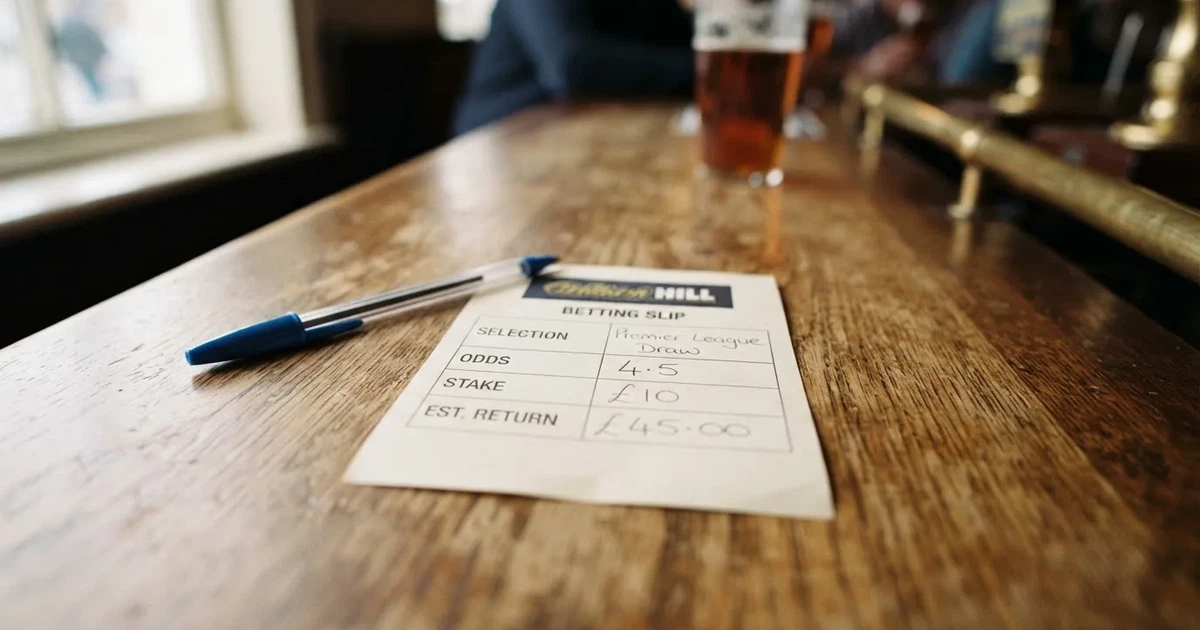
The mechanics on the slip are ordinary bookmaker mechanics, not a corner-special. A punter on a mobile app selects the football fixture, opens the corners tab, picks the line (for example, over 10.5 corners), enters the stake, confirms the bet. The bet is added to the slip; the slip carries the line, the odds, the stake and a unique identifier; the bet settles at full time.
What is different from a goal bet is the settlement source: the count of corners awarded, recorded by official match data. The bookmaker’s settlement stands until the count is contested in the right way — most operators carry a settlement-disputes clause that runs through a regulator-recognised alternative dispute resolution (ADR) body. A punt that lands on a void whole-number line (over 10.0 corners, with exactly 10 in the match) is settled as a push and the stake returned; this is the practical reason the half-line (over 10.5) is the popular form.
The customer-protection channel on a dispute is the Commission’s ADR route for licensed operators; an unlicensed operator carries no such route and the punter’s recourse is the courts, in the operator’s own jurisdiction.
The in-play angle: what changes when the bet is live
In-play corner markets let a punter bet throughout the match on the running total — over a line, the next corner to a side, the race to a number. The dynamics are different from pre-match: the bookmaker’s margin widens as the live data feed gets stale, narrows on top fixtures with low-latency feeds, and the book’s exposure on a heavily one-sided match gets repriced fast.
Three things follow from going in-play on corners:
- The line moves with the count. Over 10.5 / under 10.5 with the score at 1-0 in the 60th minute and 6 corners taken: the line still sits at 10.5, but the perceived probability on the over has shifted and so have the prices.
- The pace of corners in the last twenty minutes is the dominant live variable. A tired side defending a lead pulls bodies behind the ball and the opposition push them wider; corners follow. The live punter is reading the same thing the data feed is reading, which is why the price rarely lags a clear tactical shift but can lag a confused few minutes in injury time.
- Cash out is the operator’s exit. A punter who has had a change of mind mid-match — the favourite is leading 2-0 and the over looks dead — can lock in a fraction of the current value with a cash-out button; the operator pays out a discounted value to close the position. Cash out is a bet against the bookmaker’s own live feed; the discount is the fee.
In-play corner markets are licensed under the same remote general betting standard licence as pre-match; the in-play status adds an operator duty of care, not a separate category of licence.
Predictions, systems and the part a punter cannot buy
Every corners betting tips service sells the same product in different packaging: a list of fixtures for the weekend, with predicted corner totals, lines and stake recommendations. The product is information, not edge. The arithmetic the rest of this page runs is independent of any particular tip. A system purporting to beat the book on corners needs to generate prices whose expected value, after the margin, is higher than the prices the book is offering — and the tip service has no way to prove that from a public prediction list.
What a punter can do, on a punter’s own time:
- Read the line. Compare the margin across operators; the lowest-margin book on a flagship line is the cheapest place to bet, before the line is even considered.
- Read the fixture. A team playing wide and high up the pitch concedes more corners than a team that sits deep; a team that shoots from wide positions wins more corners than a team that shoots centrally. Corner counts correlate with shape, not with form.
- Read the time. A match that needs a goal is a different match from a match that does not. The live corner count moves fastest when the trailing side is pressing.
- Read the conditions. A wet, slippery surface pushes the ball out for corners more often; a dry, fast surface keeps it in play. Weather is a free edge the book does not load.
Reading the line, the fixture, the time and the conditions does not make a winning system. It does make a punter who pays less for the same bet.
Tournaments and the football calendar
Corner markets are not a uniform product across the football calendar. The number of fixtures, the strength of opposition and the tactical patterns differ by tournament. The Premier League and the Championship run near-continuous fixtures, with most top-flight teams generating a deep tactical set-up; cup competitions (FA Cup, League Cup) play one-off, with upset potential skewing tactical choices; European club competitions (Champions League, Europa League, Conference League) play midweek, with travel and squad rotation pushing corner counts around; international tournaments (Euros, World Cup, Copa América) run during breaks in the domestic calendar, with national-side tactical discipline uneven. Each shape — league, cup, European, international — produces a different corner count and a different margin.
The page does not rank tournaments by corner yield; a tournament-by-tournament corner model would be a tipping product, and the page is not one. What is worth saying: a fixture’s expected corner count is a feature of its tactical match-up, and the punter who reads the match reads the corners.
The corner bettor’s bank, set in the same currency as every other bettor’s
A corner bettor is a football bettor whose market is set-pieces; the bankroll rules are the same. A stake of 1-2% of bank per bet is the standard bankroll prescription; a corner-betting unit is the same unit as a goals market. The punter who lets a single bad weekend double the unit loses the bank; the punter who keeps the unit under control survives the bad weekend and bets the next one. The discipline is bankroll management, not corner-market-specific.
The British terms for the bankroll are stake, return and profit; the in-the-know punters say *unit* in place of unit stake. A unit stake of £5 (£10 on a Lucky 15, where the bet count is 15) is the typical small-recreation book. A unit stake of £100 on the same line is the typical professional book; the bettor who runs the professional book does not use a corner market as the entry point.
What corners offer cost the bettor: a quick wrap
Read the margin before the line. A 1.85 line carries a margin of roughly 8%; a 1.90 line carries a margin of roughly 5%; the line difference is 5 percentage points of margin the punter either pays or does not pay. Across a season of bets, that 5 points decides whether the punter’s staking budget returned a profit at the edges they had or a loss the book took.
The bookmaker’s edge compounds. It is the same edge on every market — 1X2, both teams to score, total goals, corners, handicaps — and it varies in size by market, by fixture and by operator. The punter who picks the lowest-margin book for the bet in front of them pays less for the same bet and keeps more of the return. That is the mechanic behind the rest of this page: the cheapest book for a corner bet, on a given day, is the one with the lowest margin on the line the punter wants.
A landscape read across the licensed corner market
The licensed GB corner market is wide, with several operators carrying deep corner coverage and others carrying the headline Premier League lines only. Where the operator set differs is at the edges: pre-match depth, in-play corner markets, bet-builder availability on corners, and the offer book on the football calendar. None of these differences are licence questions. They are question-of-the-day practical differences a punter sorts out each fixture.
What the licensed operators share is more than the licence: they share the wagering cap on bonuses, the £150 vulnerability-check threshold, the source-of-funds question on higher spend, the GAMSTOP self-exclusion scheme, the credit-card ban and the ADR route for disputes. The licensed operators also share the absence of a state deposit ceiling; each operator sets its own.
What licensed operators do not share, and what the punter sorts out, is the offer. Free bets, deposit matches, price boosts and acca insurance differ by brand; the licensed frame is the same, the marketing on top of it is the variable.
The licensed corner market at a glance
The table below sets out the licence entry that backs each featured brand and what that brand’s own terms state on the corner market — the practical question the punter needs answered before staking. The licence entry is the entry the Commission’s public register carries; the operator-side description is the corner of the offer the brand itself documents.
| Brand | Gambling Commission remote licence | Licence holder | Operator-side position on corners |
|---|---|---|---|
| Dabble | 065677-R-340363-005 (Commission account 65677) | Dabble Sports UK Ltd | Standard football corner markets on the major leagues, with the brand’s weekly social-betting features layered on top |
| Coral | 054743-R-330863-014 (Commission account 54743) | LC International Limited | Deep football coverage across the Premier League and Championship, including corner lines on most televised fixtures |
| 10bet | 043173-R-322899-023 (Commission account 43173) | Blue Star Planet Limited | Football, tennis and horse racing on the sportsbook, with cash out, bet builder and live streaming alongside |
| Geoff Banks | 054095-R-330366-010 (Commission account 54095) | GB Sports Advisors Limited | A specialist bookmaker app with live in-play prices and ante-post markets on football and racing |
| Paddy Power | 039439-R-319330-013 (Commission account 39439) | PPB Counterparty Services Limited | One of the deepest UK football books; Bet Builder+, acca stats and player markets sit alongside the corner lines |
| Bet Ahoy | 100094-R-341742-003 (Commission account 100094) | Bet Ahoy Ltd | Football-focused offer with a £5 sports bet and £5 acca token on first deposits for new customers |
| LiveScore Bet | 056859-R-332720-005 (Commission account 56859) | LiveScore Betting and Gaming (Gibraltar) Limited | Bet builder up to ten selections, with corners a settable leg alongside match result, both teams to score, total goals, player scoring and card markets |
| BetTom | 064959-R-339314-003 (Commission account 64959) | Bet Tom Limited | A 50% back-as-free-bet offer on a first sports bet, with full terms stated on the operator’s site |
| Betfred | 039544-R-319290-010 (Commission account 39544) | Petfre (Gibraltar) Limited | Bet Builder, Sub Switch, Extra Places and Racing Post data on a long-established UK sportsbook |
| DragonBet | 064908-R-339041-003 (Commission account 64908) | DragonBet Ltd | A Welsh-focused bookmaker with football, rugby and racing markets, plus in-play and bet builder features |
The brands are interchangeable on the licence test — all ten hold the betting category required to offer corners to British customers — and they differ on the offer. Where the punter sorts them is at the price and the line, on the fixture in front of them, in the moment the bet is placed.
How each bookmaker shapes up on corners
The set below is the ten brands the Gambling Commission register lists as licensed for remote general betting standard (real events) and on which corner markets appear in the operator’s own catalogue. Each card ends on a verdict — what the brand is worth for a corner punter specifically, not for football betting in general. The corner question is narrow, and the verdicts stay narrow.
Dabble: social betting on top of a standard book
Dabble Sports UK Ltd holds the licence behind Dabble (account 65677). The product is a standard sportsbook with a social layer — a chat function on the app where customers post picks and follow other customers’ bets — and the social layer is the marketing hook. The sportsbook under it carries the main football markets: 1X2, both teams to score, totals, corners. Corner markets are present on Premier League fixtures, with a representative line of over/under 10.5 and a handicap on closer matches. Welcome-offer mechanics are layered on top of the standard book.
For a corner punter, Dabble sits in the middle. The licensed frame is the same as every other licensed GB book, the social layer is the brand’s differentiator, and the corner market is ordinary. The punter who likes the social feature is paying the same margin as a punter on any other licensed book; the punter who does not is buying a different feature for no reason. The verdict: a reasonable book on the corners it carries, with the brand’s social layer being the differentiator that matters to some readers and not to others.
Coral: a deep Premier League book on a long licence history
Coral sits on LC International Limited (account 54743), which also carries Ladbrokes and a handful of other long-established brands. The licence is one of the older remote licences and the coverage that sits underneath it is one of the deepest on UK football: Premier League, Championship, the Scottish Premiership, plus major European leagues, with corner markets on televised fixtures. The sports welcome offer is a £40 free-bet bundle on a £20 sports bet at minimum odds of 2.0 (1/1), issued within seven days and expiring seven days after issue for new GB customers who opt in.
For a corner punter, Coral is solid on depth and ordinary on margin. The punter who watches a lot of televised football has the lines; the punter who shops across books pays the same margin here as elsewhere. A sensible option for the corner bettor who prefers a well-populated fixture list.
10bet: a multi-sport book with cash out and bet builder
Blue Star Planet Limited holds the licence behind 10bet (account 43173). The sportsbook covers football, tennis and horse racing, with cash out, bet builder and live streaming carried alongside. Corner markets are present on the football book alongside the more prominent 1X2 and totals lines, with bet-builder compatibility on the bigger leagues.
For a corner punter, 10bet is well-positioned where the bet-builder story matters. The punter who wants a corner leg inside a same-game multi sits inside the bet-builder product the book carries. The punter who wants a single on the over line pays the same margin and has a single. The verdict: a competent football book with the corner leg well-placed inside a bet builder, but with nothing in the proposition that addresses the corner punter specifically.
Geoff Banks: a specialist bookmaker app from GB Sports Advisors
GB Sports Advisors Limited holds the licence behind Geoff Banks (account 54095). The product is a smaller-press app with live in-play prices and ante-post markets on football and racing. Corner markets are present on the football book, with depth varying by fixture. The welcome offer is the specialist-app default: a free-bet bundle on first deposits.
For a corner punter, Geoff Banks is a specialist bettor’s shop. The punter who values the in-play feed and the ante-post pricing has more reason to be here; the punter who wants the deepest market on Premier League corner lines is buying from a smaller book. The verdict: a useful specialist app on the fixtures it carries, with a different proposition from the multi-product books but no price edge on the corners they share.
Paddy Power: the deep book with social-led marketing
Paddy Power runs on PPB Counterparty Services Limited (account 39439), the same licence holder as Betfair. The product is one of the deepest UK football books, with Bet Builder+, Popular Bet Builders, Super Sub (a bet rolls over to the replacement if a selected player is substituted), expanded Win More markets and acca stats. Corner markets are present on the standard football book. Welcome-offer mechanics are the standard bookmaker shape on first deposits.
For a corner punter, Paddy Power is the depth play. The brand’s football book is one of the densest on UK fixtures, and corner lines are present at the same depth. The punter who wants one book for the football calendar has reason to use it; the punter who wants the lowest margin has the same job as on every licensed GB book. A standard choice for the punter looking for broad match coverage.
Bet Ahoy: a football-focused offer with an acca-friendly bundle
Bet Ahoy Ltd holds the licence behind Bet Ahoy (account 100094). The product is a football-focused sportsbook with a first-deposit welcome bundle — a £5 sports bet and a £5 acca on a qualifying £10 first deposit. Corner markets are present on the football book at standard depth.
For a corner punter, Bet Ahoy is a smaller-press book carrying the standard football menus. The bundle is acca-skewed rather than corner-skewed; the corner punter who collects accas with a corner leg as one of four or five is the customer the brand reaches for. The verdict: a reasonable book for the football bettor with acca habits, less compelling for the corner punter buying a single on the over line.
LiveScore Bet: a bet builder built around the live-score feed
LiveScore Betting and Gaming (Gibraltar) Limited holds the licence behind LiveScore Bet (account 56859). The product is centred on a bet builder offering up to ten selections across match result, both teams to score, corners, total goals, player scoring and card markets. Corner legs are explicitly available inside the builder, which is one of the more thorough bet-builder products on the GB market.
For a corner punter, LiveScore Bet is well-placed on the bet builder. The punter who wants a corner leg inside a same-game multi has a clear product to use; the punter who wants a single on the over line has the same job as on every other licensed book. The verdict: the cleanest match for the bet-builder habit on the GB market, with corners as a first-class leg inside the builder.
BetTom: a free-bet-back welcome on a smaller-press book
Bet Tom Limited holds the licence behind BetTom (account 64959). The product is a smaller-press sportsbook with a 50% back-as-free-bet offer on a first sports bet of up to £50, paired with a 50% back-as-free-slot-funds offer for casino play. Corner markets are present on the football book at standard depth.
For a corner punter, BetTom is a smaller-press book carrying the standard football menus. The welcome offer follows the standard free-bet-back structure: the first sports bet loses → a free bet is issued as a refund → the free bet carries its own minimum-odds rule and its own expiry. The verdict: a standard book with a standard welcome, neither positioned for nor against the corner punter specifically.
Betfred: a long-established book with bet builder and racing data
Petfre (Gibraltar) Limited holds the licence behind Betfred (account 39544). The product is a long-established UK sportsbook with bet builder, Sub Switch, Racing Post data, Extra Places, live casino and bingo carried alongside. Corner markets are present on the football book, with depth varying by fixture.
For a corner punter, Betfred is the legacy book on the GB list. The brand has the longest trading history of the GB-licensed group and carries the standard football menus. This remains a default choice on the licensed list, useful for the football and horse racing specialist.
DragonBet: a Welsh-focused sportsbook with in-play and bet builder
DragonBet Ltd holds the licence behind DragonBet (account 64908). The product is a Welsh-focused sportsbook with football, rugby and racing markets, in-play betting and bet builder. Corner markets are present on the football book.
For a corner punter, DragonBet is the smaller-press book with a regional identity. The punter who lives in the markets DragonBet covers — Welsh football, Welsh rugby, the British racing calendar — has more reason to be here; the punter on mainstream English football has a thinner selection. The verdict: a useful specialist book on its regional markets, ordinary on the broader corner lines, with no price edge at the level a corner punter would chase.
The arithmetic behind the offer, restated
The cost of every corner bet is the margin the bookmaker keeps, expressed as a percentage of every pound staked. The arithmetic is a single set of reciprocals. Take a two-way market at decimal odds of 1.90 / 1.90 — both sides at the same price, picked as the simplest worked example. The implied probability of each side is 1 / 1.90 = 0.5263, or 52.63%. Adding the two sides gives 105.26%. The extra 5.26 percentage points above the 100% fair book is the operator’s margin — the slice of every pound staked the bookmaker keeps across the long run.
On a three-way market at decimal odds of 3.40 / 3.50 / 2.10, the implied probabilities are 29.41% / 28.57% / 47.62%, summing to 105.60%. The margin is 5.60 percentage points across the three sides.
What this means for the corner punter in plain terms: the punter’s expected return on the over line at 1.90 is roughly £0.95 for every pound staked across many bets, because the margin keeps 5p of every pound. The punter who picks a 1.95 line keeps more of every pound; the punter who picks a 1.85 line keeps less. The cost shows up in the losing tickets, which sit at 52.63% under fair pricing and a touch higher under the margin-loaded pricing the book offers. The skill of being a corner punter is, in part, finding the lines with the lowest margin on the days the margin matters.
Safe gambling, and the routes the licence carries
A corner bettor on a GB-licensed book has access to the full suite of consumer protections. The headline mechanics:
- GAMSTOP. The national multi-operator self-exclusion scheme. A punter who wants out of every licensed site registers once and is excluded from every GB-licensed online operator for the chosen period (six months, one year, five years, or five years with auto-renewal). After the minimum period the exclusion stays in place for a further seven years unless the punter asks GAMSTOP to remove it. GAMSTOP covers online sites and apps; betting shops use a separate service.
- Deposit limits. Every licensed remote operator offers a gross deposit limit on a fixed time frame (the operator’s product settings call it “deposit limit”, “reality check” or “safer gambling controls”). The customer sets the limit; the operator enforces it. The first phase of changes applied on 31 October 2025, with a second phase postponed to 30 September 2026, and whether that second phase is in force is not settled.
- Reality checks. A licensed remote operator surfaces the customer’s session time and net position at intervals. The customer can set the interval; the operator enforces it.
- Self-exclusion at the operator. Beyond GAMSTOP, a customer can self-exclude at a single operator, at a period of the operator’s choice. The exclusion carries across the brand’s product set.
- Help. GamCare runs the National Gambling Helpline, NHS gambling clinics operate in some regions, Gamblers Anonymous runs peer-support meetings, and GambleAware funds treatment and research. None of those routes are bookmaker routes.
The advertisement code — the CAP Code — restricts the marketing. Betting ads are not shown on TV from five minutes before a live sporting event to five minutes after it, before the 9pm watershed (horse and greyhound racing excluded). Marketing must not be of strong appeal to under-18s, and no one who is or seems to be under 25 may be featured gambling or play a significant role in the advertisement. The Premier League clubs’ withdrawal of gambling sponsorship from the front of matchday shirts (from 2026/27) is voluntary, not law. None of that is the corner punter’s decision, but the corner punter sees all of it.
The offshore book: who pays the absence of the licence
An unlicensed operator can advertise to a British resident without being licensed at the point of consumption. The punter who opens an account there is not committing an offence — there is no offence aimed at the customer who merely bets on an unlicensed site — but is foregoing a defined list of protections:
- No GAMSTOP coverage (the operator is not part of the scheme).
- No Gambling Commission complaints route (the regulator’s enforcement reaches the operator, not the customer).
- No approved alternative dispute resolution body approved by a British regulator (the customer’s recourse is the courts, in the operator’s own jurisdiction).
- No General Betting Duty paid in the same way as a licensed operator (the operator’s tax position is its own).
- No automatic application of the 10x bonus cap or the £150 vulnerability-check threshold.
- No British consumer redress if funds are withheld.
The licensed alternative gives GAMSTOP coverage, the Commission’s complaints route, ADR, the General Betting Duty paid by the operator, the bonus cap and the vulnerability check, and British consumer law to back the punter’s claim. Both setups have a price. The licensed setup is priced in margin, identity checks, verification on first deposit and a regulatory ceiling on what a bonus can ask for; the unlicensed setup is priced in unprotected funds.
ISP-level blocking is not in operation. The Commission has been given, or is about to receive, court-order DNS blocking powers, but the mechanism is disruption, not blanket blocking. Cease-and-desist notices, search-engine referrals and registrar work are the visible enforcement. The honest framing: licensed means checks, limits, GAMSTOP and a bonus ceiling, but also verification before the first bet; unlicensed means none of those protections and the risk of funds going missing.
Tax, in two paragraphs
The punter in Great Britain pays no tax on betting winnings. That is the position in plain language; a punter whose activity crosses into professional gambling should ask HMRC or an adviser, because the position changes at the boundary.
The operator pays the General Betting Duty on gross profits at 15% today; from 1 April 2027 a new remote betting rate of 25% applies within it (remote bets on UK horse racing, SSBTs, pool betting and in-person betting stay at 15%). Whether operators pass duty on through the odds is not established. A punter reading “the duty went up” should not read “the prices fell”; the duty is the operator’s tax and the operator’s choice on whether to absorb or pass it.
What to check before placing a corner bet
A short list of checks, in plain order:
- The licence. Type the brand name or domain into the Gambling Commission’s public register and read the licence. If the categories include “remote general betting standard (real events)”, the operator can offer corners.
- The line. Compare the same line across the licensed books; the lowest margin is the cheapest place to bet.
- The timing. In-play corners are a separate market with separate margin; pre-match is a separate market with separate margin. Pick the timing that suits the bet.
- The offer. A free bet’s stake is not returned with a win; a bonus carries turnover; a price boost replaces a price rather than beats the book. The advertised headline is not the value.
- The settlement rules. Read the operator’s rules on void whole-number lines, abandoned corners and push settlements. The fine print is the line that wins or loses the bet.
A closing read on the corner market
The corner market is a count-of-events market on a definition settled by the rulebook, offered by a licensed book under the standard licence category, settled by the count of corners awarded, and priced with the standard margin. The punter’s job is to find the lowest margin on the line worth betting at the fixture the punter wants to bet on, and to read the fixture well enough to find one. Everything else — the offer, the welcome bundle, the loyalty mechanics — sits on top of the margin and is the same on every licensed GB book at the structural level. The cheapest book for a corner bet is the cheapest book for any other market, on the day the bet is placed, on the line the punter wants.
The page is a read, not a tip. The punter who values the read reads the register, reads the line and reads the fixture. That is the mechanic a tip service cannot sell.
Frequently asked questions on corner betting in Great Britain
How is a corner bet actually placed?
A punter picks the football fixture in the operator’s menu, opens the corners tab, chooses the line (over/under, handicap, race-to or match bet) and enters the stake on the slip. The bet settles at full time on the count of corners *awarded*; corners cancelled before delivery are settled under each operator’s house rules.
What does an Asian corner line actually do?
An Asian corner line splits a stake across two adjacent half-lines (for example, a bet on over 10.0 corners splits into 9.5 and 10.5) when the line lands on a whole number; the stake is refunded on the half that pushes and the other half settles. The mechanic mirrors an Asian handicap on goals and lets the punter move the line in half-steps.
What is a corner match bet?
A two-way bet on which side takes more corners in the match. In the two-way version a level count refunds the stake; in the three-way version a level count is a separate priced draw outcome. The bet is settled on the count of corners *awarded*, not on corners *taken*.
How can a punter check a bookmaker’s licence?
The Gambling Commission’s public register is searchable by business name, trading name, domain or account number. The register entry shows the licence holder’s name, the licence categories it operates under, and the domains and trading names registered against the licence. If the categories include “remote general betting standard (real events)”, the operator can offer corners to British customers.
How is the return on a bet worked out from the stake and the odds?
The return is stake times the decimal odds. On a £10 bet at decimal odds of 1.90, the return is £19.00 — the £10 stake plus £9.00 of profit. The profit, and not the return, is what the punter pays tax on (and the punter in Great Britain pays no tax on it anyway). Fractional odds of 5/1 convert to decimal odds of 6.00: stake × 6.00 = return, profit = stake × 5.00.
What is the bookmaker’s margin, and where can it be seen?
The margin is the slice of every pound staked the bookmaker keeps across the long run, calculated by adding the implied probabilities of every outcome and subtracting the fair 100% book. The number is invisible at the betting slip and visible to anyone willing to do the arithmetic; on a two-way line at decimal odds of 1.90 / 1.90, the implied probabilities are 52.63% on each side, summing to 105.26% — an overround of 5.26 percentage points, which yields a margin of roughly 5.00%. Lower margin means cheaper bet.
Bet types & in-play – Basketball betting
Content created by the «Basketball betting» team
