
Booking points betting in football: how it settles and where to find it
 Available in US
Data current as of 27 October 2026, checked against the Gambling Commission’s public register.
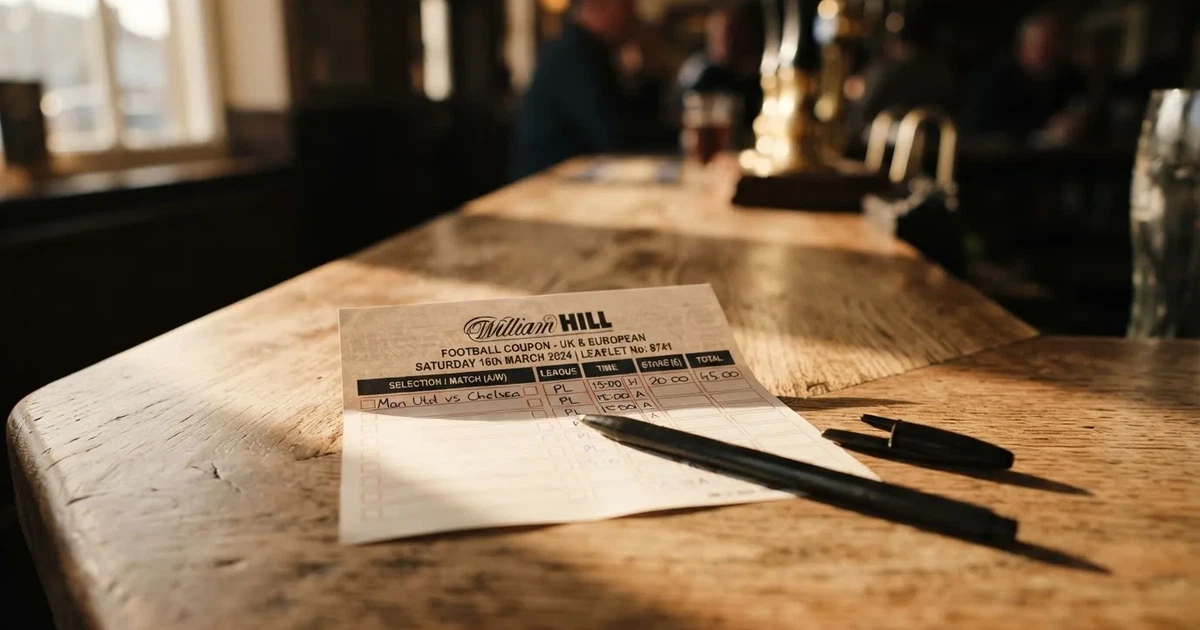
Safer gambling comes before any booking-points price
A booking-points bet looks like a tidy statistical market. Yellow card totals, points per booking, team totals: the kind of bet a regular punter can build a system around. The way to lose more than the deposit is also statistical, and the regulator has built the guardrails around it. Anyone reading the rest of this page should know where the help lines are before they open a betting account.
GAMSTOP is the national multi-operator self-exclusion scheme. Registering with GAMSTOP blocks every GB-licensed online bookmaker from accepting the customer; an account already open is closed and balance returned. Exclusion periods run six months, one year, five years, or five years with auto-renewal, and after the minimum period the exclusion stays in place for a further seven years unless the customer asks GAMSTOP to remove it. Every brand featured in the comparison below is in GAMSTOP, because the licence condition requires it. Betting shops run on a separate service.
GamCare runs the National Gambling Helpline. GambleAware funds treatment and research. The NHS runs gambling clinics. Gamblers Anonymous runs meetings. None of these is a “safer” alternative to the other: they overlap, and any of them takes a first call.
The Gambling Commission sets three controls that bear on the betting act itself. Identity is checked before the first deposit (name, address, date of birth, since 7 May 2019); the check covers free bets and bonuses, so there is no anonymous play at a GB-licensed site, even with a token. Once deposits minus withdrawals exceed £150 in a rolling 30-day window, a financial vulnerability check kicks in (in force since 28 February 2025): a public-record look-up for bankruptcies or county court judgments, not an income check and not a credit-reference search. A further stage of financial risk assessments — the affordability checks the press has been calling for — was set out by the Commission on 7 July 2026 as a staged plan with no start date; the rule as written today is the £150 vulnerability threshold.
Deposit limits at GB-licensed bookmakers are set by the customer under the operator’s own tools; there is no state-set ceiling. The Commission’s Remote Technical Standards require operators to offer a gross deposit limit over a fixed time frame, the first phase of which applied from 31 October 2025 and a second phase was postponed to 30 September 2026; the question of whether the second phase is live is not established.
The point of laying all of this out at the top is not to bury the lede. Booking points is a small market with the same risks as any other. The bettor who wants to play it for a long stretch needs the same toolkit — a fixed deposit limit, a log of sessions, and an exclusion plan they will actually use — as the bettor who plays Premier League match result markets every Saturday. Skipping this section because the market feels niche is the move that costs real money, not the move that saves time.
What booking points is, and how it settles
A booking-points market is a totals market on cards shown during a football match. Each yellow card carries a value, each red card carries a higher value, and the bet is on the running total at full time. Different bookmakers use slightly different weights, so the headline number is never settled until the punter has read that brand’s rules. The shape, however, is consistent: a points table inside the market rules, and a price on each total.

The most common weighting in British football is ten points for a yellow card, twenty-five for a straight red, and thirty-five for two yellows leading to a red (the second yellow is already booked, so the points count the first yellow plus the dismissal). A fixture that sees one yellow per team settles at twenty points; a fixture with a sending-off settles higher. Some bookmakers use a 10 / 25 / 35 split; others use 10 / 20 / 25 or 10 / 25 / 30. A handful publish over/under lines rather than fixed totals (over 30.5 points, under 40.5). What never varies is that a card shown after the final whistle does not count, and a card shown to a substitute who has not entered the field does not count. Refereeing decisions on whether a booking has been awarded stand for settlement purposes; VAR rarely intervenes on a booking because VAR reviews goals, red cards and mistaken identity, but the referee can revise a card during the match and that revision stands.
The market has two shapes a punter meets again and again. The first is the team total: home team’s cards, away team’s cards, in points. The second is the match total: every point scored by every card to either side. Some bookmakers split this into halves, so a punter can take over/under on first-half cards and a separate line for the full match. Both shapes price from the referee’s card history, the teams’ disciplinary record and the importance of the fixture: a derby or a relegation six-pointer prices tighter than a dead rubber.
Three features of the market matter for the price. Card markets sit on top of a real-world limit: referees cannot hand out more than a small number of cards in a single match, and the upper tail of the distribution is thin. Bookmakers price accordingly — overrounds on the extremes are higher than overrounds near the median. A punter shopping for value at the extreme points needs to know the shape of the distribution, not just the headline price. Second, the data is noisy. A referee’s season-long card average moves on small samples, and a single high-card match swings it. A punter betting on a referee should weight a long run of matches more heavily than the most recent two or three. Third, late cards drive total-points betting more than first-half cards. A booking in the 89th minute matters for the full-match line and not at all for the half-time line.
Booking points differs from the related player-to-be-booked market in one important way: it does not require naming a player. The card is the bet, the player is incidental. A punter uncomfortable assessing individual players can sit on the team or match total instead, which is the form of the market most casual punters find approachable.
How to read a booking-points price, and what the margin really costs
A price on booking points is two numbers, the stake and the return, separated by a fraction or a decimal. The stake is the pounds risked; the return is what comes back if the bet wins. Profit is return minus stake. A price of 5/1 returns six pounds for every pound staked: five pounds profit, one pound stake returned. The same price in decimals is 6.00 — divide the numerator by the denominator and add five, here five divided by one equals five, plus one equals six. A price of 11/4 is 11 ÷ 4 + 1 = 3.75 in decimals. “Evens” is 1/1, or 2.00 in decimals. “Odds-on” means shorter than evens: 4/6 or 1.67, the favourite.
A combination bet multiplies the legs into one price. Two selections at 3.00 and 4.00 become a combined price of 12.00: stake times 12.00 is the return if both win, profit is return minus stake. The combined price is what the punter cares about, and it is also where the bookmaker’s margin compounds — each leg carries its own margin, and the combined price carries the product of those margins.
A booking-points market typically offers four to six lines, each with its own over and under. The combined margin across all lines is the bookmaker’s edge. It is the same edge on any other market: the difference between what the punter would win in a perfectly fair book and what this book actually pays. Margin is calculated by inverting each price to an implied probability (1 ÷ decimal odds), adding those probabilities across the full set of outcomes for one event, and subtracting from one. If the implied probabilities add up to 1.05, the bookmaker keeps 5% of every pound bet on that market on average. Five per cent is roughly mid-market for a major football fixture; ten per cent is on the steep side.
To make the arithmetic visible, take an illustrative two-way market priced at decimal odds 1.90 / 1.90 — which a fraction punter reads as 9/10 against either outcome. The implied probability of each side is 1 ÷ 1.90, or about 52.63%; the two sides together imply 105.26%. The excess over 100% is the overround of 5.26%, which converts to a bookmaker’s margin of 5.0%. That is the bookmaker’s expected take from this market, on average, across a large number of bets at these prices. The figure is a band, not a point: a single bet of £10 at 1.90 wins £19 if it lands and loses £10 if it does not, and no calculation of margin changes that single outcome. But across thousands of bets at this price, the bookmaker keeps 5.0% of turnover on average. A punter reading a booking-points price should treat the headline number as the price and the 5.0% as the tax.
The calculation is worth running on any line before staking. Most major bookmakers on major football fixtures sit between 4% and 7% margin on booking-points markets, sometimes tighter on the 30.5 / 40.5 lines, sometimes looser on extreme lines and team totals. A punter shopping two bookmakers can pick the cheaper price on the line they want to back without going outside the market.
A margin of 5% sounds small. It compounds. A punter backing one bet a week at average odds of 2.00 and an average margin of 5% gives back roughly 5% of turnover to the bookmaker over a season — the same effect as paying a 5% fee on every deposit. The figure is not a prediction and it is not a system; it is the long-run cost of every pound wagered, and it is the single number the bookmaker never prints on the betting page.
How the bookmakers stack up on booking-points betting
Ten bookmakers hold a Gambling Commission remote licence for fixed-odds betting in Great Britain and run booking-points markets on major football fixtures. The set below is the comparison group for this page; each review carries the operator’s licence account, what its own terms say on the cards market, and a verdict on who it suits. The order is the publisher’s, not a ranking by quality.
The comparison set has one shared feature: every brand below takes part in GAMSTOP, verifies identity before the first deposit, and offers a customer-set deposit limit. Three of the ten are betting intermediaries or sit close to the exchange model; the rest are fixed-odds bookmakers. A punter’s choice between the two shapes is the choice between back-and-lay pricing (exchange) and traditional overround pricing (bookmaker). A booking-points market is offered by both; the liquidity on a mid-table Premier League fixture is generally deeper on the fixed-odds side, and the price is generally tighter on the exchange.
| Brand | Gambling Commission remote licence | Stance on booking points and related markets |
|---|---|---|
| Bet Ahoy | 100094 (Bet Ahoy Ltd) — remote general betting standard (real events) | Sports markets with welcome offer of a £5 sports single and a £5 acca for new customers (terms apply) |
| DragonBet | 64908 (DragonBet Ltd) — remote general betting standard (real events) | Welsh football and rugby markets, racing, American football, in-play betting and bet builder markets |
| BetTom | 64959 (Bet Tom Limited) — remote general betting standard (real events) | 50% back as a free bet up to £50 on the sports welcome offer with a matching casino free-spins leg |
| Smarkets | 39173 (Smarkets (Malta) Limited) — remote betting intermediary | Exchange-style pricing with a standard 2% commission on eligible bets and a 60-day 0% commission window for new customers |
| Paddy Power | 39439 (PPB Counterparty Services Limited) — remote general betting standard (real events) | Bet Builder+, Popular Bet Builders, Super Sub, expanded Win More markets and player stats |
| Bar One Racing | 56516 (Bar-One Racing Limited) — remote general betting standard (real events) | Irish independent bookmaker rebranded as BAR 1 Betting with racing sponsorships |
| Fitzwilliam Sports | 48760 (SBKI Limited) — remote general betting standard (real events) | Prices benchmarked to Oddschecker’s average price per selection with Apple and Android apps |
| Betmaster | 65699 (BM Solutions GB Ltd, registered in Malta) — remote general betting standard (real events) | General sports markets under a Maltese-incorporated UK-licensed operator |
| Lottoland | 38991 (EU Lotto Limited) — remote general betting standard (real events) | Combined casino, lottery betting, sports and scratchcards under one account |
| 888sport | 39028 (888 UK Limited) — remote general betting standard (real events) | Pre-match and in-play betting, Cash Out, Bet Builder, racing streams, daily boosted odds |
A booking-points market shows up on the football coupon of every brand in the table; what changes is the depth. A punter expecting team totals, half-time lines and player-to-be-booked markets on a Champions League fixture will find the deepest card at Paddy Power, Betfair and bet365 on most match nights; the table above is the licence view, not the coupon view, and the coupon itself is what the punter checks before staking. Liquidity and price move week to week; the licence does not.
Bet Ahoy is a new GB-licensed sportsbook and runs the same kind of pre-match and in-play card markets as the rest of the fixed-odds set, with a welcome offer split between a £5 sports single and a £5 acca for new customers who meet the qualifying conditions. The book is small, the licence is current, and the right reader is a punter starting out on booking points and willing to take a thinner coupon in exchange for a brand-new account with a clean bonus structure. The bonus runs through its own terms, which include minimum odds on the qualifying bet, a deadline for using the free bets and a cap on what the free bets pay back — the kind of small print every free bet carries, and the kind a punter reads before staking the £5.
DragonBet publishes its app from dragonbet ltd and lists Welsh football and rugby, racing, American football, in-play and bet builder markets. Card markets on Welsh football are the brand’s distinctive edge — a punter following the JD Cymru Premier or the Welsh Premier League has markets that the bigger books often overlook. Outside Welsh football the coupon is a standard Premier League / EFL / European book. The right reader is a Welsh-football punter who wants in-play on a regional fixture and is happy with a smaller brand.
BetTom splits its welcome offer between sports and casino: 50% back as a free bet up to £50 on sports, and a matching 50% back up to £50 as free slot funds for casino play. The sports side runs the standard football coupon, including booking points on major fixtures; the casino leg is the part to watch, because mixed-product promotions are banned under the Commission’s promotion rules that took effect on 19 January 2026 — BetTom’s existing offer predates that rule and was live when the rule came in, but a punter reading today’s terms should expect the structure to change at the next refresh. The right reader is a punter who wants both halves of the offer and accepts that one of them is on slots rather than cards.
Smarkets is a betting exchange, licensed as a remote betting intermediary. Pricing is exchange-style: customers back and lay against each other rather than against a bookmaker’s margin. Commission is 2% on eligible exchange bets, and new customers have been offered 0% commission for 60 days on a minimum first deposit of £10. A booking-points market on Smarkets looks different from a bookmaker’s: liquidity is shown, the back price sits above the lay price, and the spread is the gap between them. A punter who can read an exchange order book gets tighter pricing on most fixtures than the fixed-odds side, especially close to kick-off. The right reader is a punter comfortable with back-and-lay pricing and willing to commission.
Paddy Power is the big fixed-odds book in this set: Bet Builder+, Popular Bet Builders, Super Sub (a bet rolls over to the replacement if a selected player is substituted), expanded Win More markets and player stats. The card market sits inside Bet Builder+ and as a standalone market; a punter wanting player-to-be-booked, team totals and match totals on a Premier League fixture has the deepest card here. The right reader is a Premier League punter who wants the most markets per fixture and is happy to back at a margin of 4-6% on most lines.
Bar One Racing is an Irish independent bookmaker that has rebranded to BAR 1 Betting; it runs shops across Ireland and sponsors racing at Dundalk, Fairyhouse, Navan, The Curragh, Curraheen Park and Cork. The GB-facing site is a remote betting licence holder. A punter outside Ireland looking for racing-first markets and a quieter football card will find BAR 1 a smaller, leaner alternative to the big UK books. The right reader is a punter who wants a smaller book with a strong racing base.
Fitzwilliam Sports prices every selection against Oddschecker’s average price, which means a punter sees a market-average line rather than a bookmaker’s own price. The arithmetic that produces that average is the average of the major books on that fixture; on a booking-points market it lands somewhere near the median price across the major books. Apple and Android apps are published. The right reader is a punter who wants the average price and is happy with a smaller brand.
Betmaster is operated by BM Solutions GB Ltd, registered in Malta, and holds Gambling Commission account 65699. A Maltese-incorporated operator is a normal shape for a GB-licensed book — the licence is the GB one, the company is Maltese — and a punter checking the Commission’s public register sees Betmaster against the Maltese company’s name. The football coupon is a standard major-fixtures book, including booking points on the Premier League, EFL and the European competitions. The right reader is a punter comfortable with a Malta-registered operator.
Lottoland’s UK app combines casino, lottery betting, sports betting and scratchcards under one account, with a Gambling Commission licence for customers in Great Britain. A punter wanting the booking-points market inside an account that also runs lottery, scratchcards and casino has Lottoland as one option; a punter wanting a sports-only book has plenty. The right reader is a punter who already plays lottery or scratchcard at Lottoland and wants the sportsbook as a side.
888sport offers pre-match and in-play betting, Cash Out, Bet Builder, racing streams, BetFinder form tools, a live bet feed and daily boosted odds. A booking-points market sits inside the football coupon; a punter who wants boosted odds on card markets will see them on selected fixtures. The right reader is a punter who likes boosts on small markets and wants Cash Out on a booking-points bet that has gone in-play.
The 5% margin number above sits behind every price on the table; what changes between brands is the depth of the card and the structure around it. A punter deciding between brands reads two things: the headline price on the line they want to back, and the way the bet settles — in-play rules, settlement rules on cards after the whistle, and the cash-out availability on a card market. The licence is the floor, not the ceiling.
The legal frame around a booking-points bet in Great Britain
A booking-points bet in Great Britain sits inside a regulatory regime the Gambling Commission runs under the Gambling Act 2005. England, Scotland and Wales are inside the Act; Northern Ireland is not, and a GB licence does not cover Northern Irish customers. A bookmaker taking a bet from a customer in Great Britain needs a Commission licence wherever it is based — since the Gambling (Licensing and Advertising) Act 2014 closed the previous loophole that let offshore operators serve British customers on a home-jurisdiction licence. A Curaçao, Maltese or Gibraltar licence is not a substitute for the GB licence, and it never was, but the 2014 Act is what made the GB licence compulsory at the point of consumption.
The Commission issues five remote betting licence categories that bear on the markets above. Remote general betting standard (real events) covers pre-match and in-play fixed-odds betting on real sporting events — the licence category every brand in the table above holds. Remote general betting standard (virtual events) covers computer-generated events. Remote general betting limited is a narrower permission for restricted products. Remote pool betting covers off-course pool betting on horse and dog racing. Remote betting intermediary is the licence for betting exchanges — the category Smarkets holds. An operator offering booking-points markets needs a real-events licence; an exchange offering a booking-points market needs an intermediary licence. The Commission’s public register lists the categories against each account number and is the whole test of whether a brand holds a licence.
There is no statutory list of permitted markets. The 2005 Act does not list which markets may be offered; an operator holds a licence for a category and offers markets under its own rules, the Licence Conditions and Codes of Practice (LCCP) and the Commission’s social responsibility code. In-play betting on football is licensed and operated at every major GB bookmaker; the controls are licence conditions and customer-protection duties, not a separate statute. Esports is treated like any other event; virtual events are a separate licence category. Bets on politics, TV shows and novelty markets are offered by GB bookmakers and no statutory prohibition was found. The shape of a booking-points market — its weighting, its team or match orientation, its lines — is the operator’s choice.
Financial spread betting is regulated by the Financial Conduct Authority, not the Commission — a distinction a punter should hold in mind, because the FCA’s regime is closer to a derivatives rulebook and the consumer protections are different. Spreadex, which runs both a financial spread betting book and a fixed-odds sportsbook, is the case in point: the same brand sits under two regulators, one for each book.
Player protection is set out above. The controls that bear on the bet itself are three. Identity verification before the first deposit, in force since 7 May 2019, including with a free bet or bonus. The £150 rolling-30-day vulnerability check, in force since 28 February 2025. The staged financial risk assessments announced by the Commission on 7 July 2026 with no start date. None of these is an income check; the first is a public-record look-up for county court judgments or insolvency, the second is a public-record look-up at higher cumulative spend, and the third is the affordability regime the press has called for.
Advertising runs through the CAP Code (non-broadcast) and the BCAP Code (broadcast), enforced by the ASA, alongside the LCCP marketing conditions. The CAP Code at section 16 sets the social-responsibility standard: marketing must not be of strong appeal to under-18s, no one who is or seems to be under 25 may feature gambling or play a significant role (with an exception for marketing placed where a bet can be made directly). That rule concerns who may appear in the advertisement, not who may bet, and it does not displace the 18-and-over minimum age at the betting site itself. “Whistle-to-whistle” — the rule that betting ads do not run on TV from five minutes before a live sports broadcast to five minutes after it, before the 9pm watershed — is an industry code rather than statute, in force since 1 August 2019, with horse and greyhound racing excluded. The Premier League’s voluntary withdrawal of gambling sponsorship from the front of matchday shirts, starting from the 2026/27 season, is a league-level decision and not a regulatory one; sleeves and hoardings remain.
Promotion rules in force since 19 January 2026 cap wagering requirements on bonuses at 10x — a £10 bonus at 50x wagering needed £500 of qualifying bets; under the cap the same bonus needs no more than £100. Mixed-product promotions — an offer that requires gambling on two or more product types such as betting, casino, bingo and lottery, the kind of “bet on football to get free spins” structure the major books used to run — are banned. Whether the cap applies to free bets with no wagering condition, and any cap on the money value of a bonus, are not established. The bonus cap a mover does not read: the cap covers wagering requirements on bonus funds, not the price of a free bet token; the bonus cap a mover should read is the maximum win on a free bet, which is set by each operator’s own terms.
The player pays no tax on betting winnings in Great Britain — a general statement, not tax advice, and a professional gambler should ask HMRC or an adviser. General Betting Duty is the operator’s tax on gross profits, currently 15%; from 1 April 2027 a new remote-betting rate of 25% applies within it, while remote bets on UK horse racing, bets on self-service betting terminals in licensed premises, pool betting and in-person betting stay at 15%. Until 1 April 2027 the remote rate stays at 15%; whether operators pass duty on through odds is not established, and a punter should never read the duty as a charge passed through to the customer.
Offshore operators without a GB licence are a different case. The point of consumption makes a GB licence compulsory; providing gambling facilities in Great Britain without the licence the Act requires is an offence under section 33 of the 2005 Act, with penalties on summary conviction of up to 51 weeks’ imprisonment, a fine up to level 5, or both (six months in Scotland). The offence is aimed at the operator, not the customer: a customer who merely bets on an unlicensed site commits no offence, but loses the GB-licensed site’s protections — no GAMSTOP coverage, no Commission complaints route, no approved dispute-resolution body, no British consumer redress if funds are withheld, and no obligation on the operator to honour the 10x bonus cap, the £150 vulnerability check, or the customer-set deposit limit. Enforcement is disruption, not blocking — cease-and-desist notices, search-engine referrals, work with registrars, hosts and payment providers, and the court-order DNS blocking powers the Commission has been given or is about to receive. A punter should never read “unlicensed” as “illegal to bet on”; the right framing is “no GB protections, possible loss of funds”.
The minimum age is 18 across the whole GB regime. A punter under 18 betting on an unlicensed site is no more protected than an adult punter, and an unlicensed operator has no obligation to refuse the bet.
What the operators’ own terms say on booking points and related markets
Each review below takes the operator’s own published terms as the source and reads them for what they actually say about the markets a booking-points punter uses. There is no value-judgement here on which bookmaker is “best” — that decision is the punter’s, on the price they see and the fixture they want.
Bet Ahoy — new GB-licensed sportsbook with a small welcome offer
Bet Ahoy’s welcome offer splits into a £5 sports bet and a £5 acca for new customers who meet the qualifying conditions, and the operator runs a pre-match and in-play football coupon with booking points on major fixtures. The licence is current and the operator is on GAMSTOP. A punter checking the betting rules for card markets should expect the same shape as the bigger books — team totals, match totals and over/under lines — and should weigh the smaller brand’s narrower coupon against the welcome offer’s small-stake simplicity.
DragonBet — by the book for Welsh football and rugby
DragonBet’s published terms feature Welsh football and rugby, racing, American football, in-play and bet builder markets, and the licence is current on the Commission’s register. A punter following the JD Cymru Premier has markets that the bigger books often miss. The football card on the bigger European fixtures is a standard bookmaker’s book. Card-market rules follow the operator’s published weighting — the punter reads the rules page before staking.
BetTom — sports welcome split with a casino leg
BetTom’s sports welcome offer is 50% back as a free bet of up to £50, with a matching 50% back up to £50 as free slot funds for casino play, and full terms apply on both legs. The licence is current. A punter reading the sports side of the offer sees a standard fixed-odds welcome offer; the casino leg is the part to check, because mixed-product promotions are banned under the Commission’s promotion rules that took effect on 19 January 2026. The sports coupon carries booking points on major football fixtures.
Smarkets — exchange pricing with a commission structure
Smarkets applies a standard commission of 2% on eligible exchange bets, and new customers have been offered 0% commission for 60 days with a minimum first deposit of £10. The licence category is remote betting intermediary. A punter reading the booking-points market on Smarkets sees back-and-lay pricing with the spread between the back and lay prices; commission sits on winning bets, not on losing ones. The exchange model prices tighter than the fixed-odds book on most fixtures.
Paddy Power — the Premier League card
Paddy Power’s app offers Bet Builder+, Popular Bet Builders, Super Sub (a bet rolls over to the replacement if a selected player is substituted), expanded Win More markets and player and ACCA stats. The booking-points market sits inside Bet Builder+ and as a standalone market. The licence is current. A punter wanting the deepest card on a Premier League fixture has BetBuilder+ as one of the broadest single-event builders in the GB market. The cash-out rule on a card market is the operator’s standard in-play rule.
Bar One Racing — Irish independent rebranded as BAR 1 Betting
Bar One Racing has rebranded as BAR 1 Betting, an Irish independent bookmaker with shops across Ireland and racing sponsorships at Dundalk, Fairyhouse, Navan, The Curragh, Curraheen Park and Cork. The GB-facing site holds a remote betting licence. A punter outside Ireland looking for a quieter book with a strong racing base has BAR 1; a punter wanting Premier League depth has bigger books.
Fitzwilliam Sports — priced to the Oddschecker average
Fitzwilliam Sports bases its prices on Oddschecker’s average price for each selection and publishes Apple and Google mobile apps. A punter reading the betting page sees a market-average line on every fixture; the arithmetic is the average of the major books. The licence is current. A booking-points punter wanting the average price has Fitzwilliam as one option; a punter wanting the lowest available price should still check the cheapest book on the day.
Betmaster — Maltese-incorporated, GB-licensed
Betmaster is operated by BM Solutions GB Ltd, registered in Malta, and states it holds Gambling Commission account 65699. A Maltese-incorporated operator with a GB licence is a normal shape — the licence is the GB one, the company is Maltese — and the punter checks the Commission’s public register against the Maltese company’s name. The football coupon is a standard major-fixtures book with booking points on the Premier League, EFL and the European competitions.
Lottoland — sportsbook as a side
Lottoland’s UK app combines casino, lottery betting, sports betting and scratchcards, and is licensed by the Gambling Commission for customers in Great Britain. A punter reading the sports side of the app finds a standard football coupon with booking points on major fixtures; the lottery and casino are the operator’s main business. The licence is current.
888sport — boosted odds and Cash Out
888sport offers pre-match and in-play betting, Cash Out, Bet Builder, racing streams, BetFinder form tools, a live bet feed and daily boosted odds. A booking-points market sits inside the football coupon. A punter wanting boosted odds on card markets sees them on selected fixtures; Cash Out on a booking-points bet is the operator’s standard cash-out rule, with availability on selected markets.
How to settle a booking-points bet, and what to do when it goes wrong
A booking-points bet settles on the referee’s decision at full time. Cards shown after the final whistle do not count; cards shown to substitutes who have not entered the field do not count; cards shown on the touchline to coaches and bench staff do not count. The referee’s decision on whether a booking has been awarded stands for settlement purposes. If the referee revises a card during the match (for example, after a VAR review of mistaken identity), the revised card stands. Where VAR has changed the on-field decision from no card to a red card, or from a yellow to a red, the new decision settles the market. Bookmakers settle on the official match data feed at the end of the match; a delayed broadcast feed is not the settlement source.
Two settlement issues recur on card markets. The first is the late dismissal: a card shown in the eighth minute of added time, for a player who was on the pitch when the substitution window closed, counts on the full-time line and on the team total. The second is the substituted player: a player who was on the pitch at kick-off, booked during the match and substituted before full time, has the card count on the team total but not on the player-to-be-booked market (if the punter took a player market with a “must start” rule). Most bookmakers settle card markets on the data feed at full time; a small minority allow a settlement review of up to 24 hours after the match. The punter reads the rules page for the brand they are on.
Settlement disputes go to the operator’s customer service first, then to an approved alternative dispute resolution (ADR) body if the customer is not satisfied — the operator’s licence requires the use of an ADR provider. The Commission’s public register lists the ADR provider against each licence. A punter who has used a GB-licensed bookmaker and reached a settlement dispute has a route; a punter on an unlicensed site does not.
The bookmaker’s customer-protection rules are the floor, not the ceiling. A punter who loses more than they can afford — whether the bets were on booking points, on Premier League match result or on a casino game — has the support lines set out in the opening section of this page. The bookmaker’s deposit limit and the GAMSTOP exclusion are the structural tools; the support lines are the human ones.
Frequently asked questions about booking points betting
What are booking points in football betting?
Booking points is a totals market on the cards shown during a football match. Each yellow card carries a set of points and each red card carries more; common weightings are 10 / 25 / 35 or 10 / 20 / 25, depending on the bookmaker. The bet is on the running total at full time. Cards shown after the final whistle do not count.
How many points is a booking in betting?
Most GB bookmakers use ten points for a yellow card, twenty-five for a straight red, and thirty-five for a second yellow leading to a red. Some operators use slightly different weightings, so the punter reads that brand’s market rules before staking. The shape of the market — team totals, match totals, over/under lines — is the same across the bookmaker set.
How can it be checked that a bookmaker holds a Gambling Commission licence?
The Commission’s public register can be searched by business name, trading name, domain or account number and is the whole test of whether a brand holds a licence. Each licence account lists the licence categories — remote general betting standard (real events), remote betting intermediary, and so on — and the address of the registered business. A bookmaker’s own terms page should show the licence account number; if it does not, the punter checks the register directly.
How is the return on a bet worked out from the stake and the odds?
Return is stake times the decimal odds. Profit is stake times (decimal odds minus one). A £10 bet at 3.75 returns £37.50, a profit of £27.50. For a combination bet the odds of the legs multiply into one price; a double at 3.00 and 4.00 has a combined price of 12.00. Fractional odds convert to decimals by dividing the numerator by the denominator and adding one — 11/4 is 3.75, 5/1 is 6.00, evens (1/1) is 2.00.
What is the bookmaker’s margin and how is it visible in the odds?
The margin is what the bookmaker keeps of every pound bet on the market, on average. It is calculated by inverting each decimal price to an implied probability (1 ÷ odds), adding those probabilities across every outcome, and subtracting from one. An illustrative two-way market at 1.90 / 1.90 implies 52.63% on each outcome, total 105.26%, margin 5.0%. The number is a long-run average across many bets at those prices, not a charge on a single bet. The margin is a band on a real fixture: a major football fixture’s booking-points market typically sits between 4% and 7% on the central lines, looser on the extremes.
Bet types & in-play – Basketball betting
Content created by the «Basketball betting» team
