
Floorball betting odds in 2026: where to bet, what the price gives up, and what the offer takes
 Available in US
Floorball is a small market on British sportsbooks — a winter sport on a sparsely priced menu — so the question is rarely *who offers floorball*. Most licensed brands do, around the World Championship window and the leading Nordic leagues. The question that pays the bills is what each one charges for the privilege: the margin between the two sides of a market, the rollover on a bonus, the minimum price a free bet will take, the deadline on a free bet, the cap on what it wins. Cost is the angle through which the rest of this page is written.

A short note on dates and verification. The price-and-licence material on this page is current as of 27 October 2026 and was checked against the Gambling Commission’s public register of operating licences for each brand named below. Operator offers are described in their own terms, as those terms state them, with no working bonus code printed anywhere on this page.
How this ranking was put together
Ten operators were chosen because each holds a remote operating licence from the Gambling Commission for Great Britain. The set is not exhaustive — the register lists many more — and it is not a leaderboard. Several of these brands price floorball thinly outside the World Championship window, and two of them have only recently added the sport at all. Three were picked for reasons of pricing depth or breadth (live markets, bet builders, acca insurance). Two are spread-betting or exchange brands that handle the sport differently. Two are smaller UK brands whose floorball coverage exists primarily around Nordic top-flight fixtures. The rest run large general sportsbooks whose floorball markets read like a slimmer copy of their football coverage.

What every entry below covers: the licence, the holder behind the trade name, and what the operator’s own published terms say on the two matters most relevant to a floorball bettor — whether (and how) floorball appears in the sportsbook, and what the headline offer takes in turnover, minimum price or expiry. Where the operator’s site states none of that, the entry says so plainly and stops.
The licensed operators side by side
The licensing detail is what the Commission’s public register carries for each brand. The “terms on this market” column is a paraphrase of what each operator’s own house rules or offer page state, in the operator’s own words and without a working code attached. Where an entry names a price, expiry or minimum, the figure is the one the operator’s own page carried at the time this article was assembled — verify it against the live terms before staking.
| Brand | Gambling Commission remote licence and holder | What the operator’s own terms say on the sport, the offer or the free bet |
|---|---|---|
| DragonBet | 064908-R-339041-003 — DragonBet Ltd | Floorball sits alongside Welsh football and rugby, racing and American football; in-play and bet-builder markets published through the app. No deposit-gated welcome package detailed on the public site. |
| Betmaster | 065699-R-339929-002 — BM Solutions GB Ltd | Sportsbook covers football, cricket, horse racing, NFL and eSports; floorball is not among the sports the app listing names in full. Bonus terms are stated on the operator’s site and apply per product, not per sport. |
| Bar One Racing | 056516-R-332750-007 — Bar-One Racing Limited | Irish-focused racing bookmaker with horse-racing sponsorships at Dundalk, Fairyhouse, Navan, The Curragh, Curraheen Park and Cork; floorball coverage is not the shopfront offer and falls outside that focus. |
| BetGoodwin | 002927-R-327985-008 — Goodwin Racing Limited | Sports welcome offer: “Bet £10 & Get £15 in Free Bets”, made up of a £5 sports bet, a £5 acca and a £5 Sub-Cover bet. Bonus split is the headline condition; expiry and minimum-odds terms apply per leg. |
| Dabble | 065677-R-340363-005 — Dabble Sports UK Ltd | Welcome offer: “Bet £10, Get £10 in Free Bets” on a first deposit, with minimum odds, a 7-day free-bet expiry, and the stake not returned with a win. |
| Spreadex | 008835-R-104580-022 — Spreadex Limited | Combined fixed-odds and financial-spread bookmaker, FCA-regulated for spread betting and UKGC-regulated for fixed odds; Bet Builder available on fixed odds or spreads; spread losses can exceed the deposit and are a separate risk class from the fixed-odds line. |
| 10bet | 043173-R-322899-023 — Blue Star Planet Limited | Sportsbook lists football, tennis and horse racing in the app description, with Cash Out, Bet Builder and live streaming stated. Floorball market depth was not specified on the listing, so punters check the sportsbook before staking. |
| Betboro | 044181-R-324363-007 — Webmedia Development N.V. | Sports welcome offer: a 100% matched free bet up to £25 on the first qualifying wager, requiring a debit-card deposit of at least £10 and a first bet of £5 to £25 with at least three selections at 3/5 (1.60) or higher. |
| London Bet | 066162-R-340278-004 — Thistle Bet Limited | App covers football, tennis, horse racing, greyhounds, darts, golf, cricket, NFL, NBA, MLB, snooker, with Pragmatic Play casino slots alongside and live in-play published on the listings. Welcome terms apply to the sportsbook product, not to casino. |
| NetBet Sport | 039170-R-319343-032 — Netbet Enterprises Limited | Sportsbook publishes Daily Boosts, Profit Boosts and free-bet offers, a Bet Builder with instant dynamic odds, and sports stats for major leagues. Floorball-specific market depth is not on the listing; the operator’s own sportsbook page is the source to check. |
The brand list is ordered by Commission account number, not by quality of coverage. Several of these operators run floorball markets primarily around the Men’s World Floorball Championship window and the Swedish Superligan regular season; year-round Nordic-league pricing is patchy across all ten. The single conclusion this table supports is a structural one: floorball coverage on a GB sportsbook is a side product, not a shopfront category, and the price-and-offer terms for the sport are inherited from the operator’s general sportsbook terms rather than from a sport-specific page. That is the marketing side of why the cost read-through matters more than the depth read-through.
Floorball as a betting market
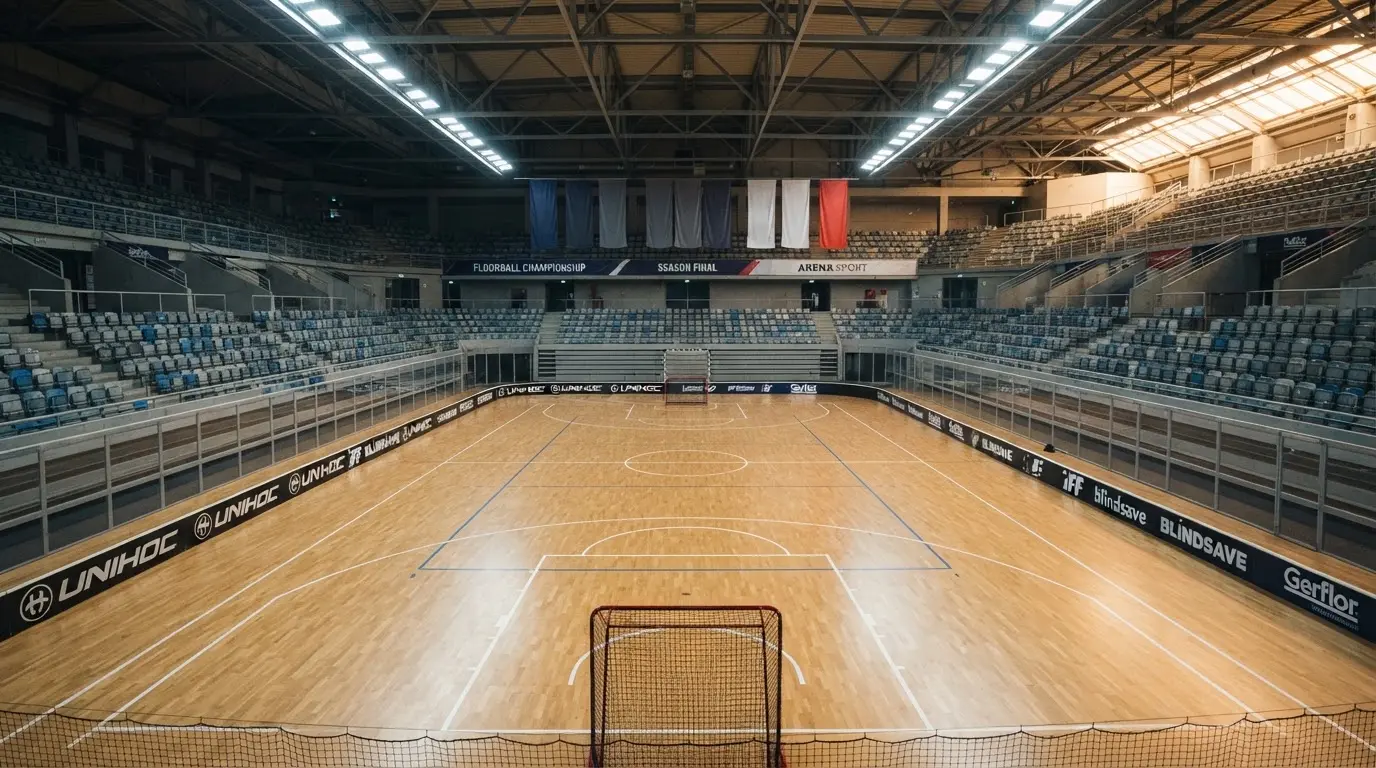
Floorball is an indoor stick-and-ball sport played five-a-side plus a goalkeeper on each side, over three periods of twenty minutes each, with sudden-death overtime if the regulation scores are tied. The rules are short enough to fit on one sheet — that brevity is most of what the sport has going for it as a betting proposition. There is no offside in the strict football sense, no body-checking, and a clear pattern of scoring runs inside the third period once legs tire and short rotations come into play.
That simplicity cuts two ways for a price. Betting markets built on small team sports tend to be sparse: a 1X2 line, an over/under on total goals, a handful of handicaps at small line values, and a period-by-period market where the operator’s pricing engine is mature. Anything more elaborate — player props, shot totals, shots-on-goal — is the territory of a handful of sportsbooks at tournament time only, and it tends to look thin even then. The price a sportsbook prints for that menu is shaped less by competitive depth than by what its pricing engine was told to assume about the league in question. Where the engine was trained on Swedish Superligan results and is asked about the Czech Extraliga, what comes back is a confident-looking number built on incomplete data, and the margin the operator loads on top of it is higher than it is for a market it prices every week.
This matters for the punter because floorball season runs almost year-round in the Nordic leagues, with a December window for the World Championship (the men’s edition lands every second December in even-numbered years, the next one being Tampere 2026 on 4-13 December). Pricing depth follows that calendar: there is more of it in October to April, and noticeably less in May to August, when the bookmakers’ compilers are looking at friendly tournaments, summer leagues and qualification rounds. Outside that main window, the market on any given league is best understood as a thin one — fewer selections, fewer prices, more movement per bet, and a wider margin on whatever is left to bet on.
The simplest price, in plain words
A floorball bet is a contract: you put a stake on a selection, the operator names odds, and if you are right the operator pays stake × odds back. A £10 bet at 2.50 returns £25 — £10 of which is your original stake and £15 of which is profit. A £10 bet at 1.50 returns £15, with £5 of profit. The shorter the price (the closer to 1.00, or “evens” in fractional terms at 1/1), the smaller the profit margin relative to the risk, because the operator is signalling that the outcome is more likely than not.
Odds are printed one of two ways in Great Britain. Fractional odds such as 5/1 or 11/4 are the older British convention; they mean a £5 profit on a £1 stake at 5/1, or an £11 profit on a £4 stake at 11/4, with the stake added back for the return. Decimal odds such as 6.00 or 3.75 are the same information in another form: multiply the stake by the decimal to get the return, with the profit being everything above the stake. Converting from fractional to decimal is to divide the first number by the second and add one — 5/1 becomes 6.00, 11/4 becomes 3.75, evens (1/1) becomes 2.00. Both forms appear on the same betting slip; switching between them does not change the price.
What the margin really looks like
Every price a bookmaker prints already contains its margin, and the margin is the share of every pound wagered the operator expects to keep across the long run. It is built into the prices rather than levied as a fee, which is why a market on a thinly covered league tends to feel expensive without anything looking obviously wrong on the slip. The maths is the giveaway: a market with no margin would have all selections’ implied probabilities add up to exactly 100%; a real market has them add up to more than 100%, with the extra amount being the margin.
Take the simplest possible two-way floorball market — match winner with no draw option, or a totals line priced 1.90 / 1.90 in decimal. The over and the under each imply a 52.6% chance of landing (1 ÷ 1.90); adding the two implied chances gives 105.3%. That 5.3% gap is the margin, distributed across the two sides of the market. A punter staking on it should expect, as an average over many bets, to lose about 5p of every £1 staked to the operator — before any offer that discounts the price or refunds part of the stake. Two-way markets at 1.90 / 1.90 are closer to the floor of what the floorball market prints; three-way markets with a draw option are wider, with margins in the 6%-9% range being ordinary for a less-trafficked league. The exact figure depends on the league, the time of season and which sportsbook is printing the price.
This margin is the load-bearing column of everything else on this page. A free bet worth £10 is not £10 in your pocket: it is whatever the operator pays back after the margin is removed, on average. A boosted-odds headline is rarely as generous as the headline number suggests, because the operator adjusts the boost to absorb its margin first. An accumulator is many two-way markets multiplied together, and the margins compound with each leg. A bet builder on a single match stacks markets, and the stacks of margins are why a builder price often feels stingier than the individual legs would have been. Every pricing decision on the page eventually comes back to the margin; everything else is presentation.
Combination bets and the compounding margin
A combination bet — a double, a treble, an accumulator, a Trixie, a Yankee, a Lucky 15, a Heinz — multiplies the prices of its legs into one composite number. A £10 stake on three legs at 2.00, 3.00 and 4.00 reads as a £10 bet at 24.00, paying back £240 if all three legs win. The arithmetic is simple; the cost is harder to see. Each individual leg carries its own margin against the true probability, and the multiplication spreads and compounds that margin across the bet. A £10 bet at 24.00 is not a fair bet at 23-to-1 against the true odds of all three legs landing; it is a bet at 24-to-1, and the extra 1 unit is the accumulated operator margin.
Multi-leg bets are attractive precisely because the proportional return on a small stake looks life-changing on the slip. The punt is on how often the combination lands, not on how the price was built. A four-leg acca at the average per-leg margin of around 7% carries a compounded margin north of 30% at the bookmaker’s edge. That is why acca-insurance offers exist: the operator knows the margin is already generous, and a refund on a one-leg miss is a marketing cost rather than a real concession. The same pattern runs through bet builders on a single match — a same-game multi across three or four markets is not the same as three or four individual bets, because the operator’s pricing engine has removed the cross-leg vigourish before it shows you the number.
The practical upshot: combination bets are how a sportsbook turns a small per-bet margin into a comfortable per-bet profit without changing the headline price. The punter who likes to build accas is paying, on average, roughly five times the margin of a single-bet punter on the same sport.
Where floorball sits in the British legal frame
A bookmaker serving customers in Great Britain needs an operating licence issued by the Gambling Commission, regardless of where in the world it is headquartered. The Gambling (Licensing and Advertising) Act 2014 closed off the old point-of-supply loophole, so a Curaçao, Maltese or Gibraltar licence no longer covers operators taking bets from British customers — they need a Commission licence on top. The framework, the Licensing Conditions and Codes of Practice, the social responsibility code and the player-protection duties all flow from the Gambling Act 2005 (sections 33 and 36 as amended), and they apply uniformly to every licensed brand.
The Commission itself is a non-departmental public body sponsored by the Department for Culture, Media and Sport. Its public register lists every operating licence by business name, trading name, domain and account number, and the register is the only source to rely on for whether a brand is licensed. It is searchable on those four criteria; licenses run for five years and renew on application. Where the register says a brand is licensed for “remote general betting standard (real events)”, that brand can offer floorball markets under its general betting licence — no separate sport licence is needed, because there is no statutory list of permitted sports, and the operator’s own licence conditions and house rules decide what appears on its sportsbook.
This is the bit that catches out new floorball punters: a GB licence is the test of who can take bets in Britain, but it does not in itself say anything about what sports or markets any given operator offers. The bookmaker on the licence is the operator; what it prices is its own decision. Some punters assume that “licensed to take bets” means “licensed to take bets on every sport ever played”; the register says no such thing. Floorball markets exist because a bookmaker decided to add them, not because a regulator told it to.
Spread betting and the FCA
Floorball sits squarely inside fixed-odds sports betting, and a normal sportsbook does everything a punter needs. One of the operators in the table above — Spreadex — runs both a fixed-odds sportsbook regulated by the Gambling Commission and a financial spread-betting book regulated by the Financial Conduct Authority. The two products look superficially similar but carry very different risk profiles. Fixed-odds bets pay back stake × odds at most; financial spread bets expose the punter to losses larger than the deposit because they are priced off a per-point movement in the underlying market, and the operator does not cap how far the market can move against a position before settlement.
This is the only entry in the ten where the regulator’s name on the licence is not the Gambling Commission alone. It matters because a punter who opens a Spreadex account intending to use it for fixed-odds floorball bets can also end up using the financial-spread product for a more demanding position than they intended. The two products live in the same app and on the same wallet — easy to confuse, very different cost.
Tax on winnings
Betting winnings in Great Britain are not taxed on the punter’s side. A successful floorball bet pays the operator’s return in full and that return is the punter’s to keep, with no further tax to HMRC. The general rule stands across fixed-odds betting, pool betting, betting exchanges and spread betting on sport; a professional gambler whose living comes from betting is a different matter, and one HMRC or an adviser should be asked directly.
General Betting Duty is the operator’s tax, levied on its gross profits from betting at the current rate of 15%, with a separate remote rate of 25% scheduled to apply to remote bets from 1 April 2027 (HM Government policy paper of 26 November 2025). The duty is an operator-side figure — a tax paid to HMRC by the bookmaker — and it does not appear on a betting slip. Whether an operator chooses to recoup part of the duty by tightening its margins is a strategic decision, not a published number, and it is not established that the remote rate change will pass through to prices at all. The punter’s exposure to General Betting Duty is, in practice, zero. The punter’s exposure to whatever the operator does in response is, in principle, real but unmeasurable until the change happens.
Offshore sites, and what is lost by using one
A bookmaker that does not hold a Commission licence but nevertheless takes bets from customers in Great Britain is committing an offence under section 33 of the Gambling Act 2005. The offence is aimed at the operator — on summary conviction, up to 51 weeks’ imprisonment, a fine, or both (six months in Scotland) — not at the customer. A punt on an unlicensed site is not “illegal to use” in any sense the Gambling Act creates, but the customer gives up the protection the British framework provides. Concretely, that means no GAMSTOP coverage, no Commission complaints route if a payout is withheld, no approved alternative dispute resolution body for a disputed settlement, no British consumer protection if funds are held, and no application of the 10x bonus cap or the £150 vulnerability-check threshold to the offer the site gives.
Enforcement against the unlicensed operator is disruption rather than blocking: cease-and-desist notices, referrals to search engines, work with registrars and payment providers. The Commission has been given, or is about to receive, court-order DNS blocking powers, but that is not in the same category as a network-level block already running. The honest framing is that a licensed site is the only site in Britain where a punter has a complaints route to a regulator that can act, and an unlicensed site is the only site in Britain where a punter has no protection from a regulator at all. Neither is “the safe choice” by default; the licensed one is the *only* choice with recourse.
The player-protection duties a licensed site owes
Player protection under the Gambling Commission’s framework is layered, and the layers bite in different ways. GAMSTOP is the national multi-operator self-exclusion scheme — a single registration that closes the door on every licensed online bookmaker at once. It is a mandatory licence condition for online operators, in force since 31 March 2020, and every GB-licensed operator takes part. Exclusions can run six months, one year, five years, or five years with auto-renewal; the minimum period is followed by a seven-year period during which the exclusion stays in force unless the customer asks GAMSTOP to remove it. GAMSTOP covers online sites and apps; the betting shop uses a separate scheme. It costs nothing, takes a few minutes to set up, and is the single most powerful tool a British customer has for closing online betting accounts.
The Commission’s player-protection work is layered beyond self-exclusion. Identity verification before the first deposit — name, address and date of birth, in force since 7 May 2019 — means there is no anonymous play at any licensed site. The verification requirement applies even when a customer is claiming a free bet or bonus, so the “free” in a free bet offer applies only to the stake-not-returned rule, never to the registration step.
A financial vulnerability check applies to remote betting when a customer’s deposits minus withdrawals exceeds £150 in a rolling 30 days, in force since 28 February 2025. It is a public-record check — bankruptcy orders, county-court judgments, similar registers — not an income check, and not the credit-reference check that some press coverage describes. The financial risk assessments that the press calls “affordability checks” have been announced in a staged plan by the Commission on 7 July 2026, with no start date. Until the Commission publishes a date, those checks are policy under development, not a live requirement. Deposit limits — the operator’s obligation to offer a gross deposit limit on a fixed time frame — were first introduced on 31 October 2025, with a second phase postponed to 30 September 2026, and whether the second phase is live is not established. There is no state-set deposit or loss ceiling for betting; limits are a customer’s choice and an operator’s offer, not a state-set figure.
The marketing rule that affects what an offer looks like is the bonus cap: from 19 January 2026, wagering requirements on bonuses are capped at 10x (a £10 bonus at 50x would need £500 of bets; under the cap no more than £100), and mixed-product promotions — offers that require the customer to gamble on two or more product types such as betting, casino, bingo and lottery — are banned. “Bet on football to get free spins” is the kind of offer this rule takes off the table. Free bets with no wagering condition are a separate question; whether the cap applies to them is not established, and neither is any cap on the money value of a bonus.
Help is available outside the operators themselves. GamCare runs the National Gambling Helpline. GambleAware funds treatment and education. The NHS runs gambling clinics in several regions. Gamblers Anonymous runs peer-support meetings. The Commission’s safer-gambling register of approved bodies is a useful shortlist if one of these is needed; the headline point is that a licensed operator has to point customers at these services, and an unlicensed one does not.
Payments and the credit-card ban
Credit cards are banned for gambling in Great Britain, in force since 14 April 2020. The ban covers credit cards themselves and credit-card-funded payments through an e-wallet — the funding instrument is the test, not the destination. Debit cards and bank-based payments are not covered by the ban, which is why almost every British sportsbook centres its payment page around Visa Debit, Mastercard Debit, bank transfer and a small set of bank-direct payment rails (Faster Payments, Open Banking, sometimes Pay by Bank App). Some operators offer PayPal, Apple Pay and Google Pay as debit-card-fronted rails, and a few accept prepaid vouchers.
E-wallets are caught two ways. An e-wallet funded from a credit card is covered by the credit-card ban and is refused at the deposit stage. An e-wallet funded from a debit card or bank account is fine, though the operator may apply its own internal restrictions on which accounts can withdraw back to which funding source. Source-of-funds questions at higher spend are normal under the anti-money-laundering framework and do not indicate a problem with the deposit itself. Cryptocurrency deposits at licensed operators are not addressed by a British-named-account rule and not banned at the regulator level; describe them only where an operator’s own terms address them, because the operator’s site is the source for that figure.
Identity verification before the first deposit means no anonymous play at a licensed site, and that is the same point made earlier in the player-protection section. From a payments point of view, it means a customer’s first deposit can stall on a verification prompt that looks unnecessary for a £10 top-up. The stall is the system working as designed; the alternative is the kind of anonymous-play environment that has been illegal at a licensed site since the verification requirement came in. The credit-card ban and the identity check together are the two-step entry door at every British sportsbook; the cost of compliance is the price of consumer protection.
What the headline offers really take
A welcome offer printed on a sportsbook landing page is a contract with three moving parts: what you put in (a deposit, a qualifying bet), what you get back (free bets, bonus cash, a price boost), and what the operator wants back in return (a turnover multiple on the bonus, a minimum price on qualifying bets, an expiry on free bets, sometimes a cap on what a free bet wins). The headline is rarely the cost.
A “Bet £10, Get £10 in Free Bets” offer is the cleanest illustration. The marketing number is £10; the cost is what the £10 free bet does not return to you. Where the stake is not paid back with a win — and that is the standard rule on most welcome offers — a £10 free bet at 3.00 returns £30, with £20 of profit, and you put the £10 stake down and did not put your own money on the line for that stake. What the offer is worth in your pocket depends on the price at which you place it and the margin the market on which you place it carries.
A free bet is worth roughly the stake × (odds − 1) ÷ odds × payout share on average, where payout share is one minus the margin of the market used. On a market at 1.90 / 1.90, with an overround of 5.3%, the implied payout share is 95.0%. A £10 free bet at decimal odds 3.00 (fractional 2/1) placed on such a market is worth £10 × (3.00 − 1) ÷ 3.00 × 0.950 ≈ £6.33 on average across many bets. That is roughly 63% of the nominal value of the free bet. Higher-priced legs (say 6.00) lift the value; lower-priced legs compress it; tighter markets with a smaller margin lift it further. The same £10 placed at 1.50 on a tighter market is worth closer to £3.20. The whole point of a free bet is that the operator controls the pricing environment, and most welcome offers lean on that control.
A boosted-odds offer is the same sort of deal: the operator names an inflated price on a selection, the inflated price replaces the regular price for the duration of the offer, and the inflation is the cost of the marketing. On a real market at 5.00, a “boosted” 10.00 is not the same offer as a flat 10.00 would have been, because the operator has priced the boost in a way that absorbs its margin first. The punter is offered a headline number that looks bigger; the realised expected value of the boost is much smaller than it looks, because the margin is what pays for the boost.
Acca insurance — one leg of an accumulator falls, the operator refunds the stake as a free bet — is the same calculation with a different cost. A four-leg acca carries a compounded margin well above 30%, on average, and the operator offers a refund on one missed leg because the margin is already there to support it. The refund is a marketing cost that does not threaten the underlying profit on customers whose accas land. The same logic applies to a bet-insurance offer on a same-game multi or a wagering-promotion refund on a losing bet, in any form the operator publishes.
The bonus cap from 19 January 2026 is the reason some of the bigger headline offers have quietly shrunk. A 10x rollover cap on the bonus base rules out the old £10-at-50x designs, and the offers that survive are typically either single free bets with no wagering condition (cap application not established) or bonuses on the £10 scale with simpler conditions. Mixed-product promotions being banned also reshapes the offers a sportsbook can run, in particular anything that mixed a sportsbook bonus with casino free spins.
The cleanest way to read a welcome offer
There are five pieces to read. First, the qualifying deposit or qualifying bet — what the offer actually requires you to put down to unlock the headline. Second, the bonus — the headline number, and what kind of thing it is (free bet, bonus cash, a price boost). Third, the rollover or wagering multiple on the bonus if it is bonus cash, and the minimum price on qualifying bets if it is a free bet. Fourth, the expiry — how long you have to use the bonus before it is forfeit, normally 7 to 30 days. Fifth, any cap on what a free bet wins, which the operator sets in its own terms and which is independent of the stake-not-returned rule.
The same five checks work on an existing-customer promotion (a price boost, an acca insurance, a refund offer). The stake-not-returned rule on a free bet is the rule most customers do not notice until they look at the slip — a £10 free bet at 5.00 returns £50, of which £40 is profit; it does not return £60. The rule is the standard at every GB-licensed sportsbook, and it is what makes “free bet” a marketing label rather than a cost statement.
The bookmakers priced here, one by one
Below is the per-operator read-through, in the order in which the licences appear in the table above. Each entry names what the Commission’s register carries, what the operator’s own terms say about the sport or the offer, and how that lands for a floorball bettor at a British bookmaker. Where an operator’s own site gives the relevant figure, the figure is the one stated. Where it does not, the entry says so and stops.
DragonBet
DragonBet Ltd holds Commission licence 064908-R-339041-003 for remote general betting standard on real events. The Commission’s register names dragonbet.co.uk as the principal trading address. Floorball sits on the app alongside Welsh football, Welsh rugby, racing and American football, with in-play and bet-builder markets published through the mobile application. The welcome-offer detail is not on the public site for floorball specifically; the operator’s terms page is the live source.
The cost angle for a DragonBet customer is the offer depth rather than the offer headline: the brand publishes a clear list of markets, but its promotional schedule is small compared with a general sportsbook, and the regular offer is closer to a price boost on a Welsh selection than to a large welcome package. For a floorball punter who wants a single-account shop for an in-play bet, it is a usable site; for a punter chasing the headline offer on the front page, it does not run the same scale of promotion.
Betmaster
BM Solutions GB Ltd holds Commission licence 065699-R-339929-002. The Commission’s register names betmaster.co.uk. The app’s published description covers football, cricket, horse racing, NFL and eSports, including League of Legends and Dota 2. Floorball is not on the list of sports the app description names in full. The bonus-terms conditions apply per product rather than per sport, which means a sportsbook welcome on a football stake does not imply a floorball equivalent.
The cost angle is narrow: a customer whose account is going to be used for eSports and racing will get more from the operator than a customer whose account is going to be used for floorball. For a floorball-only bettor, Betmaster is better understood as a smaller sportsbook in a larger catalogue.
Bar One Racing
Bar-One Racing Limited holds Commission licence 056516-R-332750-007. The Commission names Bar One Racing. The brand is an Irish independent with shops across Ireland and horse-racing sponsorships at Dundalk, Fairyhouse, Navan, The Curragh, Curraheen Park and Cork, recently rebranded from Bar One Racing to BAR 1 Betting. The sports catalogue is racing-led, with British and Irish racing at the front and other sports around it; floorball is not a focus of the offering.
The cost angle is structural: a punt on a floorball market through this brand is a one-off selection on a bookmaker whose sports catalogue is built around a different sport, and the floorball depth will reflect that. For a customer whose primary interest is racing, the rest of the book is acceptable; for a floorball-focused customer, it is not where the menu is built.
BetGoodwin
Goodwin Racing Limited holds Commission licence 002927-R-327985-008. The Commission names betgoodwin.co.uk. The sports welcome offer is published as “Bet £10 & Get £15 in Free Bets”, split into a £5 sports bet, a £5 acca and a £5 Sub-Cover bet. The split is the structural feature: each leg of the bonus has its own terms, and the headline £15 is three separate things rather than a single £15 free bet.
The cost of the offer is three rollover-style conditions at small stake values rather than one big bonus with one big rollover. A punter who places the three legs on selections that are not in the operator’s interest pays the price of a misaligned bonus, and the operator’s site is the source for the minimum odds on each leg. For a floorball bettor, the three-leg design gives flexibility; it is also the reason the headline £15 is not a free-bet stake at odds of the punter’s choosing.
Dabble
Dabble Sports UK Ltd holds Commission licence 065677-R-340363-005. The Commission names dabble.co.uk. The sports welcome offer is “Bet £10, Get £10 in Free Bets” on a first deposit, with minimum odds, a 7-day free-bet expiry and the stake not returned with a win. The 7-day window is the tight constraint: a free bet that sits unused at the end of week one is forfeit.
The cost angle is the window. A punter whose floorball fixtures cluster inside a single weekend can plan around it; a punter whose first floorball bet is three days from the welcome offer has very little room to wait for the right price. The minimum odds and the stake-not-returned rule are standard; the deadline is the design constraint on this offer.
Spreadex
Spreadex Limited holds Commission licence 008835-R-104580-022, and the same company is authorised and regulated by the Financial Conduct Authority for financial spread betting. The Commission names Spreadex. The product combines fixed-odds sports betting with financial spread betting in a single app and a single wallet, with one-click, auto and partial cash out, a Bet Builder that works on fixed odds or on spreads, and live streaming of UK and Irish horse racing, greyhounds, tennis, NFL and selected football. The brand states that spread-betting losses can exceed the deposit.
The cost angle is the dual product, not the headline offer. A floorball punt at fixed odds on Spreadex is a fixed-odds bet like any other; the same account, opened to a financial-spread product, can carry losses larger than the deposit because the spread position is priced off a per-point movement in the underlying market, with no ceiling on how far it can move against the punter before settlement. The same wallet holds both, and the same login can put the customer on either side of the product. For a punter who has no intention of placing a spread bet, the fixed-odds product is fine; the punter who wanders into the financial-spread book without realising what it costs is the operator’s worst customer from a recourse point of view.
10bet
Blue Star Planet Limited holds Commission licence 043173-R-322899-023. The Commission names 10bet.co.uk. The published app description covers football, tennis and horse racing, with Cash Out, Bet Builder and Live Streaming as listed features. The depth of the floorball offering is not stated on the app listing; the operator’s sportsbook is the live source for the menu.
The cost angle is feature breadth on a small catalogue: Cash Out, Bet Builder and Live Streaming cover the operator’s standard features for major sports, and floorball’s inclusion in a Cash Out-eligible event list or in the bet-builder catalogue will dictate how the £10 stake interacts with a same-game multi. For a punter whose interest is feature-rich betting on the major sports, it is a contender; for a floorball-only bettor, it is a brand whose floorball depth has to be checked rather than assumed.
Betboro
Webmedia Development N.V. holds Commission licence 044181-R-324363-007. The Commission names Betboro. The sports welcome offer is a 100% matched free bet up to £25 on the first qualifying wager, requiring a debit-card deposit of at least £10 and a first bet of £5 to £25 with at least three selections at 3/5 (1.60) or higher. The minimum price on each of three or more legs and the upper cap on the matched free bet are the two terms to read before placing.
The cost is in the three-leg structure: an acca-style minimum of three selections means a first bet cannot be a single; the cap on the matched free bet at £25 means a deposit of more than £25 does not yield more than a £25 free bet; the minimum price at 1.60 excludes the very short favourites from counting. Together the three are the shape of the offer, and a floorball punter who places three short-priced legs gets the offer but works against the design that paid for it.
London Bet
Thistle Bet Limited holds Commission licence 066162-R-340278-004. The Commission names London Bet. The app combines sports betting (football, tennis, horse racing, greyhounds, darts, golf, cricket, NFL, NBA, MLB, snooker) with Pragmatic Play casino slots, with live in-play betting on the sports catalogue. Welcome terms apply to the sportsbook product rather than to the casino, so a floorball selection qualifies under the same headline offer as a football one.
The cost angle is product mix: a customer who places a first qualifying sports bet gets the sportsbook welcome, and the rest of the catalogue — casino, other sports, in-play — is accessible on the same wallet. For a floorball bettor who also plays casino, the wallet is broad; for a sportsbook-only customer, the casino catalogue is irrelevant and the welcome offer is the headline.
NetBet Sport
Netbet Enterprises Limited holds Commission licence 039170-R-319343-032. The Commission names netbet.co.uk. The sportsbook publishes Daily Boosts, Profit Boosts and free-bet offers, with a Bet Builder that recalculates odds dynamically and sports stats for the major leagues. The floorball-specific market depth is not on the app listing; the operator’s own sportsbook page is the live source.
The cost angle is the boost schedule: a customer who is happy with a daily price boost on a major-sport selection will be served well, and a customer whose interest is a floorball market can look for the same boost if the operator publishes it on that sport. The bet builder with instant dynamic odds gives a same-game multi at a price the engine recalculates as the customer adds legs, which is where compounded margins bite hardest.
The 2026 World Floorball Championship, and what the calendar tells a punter
The 16th Men’s World Floorball Championship runs from 4 to 13 December 2026 in Tampere, Finland, with 16 national teams. Finland qualifies automatically as host and is the defending champion from the 2024 edition. Sweden has won the tournament ten times, most recently in 2022. The structure is a group stage into a knockout, with placement rounds in between, and the match schedule is short enough — ten days of fixtures — that the depth of pricing in the window is the deepest the sport reaches all year.
Around the World Championship, the Swedish Superligan and the Czech Extraliga run most of the year and provide the regular-season menu; the Finnish Salibandyliiga, the Swiss Unihockey Prime League and the German Floorball Bundesliga round out the bigger leagues. Outside the top five or six leagues, floorball pricing is patchy on British sportsbooks and even patchier on a given week. The tournament calendar is therefore the predictor of when a floorball punter gets choice: October to April is the depth window, May to August is thin, late November into mid-December is the peak.
For a GB punter with no connection to any of the top leagues other than the UK federation and its participation in the IFF general assembly, the World Championship is the one fixture block that draws a sustained audience and a sustained pricing effort. Tampere 2026 has 48 matches across the ten days; pricing on those 48 fixtures is the deepest the sport reaches on a British sportsbook in the calendar year.
A note on tournament betting
The odds on a tournament such as the World Floorball Championship are built off of two things: the operator’s pricing engine on the international matches, and the operator’s view of the injury and form status of each squad. Pricing on individual matches is generally thin in this sport outside the biggest match-ups; pricing on outright winner, group winner, top scorer and reach-the-final markets is more often priced through the whole tournament window. A punter whose interest is tournament-wide rather than match-by-match is in the deeper segment of the market.
In-play betting on floorball exists at the major brands and is constrained by the volume of fixtures: an in-play market needs a steady flow of bets to keep its margin accurate, and a sport that runs two or three matches a week on a given league does not give the operator much to work with. That is why in-play coverage on floorball, where it exists, tends to be the major tournament window only, with regular-season in-play patchy.
A margin worked through, in plain prose
Take a two-way floorball market priced 1.90 / 1.90 in decimal, with neither side favoured. Each side implies a 52.6% chance of landing (1 ÷ 1.90), and the two sides sum to 105.3% — which is more than the 100% that a fair market would have totalled. The gap between 105.3% and 100% is the margin, and for this market the margin sits at 5.3%. The punter’s expected cost on every £1 staked on this market, before any offer or bonus, is roughly £0.053 — five-point-three pence of every pound goes, on average across many bets, to the operator.
A three-way 1X2 market on the same match — home, draw, away — carries a heavier margin because three outcomes have to be priced instead of two, and a less-trafficked league’s pricing engine does not have the data to make the marginal lines tight. Margins on the order of 6% to 9% are ordinary for the smaller leagues in floorball, with the largest leagues toward the bottom end of that range and the friendlies and qualification rounds at the top.
An acca of three legs at the standard price range compounds the margin: a per-leg margin of around 7% over three legs of an average 2.50 price does not give the punter a fair bet at the combined price, because each leg has carried its margin forward independently. The compounded margin on a typical three-leg acca lands at roughly 30% at the operator’s edge — which is the structural reason acca-insurance offers exist.
What this means for a punter is straightforward. A two-way market at 1.90 / 1.90 is the cleanest price the floorball menu prints, and even at that price the operator keeps about one pound in twenty. A three-way market keeps about one pound in fifteen. An acca keeps about one pound in three. The marketing-free headline of a price is not the same thing as the realised cost of the bet, and the realised cost rises sharply as the bet structure moves from a single to a combination.
Reading a welcome offer without the marketing
The cleanest practical example is the “Bet £10, Get £10 in Free Bets” form, on a deposit of £10 from a new account, with a 7-day expiry and the stake not returned on the free bet. The qualifying bet is your own money on a floorball or other selection at the minimum odds set by the operator; the £10 free bet lands on settlement; the stake on the free bet is forfeit whether the bet wins or loses; the expiry forfeits the free bet at the end of seven days; the cap on what the free bet wins is whatever the operator sets in its own terms.
The realised cost of the offer is the difference between the nominal £10 and what the £10 free bet is worth on average. A £10 free bet at decimal odds 3.00 on a market with a 5.3% margin is worth about £6.31 across many such bets; a £10 free bet at 2.00 on the same market is worth about £4.74; a £10 free bet at 1.50 is worth about £3.16. Lower prices compress the realised value because the operator’s hold absorbs more of the return; higher prices stretch it. The expiry cuts the realised value further, because unfreezing the offer’s worth requires the punter to place the free bet inside the deadline.
The plainest description of “Bet £10, Get £10 in Free Bets” is therefore: a £10 qualifying bet, a £10 free bet with seven days to use, the stake not returned on the free bet, and a realised value of roughly £3-£6 of the £10 depending on the price and the market. That is not a marketing-free number; it is the marketing-aware number, and it is the one a cost-conscious punter works with.
The 10x bonus cap from 19 January 2026, on the wagering multiple, is the rule most relevant to a large bonus cash offer: a £10 bonus at 50x would need £500 of qualifying bets, which is now banned; under the cap no more than £100. The change has quietly shrunk the headline on several large welcome offers in the British market, with the offers that remain being either smaller-cash bonuses at lower multiples, free bets with no wagering condition, or simple match-the-deposit packages.
Frequently asked questions
How can it be checked that a bookmaker holds a Gambling Commission licence?
The Commission’s public register is searchable by business name, trading name, domain or account number, and it is the only source to rely on. The register carries the licence status, the licence holder’s company name, the licence categories and the licensed activities. A GB-licensed operator can run a .com as easily as a .co.uk, so the domain does not prove the licence — the register does.
How is the return on a bet worked out from the stake and the odds?
At decimal odds, multiply the stake by the odds to get the return; subtract the stake to get the profit. At fractional odds such as 5/1, multiply the stake by the first number, divide by the second, and add the stake back for the return. A £10 stake at decimal 2.50 returns £25 with £15 of profit; a £10 stake at 5/1 returns £60 with £50 of profit.
What is the bookmaker’s margin and how can it be seen in the odds?
The margin is the share of every pound staked the operator expects to keep. Adding the implied probabilities of all selections on a market gives more than 100%, and the gap to 100% is the margin. A two-way market at 1.90 / 1.90 implies 52.6% plus 52.6%, totalling 105.3%; the overround is 5.3% and the margin is 5.0%. Wider margins indicate a market with less competitive depth.
How do fractional odds such as 5/1 convert to decimal odds such as 6.00?
Divide the first number by the second and add one. 5/1 becomes 6.00 (5 ÷ 1 + 1 = 6.00). 11/4 becomes 3.75 (11 ÷ 4 + 1 = 3.75). Evens (1/1) becomes 2.00. Both forms are equivalent; the betting slip usually shows them side by side and you can switch without the price changing.
Which tools for controlling play does a licensed bookmaker have to offer?
GAMSTOP for self-exclusion across all GB-licensed online operators at once; deposit limits on a fixed time frame at the operator; reality checks on session length; timeouts for short breaks; product restrictions that block specific categories; and links to GamCare, the National Gambling Helpline, GambleAware, NHS gambling clinics and Gamblers Anonymous. The 10x bonus cap from 19 January 2026 limits how heavy a wagering requirement an offer can carry.
Are betting winnings taxed in Great Britain, and who pays General Betting Duty?
The punter pays no income tax or capital gains tax on betting winnings in Great Britain; the operator pays General Betting Duty on its gross profits from betting, currently at 15% and rising to a 25% remote rate from 1 April 2027. The duty is the operator’s tax, does not appear on the betting slip, and is not a charge against the punter’s winnings.
US & other team sports – Basketball betting
Content created by the «Basketball betting» team
