
Greyhound racing betting odds 2026: what every price on the slip actually means
 Available in US
27 October 2026 · Gambling Commission public register
A greyhound race at a licensed British track settles into a handful of prices before the lids open, and those prices decide what the bettor wins and what the bookmaker keeps. This guide works through what those numbers mean, how they are built, which bookmakers serve customers in Great Britain with greyhound markets, and where the same picture looks different across the ten brands on the shortlist. The angle is consequence: what follows from a given price, a given market, a given operator’s terms once the bet has been placed.
How greyhound racing odds work, and what they cost
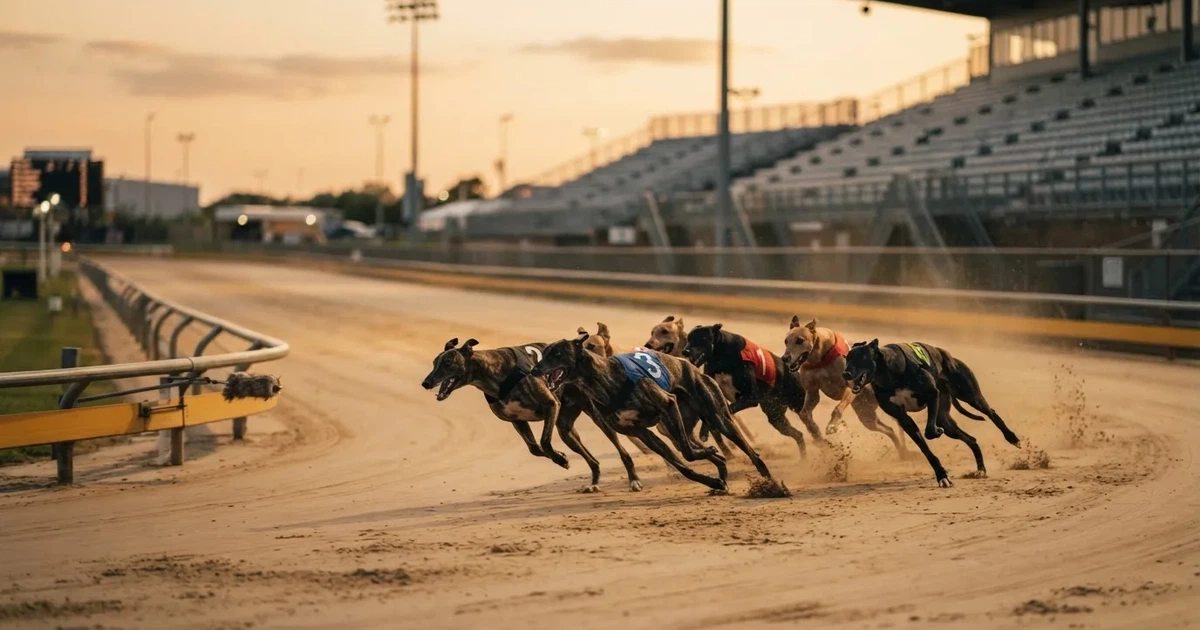
A greyhound race is a parimutuel or bookmaker-priced event run behind a mechanical lure along a track rail. Eight runners is the upper bound at most British stadia; six is more common. The race settles quickly, the photo-finish camera is the rule rather than the exception, and starting price (SP) applies to greyhounds in exactly the same way it applies to horses — the price on the entry when the race begins, set by the on-course fixed-odds market.
Decimal odds are the working form for everything that follows. A price of 1.85 returns £18.50 on a £10 stake, made up of the £10 stake and £8.50 of profit. Fractional odds (5/2, evens, 11/4) convert by a/b → a ÷ b + 1, so 5/2 becomes 3.50 and 11/4 becomes 3.75. Odds-on means shorter than evens — 4/5, 1/2, 4/6 — where the stake exceeds the potential profit. Odds-against means longer than evens, where the potential profit exceeds the stake. The mechanics do not change with the race or the dog; the same arithmetic that converts a horse price converts a greyhound price.
A single bet pays return = stake × odds, and profit = stake × (odds − 1). A combination bet — a double, an accumulator, an each-way Lucky 15 — multiplies the legs into one price and applies the same multiplication to the return. An each-way is two bets of equal size, so a £5 each-way stake costs £10 in total, and the place half pays at a fraction of the win price that depends on the number of runners in the race and the operator’s terms. The arithmetic does not change the house edge. It multiplies with the legs.

The market the bookmaker builds around the race carries a margin, and the margin is what every price on the slip is quietly paying for. Take a two-runner match at 1.90 (9/10) on each side — a coin-toss priced at less than evens. The payout share across both outcomes is 1 ÷ (1/1.90 + 1/1.90), which comes out at 0.95. The bookmaker keeps 5%. On a 100/1 shot priced into an eight-dog race, the same arithmetic extends to all eight runners, and the gap between the “true” combined probability and the combined implied probability is what funds the operation. Every dog has a price; every price carries the cut.
A useful band sits where greyhound racing tends to settle. Two-runner markets priced around 1.91 carry a margin in the low single digits, somewhere between 4 and 5%. Six-dog win markets typically run from 8 to 12%, with handicaps and forecast markets higher. The margin varies by race, by meeting, by bookmaker and by whether the race is shown live in play or priced pre-off. The bookmaker’s terms state the markets they price; the price itself carries the margin whether or not the bettor sees it.
The difference between a margin and a payout share is a matter of which side of the same market a writer is looking at. A payout share of 95% and a margin of 5% describe one set of prices; neither is a discount to the bettor. The 5% is the slice the bookmaker keeps of every unit bet on that market, and it is the same slice regardless of which dog wins. The margin is the price the bettor pays for the service, baked in before the bet is placed.
Starting price on greyhounds is the odds on the entry when the race begins, set on the on-course fixed-odds market at the track. SP applies to greyhounds in the same way that it applies to horses, and BOG (Best Odds Guaranteed) — where the bookmaker pays the higher of SP and the price taken when the bet was struck — is the usual reason a bettor takes an early price on a greyhound at all. BOG is offered by most of the British brands in this guide and is described in the operator’s own terms.
Non-runner rules apply. A non-runner in a single reduces the stake to the next leg in a combination bet, or refunds it where the rule calls for a refund. Rule 4 deductions apply when a runner is withdrawn from a race after the market has been formed, and they trim the price on the remaining runners by a fixed pence-in-the-pound amount. Rule 4 is a bookmaker rule, not a statute, and its application varies by race, by operator and by the timing of the withdrawal.
A greyhound race is a finite event: eight dogs, one mechanical lure, one finish line. The markets around it are bookmaker markets with the same shape as football and tennis markets, and the prices on them carry the same kind of margin. The race is short, the in-play window is short, and the bookmaker’s terms govern what runs alongside the win market on the slip.
Where greyhound racing is regulated, and what that means for the bettor
Greyhound racing in Great Britain is regulated by the Greyhound Board of Great Britain (GBGB), which oversees 18 licensed stadia. The GBGB licenses the tracks and the races that take place on them; the betting that takes place on those races is licensed separately by the Gambling Commission. A bookmaker running greyhound markets to customers in Great Britain holds a Commission licence, and the register of those licences is the whole test of who holds one. The Commission’s register can be searched by business name, trading name, domain or account number.
A Commission licence means a brand is regulated under the Gambling Act 2005 and is bound by the Licence Conditions and Codes of Practice (LCCP), the social responsibility code and the Remote Technical Standards. It also means the brand is a member of GAMSTOP, the national multi-operator online self-exclusion scheme that has been a mandatory licence condition for online operators since 31 March 2020. A brand without a Commission licence is not a member of GAMSTOP and is not bound by the LCCP, and a customer using such a brand has no British complaints channel and no approved dispute-resolution body to approach if funds are withheld.
The Gambling Act 2005 covers Great Britain — England, Scotland and Wales. Northern Ireland sits outside it under older law, and a Great Britain licence does not cover Northern Ireland. Since the Gambling (Licensing and Advertising) Act 2014 an operator whose remote facilities are used in Great Britain needs a Commission licence wherever it is based, and a Curaçao, Maltese or Gibraltar licence is not a substitute. There is no statutory list of permitted sports or markets: a licensed bookmaker runs the markets its licence category allows under its own rules and the LCCP. Remote general betting standard (real events) is the category that covers greyhound racing.
In-play greyhound betting is offered by GB bookmakers and is governed by the operator’s licence conditions and customer-protection duties. No statutory prohibition on in-play greyhound betting exists, and no statutory cap on stakes exists. Operators set their own maximum stakes and may restrict customers. The bet on the race is the bet on the race — a real-money bet on a real event at a licensed British track, priced by a licensed bookmaker and settled by the photo-finish camera and the GBGB result.
Greyhound racing in New Zealand was ended by the Racing Industry (Closure of Greyhound Racing Industry) Amendment Act 2026, passed on 2 April 2026, with the phase-out set for 1 August 2026. Winston Peters had announced the ban on 10 December 2024. Before the closure Greyhound Racing New Zealand (GRNZ) organised seven affiliated clubs: Auckland, Waikato, Whanganui, Palmerston North, Canterbury, Otago and Southland. The New Zealand closure does not affect the British market, where greyhound racing continues at 18 licensed GBGB stadia and betting on it continues through licensed bookmakers.
A licensed bookmaker serving customers in Great Britain verifies identity before the first deposit, which has been the rule since 7 May 2019 and applies to free bets and bonuses as well as to cash deposits. The bettor who wants to bet anonymously cannot do so through a licensed British bookmaker. The bettor who wants to use a brand outside the Commission register forgoes GAMSTOP, the LCCP social responsibility protections, the 10x bonus cap, the £150 financial vulnerability check and the British complaints route — and the description that fits is that the protection goes with the licence, not with the bet.
Where the bettor gets help, and what a licensed bookmaker is required to offer
GAMSTOP is the self-exclusion scheme. A customer who registers with GAMSTOP excludes themselves from all online gambling sites and apps run by licensed operators in Great Britain for a period of six months, one year, five years, or five years with auto-renewal. After the minimum period the exclusion stays in place for a further seven years unless the customer asks GAMSTOP to remove it. GAMSTOP covers online sites and apps; betting shops use a separate service. The exclusion is the bettor’s choice, and the operator’s licence requires them to honour it.
Deposit limits are a customer-set tool, not a state-set ceiling. The LCCP requires operators to offer a gross deposit limit on a fixed time frame; the first changes have applied since 31 October 2025, and a second phase was postponed to 30 September 2026. Whether that second phase is live is not established. The bettor who wants a hard limit sets it on the operator’s site, and the operator is required to apply it. The bettor who wants no limit has none imposed — a state ceiling on deposits or losses for betting does not exist in Great Britain.
The financial vulnerability check is a public-record check that applies when a customer’s deposits minus withdrawals exceed £150 in a rolling 30 days (in force since 28 February 2025). It is not an income check and not a credit reference check. The financial risk assessment — what the press calls “affordability checks” — is announced in a staged plan with no start date. A bettor who crosses the £150 threshold is asked a question the operator is required to ask; the bettor who does not cross it is not.
The minimum age for betting in Great Britain is 18, and the rule is enforced at the point of account opening. Identity verification happens before the first deposit and before the first bet. A bettor who has set up an account and crossed the identity check has met the rule; an under-18 cannot open an account at a licensed British bookmaker.
Help outside the operator is there as well. GamCare runs the National Gambling Helpline. GambleAware funds treatment and education. The NHS runs gambling clinics in several regions. Gamblers Anonymous runs peer-support meetings. Fitzwilliam Sports links to all four from its responsible-gambling page; other licensed brands carry equivalent links. The links are a requirement of the licence, and the services behind them are not operated by the bookmaker.
The protection list reads as a list of what a licensed bookmaker must do, and it is. The bettor who uses a brand without the list forgoes it. The bettor who uses a brand with the list still has the choice of whether to use the tools. GAMSTOP, deposit limits, timeouts, self-exclusion and the financial vulnerability check are tools the bettor can decline; once used, they bind the operator.
What bonus offers on greyhound racing actually cost
A greyhound racing welcome offer usually takes one of three shapes: a free bet, a price boost on a named race, or accumulator insurance that refunds a stake on a losing multi-leg bet when one leg lets the rest down. The shape determines what the offer is worth, and the shape matters more than the headline figure.
A free bet is paid out on a winning bet, but the free-bet stake itself is usually not returned with the win. A £10 free bet at 5.00 returns £40 of profit on a winner — £10 of the stake does not come back. The value of the free bet is the free-bet amount × (odds − 1) ÷ odds × the payout share of the market. At odds of 5.00 on a market with a 90% payout share, the £10 free bet is worth £7.20 on average. At odds of 10.00 on the same market, it is worth £8.10. The headline figure overstates the actual return.
A cash bonus has a different shape. The bonus money is added to the withdrawable balance when the wagering requirement is met. The requirement is a multiple of the bonus — or of the bonus plus the deposit — that has to be turned over in qualifying bets at or above a minimum price before the bonus becomes withdrawable. Wagering requirements on bonuses are capped at 10x under the Commission’s promotion rules in force since 19 January 2026: a £10 bonus at 50x needs £500 of qualifying bets; under the cap no more than £100 of qualifying bets is required. The cap is on the bonus wagering requirement, and mixed-product promotions — an offer that requires gambling on two or more product types such as betting, casino, bingo and lottery, for example “bet on football to get free spins” — are banned. Whether the cap applies to free bets with no wagering condition, and any cap on the money value of a bonus, are not established.
The cost of clearing a bonus depends on the market the qualifying bets are placed on. A £10 bonus at 10x wagering requires £100 of qualifying bets at the minimum price. Placed on a 6-dog greyhound win market at 12% margin, the expected cost is £100 × 0.12 = £12 — meaning the bonus is paid for before the bettor sees it. Placed on a two-runner match at 5% margin, the expected cost is £5. The same bonus reads very differently on two different markets, and the bookmaker’s terms state the qualifying market.
A price boost on a named race looks like free money until the arithmetic runs through it. A boost on a dog from 5.00 to 7.00 is a price on a dog whose true chance the bookmaker has decided to take a smaller margin on. The customer gets a bigger return on a winner and a normal loss on a loser. The boost is a marketing line, not a margin concession across the rest of the race card. A bookmaker offering a daily boost on a greyhound race is offering a price on one race, and the rest of the race card carries the usual margin.
Accumulator insurance refunds a stake as a free bet when one leg of a multi-leg bet loses. The free bet is then subject to the free-bet rule above: the stake is not returned with the win, and the value is bounded by the formula. The refund on a losing six-fold acca is not what an unrefunded acca would have paid on a winner; it is the free-bet value of the refund amount on the next bet.
The shape dictates the cost. A free bet at 10.00 is worth more than the same free bet at 2.00. A bonus at 10x wagering on a low-margin market is cheaper to clear than a bonus at 10x wagering on a high-margin market. A price boost on one race carries no margin concession on the others. The bettor who reads the terms reads the cost.
How greyhound betting works on mobile and in apps
A greyhound bet app is the bookmaker’s mobile application — iOS, Android, sometimes a mobile-optimised browser. The ten brands in this guide all run an app, and the app is the primary betting surface for most bettors. The greyhound race card sits inside the app, the in-play markets sit next to it, and the cash-out button sits inside the bet slip.
An app carries the same markets as the desktop site. Ante-post markets, place markets, forecast markets, trap challenges and match bets on the two greyhounds in a particular race are all priced inside the app on most brands. Live greyhound betting — the markets taken while the race is in progress — is run through the app’s in-play interface, and the prices on those markets are governed by the operator’s in-play rules and the photo-finish settlement. Bet Builder is a single-event combination bet (sometimes called a same-game multi) that combines markets from one race into one slip; it is offered on some greyhound cards and not on others.
Best Odds Guaranteed (BOG) is offered on horse racing by most British brands and on greyhound racing by some. The bookmaker pays the higher of SP and the price taken when the bet was struck, and the bettor who takes an early price has the safety of the on-course market running at the start. BOG is stated in each brand’s terms, and the brands that run BOG on greyhounds are listed alongside those that do not.
Live streaming of greyhound races is offered by some British brands inside their apps, and the stream is usually gated by a positive account balance, a recent bet on the race meeting, or both. Live streaming is a separate proposition from live betting, and the two are not always offered together. Cash out is offered on selected markets — pre-off and in-play — and the cash-out figure is the bookmaker’s price on the bet at the moment of the cash out, not the price the bet was struck at. The cash-out price carries the margin in the same way the original price did.
A greyhound bet app for Android is offered by every brand on the shortlist, and the iOS version is offered by most. App availability, ratings and feature lists are stated by the operators themselves, and the bettor who wants a particular feature — live streaming, BOG on greyhounds, bet builder — checks the brand’s app listing before signing up.
A bettor who bets on a phone through a licensed British bookmaker is betting through a brand bound by the LCCP, the social responsibility code, the GAMSTOP membership and the Remote Technical Standards. The app carries the protection with it. The bettor who bets through an app outside the Commission register forgoes the protection, and the protection that holds is not on the bet.
Live greyhound betting and cash out
Live greyhound betting is the in-play market on a greyhound race — the markets taken between the lids going up and the photo-finish camera confirming the result. The in-play window is short: a six-dog race over 500 metres runs in under 30 seconds; over 700 metres it runs in under 45. The window is the operator’s most contested territory, and the price on the in-play market carries the operator’s in-play margin on top of the pre-off margin.
A bookmaker’s in-play greyhound markets settle from the official result on the photo-finish camera. A bet on the winner at 4.00 in-play pays £40 of return on a £10 stake if the dog holds on; it pays nothing if the dog is headed in the final stride. The settlement is on the official result, not on the bookmaker’s live feed, and the bettor who bets on a feed that loses signal before the finish has bet on the feed, not on the result.
Cash out is a separate proposition. The bettor who has backed a dog pre-off and wants to lock in a profit (or a loss) before the race begins can do so at the cash-out price the bookmaker is willing to pay on the bet. The cash-out price carries the bookmaker’s margin on the cash-out itself, and the cash-out figure is usually below the figure the bet would return on a win. A £10 bet at 5.00 that has moved to a cash-out figure of £25 has paid the bookmaker for the privilege of locking in the return, and the difference between £25 and £50 is the cost of the cash out.
Live streaming is offered by some brands and not by others. A live stream of a greyhound race requires either a positive account balance, a recent bet on the race meeting, or both, depending on the brand. A bettor who wants to watch the race and bet on it has to check the brand’s gating rules before signing up.
In-play greyhound markets settle from the GBGB result on the photo-finish camera, and the bookmaker’s terms state the conditions under which a market is voided, suspended or settled early. A non-runner before the start voids the market; a non-runner after the start settles as a losing bet for the purposes of multi-leg bets. The settlement is the operator’s rules, and the rules are stated in the terms.
A bettor who uses the in-play market on a licensed British bookmaker is betting inside the LCCP and inside the operator’s customer-protection duties. The in-play window is short, the prices carry the margin, and the cash-out figure carries its own margin on top. The bettor who uses the in-play market on an unlicensed brand is betting outside the protection.
Predictions, tips, and the betting strategies that claim to find winners
Greyhound betting tips and greyhound racing betting strategies are sold on the open internet as if they were predictive models. They are not. A greyhound race is a finite event with eight runners, a mechanical lure, and a photo-finish camera. The race takes between 25 and 45 seconds. The factors a tipster can name — track, distance, trap, form, going — are factors the bookmaker has already priced into the market, and the market price is the bookmaker’s reading of those same factors. A tipster who claims a price the market has missed is claiming a market inefficiency, and the persistence of such inefficiencies across thousands of bets is the bet that no tipster has paid out over time.
A greyhound betting system is a rule for selecting and staking bets — back the favourite, back the outsider, lay the favourite on an exchange, increase the stake after a loser. The rule is mechanical; the outcomes are not. A staking plan that doubles the stake after every loss (a Martingale) runs into the table limit or the bettor’s bankroll before it recovers the losses. A staking plan that backs every favourite loses to the margin over thousands of bets. The arithmetic is the same on greyhound races as on every other market: the bookmaker keeps a slice of every bet, and the slice adds up.
Greyhound betting tips today is a phrase that promises information the tipster does not have. The race card is published, the form is in the Racing Post, the odds are on the screen. The information a tipster can offer is the same information the bettor can read. What a tipster sells is a selection, and the selection is the tipster’s call, not a forecast. The bettor who wants to back a tipster’s selection pays for the tip and then bets the market the same way they would have bet it without the tip. The expected return is identical.
A greyhound racing betting strategy has the same shape as a tipster. The strategy names a way of reading the race; the bookmaker’s price carries the same reading with a margin attached. The bettor who follows a strategy at a licensed British bookmaker is betting the bookmaker’s market; the bettor who follows it at an unlicensed brand is betting the unlicensed brand’s market with no protection in either case. The protection is on the licence, not on the selection.
Forecasts and tricast bets are markets on the first two or three dogs home in order. The markets carry a higher margin than win markets, the payout is large on a small stake when the bet lands, and the bet lands roughly one in seven races for a forecast and one in 50 for a tricast. The arithmetic is the same as the win market: the margin compounds across the outcomes, and the margin is the price the bettor pays for the service.
No system wins. The bookmaker’s margin sits inside every price, and a system that does not overcome the margin loses over time. The bettor who understands the margin understands the strategy: any system that claims a return over the bookmaker’s margin over a run of thousands of bets has either been lucky or has not finished yet. The race is short, the price carries the cut, and the cut adds up.
Top 10 UK bookmakers for greyhound racing betting odds
The ten brands below are all listed on the Gambling Commission’s public register against a licence holder holding a remote betting licence for Great Britain. Several brands can run under one licensee — for example Ladbrokes and Coral run under LC International Limited, Paddy Power and Betfair run under PPB Counterparty Services Limited — and they are not independent operators. Every GB-licensed online operator is a GAMSTOP member. None of the brands below is the only licensed one; a place in this comparison is not a licence.
The table is a snapshot of the brands against four matters. The licence holder and account number come from the Commission’s register, and the domains on the operator’s own terms state the markets and conditions. Where a brand’s offer or feature is not stated in the table, the operator’s own terms carry it.
| Brand | Licence holder | Commission account | What the operator’s terms state on greyhound markets |
|---|---|---|---|
| Fitzdares | Fitzdares Limited | 400 | Cash out, accumulators, specials and antepost markets across greyhound, horse and other sports; in-play live odds on the app. |
| Geoff Banks | GB Sports Advisors Limited | 54095 | Live in-play prices and ante-post prices on future events across the racing programme. |
| Bar One Racing | Bar-One Racing Limited | 56516 | Irish independent bookmaker with shops and racing sponsorships at Dundalk, Fairyhouse, Navan, The Curragh, Curraheen Park and Cork. |
| Bet Ahoy | Bet Ahoy Ltd | 100094 | A welcome of “Bet £10 & Get £10 in Free Bets” — a £5 sports bet and a £5 acca — subject to the operator’s terms. |
| Fitzwilliam Sports | SBKI Limited | 48760 | Dublin bookmaker with capped membership; instant deposits, fast withdrawals, timeouts and deposit limits, with links to safer-gambling services. |
| Paddy Power | PPB Counterparty Services Limited | 39439 | Greyhound and horse racing coverage across the racing programme alongside football, boxing, rugby, tennis, golf, darts, snooker and F1. |
| Coral | LC International Limited | 54743 | A sports welcome of £40 in free bets on a £20 qualifying bet at minimum odds 2.0, expiring seven days after issue for new GB customers who opt in. |
| London Bet | Thistle Bet Limited | 66162 | Greyhound and horse racing alongside football, tennis, darts, golf, cricket, NFL, NBA, MLB and snooker, with Pragmatic Play casino slots and live in-play. |
| Betmaster | BM Solutions GB Ltd | 65699 | Football, cricket, horse racing, NFL and esports (League of Legends, Dota 2) coverage on the app. |
| Swifty Sports | Swifty Global (UK) Ltd | 58957 | Best Odds Guaranteed, cash out on horse racing and football markets, daily price boosts, live streaming and in-play betting; bet builder listed as coming soon. |
The order of the table is not a ranking. A brand near the top is not better positioned for greyhound racing than a brand near the bottom; each brand carries its own terms, its own licence category and its own racing programme. The bettor who picks a brand from the table picks it on the terms, not on the order.
Fitzdares
Fitzdares runs on Gambling Commission account 400 against Fitzdares Limited as licence holder. The operator’s app offers cash out, accumulators, Lucky 15s, specials and antepost markets across horse racing, greyhound racing, football, tennis, rugby, cricket, golf and American football, with in-play live odds. The racing coverage sits inside a wider book, and the antepost market is the longer-odds book on meetings weeks in advance. BOG is not separately stated for greyhounds in the terms; the bettor who wants BOG on greyhounds reads the terms page before staking.
The Fitzdares product sits in the higher-end of the British betting market, and the price on a greyhound race card carries the same kind of margin as any other bookmaker’s price. The antepost markets on the major meetings carry a wider margin than the pre-off markets, and the cash-out figure carries its own margin on top. A bettor who uses Fitzdares for greyhound racing is using a brand with a Commission licence, a GAMSTOP membership and a Racing coverage that runs across horse, greyhound and a wider sports book. The operator’s wide racing book makes it a candidate for those who want their racing in one place.
Geoff Banks
Geoff Banks runs on Gambling Commission account 54095 against GB Sports Advisors Limited as licence holder. The operator’s app offers live in-play prices and ante-post prices on future events across the racing programme. The Geoff Banks product is a smaller racing book than the major brands, and the racing programme runs alongside a narrower sports book. BOG is not separately stated for greyhounds in the terms; the ante-post book is the longer-odds offering on the major meetings.
Geoff Banks suits the bettor who wants a racing-focused book with in-play and ante-post coverage and who does not need a wide sports book behind the racing. Worth it for the racing-focused bettor who reads the ante-post terms before staking, and who is comfortable with a smaller book than the major brands.
Bar One Racing
Bar One Racing runs on Gambling Commission account 56516 against Bar-One Racing Limited as licence holder, and the operator rebranded to BAR 1 Betting as an Irish independent bookmaker with shops across Ireland and racing sponsorships at Dundalk, Fairyhouse, Navan, The Curragh, Curraheen Park and Cork. The British-facing product sits inside an Irish independent operation with a smaller online book. Greyhound racing is covered inside the racing book alongside horse racing, and the in-play offering is narrower than the major British brands.
BAR 1 Betting suits the bettor who wants an independent Irish-British book with racing sponsorships. The independent angle is the main feature here, provided the racing terms are clear to the user before they stake.
Bet Ahoy
Bet Ahoy runs on Gambling Commission account 100094 against Bet Ahoy Ltd as licence holder, and the operator’s welcome is described in the App Store listing as “Bet £10 & Get £10 in Free Bets”, made up of a £5 sports bet and a £5 acca, subject to the operator’s terms. The free-bet value is the free-bet amount × (odds − 1) ÷ odds × the payout share of the market, and a £5 free bet at 5.00 on a market with a 90% payout share is worth £3.60 on average. The bettor who reads the terms reads the qualifying market, the minimum price and the expiry.
Bet Ahoy’s greyhound markets are stated in the operator’s own terms, and the listing summary does not name a greyhound-specific market. The operator’s welcome structure requires a look at the terms for the separation of the £5 acca and £5 sports bet components.
Fitzwilliam Sports
Fitzwilliam Sports runs on Gambling Commission account 48760 against SBKI Limited as licence holder, and the operator describes itself as a Dublin bookmaker with capped membership and a “High Stakes Welcome” subject to compliance criteria. The brand offers instant deposits, fast withdrawals, timeouts and deposit limits, and links to GambleAware, GamStop and Gamblers Anonymous from its responsible-gambling page. The capped-membership angle is unusual in the British market and signals a bookmaker that limits the number of customers it takes on.
The greyhound coverage sits inside the racing book, and the operator’s terms state the racing programme. The capped-membership Dublin book approach offers a distinct responsible-gambling focus, and those interested in joining should ensure they meet the membership criteria first.
Paddy Power
Paddy Power runs on Gambling Commission account 39439 against PPB Counterparty Services Limited as licence holder. The operator’s app covers football, horse racing, boxing, rugby, tennis, golf, darts, snooker and F1. Greyhound racing sits inside the racing book alongside horse racing, and the in-play offering is one of the wider books in the British market. Paddy Power is part of the Flutter group alongside Betfair, and the two brands run under the same licence holder.
Worth it for the bettor who wants a major British brand with a wide racing and sports book and a Commission licence behind it, and who reads the greyhound market terms before staking. The Flutter-group angle means Paddy Power and Betfair are not independent operators, and the bettor who opens both opens two accounts inside the same licence holder.
Coral
Coral runs on Gambling Commission account 54743 against LC International Limited as licence holder, and the operator’s sports welcome is described on the homepage as “Get £40 in Free Bets when you bet £20” — a deposit and sports bet of £20 or more at minimum odds of 2.0 (1/1), with the £40 in free bets issued within seven days and expiring seven days after issue, for new GB customers who opt in. Coral is part of the Ladbrokes-Coral group, and the two brands run under LC International Limited as the same licence holder.
The greyhound racing coverage sits inside the racing book alongside horse racing, and the in-play offering is one of the wider books in the British market. The £40 free-bet welcome has a clear qualifying bet (a £20 sports bet at minimum odds 2.0), a clear issue window (seven days) and a clear expiry (seven days after issue). Worth it for the bettor who wants a major British brand with a stated welcome and a Commission licence behind it, and who reads the qualifying terms before staking. The free-bet stake is not returned with a win; the £40 is £40 of free bets, not £40 of cash.
London Bet
London Bet runs on Gambling Commission account 66162 against Thistle Bet Limited as licence holder. The operator’s app combines sports betting (football, tennis, horse racing, greyhounds, darts, golf, cricket, NFL, NBA, MLB, snooker) with Pragmatic Play casino slots and live in-play betting. The greyhound coverage sits inside a wider book that includes a casino product. The in-play offering runs on the sports side of the app.
London Bet suits the bettor who wants a sports-and-casino app under a single account and a Commission licence. Worth it for the bettor who values the casino-and-sports combination and who reads the greyhound market terms before staking. The mixed-product angle — sports and casino inside the same app — is one to read against the LCCP mixed-product promotion ban: the ban is on promotions that require gambling on two or more product types, not on a brand offering both products.
Betmaster
Betmaster runs on Gambling Commission account 65699 against BM Solutions GB Ltd as licence holder, and the operator’s app covers football, cricket, horse racing, NFL and esports (League of Legends, Dota 2) betting. Greyhound racing is not separately named in the App Store summary; the racing coverage the summary names is horse racing, and the bettor who wants greyhound coverage checks the operator’s own terms before staking.
Betmaster provides a sports book incorporating horse racing and esports. Prospective greyhound bettors should check the platform’s specific coverage before committing to an account.
Swifty Sports
Swifty Sports runs on Gambling Commission account 58957 against Swifty Global (UK) Ltd as licence holder, and the operator’s app offers Best Odds Guaranteed, Cash Out on horse racing and football markets, daily price boosts, live streaming and in-play betting, with Bet Builder listed as coming soon. The greyhound coverage sits inside the racing book, and the BOG and cash-out terms apply where the racing programme carries them.
Swifty Sports suits the bettor who wants BOG, cash out and live streaming inside a single app. The combination of BOG and streaming is the primary value proposition, though users should check the status of Bet Builder before relying on it for complex combinations.
Frequently asked questions
How does someone place a bet on greyhound racing?
A bettor opens an account with a bookmaker licensed by the Gambling Commission for customers in Great Britain, verifies identity (name, address and date of birth) before the first deposit, and deposits funds from a debit card or a bank-based payment method — credit cards are banned for gambling in Great Britain. The bettor then opens the greyhound race card, selects a market, enters a stake and confirms the bet on the slip. The bet settles from the official result on the photo-finish camera at the GBGB-licensed track.
How does someone place a bet on greyhound dogs?
The mechanics are the same as any other racing bet. The bettor opens the greyhound race card, selects a market (win, place, each-way, forecast, tricast), enters a stake, and confirms the bet. The race settles from the GBGB result on the photo-finish camera, and the bet pays the decimal odds on the slip on a winner. A non-runner voids the bet; Rule 4 deductions apply where a runner is withdrawn after the market is formed.
Can greyhound betting be won?
The bookmaker’s margin sits inside every price, and a run of bets at the bookmaker’s prices returns less than the stake over time. The bettor who wins on a single race wins that race; the bettor who wins across a run of races has either beaten the margin on a sample too small to be meaningful, or has not yet hit the sample size at which the margin compounds. No system beats the margin over thousands of bets, and a tipster who claims one has either been lucky or has not finished yet.
How can a bookmaker’s Gambling Commission licence be checked?
The Commission’s public register can be searched by business name, trading name, domain or account number. A brand whose name, account number and licence category appear on the register holds a Commission licence; a brand that does not appear does not. The register is the whole test of who holds a licence. A licence in Curaçao, Malta or Gibraltar is not a substitute for a Commission licence for customers in Great Britain, and the domain extension (.com or .co.uk) does not prove the licence either way.
How is the return on a bet worked out from the stake and the odds?
A winning single bet returns stake × odds. A £10 stake at decimal odds of 5.00 returns £50 — the £10 stake plus £40 of profit. A combination bet multiplies the legs into one price, so a double at 3.00 and 4.00 has a combined price of 12.00, and a £10 stake returns £120 on a winner. Profit on a single is stake × (odds − 1), so the £10 at 5.00 makes £40 of profit.
What is the bookmaker’s margin, and how does it show up in the odds?
The margin is what the bookmaker keeps of every unit bet on a market. A two-runner match priced at 1.90 on each side carries a payout share of 95% across both outcomes, and a margin of 5%. The price on each outcome is the payout the bettor would receive on a winner, and the margin is the slice the bookmaker keeps across both outcomes. Every dog in a race has a price; every price carries a slice; the slice is the margin.
Horse racing & greyhounds – Basketball betting
Content created by the «Basketball betting» team
