
MMA betting odds: how to read the price, what the margin costs, and who prices the fights
 Available in US
27 October 2026 · Gambling Commission public register (GB-licensed operators) and each bookmaker’s own terms

An MMA betting market looks simple until the reader watches two prices that should add to a number and notices they do not. A price on the favourite sits at 1.55; the underdog is 2.70. Multiply them through the sense they were calibrated by and the market keeps a slice of every pound staked on it. That slice — the margin, sometimes called the overround — is the cost the reader pays for the privilege of betting at all, and it lives inside every market on every fight card the year round. The work on this page is to make that cost visible: what decimal odds say, what the margin hides, what free-bet language conceals, and which British-licensed bookmakers carry MMA markets worth a serious punter’s attention in 2026.
The first section looks at the place most readers start, the mobile app, because that is where the betting slip now lives for the majority of punters in Great Britain. The second examines in-play betting and cash out, the two mechanisms that let the reader cut or extend a position once a fight is underway. From there the page moves through predictions and bankroll discipline, then into the mechanics of odds and bet types, then into the fight calendar itself — promotions, weight divisions and the show structure that decides which markets even exist. The ranking of ten UK-licensed bookmakers follows, with a side-by-side on their licence and their MMA offer, and the comparison leads into a wider look at the British regulatory frame, at responsible gambling and player protection, at how crypto and anonymity fit into the licensed market, and finally at what bonuses and free bets actually require of the reader. The FAQ at the foot of the page answers the six questions most commonly asked by readers of this subject.
Mobile apps and the MMA betting slip
The MMA betting slip sits on a handset more often than on a desktop these days, and the choice of app shapes what the reader can actually do during a fight. A good MMA betting app does three things well: it keeps the in-play markets within a thumb’s reach, it lets the reader build an accumulator or a bet-builder without losing the slip, and it streams or tracks the live action so a punt is not blind. Most of the brands covered on this page offer all three; the differences lie in polish, in latency and in the depth of the MMA menu.

A reader comparing apps should check four things before installing one. The first is whether the app lists fights by promotion: the UFC, PFL, Bellator and ONE Championship each run their own cards, and an app that only carries the UFC blinds the reader to most of the calendar. The second is the in-play market depth: a fight can be bet on round-by-round, on method of victory, on whether the finish comes by strikes or by submission, and on whether it goes the distance. The third is whether cash out is offered in-play, and whether the cash-out figure updates in seconds or in tens of seconds — during a five-minute round, a slow update is a missed window. The fourth is whether live streaming is bundled, or whether the app tracks strikes landed, takedowns and significant strikes so a bet can be read against the action rather than the clock.
Bet365’s app is described by the App Store as the most downloaded sports betting app in the UK, and its feature set includes Bet Builder+ (combining markets from one event into a single bet, both pre-match and in-play), Super Boosts, Winnings Boosts on Bet Builders and selected singles, daily Bet Boosts, in-play betting and live streaming of events worldwide, plus Bet Track, Match Live and a Live Golf Tracker for following bets in play. Spreadex combines fixed-odds and spread betting in one app, with one-click, auto and partial cash out, Bet Builder across fixed odds or spreads, and live streaming of UK and Irish horse racing, greyhounds, tennis, NFL and selected football. Midnite’s site cites Gambling Commission licence 101839 and shows in-play events, an acca builder, popular accas and price boosts with maximum-stake limits. Dabble’s app carries a “Bet £10, Get £10 in Free Bets” welcome on a first deposit for new customers, with minimum odds applying, a 7-day free bet expiry and the stake not returned. Fafabet’s app pays Best Odds Guaranteed on UK and Irish horse racing win and each-way bets from 9am on race days. Lottoland’s app combines casino, lottery betting, sports betting and scratchcards and states it is licensed by the Gambling Commission for customers in Great Britain. Kwiff carries a 17+ age rating and describes itself as a trademark operated by Spryme Ltd under a UK Gambling Commission licence.
A reader who wants MMA and only MMA may find the all-purpose apps busy. Bet Builder menus get crowded when a sport offers dozens of markets per fight, and a smaller menu can be faster to use during a live round. The apps that focus on combat sports in particular tend to surface the method-of-victory market first, then round betting, then totals on significant strikes or on whether the fight goes the distance. A reader should try a small stake on the live app before committing to a free bet, because latency is rarely apparent until a round starts.
Live MMA betting and cash out
Live MMA betting has matured into a market of its own, with the markets themselves sitting beneath a cash-out layer. In-play, the bookmaker keeps offering prices as the fight progresses, and the price on each fighter moves with the action — a takedown lands, the price shortens; a fighter takes a cut, the price drifts. Most British-licensed bookmakers run in-play on MMA, and the controls on what they may offer are their own licence conditions and their customer-protection duties rather than a statutory list.
The cash-out feature is what makes in-play MMA manageable. Without cash out, a punt is locked in until the fight ends. With cash out, the bookmaker offers to settle the bet early at a price derived from the current live odds; the offer is the bookmaker’s, not the reader’s, and the price is the bookmaker’s margin plus the current state of the fight. Cash out can be full (settle the whole bet at the offered figure) or partial (settle part of the stake and leave the rest running). Auto cash-out is offered by several of the apps on this page — Spreadex describes one-click, auto and partial cash out, and other apps carry the auto version as well. The auto cash-out sets a threshold and settles the bet when the live price crosses it, which is useful for a reader who does not want to watch every second of every round.
The cost of cash out is the margin. The bookmaker’s offer is the live odds adjusted downward by the same percentage the pre-match market would charge; a reader who cashes out early accepts that adjustment in exchange for removing the variance of the rest of the fight. On a fight where the favourite has just dropped the favourite, the cash-out figure on a back-the-favourite bet can be a fraction of what the bet would pay at full time, and the difference is the price of certainty. A reader who bets in-play on MMA and never uses cash out is leaving the variance on the table; a reader who uses cash out on every bet is paying the bookmaker twice — once through the margin and once through the cash-out haircut. The right use depends on whether the punter is hedging a future bet, locking in profit, or cutting a loss, and on the size of the live price move.
The in-play market depth varies more than the pre-match menu does. A reader looking at a UFC main event sees method-of-victory, round betting, fight-goes-the-distance, total rounds over/under, and significant-strikes totals; a smaller card may carry only the moneyline and the method of victory. The live tracker — a count of significant strikes, takedowns and submission attempts — sits inside several apps and lets the reader price the live market themselves. Live streaming is bundled with the larger apps; Spreadex offers it for UK and Irish horse racing, greyhounds, tennis, NFL and selected football, and the same apps stream selected MMA fights under the same rights deals, although the catalogue shifts from card to card.
Predictions, tips and bankroll discipline
The reader who searches for “MMA betting tips” or “top value MMA bets for this weekend” is looking for something nobody can honestly provide: a forecast of who will win. The honest framing on this page is that the prediction part of MMA betting is not where the long-run edge lives. The fight is decided inside the cage by two people, and the value of a tip is a measure of how much the reader believes it before the market prices it in. The reader who pays for tips is paying for someone else’s reading of form, of style, of training camp and of weight cut — useful inputs, all of them, but inputs that the market also has.
Where the reader can build an edge is on the margin. Two bookmakers price the same fight at 1.91 / 1.91; a third prices it at 1.85 / 1.95; the third’s favourite pays less in the next six months for the same number of wins, and that difference compounds. Bankroll discipline is the reader’s defence against the variance of MMA, where a three-fight losing streak is unremarkable and a five-fight one is not unusual. Three rules apply. The first is staking the same fraction of the bankroll on each bet, so a losing run does not require doubling the stake to recover. The second is keeping the unit small enough that ten losses in a row do not end the bankroll. The third is keeping a record, so the reader can see over a season whether the tips they paid for actually beat the closing line of the market.
None of these guarantees a win; what they do is turn betting from a coin-flip with odds into a process with a measurable edge over time. A reader new to MMA betting should not pay for tips before they have a record, and the record should be at least a few hundred bets before the reader concludes anything about whether they are good at picking fights. The single biggest move the reader can make is to back the line they believe in rather than the fighter, because the line moves once the rest of the market agrees.
Bet types and how MMA odds are built
An MMA betting market is a set of mutually exclusive outcomes priced so that a bookmaker makes a margin on every pound staked across them. The simplest market is the moneyline: fighter A wins, fighter B wins, and possibly a draw. The reader picks one outcome, stakes a sum, and is paid at the decimal odds carried on the slip. Decimal odds convert to a return by multiplying the stake by the odds; profit is the return minus the stake. Fractional odds, the older British convention, write the profit as a fraction of the stake; 5/1 means a £10 stake returns £60 (the £50 profit plus the £10 stake), 11/4 means a £10 stake returns £37.50 (the £27.50 profit plus the stake). British bookmakers use both forms, and the page gives the decimal figure alongside the fractional one for direct comparison.
The bookmaker’s margin sits inside the prices. A two-way market where the bookmaker wants to keep five per cent of every pound staked prices the two outcomes so that the implied probabilities add to 105 per cent, not 100 per cent. The five per cent is the overround, and the implied probability of an outcome at decimal odds is 1 divided by the odds. A fight at 1.55 / 2.70 implies the favourite at 64.5 per cent and the underdog at 37.0 per cent, summing to 101.5 per cent; the 1.5 per cent is the margin the bookmaker keeps. The narrower the margin, the more of every pound the reader keeps; the wider it is, the more the bookmaker takes. The reader comparing two bookmakers on the same fight is comparing their overround, not their opinion.
The other MMA markets work the same way. Method of victory lists the ways a fight can end — knockout or technical knockout, submission, decision, possibly a draw — and each outcome is priced separately. Round betting asks the reader to name the round in which the fight ends, and the more precise the call the longer the price. Fight-goes-the-distance is a yes/no market on whether the bout runs to the judges’ scorecards; significant-strikes totals run over/under on the count the live tracker records. Each of these markets is a separate book with its own margin, and the margin can differ widely. The moneyline on a UFC main event is typically priced tighter than the method-of-victory market, which is in turn tighter than round betting, and totals markets are somewhere between.
Bet builders and accumulators multiply prices together. A bet builder combines markets from a single fight into one slip: pick the winner, the method and the round, and the slip multiplies the three prices into one. The combined price carries a margin that is the product of the per-market margins, less a small discount for the bookmaker’s reduced risk. An accumulator combines selections across fights: pick three winners and the slip pays the product of the three prices if all three win. Each leg carries its own margin, and the accumulator’s margin is the product of the legs’ margins. A four-fold at four prices of 1.90 has a per-leg margin around five per cent and an accumulator margin of roughly nineteen per cent; the reader is paying the bookmaker a slice of every leg on top of every other leg.
Combination bets are settled at the combined odds on winning, and the combined odds reflect the per-leg prices. A Patent, a Trixie, a Yankee, a Lucky 15, a Heinz and a Goliath each name a fixed structure of singles, doubles, trebles and accumulators, with the total stake equal to the unit stake multiplied by the number of bets the structure covers. Lucky 15 covers 15; Heinz covers 57; Goliath covers 247. These structures share the same unit-stake calculation: total stake = unit stake × number of bets.
The calculation the plan prescribes is the simplest case of the margin: an illustrative two-way market at decimal odds 1.90 / 1.90. The implied probability of each outcome is 1 / 1.90, which is 52.6 per cent; the sum is 105.3 per cent; the margin is the gap between that and 100, or 5.3 per cent. The result is a band — five to six per cent is the typical margin on a tight two-way MMA moneyline, and the page states it as a band rather than one figure, because the precise figure depends on the snapshot and on the bookmaker. A reader who sees 1.85 / 1.95 on a fight is looking at a 5.1 per cent margin, and a reader who sees 1.80 / 2.05 is looking at an 8.6 per cent margin; the difference is what an afternoon of betting is worth.
Sports and tournaments — the MMA calendar
The MMA calendar is a stack of promotions, each running its own cards on its own schedule. The Ultimate Fighting Championship (UFC) was founded on 12 November 1993, when UFC 1 was held at McNichols Sports Arena in Denver, Colorado. The UFC has 11 weight divisions, eight men’s and three women’s. The Bellator promotion ran under different ownership through to its final events; the PFL runs a season-long tournament structure with a playoff and a final; ONE Championship runs across Asia and broadcasts in different time zones. Each promotion carries its own roster and its own cards, and the markets a UK bookmaker offers depend on which promotions the bookmaker has signed with.
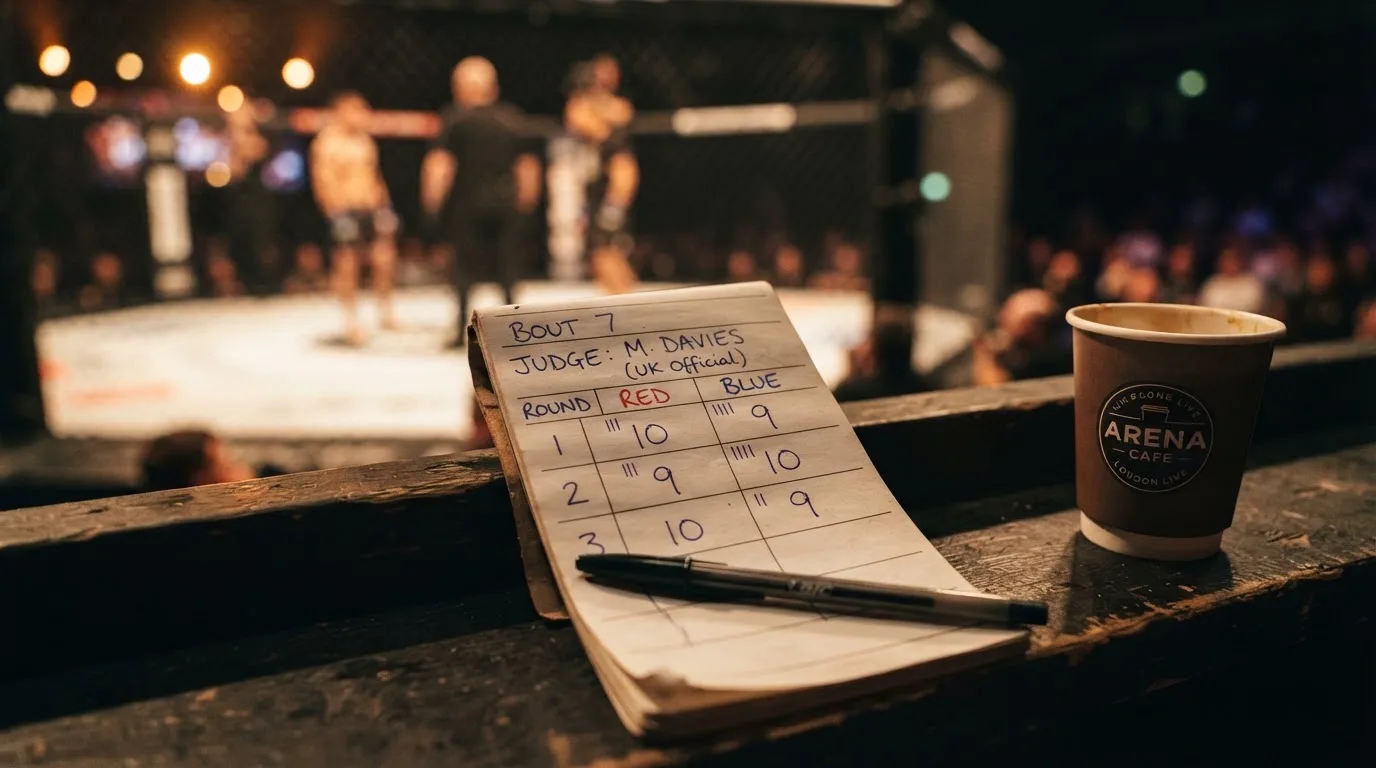
A fight ends in one of a small set of ways. Under the Unified Rules of mixed martial arts each round lasts five minutes with a one-minute rest between rounds; non-title bouts normally go no more than three rounds, while title bouts can be sanctioned for five rounds. In MMA’s 10-point must system three judges score each round: the round winner gets 10 points, the loser 9 or fewer, and an even round is scored 10–10. Under the Unified Rules a decision can be unanimous, majority or split, and a draw can also be unanimous, majority or split. Under the Unified Rules a bout ends in disqualification if an intentional foul incapacitates a fighter, and in a no contest if an unintentional foul incapacitates a fighter.
The bout structure decides which bets even exist. Method-of-victory markets quote knockout, technical knockout, submission, decision and sometimes disqualification or no contest. Round betting asks for the round in which the fight ends, with the fight going the distance priced as a separate outcome. A five-round title fight carries different round-betting depth from a three-round non-title fight, and the markets scale to the structure.
Weight classes matter to the markets in a way that does not always appear on the betting slip. A heavyweight fight tends to finish inside the distance more often than a flyweight fight; a women’s fight runs to decision more often than a men’s heavyweight fight. The market prices these patterns in, and the reader who knows the historical finish rates by weight class prices them too. There is no British statutory list of permitted sports or markets: a bookmaker serving customers in Great Britain needs a Gambling Commission licence wherever it is based, and the Commission’s public register is the whole test of who holds one. Every market the bookmaker offers sits under the bookmaker’s own licence and the Commission’s Licence Conditions and Codes of Practice.
The ten UK-licensed bookmakers reviewed
The comparison below covers the ten UK-licensed brands offering MMA betting in 2026. Each holds a Gambling Commission remote licence for real-event betting; each runs the MMA menu under its own licence and the same LCCP. The licence numbers and the registered domain on the public register are the test of who is licensed; the offers and the markets are each bookmaker’s own.
| Brand | Licence holder (per Gambling Commission register) | What the operator’s own terms state on the offer, the app and the MMA in-play menu |
|---|---|---|
| Octobet | Octopus Game Limited (Commission account 62545) | Sports welcome of 50 per cent back as a free bet up to £50, plus a £10 casino bonus for new customers |
| Tote | TDCO Limited (Commission account 54779) | Pool-betting heritage, with fixed-odds sports and MMA under the same remote licence |
| BetUK | LeoVegas Gaming PLC (Commission account 39198) | Sports welcome of four £10 free bets after a £10 deposit and a qualifying sports bet within 7 days; opt-in required; free bets valid 7 days |
| LiveScore Bet | LiveScore Betting and Gaming (Gibraltar) Limited (Commission account 56859) | Bet Builder up to 10 selections, covering match result, both teams to score, corners, total goals, player scoring and card markets |
| Sporting Index | Sporting Index Limited (Commission account 27343) | Fixed odds and spread betting in one account, in-play betting, Bet Builder for football, auto cash-out and Multi-Markets |
| Spreadex | Spreadex Limited (Commission account 8835) | Fixed odds and spread betting in one app, with one-click, auto and partial cash out, Bet Builder across fixed odds or spreads, and live streaming |
| bet365 | Hillside (UK Sports) ENC (Commission account 55148) | Bet Builder+ combining markets from one event pre-match and in-play, Super Boosts, Winnings Boosts on Bet Builders and selected singles, daily Bet Boosts, in-play betting and live streaming, Bet Track, Match Live and a Live Golf Tracker |
| Dabble | Dabble Sports UK Ltd (Commission account 65677) | Welcome of a £10 free bet for a £10 first deposit, minimum odds applying, 7-day free bet expiry, stake not returned |
| Fafabet | Taichi Tech Limited (Commission account 57385) | Best Odds Guaranteed on UK and Irish horse racing win and each-way bets from 9am on race days |
| Kwiff | Eaton Gate Gaming Limited (Commission account 44448) | Trademark operated by Spryme Ltd under a UK Gambling Commission licence; 17+ age rating |
Each operator is licensed by the Gambling Commission for remote betting on real events, and each takes part in GAMSTOP. Several of the larger groups run more than one of these brands from a single licence; Ladbrokes and Coral, Paddy Power and Betfair share licensees elsewhere in the market. The reader should treat the table as a check of who is licensed and what each operator’s own terms state on the listed features, not as a ranking. The next ten reviews read what each operator actually offers the MMA punter, and where the offer falls short.
Octobet
Octobet’s licence sits with Octopus Game Limited under Commission account 62545, and the operator’s sports welcome is 50 per cent back as a free bet up to £50, with a £10 casino bonus for new customers. The MMA menu is part of the wider sportsbook; the reader who wants the deepest in-play menu may need to look elsewhere, and the welcome package splits between sports and casino in a way that the punter who only bets MMA leaves part of the offer unused. The licence is current; the offer is the operator’s own.
The verdict on Octobet is that the welcome offer is moderate by the wider market’s standards, and the MMA menu is a smaller operator’s menu rather than a flagship one. The punter who already has an account with the bigger brands and wants a second bookmaker for line-shopping can find a use here; the punter who wants the deepest method-of-victory and round-betting depth should look at the larger apps first.
Tote
Tote runs under TDCO Limited on Commission account 54779, with a heritage in pool betting and a fixed-odds sportsbook running alongside. The MMA menu sits inside the fixed-odds sportsbook, and the pool-betting heritage shows in the way the markets are framed around place and each-way equivalents where they exist. The Tote’s reader is the punter who likes pool-betting structures and is willing to take the Tote’s take on a fight.
The verdict on Tote is that it suits the reader who likes the brand’s pool heritage and is happy to take a smaller fixed-odds menu in exchange. The bigger MMA menu lives at the bigger books; the Tote’s MMA offering is functional rather than flagship.
BetUK
BetUK runs under LeoVegas Gaming PLC on Commission account 39198, and the operator’s sports welcome is four £10 free bets after a £10 deposit and a qualifying sports bet within 7 days, with opt-in required and free bets valid 7 days. The free bets split between two football accumulators of 4+ selections and two multiples of 2+, which is a structure that fits the punter who bets accumulators more than the punter who bets singles. The stake is not returned on the free bets, in line with the wider market, and the 7-day window is the kind of deadline a busy punter can miss.
The verdict on BetUK is that the welcome offer is built around accumulators, and the punter who bets singles will leave half of it on the table. The LeoVegas licence is solid; the structure of the offer is the deciding factor for whether it suits the reader.
LiveScore Bet
LiveScore Bet runs under LiveScore Betting and Gaming (Gibraltar) Limited on Commission account 56859, with a Bet Builder that allows up to 10 selections and covers match result, both teams to score, corners, total goals, player scoring and card markets. The Bet Builder’s depth on MMA sits behind the depth on football, where the 10-selection cap and the listed markets are clearly designed; the MMA Bet Builder is workable rather than the flagship feature.
The verdict on LiveScore Bet is that the brand is strongest where the Bet Builder’s 10-selection depth lands on football, and the MMA reader is using a feature designed for another sport. The licence is in order; the MMA experience is a thinner cut of the brand’s flagship.
Sporting Index
Sporting Index runs under Sporting Index Limited on Commission account 27343, and the operator lets customers switch between fixed odds and spread betting, with in-play betting, Bet Builder for football, auto cash-out and Multi-Markets. The brand’s centre of gravity is spread betting rather than fixed odds, and the financial-spread-betting side is regulated by the FCA; the fixed-odds MMA side is under the Commission’s general betting licence. A reader who already trades spread markets may find the cross-over useful; a reader who has never traded spread markets should read Spreadex’s own disclosure that spread betting losses can exceed the deposit before staking anything.
The verdict on Sporting Index is that the cross-over between fixed odds and spread betting is the brand’s distinctive feature, and the MMA reader who has never traded spreads should treat that feature as a learning curve rather than a shortcut. The two licence regimes are different things.
Spreadex
Spreadex runs under Spreadex Limited on Commission account 8835, and is regulated by the FCA for spread betting and by the Gambling Commission for fixed-odds betting. The spread-betting side is FCA-regulated; the fixed-odds MMA side is Commission-regulated. Spreadex’s own site states that spread betting losses can exceed the deposit. The app combines fixed-odds and spread betting in one place, with one-click, auto and partial cash out, Bet Builder across fixed odds or spreads, and live streaming of UK and Irish horse racing, greyhounds, tennis, NFL and selected football. The MMA reader using the fixed-odds side is using one half of a two-regime app; the MMA reader using the spread-betting side is on a different regulatory regime entirely.
The verdict on Spreadex is that it is the right brand for the reader who wants spread and fixed odds in one place and accepts the FCA regime on the spread side. The MMA reader who only wants fixed odds is using a brand whose centre of gravity is somewhere else, and that reader may be better served elsewhere.
bet365
bet365 runs under Hillside (UK Sports) ENC on Commission account 55148, and is the official global betting partner of the UEFA Champions League. The App Store describes the app as the most downloaded sports betting app in the UK. The feature set is the deepest in the table: Bet Builder+ combining markets from one event pre-match and in-play, Super Boosts, Winnings Boosts on Bet Builders and selected singles, daily Bet Boosts, in-play betting and live streaming of events worldwide, Bet Track, Match Live and a Live Golf Tracker. The MMA menu inside this feature set is the deepest a UK punter will find at a single brand.
The verdict on bet365 is that it is the bookmaker to beat in MMA in-play depth and Bet Builder scope. The licence is current; the welcome offer, if any, sits behind the app and is best checked in the app or on the operator’s own terms. The reader who only wants one app for MMA in-play is, on this evidence, looking at bet365.
Dabble
Dabble runs under Dabble Sports UK Ltd on Commission account 65677, with a welcome of a £10 free bet for a £10 first deposit, minimum odds applying, a 7-day free bet expiry and the stake not returned. The offer is small by the wider market’s standards, and the stake not returned is the standard free-bet mechanic rather than a special condition. The MMA menu is part of the wider sportsbook, and the social features the brand carries elsewhere are part of what the punter pays attention to beyond the betting slip.
The verdict on Dabble is that the welcome is small and the social layer is the brand’s distinctive feature. The MMA reader who wants the deepest menu will look elsewhere; the MMA reader who wants a smaller, social app can find a use here.
Fafabet
Fafabet runs under Taichi Tech Limited on Commission account 57385, and pays Best Odds Guaranteed on UK and Irish horse racing win and each-way bets from 9am on race days: if the starting price is bigger than the original price, the bigger odds are paid. Best Odds Guaranteed is a horse-racing feature listed in Fafabet’s terms; the MMA menu is part of the wider sportsbook. The brand’s centre of gravity is wider than MMA, and the MMA reader is a smaller part of the customer base.
The verdict on Fafabet is that it is the right brand for the punter who bets horse racing and wants Best Odds Guaranteed; the MMA reader is using a smaller part of a wider sportsbook. The licence is current; the offer that is distinctive is the racing one.
Kwiff
Kwiff runs under Eaton Gate Gaming Limited on Commission account 44448, and describes itself as a trademark operated by Spryme Ltd. The app carries a 17+ age rating on the App Store. The brand’s distinctive feature is its “supercharged” odds mechanic, where the price on a selection can be randomly boosted at the time of bet placement; the mechanics sit under the same Gambling Commission licence as the rest of the table.
The verdict on Kwiff is that the boosted-odds mechanic is the brand’s distinctive feature, and the punter who likes the random boost can find a use here. The MMA menu sits inside that feature, and the wider sportsbook is what backs it.
The British regulatory frame
The Gambling Commission licenses the whole commercial market under the Gambling Act 2005, which covers Great Britain (England, Scotland and Wales). Northern Ireland is outside the Act and runs under its own older law; a Great Britain licence is not a Northern Ireland one. The Commission is a non-departmental public body sponsored by the Department for Culture, Media and Sport, and its public register can be searched by business name, trading name, domain or account number. The register is the whole test of who holds a licence; no count of licensees should be quoted without its access date. Since the Gambling (Licensing and Advertising) Act 2014 an operator whose remote facilities are used in Great Britain needs a Commission licence wherever it is based (sections 33 and 36 of the 2005 Act as amended); a Curaçao, Maltese or Gibraltar licence is not a substitute. There is no state monopoly and no cap on the number of licences.
The licence categories matter for what an operator may offer. Remote general betting standard (real events) covers the standard MMA menu; remote general betting standard (virtual events) is a separate category for computer-generated events; remote pool betting covers pool betting on horse or dog racing; remote betting intermediary is the licence for betting exchanges. The Commission’s LCCP sets the conditions each licensee follows, and the licence determines what may sit under it. There is no statutory list of permitted sports or markets; what an operator offers sits inside its own licence category and its own house rules, both subject to the LCCP. In-play betting is offered by GB bookmakers and the controls on it are the operator’s licence conditions and customer-protection duties; the page never writes that in-play is “unrestricted” as a legal conclusion.
Identity verification is the entry point. The minimum age is 18, and name, address and date of birth are verified before a customer can deposit or gamble, since 7 May 2019, including with a free bet or bonus. A licensed MMA bookmaker is not anonymous: the punter’s name is checked, the punter’s address is checked, and the punter’s date of birth is checked before the first deposit. The reader who wants anonymity has no path through a GB-licensed operator, and the route through an unlicensed brand carries the loss of the protections below.
Payments are checked alongside identity. Credit cards are banned for gambling in Great Britain since 14 April 2020 (LCCP condition 6.1.2), including credit-card-funded payments through an e-wallet; debit cards and bank-based payments are not covered by that ban. A British named-account rule, a state list of permitted payment methods and any rule for or against cryptocurrency deposits at licensed operators are not established; the page describes payments qualitatively and only from each operator’s terms. Source-of-funds questions at higher spend are normal under the money-laundering rules, and the punter should expect them rather than be surprised by them.
Advertising runs through the CAP Code (non-broadcast) and BCAP Code (broadcast), enforced by the ASA, alongside the LCCP marketing conditions. CAP Code section 16 says marketing must be socially responsible, must not be of strong appeal to under-18s, and no one who is or seems to be under 25 may be featured gambling or play a significant role (with an exception for marketing placed where a bet can be made directly); that rule is about who may appear in the advertisement, not who may bet. The Premier League clubs’ voluntary withdrawal of gambling sponsorship from the front of matchday shirts from 2026/27 is voluntary, not law; sleeves and hoardings remain. The “whistle-to-whistle” rule on TV advertising around live sport is an industry code, not law, and applies from five minutes before a live sporting event to five minutes after it, before the 9pm watershed, with horse and greyhound racing excluded.
Tax is the operator’s problem, not the punter’s. The player pays no tax on betting winnings in Great Britain (general information, not tax advice; a professional gambler should ask HMRC or an adviser). General Betting Duty is the operator’s tax on gross profits, currently 15 per cent; from 1 April 2027 a new remote betting rate of 25 per cent applies within it, while remote bets on UK horse racing, bets on self-service betting terminals in licensed premises, pool betting and in-person betting stay at 15 per cent (HM Government policy paper of 26 November 2025); spread betting has its own rates. Until 1 April 2027 the remote rate stays at 15 per cent; whether operators pass duty on through odds is not established, and the page never writes that the player is charged duty. The Commission’s statutory levy is a separate charge, not a tax.
An offshore brand runs on its own house rules. Providing gambling facilities in Great Britain without the licence the Act requires is an offence under section 33 of the Gambling Act 2005 — aimed at the operator, with up to 51 weeks’ imprisonment, a fine up to level 5, or both on summary conviction (six months in Scotland). No offence aimed at a customer who merely bets on an unlicensed site was found: the loss is the loss of protection — no GAMSTOP coverage, no Commission complaints route, no approved dispute-resolution body, no British consumer redress if funds are withheld, not bound by the 10x bonus cap or the £150 vulnerability check. Enforcement is disruption, not blocking: cease-and-desist notices, search-engine referrals, work with registrars, hosts and payment providers; the Commission has been given, or is about to receive, court-order DNS blocking powers, but ISP blocking is not in operation. The honest framing is that licensed means checks, limits, GAMSTOP, the bonus cap, and verification before the first bet; unlicensed means none of those protections and possible loss of funds. Neither is “the safe choice” by default.
Responsible gambling and player protection
GAMSTOP is the national multi-operator online self-exclusion scheme and a mandatory licence condition for online operators since 31 March 2020; every GB-licensed online operator takes part in GAMSTOP. Periods are six months, one year, five years, or five years with auto-renewal, and after the minimum period the exclusion stays in place for a further seven years unless the customer asks GAMSTOP to remove it. GAMSTOP covers online sites and apps; betting shops use a separate service. The MMA punter who wants a break from the betting apps for any length of time registers with GAMSTOP and is excluded from every UK-licensed online bookmaker for the period chosen; the punter who wants to bet through that period has to bet at an unlicensed brand, with the loss of protections that comes with it.
A financial vulnerability check (LCCP condition 3.4.4, in force since 30 August 2024) applies to licensed remote betting when a customer’s deposits minus withdrawals exceed £150 in a rolling 30 days (since 28 February 2025). The check is a public-record check (for example bankruptcy or county court judgments), not an income check and not a credit reference check. Financial risk assessments (the “affordability checks” of the press) are announced in a staged plan (Commission article of 7 July 2026), with no start date — they are announced, staged, and not yet in force, and the page never writes “in force” about them. Deposit limits (RTS 12) require operators to offer a gross deposit limit on a fixed time frame; the first changes have applied since 31 October 2025, a second phase was postponed to 30 September 2026, and whether it is live is not established. There is no state-set deposit or loss ceiling for betting: limits are the customer’s choice, and the punter sets them or asks the operator to set them.
Help is available outside the betting app. GamCare runs the National Gambling Helpline; GambleAware funds treatment and research; the NHS runs gambling clinics; Gamblers Anonymous runs peer-support meetings. The MMA punter who feels the betting is getting out of hand can register with GAMSTOP, can set a deposit limit on each bookmaker, and can call the National Gambling Helpline for a conversation that is not a sales call. Fitzwilliam Sports links to GambleAware, GamStop and Gamblers Anonymous; Spreadex, Midnite and others carry safer-gambling pages under their own terms. The reader who is worried about someone else can exclude that person from their own account and refer them to the same services.
Crypto and anonymity
The British MMA punter who wants to bet with bitcoin or with another cryptocurrency has no path through a GB-licensed operator. Licensed operators do not accept cryptocurrency deposits; the regulatory frame does not establish a rule for or against crypto deposits at licensed operators, but the practical position is that no licensed operator carries them, and identity verification before the first deposit means no anonymous play at a licensed site. The route through bitcoin is therefore the offshore route, and the offshore route carries the loss of the protections the previous section names: no GAMSTOP coverage, no Commission complaints route, no approved dispute-resolution body, no British consumer redress if funds are withheld, no 10x bonus cap, no £150 financial vulnerability check, and the operator is on its own house rules rather than the LCCP.
The reader who wants the speed and the pseudonymity of crypto has to weigh that against what they give up. Source-of-funds questions at a licensed operator are normal under the money-laundering rules; the offshore operator does not ask them. The licensed operator pays out through a British bank account in sterling; the offshore operator pays out in the coin it took, or in a currency of the operator’s choice, and the exchange rate and the network fee are part of the cost. The reader should treat the crypto path as a different market with different rules, and should not assume the protections of one regime cover them on the other. The cluster of search terms around “bitcoin MMA betting” and “crypto MMA betting” reads as a single market; the legal reality is two markets that look the same from a search box and behave very differently once a stake is down.
The licensed path is anonymous in a different sense: the bookmaker knows who the punter is, and the punter’s bets are visible to the operator and to the regulator on request. The punter’s identity is verified, the punter’s address is verified, and the punter’s date of birth is verified. The punter’s betting history is held by the operator and may be shared with the Commission on request, and is shared with the public-record vulnerability check when the £150 rolling-30-days threshold is crossed. The punter who wants no record of their betting has no path through a licensed operator either.
Bonuses and free bets
The marketing word on a free bet is “free”; the arithmetic on a free bet is something else. A free bet is a stake the bookmaker gives the punter, and the punter keeps the winnings, not the stake. A £10 free bet at 2.0 returns £20 in winnings, not £30 in return; the £10 stake is the bookmaker’s, and the £20 winnings are the punter’s. The stake-not-returned mechanic is the standard free-bet structure across the UK-licensed market, and the reader should expect it. The stake-returned free bet is rarer, and where it exists it is a different offer that the page would price differently. The bonus-cap regime below sets a ceiling on what a bonus can require, and the stake-not-returned mechanic sets the floor on what a free bet is worth.
The wagering-requirement cap is in force since 19 January 2026: wagering requirements on bonuses are capped at 10x, and a £10 bonus at 50x needs £500 of bets; under the cap no more than £100 of wagering is required for a £10 bonus. The cap is on the bonus, not on the deposit, and the punter should check whether the offer is a bonus on the deposit or a free bet on a qualifying stake; the two have different wagering structures. Mixed-product promotions — an offer that requires gambling on two or more product types such as betting, casino, bingo and lottery, for example “bet on football to get free spins” — are banned under the same rules. Whether the cap applies to free bets with no wagering condition, and any cap on the money value of a bonus, are not established.
The reader should price the offer rather than the word. A £10 free bet at minimum odds 1.5 on a market with a five per cent margin has a fair value around £4.50; a £50 free bet at minimum odds 2.0 on the same market has a fair value around £50. The free-bet-value formula multiplies the free-bet amount by (odds − 1) divided by odds, then by the payout share of the market, and gives the expected value of the offer over many bets. The punt on the free bet is not a free lunch; it is the bookmaker’s marketing budget turned into an expected-value transfer to the punter, and the punter’s job is to read the small print and stake the offer where the expected value is highest.
The MMA-specific offers from these bookmakers are mostly the wider sportsbook welcome offers, with no MMA-restricted terms. The punter who bets MMA should treat the wider sportsbook offers as MMA-eligible unless the small print says otherwise, and should check the minimum-odds clause: most free bets are unusable on prices below 1.5 or 2.0, and a low-priced favourite in MMA is rarely a qualifying bet. The punter who wants the offer on a long-priced underdog should check whether the underdog meets the minimum-odds threshold before claiming.
The deposit-gated package is a different shape. BetUK’s sports welcome of four £10 free bets after a £10 deposit and a qualifying sports bet within 7 days, with opt-in required and free bets valid 7 days, is deposit-gated in the sense that the deposit and the qualifying bet unlock the free bets; the bonus itself is the free-bet bundle, and the qualifying bet is the price of admission. The required turnover on the qualifying bet is one stake; the required turnover on the free bets is zero, since the stake is the bookmaker’s. The expected cost of clearing the offer is the margin on the qualifying bet plus the value the punter leaves on the table if the free bets are not used optimally.
The punter who reads the small print saves money. The deadline on each free bet is the first thing to check; the minimum-odds clause is the second; the stake-not-returned mechanic is the third. A free bet the punter cannot place within the window is a free bet the bookmaker keeps. A free bet the punter stakes at sub-minimum odds is a free bet the bookmaker voids. A free bet the punter prices as worth its face value is a free bet the punter has misread.
The MMA punter’s checklist
A short list of moves the MMA punter makes before, during and after a fight card.
Before the card, the punter checks the licence of each bookmaker they intend to use against the Gambling Commission’s public register, by business name, trading name, domain or account number. The punter reads the terms on each bookmaker’s offer, including the deadline, the minimum odds and the stake-not-returned mechanic, and prices the offer using the free-bet-value formula before claiming. The punter sets a deposit limit on each bookmaker they use, and registers with GAMSTOP if a break from the apps is needed.
During the card, the punter watches the live menu, reads the cash-out figure when one is offered, and accepts the haircut the cash-out charges in exchange for the certainty. The punter uses the bet builder on fights where the per-leg prices are tight, and skips the bet builder where the per-leg prices are loose. The punter checks the live tracker — significant strikes, takedowns, submission attempts — against the live price, and reads the price rather than the fighter.
After the card, the punter updates the record with stake, odds, result, and the closing line of the market at the time of bet. The punter reviews whether the closing line supported the bet, and reviews the free-bet usage and the cash-out usage against the alternatives. The punter reads the safer-gambling pages on each app and is honest about whether the betting is staying inside the budget. The reader who wants help calls the National Gambling Helpline, and the reader who wants a break registers with GAMSTOP.
How odds, margin and the punter’s stake interact
The arithmetic on a bet is short and worth stating. A £10 stake at decimal odds 2.50 returns £25 (£10 × 2.50), and the profit is £15 (£25 minus the stake). A £10 stake at fractional odds 5/1 returns £60 (£10 × (5 + 1)), and the profit is £50. The conversion from fractional to decimal is decimal = a/b + 1; 5/1 becomes 6.00, 11/4 becomes 3.75, evens (1/1) becomes 2.00. A combination bet multiplies the odds of the legs into one price; three legs at 2.00, 3.00 and 4.00 combine to 24.00, and a £10 stake returns £240 if all three win.
The bookmaker’s margin on a market is the gap between 100 per cent and the sum of the implied probabilities. The implied probability of an outcome at decimal odds is 1 divided by the odds. The illustrative two-way market the calculation prescribes — decimal odds 1.90 / 1.90 — implies each outcome at 52.6 per cent, sums to 105.3 per cent, and carries a margin of 5.3 per cent. The result is a band — five to six per cent is the typical margin on a tight two-way MMA moneyline — rather than one figure, because the precise figure depends on the snapshot and on the bookmaker. A reader who sees 1.85 / 1.95 is looking at a 5.1 per cent margin, and a reader who sees 1.80 / 2.05 is looking at an 8.6 per cent margin.
The free-bet-value formula multiplies the free-bet amount by (odds − 1) divided by odds, then by the payout share of the market. A £10 free bet at 3.0 on a market with a 95 per cent payout share has a fair value of £10 × (3 − 1) / 3 × 0.95 = £6.33; the same free bet at 2.0 has a fair value of £10 × (2 − 1) / 2 × 0.95 = £4.75. The reader who prices the offer against the formula before claiming knows what the offer is worth in expected terms, and can compare two offers on the same footing. The free bet is not a free lunch; it is the bookmaker’s marketing budget turned into an expected-value transfer, and the punter’s job is to maximise that transfer against the offer’s constraints.
The bonus-turnover formula multiplies the bonus base by the wagering factor to give the required turnover, and divides the required turnover by the stake per bet to give the number of bets. A £10 bonus at 10x wagering on a £5 stake per bet at minimum odds 1.5 needs £100 of qualifying bets and 20 bets to clear, and the expected cost is the required turnover multiplied by the margin of the market. The expected cost is a statistical estimate, not a guaranteed outcome for any single bettor, and the punter who clears the bonus accepts that estimate as the price of the offer.
What the reader takes from this page
The reader who has read this far should know what an MMA betting market looks like in 2026: the menu of bet types, the in-play depth, the apps, the licence frame, the safer-gambling tools, the bonus mechanics, and the ten UK-licensed bookmakers reviewed on this page. The reader should know that the bookmaker’s margin sits inside every price and is the cost the book charges for the privilege of betting at all. The reader should know that the bookmaker’s “free” word on a bonus or a free bet is the marketing word and the arithmetic on the same offer is the expected value the punter can take a stake against. The reader should know that the licensed path carries the protections and the verification, and that the unlicensed path carries neither. The reader should know that no prediction of who will win a fight is reliable enough to publish, and that the long-run edge the punter can build is on the margin and on the line, not on the outcome.
The next step is the reader’s. The licence check, the deposit limit, the GAMSTOP registration if needed, the small print on the offer, the record of the bets, the closing line at the time of stake. The reader who follows that list bets with the protections of a GB-licensed operator and the discipline of a long-run record, and that is the position the material supports.
Frequently asked questions
Are MMA betting winnings taxed in the UK?
UK punters pay no tax on betting winnings. The operator pays General Betting Duty on its gross profits, and this tax is a cost of business rather than a levy on the punter. A professional gambler should consult HMRC or a tax adviser regarding their specific financial status.
How does the Gambling Commission ensure safety in MMA betting?
The Gambling Commission regulates the market through a licensing system requiring operators to meet strict Licence Conditions and Codes of Practice (LCCP). This includes mandatory GAMSTOP participation, financial vulnerability checks, and deposit limits. Licensed sites must verify customer identity, ensuring a transparent and controlled environment for every MMA bettor.
Can I use cryptocurrency to bet on MMA fights?
Licensed operators in Great Britain do not accept cryptocurrency deposits. While no statutory prohibition exists, the requirement for identity verification before the first deposit effectively bars anonymous crypto play. Using offshore sites to bypass this carries the risk of losing funds without access to the Commission’s formal dispute resolution.
What is the current cap on bonus wagering requirements?
Since 19 January 2026, wagering requirements on bonuses are capped at 10x. This means for a £10 bonus, you cannot be required to wager more than £100. This regulation aims to ensure promotions remain fair and accessible, preventing excessively high turnover requirements from tying up a player’s funds indefinitely.
How do scorecards affect live MMA betting?
The 10-point must system allows judges to score rounds 10-9, 10-8, or even 10-10. This scoring directly impacts live odds, as a dominant round shifts the price on each fighter. Live bettors use these round-by-round shifts, alongside strike counts and takedowns, to gauge when to place bets or cash out.
Combat & motorsport – Basketball betting
Content created by the «Basketball betting» team
