
Online darts betting in Great Britain — what it costs and what the price is hiding
 Available in US
The window opens, a punter scans a Premier League Darts price, sees 9/4 on a checkout double and clicks. What nobody prints on that slip is the second number sitting behind it — the slice the bookmaker takes before any leg is thrown. Darts is a thinner market than football, the liquidity is tighter, and a misread price matters more on a 6.50 outsider than on a 1.40 favourite. Online darts betting in Great Britain runs on the same Gambling Commission licence that covers every other sport, on the same in-play rails, and on the same bonus fine print. What it costs the punter, and where that cost hides, is what this page is for.
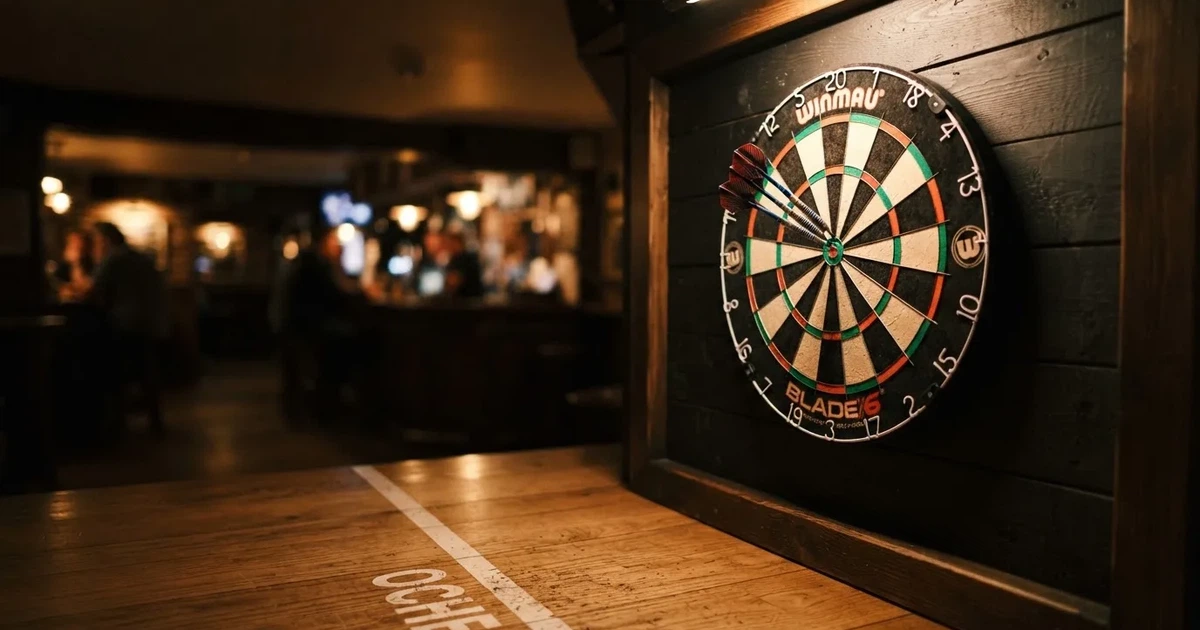
Snapshot: data current as of 27 October 2026, checked against the Gambling Commission’s public register and the operators’ own terms.
What darts betting is, in one paragraph
Darts betting is fixed-odds wagering on competitive darts matches and tournaments. A bookmaker offers a price for each outcome — usually a Match Winner in a head-to-head, or a Tournament Winner in a multi-runner field. The punter backs one outcome at that price. If the selection wins, the bookmaker pays stake multiplied by the decimal odds. If it loses, the stake stays with the bookmaker. The same rails handle in-play markets — a price given after the first leg has started, updated as the match moves. The whole exchange happens online, through licensed remote betting operators, and the rules under which the bet settles live on each operator’s terms page rather than in a statute.
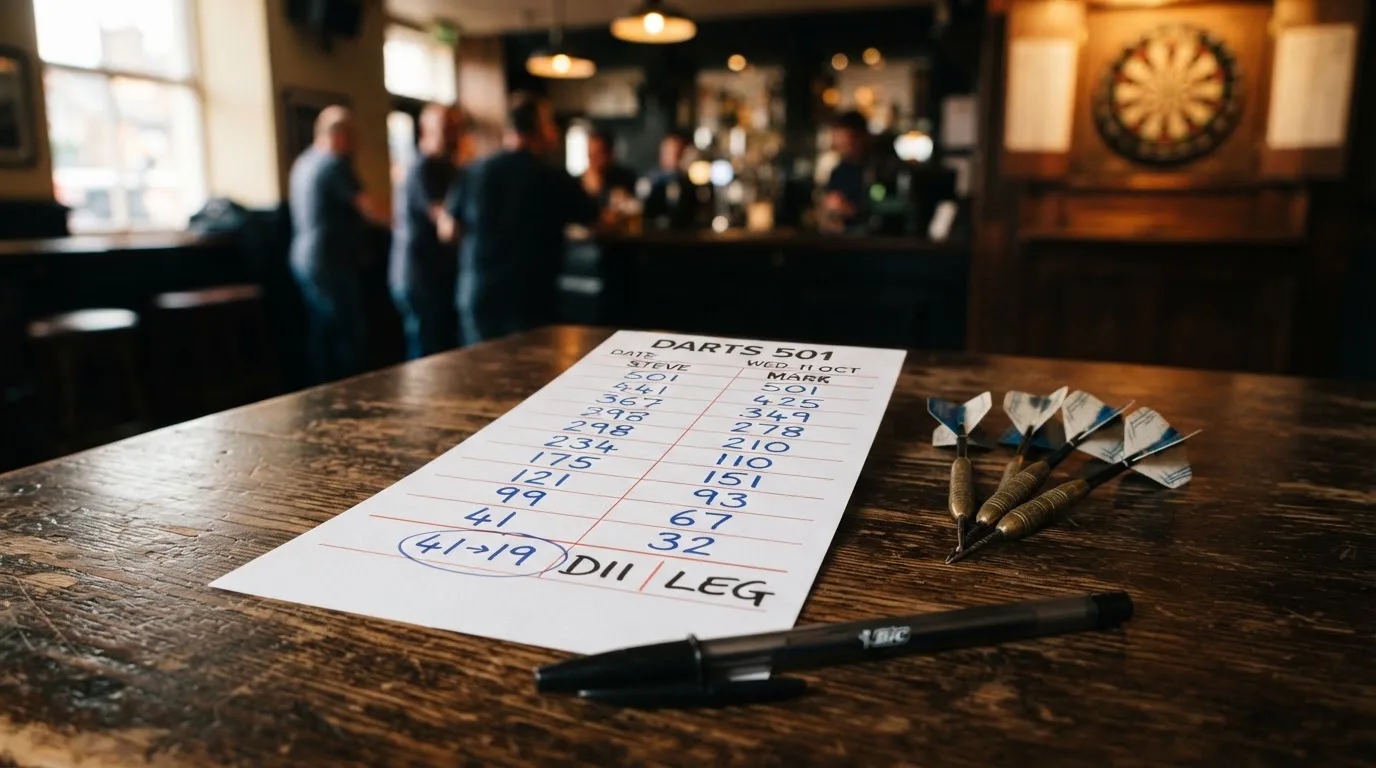
That last sentence is the one most bettors miss. Football has fixtures, but the fixtures don’t say what counts as a “completed leg”. Darts is even thinner: a leg is a race to a finish on a double, and bookmakers differ on what happens if a player withdraws mid-match, retires injured, or refuses to throw in a dead leg.
How the odds are built, and where the margin hides
Decimal odds are the published price: a stake of £10 at 3.50 returns £35, of which £10 is the stake and £25 is profit. Two numbers feed that price — what the bookmaker thinks the true probability is, and what the bookmaker charges for taking the bet. The second is the margin, also called the overround. It’s the slice of every pound bet that stays with the operator on average, after every outcome has paid out.
A clean two-way market, perfectly priced, returns 100% of every pound bet to winning punters across all outcomes. A bookmaker’s market returns less. The gap is the margin. Calculate it: payout share = 1 ÷ (1/odds₁ + 1/odds₂) over every outcome of one market. For an illustrative two-way market at 1.90 / 1.90, payout share = 1 ÷ (1/1.90 + 1/1.90) = 1 ÷ (0.5263 + 0.5263) = 1 ÷ 1.0526 = 0.95. Margin = 1 − 0.95 = 0.05, or 5%.
That 5% is the headline number a sharp bettor reads first. A 1.90 / 1.90 market at 5% margin is a healthy two-way price, on the same band as a major Premier League football match winner before kick-off. Darts match winner markets on the same match often sit one or two percentage points higher: the same illustrative 1.90 / 1.90 might appear at 5.5–7% margin for a mid-week floor event and around 4–5% for a televised Premier League night or a PDC major. Tournament winner markets over 96 or 128-player fields run heavier — 12 to 20% margin is the band on those, because the bookmaker carries more uncertainty about the long tail.
A bigger margin means a worse price for every outcome at once. There is no cherry-picking around it. The punt the bookmaker seeded into a market is the same one the operator paid, whether the favourite or the outsider is chosen.
What the bookmakers on the page actually offer
Ten bookmakers licensed to serve customers in Great Britain are reviewed below. Each holds a remote general betting licence (real events) on the Gambling Commission’s public register, which is the test of who is licensed and not the URL bar: domains prove nothing, since licensed operators run on .com and .co.uk alike.
| Operator | Gambling Commission licence | What the operator’s own terms say about darts |
|---|---|---|
| 10bet | Remote 043173-R-322899-023 — Blue Star Planet Limited | Sportsbook covers football, tennis, horse racing; Cash Out, Bet Builder and Live Streaming are advertised features |
| Sky Bet | Remote 067370-R-341330-005 — SBG Sports Limited | Free bets expire 30 days after crediting, single or each-way use only (not multiples) and exclude virtuals; stake is not returned with winnings |
| DragonBet | Remote 064908-R-339041-003 — DragonBet Ltd | App features Welsh football and rugby, racing, American football, in-play and bet builder markets |
| 888sport | Remote 039028-R-319297-014 — 888 UK Limited | Pre-match and in-play betting, Cash Out, Bet Builder, racing streams, BetFinder form tools, live bet feed and daily boosted odds |
| Fafabet | Remote 057385-R-333191-006 — Taichi Tech Limited | Best Odds Guaranteed on UK and Irish racing from 9am on race days; starting price wins if it is bigger |
| Star Sports | Remote 009177-R-104555-019 — Star Racing Limited | Customer can call 08000 521 321 to open an account, place bets or ask queries; [email protected] also offered |
| Coral | Remote 054743-R-330863-014 — LC International Limited | Welcome offer: £40 in free bets on a £20 qualifying sports bet at minimum odds 2.0 (1/1), issued within 7 days and expiring 7 days after |
| Betfair | Remote 039439-R-319330-013 — PPB Counterparty Services Limited | In-play, Bet Builder, live streaming of UK and Irish racing and football inside the app, 90 Minute Payout market |
| DAZN Bet | Remote 048756-R-327274-019 — DZBT Limited | Deposits from £5 by debit card, Apple Pay, Paysafecard, Trustly and Skrill; £20 minimum by PayPal; no processing fees |
| Kalooki Sportsbook | Remote 057730-R-333396-005 — Kalooki Sportsbook Limited | Operated by Kalooki Sports Book Ltd (company number 12938274); GAMSTOP member |
The right-hand column is what the operator says about its product, not a guarantee of how a darts market will price. A Cash Out button on the homepage is a feature; it is not a statement about tournament winner margin. The left-hand column is what every reviewer, comparator and regulator uses as a primary check.
How a licensed bookmaker is checked against the public register
The Gambling Commission runs a public register of every operating licence it has issued. The whole test of whether a brand is licensed sits in that register. To check a brand:
- Go to the Commission’s register and search by trading name, business name, domain or account number.
- Confirm the licence category. For an online sportsbook it should read “remote general betting standard (real events)”; an exchange reads “remote betting intermediary”.
- Read the licence holder (the company name) and the registered domain. The licence sits with a company, not a website, and several brands can be run by one licensee — Ladbrokes and Coral are not independent operators, Paddy Power and Betfair are not either.
- Check the status. A live licence has an active “in date” entry; an expired or revoked entry is the operator to walk away from.
A site that does not appear on the register is not licensed for Great Britain. That is not an opinion. It is the statutory answer under section 33 of the Gambling Act 2005 — any operator providing remote gambling facilities to customers in Great Britain without a Commission licence is committing an offence.
The shape of a darts match, and what that means for a price
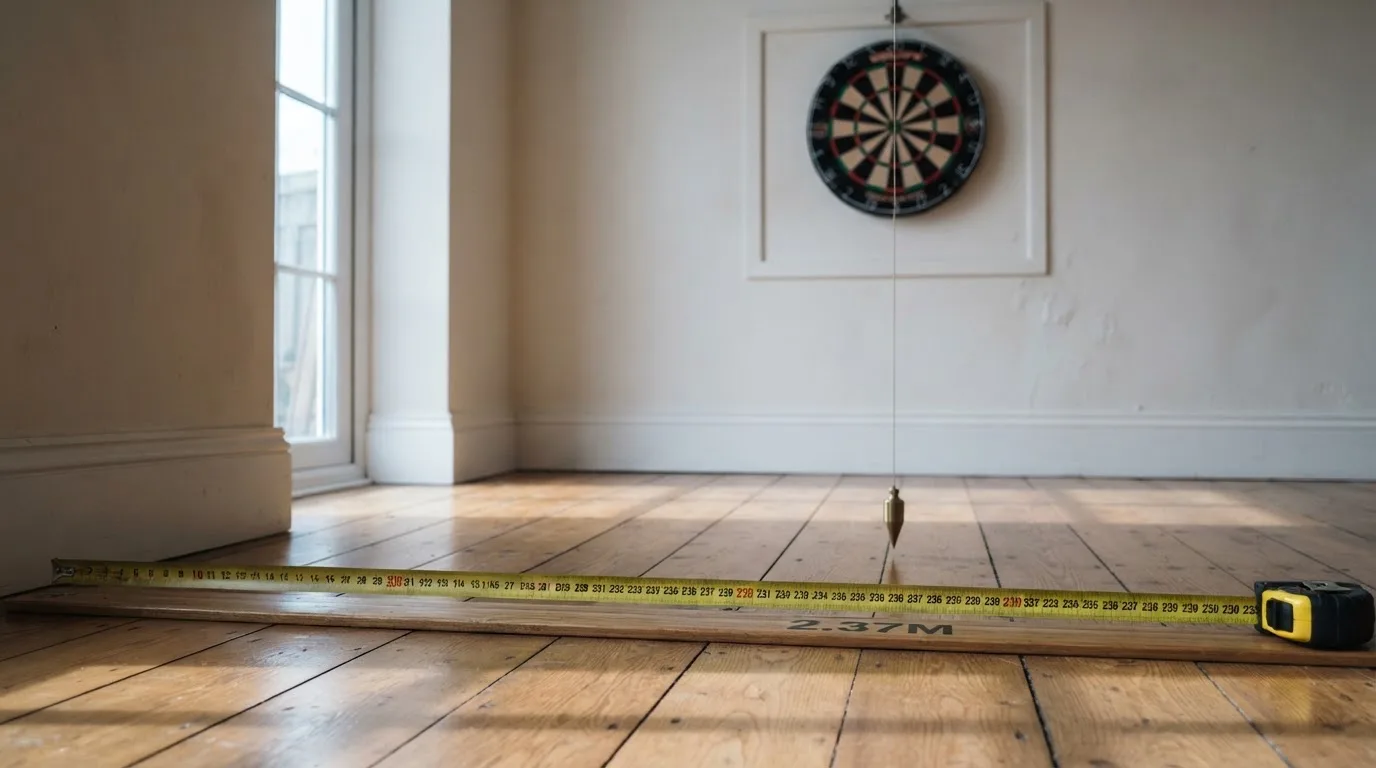
The standard dartboard has 20 numbered segments, each split into a single area, a double ring and a treble ring, and a bullseye worth 50. In 501 darts players start at 501 and must check out on a double or on the bull; the highest possible three-dart finish is 170 (treble 20, treble 20, bullseye), the lowest possible leg is nine darts. The throw line is 2.37 metres from the face of the board, with the bullseye 1.73 metres from the floor.
What this geometry does to a betting market: there are no injury-time substitutions, no referee stoppages of the kind that pause a football clock, and no running clock the bookmaker has to time. A leg is a discrete event that ends on a specific double. In-play markets price each leg as it happens, and a player who takes out a 110 checkout with his second dart moves his price the moment the third dart lands. A two-minute break between legs is normal; the price adjusts at the same pace as the throw.
Three-leg and five-leg formats are the standard for floor events and televised Premier League nights. Sets and legs are the two scoring units — players win legs to win sets, sets to win matches. The 2026 PDC World Darts Championship ran first to 3 sets in rounds 1 and 2, first to 4 in rounds 3 and 4, first to 5 in the quarter-finals, first to 6 in the semi-finals and first to 7 in the final. The match winner market settles when the final set’s deciding leg is checked out; the bookmaker’s terms say what happens if a player retires or is disqualified mid-match, and they differ.
What tournaments a dart punter actually bets on
The PDC runs the largest televised circuit alongside the World Darts Federation’s matchplay events. The PDC World Darts Championship is the headline tournament — held annually over the Christmas and New Year period. The 2026 edition ran from 11 December 2025 to 3 January 2026 at Alexandra Palace, London, with 128 players (an expansion from 96 in earlier years), a £5,000,000 prize fund and £1,000,000 to the winner. Luke Littler beat Gian van Veen 7–1 in the final.
PDC Premier League Darts runs weekly across UK and European venues through the spring, with a finals night in May. The Grand Slam of Darts, the Players Championship Finals, the World Matchplay and the World Grand Prix fill the rest of the season’s televised slots. Tournament winner markets open before a ball is thrown (ante-post) and stay live through the competition, with each round’s winner shortening and every eliminated player pulled. Outright markets carry the heaviest margins on the board — bookmakers price 128-runner fields with limited form data on the back of the draw, then re-price nightly as the field shrinks.
For an operator that prices the PDC World Darts Championship from ante-post to final, the published margin on the match winner market in the first round typically opens wider than the same fixture’s margin in the quarters or the semis, because fewer rounds of form have been played. By the time the final is set, the two players left are usually heavily priced and the margin is closer to the football equivalent.
What a winning darts bet pays back
Decimal odds published on the bet slip are what determine the payout. For a single bet of £10 at decimal odds 3.50, the formula is return = stake × odds = £10 × 3.50 = £35. The net profit is return − stake = £35 − £10 = £25. The bookmaker pays £35; the punter’s profit is the £25 over and above the original stake.
For a combination bet the prices of each leg are multiplied into a single price. A £10 double at 1.80 / 1.80 pays £10 × (1.80 × 1.80) = £10 × 3.24 = £32.40 return, or £22.40 profit. The same logic runs into trebles, four-folds and full accumulators — the price the punter sees on the slip is the product of the legs, and any one losing leg voids the bet. The audit is one dart on one leg.
Each-way bets split the stake into two equal bets: one on the win and one on the place. The stake doubles — £10 each-way costs £20. Place terms vary by operator and by event; a half-payment on the place is the norm for a field of this size.
What a free bet is actually worth
A free bet is a credit the operator stakes on the punter’s behalf. The headline number “£40 in free bets” looks like £40 cash. It usually is not. The stake of a free bet is typically not returned with a winning payout; only the profit is paid. A free bet of £10 at decimal odds 3.50 pays £10 × (3.50 − 1) = £25 — not £35. If the bet loses, the free bet is gone.
Work the average worth of a free bet at the same illustrative two-way market at 1.90 / 1.90, payout share 0.95. The expected value of a £10 free bet, taking only the profit, is free-bet amount × (odds − 1) ÷ odds × payout share = £10 × (1.90 − 1) ÷ 1.90 × 0.95 = £10 × 0.4737 × 0.95 ≈ £4.50 on average. Compared to a £10 cash stake on the same bet at the same price, which pays £10 × 0.95 = £9.50 in expected value, the free bet is worth less than half its face — a little over 47% of an equivalent cash stake at 1.90.
That is the coupon’s true cost, and it never reads that way on the marketing page. The same arithmetic holds for a £40 in free bets: roughly £18 of expected value on average at the same illustrative price, before any wagering requirement is layered on top.
Bonuses, what they take, and what they cost on average
The rules are tighter than they look. Promotion rules in force since 19 January 2026 cap wagering requirements on bonuses at 10× — meaning a £10 bonus that demanded 50× wagering (£500 of qualifying bets) can no longer be offered; under the cap, no more than £100 must be turned over per bonus. Mixed-product offers that require gambling on two or more product types (betting plus casino, betting plus bingo, betting plus lottery, the classic “bet on football to get free spins”) are also banned.
A £20 cash bonus at a 5× wagering factor, where only the bonus amount is wagered, requires turnover = bonus × factor = £20 × 5 = £100 of qualifying bets. With minimum odds of 1.50 (3/2) and stakes that count at face, the punter runs 100 bets of £1 to clear £20 of bonus. The expected cost of clearing is required turnover × market margin. On a market with a 6% margin, expected cost = £100 × 0.06 = £6 — about 30% of the headline bonus, before any minimum-odds exclusion kills part of the qualifying bet volume.
The arithmetic is the same on every market the punter clears the bonus through. The margin is the only knob that changes. Pick low-margin football match winners and the bonus costs less to clear. Pick high-margin darts tournament winners and the bonus costs more. Both are still discounts on the headline number; neither turns a £20 bonus into £20 of value, except for the few punters who hit the qualification window on the very few bets they place.
A welcome offer that pays a £40 free bet bundle for a £20 qualifying bet at minimum odds 2.0 (1/1) reads one way at the marketing page and another on the maths. The expected value of a £40 free-bet bundle at the 1.90 / 1.90 illustrative price runs in the £18 region. The qualifying bet of £20 at 2.0 has a positive expected value of £20 × (2.0 − 1) × 0.95 = £19 against a typical 5% margin — close to break-even. Net expected value of the offer is the free-bet bundle minus the qualifying-bet cost, with the qualifying bet landing close to par.
A punter who treats a welcome offer as a pure cash bonus reads it wrong. The free bet’s stake is not returned with winnings. The wagering cap exists for a reason. The offer’s value is the expected value of the free-bet bundle minus the expected cost of the qualifying bet and any turnover rule.
Live darts betting and cash out
Live darts betting lets a punter back and lay during a match. The price on a player who takes the first leg tightens; the price on the player who lost the first leg drifts. The published margin on an in-play market is wider than its pre-match equivalent on the same fixture, because the bookmaker is pricing with less information.
Cash out is the operator’s offer to settle a bet before the match is over, at a price derived from the live market. The price on offer is the bookmaker’s current quote for the same outcome, less a margin for the cash-out risk. A punter who cashes out at the right moment banks a profit; a punter who waits for the selection to win pays the same cash-out premium for nothing. The lever is the same on football, on horse racing and on darts — only the price moves faster on a sport played at three darts per leg.
Bet Builder and Same Game Multi markets on a darts match let the punter combine two or more outcomes from one match into a single price. Player to win the most legs AND total legs over 5.5 is a typical combination. The margin compounds. A bet builder is not the sum of two single markets — it is a single market the bookmaker has built, with the book’s own margin baked in across both legs. The same is true of an accumulator insurance offer: it refunds a stake if one leg loses, but the insurance has conditions of its own (minimum number of legs, minimum odds per leg, refund as a free bet) and the cost is the wider margin on the accumulator in the first place.
What to read before claiming any darts offer
No statement on the marketing page of a bookmaker is binding; the binding terms are the ones on the operator’s terms page, the bonus terms, and the sports-specific rules (most operators run a “Darts” subsection under their general sports rules). The punter checks these before any bet:
- The stake of a free bet: is it returned with winnings, or only the profit?
- The wagering requirement on a cash bonus: is the cap 10×, and what is the qualifying period?
- The minimum odds on a qualifying bet: a £20 at minimum 2.0 line moves a qualifying bet from a coin-toss price to a price with edge for the bookmaker.
- The expiry: a 7-day free bet versus a 30-day free bet is not the same offer in practice; a punter who loses track of the 7-day clock loses the free bet.
- The market exclusions: free bets restricted to singles only, or each-way only, are not interchangeable with an accumulator-friendly free bet.
- The payment rules: which deposit methods count for the offer, and which are excluded. A deposit by Skrill or Neteller is excluded at most operators.
Each operator runs its own version of these rules. The headline price on the offer page is one number; the rules around the offer are where the actual cost sits.
Responsible gambling at a darts betting site
Every operator reviewed on this page is licensed by the Gambling Commission for Great Britain. The Commission runs three protections a punter hits before a stake is placed: age verification (18+), identity verification before the first deposit (since 7 May 2019), and GAMSTOP coverage for anyone who has self-excluded across the online market.
GAMSTOP is a national multi-operator self-exclusion scheme and a mandatory licence condition for online operators since 31 March 2020. Self-exclusion periods are six months, one year, five years, or five years with auto-renewal, and after the minimum period the exclusion stays in place for a further seven years unless the customer asks GAMSTOP to remove it. GAMSTOP covers online sites and apps; high-street betting shops run a separate service. Every licensed online operator on this page takes part in GAMSTOP.
A financial vulnerability check has applied to licensed remote betting since 30 August 2024 (LCCP condition 3.4.4), with the customer-side trigger active since 28 February 2025: a public-record check (bankruptcy, county court judgments) once a customer’s deposits minus withdrawals exceed £150 in a rolling 30 days. It is not a credit check and not an income check. A further financial risk-assessment regime has been announced in stages, with the Commission’s published timetable of 7 July 2026 placing it as “announced, staged, no start date”.
A punter who feels control slipping has these routes to set a hard limit:
- A deposit limit set in the account: most operators offer it under safer-gambling settings. It is the customer’s choice, with no statutory ceiling on stake or loss.
- A time-out on the account: 24 hours, 7 days, 30 days. Stops play without enrolling in GAMSTOP.
- GAMSTOP enrolment: blocks all online gambling sites and apps run by licensed operators for the chosen exclusion period.
- GamCare (National Gambling Helpline) for confidential advice, GambleAware for information and self-help tools, the NHS gambling clinics network for treatment, and Gamblers Anonymous for peer support.
The protections are for the punter, not the page. A page that lists them and walks on is more useful than one that lists them as fine print.
The real cost of a darts bet — and what the punter does with that information
A darts bet at decimal odds 3.50 on a 5% margin market pays £35 from a £10 stake when it wins, which is the only side of the trade the slip states. The other side — the 5% the bookmaker takes on average across every outcome — is invisible on the slip. A punter who shops one match across four or five bookmakers finds match winner prices within a couple of decimal points of each other, sometimes tighter, sometimes wider, and the difference compounds across a season of bets.
Tournament winner markets are a different trade. Outright markets over 96 or 128-runner fields run at 12–20% margin on the head, and the prices on the back of the field drift further from fair value than the prices on the favourites. A punter who plays the long tail of an outright market pays the overround twice — once on the headline price and once on the per-leg place terms.
The four moves that actually lower the bookmaker’s cut:
- Pick match winner and handicap markets on televised Premier League nights and televised majors. Match winner on a televised fixture tends to run closer to football’s margin than to the outright market margin.
- Avoid combining legs into accumulators except where the per-leg margin is known and the multiplied price clears it. The multiplied price always looks generous; the multiplied margin is rarely checked.
- Use Cash Out only when the offered price is meaningfully better than waiting through the end of the match. Cash out is a price quote, not a gift.
- Hold an offer’s value to the day its wagering and expiry terms are met. The offer’s face value is not its cost-to-clear; the cost is the wagering requirement × market margin, all minus the qualifying stake.
The punt on a televised night the bookmaker is pricing live, on a market the bookmaker has spent the most time on, with a stake the punter would have placed anyway, is the lowest-cost darts bet a punter will find. Everything else is the bookmaker paying for the convenience of a price that already existed somewhere else.
Frequently asked questions
How do you bet on darts?
Pick a licensed online bookmaker from this page, register an account with a name, address and date of birth (the Gambling Commission requires identity verification before any deposit can be made), deposit by debit card or another accepted method and open the Darts section. Choose a market — Match Winner, Correct Score, Most 180s, Tournament Winner — select the outcome, enter the stake, confirm. The bet is recorded; settlement is automatic at the end of the match or tournament under the operator’s terms.
What is darts betting?
Darts betting is fixed-odds wagering on competitive darts matches and tournaments. A bookmaker offers prices on outcomes such as the match winner, the correct legs score, the most 180s in a match, the tournament winner, and on combinations across them. In-play markets run during the match, with prices updated leg by leg. Decimal odds are the published price; a stake of £10 at decimal odds 3.50 returns £35 if the selection wins (stake included), for £25 of profit.
How does handicap betting work in darts?
A handicap bet applies a leg or set advantage to the underdog before the match starts. In a three-leg match, Player A might start at -1.5 legs and Player B at +1.5; A needs to win 3-0 for a handicap winner to land on A, while a 2-1 result on the legs is now a win for the handicap backer of B. The bookmaker’s price reflects the handicaps as much as the form. Settling rules on player retirement and walkover are stated on the operator’s Darts rules page and differ slightly by bookmaker.
How can a bookmaker’s Gambling Commission licence be checked?
On the Commission’s public register, search by the operator’s trading name, business name, domain or account number. Confirm the licence category reads “remote general betting standard (real events)” for an online sportsbook (an exchange should read “remote betting intermediary”), check the licence holder company name against the operator’s own terms, and confirm the status is current. A licence that does not appear on the register is not a licence for Great Britain, whatever the website claims.
How is a return worked out from the stake and the decimal odds?
Return = stake × decimal odds. A £10 stake at decimal odds 3.50 returns £10 × 3.50 = £35. Net profit = return − stake = £35 − £10 = £25. For a combination bet the prices multiply into one figure: a £10 stake across two legs at 1.80 and 1.80 pays £10 × (1.80 × 1.80) = £32.40 return. A losing leg voids the bet, whatever the price the other leg landed at.
What is a bookmaker’s margin and how is it seen in the odds?
The margin (also called overround) is the share of every pound bet the bookmaker keeps on average across every outcome of one market. For a two-way market at decimal odds 1.90 / 1.90, payout share = 1 ÷ (1/1.90 + 1/1.90) = 1 ÷ 1.0526 ≈ 0.95, so margin = 1 − 0.95 = 0.05 (5%). The bigger the margin, the worse the prices on every outcome at once — a market at 8% margin returns 92p of every pound bet to winning punters; a market at 4% margin returns 96p. The closer the margin is to zero, the fairer the price.
Tennis, darts & cue sports – Basketball betting
Content created by the «Basketball betting» team
