
Rugby league betting from £5 stakes: ten licensed bookmakers compared on what they actually cost
 Available in US
The data carried here is current as of 27 October 2026 and was checked against the Gambling Commission’s public register alongside each operator’s own terms page.

Rugby league is a small sport in the betting shop. Super League runs from February to September in the north of England, the NRL spans the Australian winter, and the World Cup happens when international rugby league’s calendar allows. Around those fixtures sits a market that looks narrow but settles cleanly: thirteen players per side, eighty minutes split into two forty-minute halves, six tackles before the ball must change hands. Most licensed bookmakers in Great Britain price it, the prices are sharper than they look, and the rules around how each market settles decide what a winning slip actually pays.
This page is about the cost. There is no way to predict the outcome of a rugby league match from the seat you are reading from, and nobody offering such a prediction has the better of it consistently enough to make a business of selling picks. What bettors control is what they pay for the bet itself: which bookmaker charges less in margin, which one settles on eighty minutes and which on “official result”, which one refunds a stake when a handicap lands exactly on the number, and which welcome offer survives an honest read of the small print. Cost comes before guesswork, and that order is what this guide follows.
What online rugby league betting means in a British betting shop
Rugby league is the smaller of the two codes of rugby union bookmakers take bets on. The rules matter because the markets sit on top of them. A rugby league team has 13 players, a match runs 80 minutes in two 40-minute halves, and the attacking team gets a maximum of six tackles before possession must change. Scoring is try 4, conversion 2, penalty goal 2, and drop goal 1 (2 if kicked from beyond the 40-metre line). Because possession turns over quickly and most tries follow from a handling error or a kick that is misfielded, the scoreline moves in clusters rather than steady increments, and handicap lines at the bigger price points swing fast.
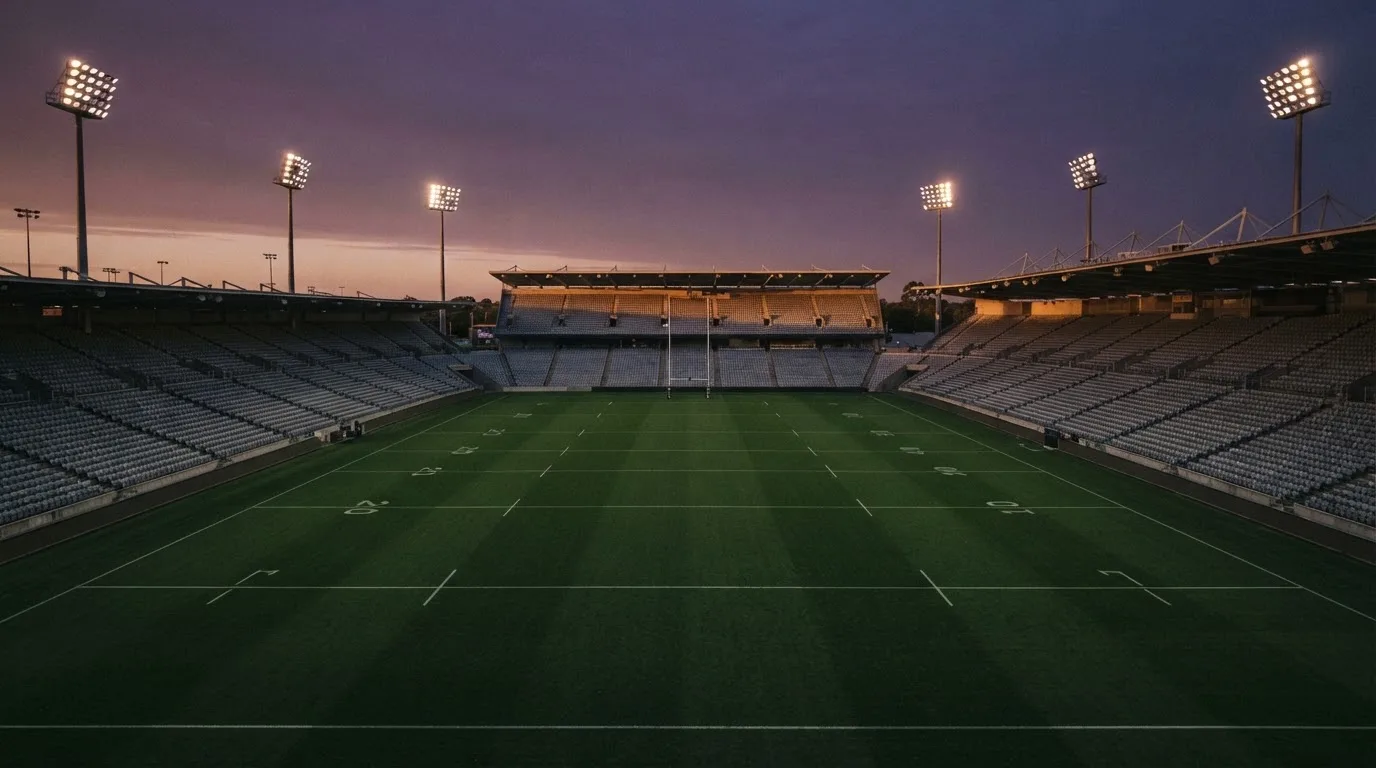
Super League is the main European club competition, with twelve teams from the north of England and one each from France and, in recent seasons, from the south of France. The NRL is the Australian and New Zealand club competition, sixteen teams across Australia and New Zealand, with the season running from March through to the Grand Final in early October. International Rugby League governs the sport and stages the Rugby League World Cup on a cycle of its own. There is a Challenge Cup in England and Wales, a 1895 Cup at the start of the Super League season, and State of Origin as the showpiece of the NRL calendar. A bookmaker that prices Super League properly tends to price the rest; a bookmaker that misses a Super League market tends to dress up football and racing markets as rugby league content.
The traffic on a rugby league betting page tends to come from people who already follow the sport, not from people exploring it. That makes the practical questions different from a beginner’s. The market list matters more than the bonus, the settlement rule matters more than the headline price, and the bookmaker’s record on minor markets and partial cash outs matters more than the welcome offer on the front of the email.
How British bookmakers handle rugby league markets
The licensed bookmakers that take rugby league bets tend to treat the sport the same way on the major markets and differently on the minor ones. Match Betting (home, draw, away — Super League uses the draw, the NRL does not), Handicap Betting, Total Points, First Try Scorer, Anytime Try Scorer, and Team Totals are the markets that almost every shop takes. Around them sit smaller offerings: winning margin bands, race to ten points, race to twenty points, half-time and full-time combinations, and player performance markets. Bet Builder coverage has expanded in the last two seasons and is now standard at the larger shops; Bet Builder+ at one operator combines markets from a single event into a single price and is offered both pre-match and in-play.

The settlement of those markets is governed by the bookmaker’s own rules. In one major British bookmaker’s published rules, Super League and NRL Match Betting and Handicap Betting settle on 80 minutes’ play, while most other markets — including outright and tournament markets — settle on the official result including extra time. That matters when a Super League game goes to extra time in the Challenge Cup; the match result stands on the eighty minutes, the outright market may not. When a handicap line is a whole number and the margin of victory lands exactly on it, every wager on that line is refunded. Postponed matches carry for 48 hours from the original kick-off and then become void. None of this is hidden — it lives in the rules page that sits behind the betting slip — but the difference between a settled and a void bet is precisely the difference between a price that pays and a price that doesn’t.
Where rugby league sits in the wider British sportsbook
Sports betting in Great Britain is licensed by the Gambling Commission under the Gambling Act 2005. There is no statutory list of permitted sports or markets: an operator holds a remote general betting standard (real events) licence and decides what to take bets on under its own commercial judgement. Rugby league sits in the second tier of sports by handle — well behind football and horse racing, comfortably ahead of Gaelic games, bandy and esports — and most licensed shops price it across the season. The licensed size of the market lets the smaller shops ignore the sport entirely if they choose; several of the brands reviewed here sit exactly in that gap.
The set of fixtures on offer moves through the year. The Super League season kicks off in mid-February with the 1895 Cup, runs through to the Grand Final at the end of September, and into the play-off series for the top six before that. The NRL runs from early March to early October. The State of Origin series sits inside the NRL season in June. The World Cup sits on a separate cycle: the last men’s tournament was held in 2022 in England and the women’s in 2022 as well, with the next scheduled for 2026. Whenever a World Cup year falls, the cluster of group games, quarter-finals, semi-finals and the final itself is the heaviest two months of international rugby league betting the calendar holds.
Why the bookmaker’s margin matters more than any welcome offer
Every price a licensed bookmaker offers is the back of a margin. Two-way markets, where there are two possible outcomes (home win and away win in the NRL), settle the margin across the two prices. Three-way markets add the draw. The margin tells you how much of every pound bet on the market the bookmaker keeps on average across all outcomes, and it is the single number that decides who pays you more per win over a long run of bets.
An example makes it concrete. A two-way market priced 1.90 / 1.90 (fractional 9/10 each way) looks fair to the eye. The implied probabilities are 1 ÷ 1.90 = 52.63% on each side, and that adds to 105.26% — five-point-two-six points of “overround” the bookmaker has built in. The payout share is the inverse: 1 ÷ 1.0526 = 95.0%, and the margin is 100% − 95.0% = 5.0%. A market at 1.90 / 1.90 keeps about five pence of every pound the bookmaker takes, on average, forever.
What changes from operator to operator is the level of that margin. The Super League handicap market for one fixture shows 5.0% at the sharper shops and climbs above 7% at the slacker ones. Rugby league totals markets run heavier, because books price them less carefully. The same match priced 1.91 / 1.91 sits at 4.7% margin; priced 1.85 / 1.85 sits at 8.1%. Two percentage points of margin, on the same fixture, is the difference between a long-run track record that pays and one that doesn’t. The bet builder markets that combine several selections from one match ride heavier margins still, because the legs multiply into a longer price and the bookmaker’s edge compounds. A reader who plans to bet rugby league seriously — not in ones and twos, but as a season of activity — gets a noticeably better return on the same fixture by shopping margins across two or three shops before placing the bet.
The legal frame: how rugby league betting is licensed in Great Britain
The whole commercial betting market in Great Britain is licensed by the Gambling Commission (UKGC), a non-departmental public body sponsored by the Department for Culture, Media and Sport. The framework is the Gambling Act 2005, which covers England, Scotland and Wales; Northern Ireland is outside the 2005 Act and has its own older law, so the right phrasing is “Great Britain licence” or “GB-licensed”, never “UK-licensed” if the question is which statute applies. Before the Gambling (Licensing and Advertising) Act 2014, a gambling operator licensed in another jurisdiction could serve British customers from that jurisdiction; since the 2014 Act, any operator whose remote facilities are used in Great Britain needs a Commission licence wherever it is based. Sections 33 and 36 of the 2005 Act, as amended, set that test. A Gibraltar, Malta or Curaçao licence is not a substitute. There is no state monopoly and no statutory cap on the number of licences; the Commission’s public register is the only place the test is recorded.
Licence categories and what each one lets a bookmaker do
Remote betting in Great Britain runs under five licence categories. Remote general betting standard (real events) is the standard sportsbook licence and the one every operator reviewed on this page holds. Remote general betting standard (virtual events) is a separate category for computer-generated fixtures and sits alongside the real-events licence where a bookmaker offers products like virtual horse racing. Remote general betting limited is a smaller category, sometimes used by start-ups and shops that haven’t grown into a full licence. Remote pool betting covers off-course pool betting on horse and dog racing and is the licence for the tote and similar products. Remote betting intermediary is the exchange licence — what separates a back-and-lay exchange from a conventional bookmaker. The Commission account number against each licence is the unique identifier; two different brands can sit under the same licensee, so Ladbrokes and Coral, or Paddy Power and Betfair, are never presented as independent operators on the same panel.
The Commission’s public register is searchable by business name, trading name, domain or account number, and it is the whole test of whether a brand holds a licence. The register’s data is live and changes; a count of licences in force carries no meaning without an access date, and so no such count is quoted on this page. A licensed operator’s domain is not always .co.uk — most use .com as well — so the domain itself proves nothing about the licence. What proves something is the account number against the trading name on the register.
What verification means before the first bet
A customer at a GB-licensed remote operator has their name, address and date of birth verified before they can deposit or gamble. That rule has been in force since 7 May 2019, and it applies even when a free bet or bonus is involved — there is no anonymous play at a licensed site. Identity checks are run against public record databases, electronic identity verification providers and, where necessary, document upload. Source-of-funds questions at higher spend levels sit inside the money-laundering rules and are normal rather than exceptional. A financial vulnerability check, under LCCP condition 3.4.4 and in force since 30 August 2024 (operating against customer deposits since 28 February 2025), sits at a £150 rolling-30-days threshold of deposits minus withdrawals and is a public-record check — for example bankruptcy or county court judgments — not an income check and not a credit reference check. A separate financial risk assessment regime has been announced in a staged plan, with no start date as of writing.
Paying for a bet: payment rules and duties
General Betting Duty is the operator’s tax on gross profits and currently sits at 15%. From 1 April 2027 a new remote betting rate of 25% applies within it; remote bets on UK horse racing, self-service betting terminal bets, pool betting and in-person betting stay at 15%; until that date the remote rate stays at 15% on the same definitions. Spread betting has its own rates — 3% on financial spread bets, 10% on other spread bets — and is regulated by the Financial Conduct Authority rather than the Gambling Commission, so a sports spread bet on a rugby league total sits in a different tax frame than a fixed-odds bet on the same total. The customer pays no tax on betting winnings in Great Britain; a professional gambler takes a different position and asks HMRC or a tax adviser, but casual bettors receive the full return.
Debit cards and bank-based payments are not restricted; credit cards are banned for gambling in Great Britain since 14 April 2020 (LCCP condition 6.1.2), and that ban extends to credit-card-funded payments through e-wallets, so an e-wallet funded from a credit card falls inside the rule. The British named-account rule, a state list of permitted payment methods and any rule for or against cryptocurrency deposits at licensed operators are not established; describe payments qualitatively and from each operator’s terms, not from a generalised British rule.
Marketing rules: how welcome offers are now capped
Advertising is not licensed by the Commission. The Committee of Advertising Practice Code (non-broadcast) and the Broadcast Committee of Advertising Practice Code (broadcast) apply, and the ASA enforces them, sitting alongside the LCCP marketing conditions. Section 16 of the CAP Code requires marketing to be socially responsible, says gambling ads must not be of strong appeal to under-18s and says no one who is or seems to be under 25 may feature gambling or play a significant role in a gambling ad — that rule is about who may appear in the advertisement, not about who may be a customer.
Promotion rules in force since 19 January 2026 cap wagering requirements on bonuses at 10x. A £10 bonus carries a maximum £100 turnover requirement; a £50 bonus carries a maximum £500 turnover requirement; a £100 bonus a maximum £1,000. A “bet on football to get free spins” offer — a mixed-product promotion — is banned. The cap applies to bonuses, and whether it applies to free bets with no wagering condition is not settled — read each operator’s terms page rather than assume. There is no state cap on the money value of a bonus.
Bonus terms cost the bettor what the small print says, not what the headline says. A £50 bonus with 10x turnover at minimum odds of 4/5 on a market of 7% margin needs £500 of bets, with each bet at or above 4/5 — and that’s a benign offer. The wagering requirement is what changes the picture. On a 5% market at 4/5 minimum, the expected cost of clearing the £500 turnover sits at £25 (5% of £500); on the same turnover at 8% margin it sits at £40. The headline is the £50 bonus; the cost is the bet the reader has to place to clear it.
Offshore brands and what going unlicensed costs the customer
GB licences are compulsory at the point of consumption. Providing gambling facilities in Great Britain without the licence the Act requires is an offence under section 33 of the Gambling Act 2005, aimed at the operator. The customer who places a bet on an unlicensed site commits no offence, but loses the protections that licensed status carries. There is no GAMSTOP coverage at an unlicensed site — a customer who has self-excluded across licensed operators can still reach the offshore shop. There is no Commission complaints route. There is no approved dispute-resolution body such as IBAS for licensed disputes. Funds are not protected by the consumer-redress framework. The 10x bonus cap does not apply. The £150 vulnerability check does not apply. A reader who wants the protections pays for them in higher prices (offshore books tend to run higher margins to compensate), and a reader who doesn’t want them gives them up entirely.
Enforcement against unlicensed operators sits on disruption rather than blocking. The Commission issues cease-and-desist notices, refers unlicensed sites to search engines, and works with registrars, hosts and payment providers to take infrastructure away. Court-order DNS blocking powers have been given or are about to be given — never write that ISP blocking is in operation, because the legal mechanism to enforce it across British ISPs has not been turned on against any unlicensed operator at scale. Honest framing for a reader who arrives at an unlicensed site is this: no identity check before deposit, no GAMSTOP, no dispute route, no fund protection, no British consumer redress if money is withheld.
Responsible gambling: what a licensed shop has to offer
The British framework gathers player protection under one roof. GAMSTOP is the national multi-operator online self-exclusion scheme and a mandatory licence condition for all licensed online operators since 31 March 2020: every brand reviewed on this page is a GAMSTOP member, and a customer who signs up at one excludes themselves from every licensed site carrying that customer in their data. Self-exclusion periods are six months, one year, five years, or five years with auto-renewal; after the minimum period the exclusion stays in place for a further seven years unless the customer contacts GAMSTOP and asks to remove it. GAMSTOP covers online sites and apps. Betting shops use a separate service, and a customer who wants to exclude themselves across the high street needs to enrol separately.
Deposit limits and stake limits at the licensed shop
Operators must offer a gross deposit limit on a fixed time frame. The first phase of the deposit-limit controls has applied since 31 October 2025. A second phase, originally due in 2025, was postponed to 30 September 2026. Whether that second phase is live at reading time is not established; describe it as “announced, staged, no start date” if a number is needed, and otherwise describe each operator’s own limit structure. There is no state-set deposit or loss ceiling for betting, and limits are the customer’s own choice within the operator’s offer. Some operators let a customer set the limit at sign-up, others surface it after registration, others push it behind a deposit-cap menu inside “safer gambling”. A customer who wants the limit in place at sign-up is best served by reading the “safer gambling” link on the registration page before depositing.
Help lines and where to find them
GamCare runs the National Gambling Helpline and offers counselling, self-help material and live chat. GambleAware funds education, prevention and treatment. The NHS runs a small network of gambling clinics through its mental-health service. Gamblers Anonymous runs peer-led support meetings across the country. Each licensed operator links to these from a footer link inside “safer gambling” or “responsible gambling”; a licensed shop that doesn’t link to one or more of these isn’t matching the LCCP marketing conditions, and a customer who can’t find the link on an account page has a reason to ask the operator where it lives.
Self-exclusion in practice at the shop
Registering at GAMSTOP is the last resort after the cheaper controls have failed. Deposit limits, timeouts, reality checks and product restrictions sit ahead of it as cheaper levers for the customer who suspects their own play is drifting. Operators must offer timeouts (24 hours, 7 days, 30 days and longer) and product blocks under LCCP conditions. A customer who wants to stop for a month at the touch of a button can do that at every operator reviewed here; a customer who wants to remove themselves from every licensed shop for the long term goes through GAMSTOP.
Bonuses and free bets: what rugby league welcome offers actually carry
The licensed bookmakers reviewed here each carry a sports welcome offer of some kind — a bet-and-get free bet, a matched deposit bonus, an enhanced odds offer on a marquee event, or a percentage-back-as-free-bet on a losing first wager. The marketing language shapes the offer; the small print sets the cost; the gap between the two is what this section is about. Wagering requirements on bonuses at licensed shops are capped at 10x under the promotion rules in force since 19 January 2026, and mixed-product promotions (an offer that requires gambling on more than one product type) are banned. The cap applies to bonuses, and a free bet with no wagering condition is not necessarily capped at 10x — read the offer page rather than assume.
How to read a bonus: turnover, minimum price and the market it sits on
A £50 bonus at 10x wagering means £500 of qualifying bets. A £30 free bet at no wagering means a stake that is lost on a losing selection and returned only as winnings on a winner. The latter is the better offer for the bettor who can place the free bet at a price above the qualifying minimum and on a market where margin is reasonable.
Where bonuses turn into cost is at the minimum qualifying price. A bonus turnover that requires bets at minimum odds of 4/5 forces the customer into markets priced 1.80 or above (decimal). On rugby league that excludes the heaviest-margin markets (some handicap lines at small favourites, some totals at small over/under) and pushes the customer into the markets the bookmaker wants volume on. The expected cost of the turnover is turnover times the market margin: at £500 turnover and 6% margin, the cost is £30. Subtract the bonus (£50), and the offer is +£20 to the bettor on average — a positive. At 8% margin on the same turnover, the cost is £40 and the offer is +£10. At 10%, the offer is break-even. Higher margin, and the offer goes negative. Read the minimum odds clause first, price the relevant market on that operator, and the picture becomes arithmetic.
Free bets that stake-not-returned mean the stake is gone on a losing selection and only the profit pays on a winner. The value of the bet is the free-bet amount times (odds − 1) divided by odds, multiplied by the payout share of the market. A £30 free bet at 5.00 odds (fractional 4/1) on a market with a 95% payout share gives a value of 30 × 4 ÷ 5 × 0.95 = £22.80. That’s the average the offer is worth over many bets at the same shape. It’s never the winnings from one bet — that’s what the marketing suggests.
Welcome offers are not the only offers. Major rugby league events (the Super League Grand Final, the Challenge Cup Final, the World Cup final) trigger price boosts and acca insurances at most shops. A price boost on a marquee fixture tends to be a short-window offer and the cost is hidden in the original margin — the boosted price sits closer to the true probability than the standard price, and the standard price is what the rest of the bet pays. Acca insurance refunds one leg of a losing accumulator in free bets if the rest lands, and is the cheapest of the running offers for the bettor who already bets multiples.
Live betting and cash out on rugby league
Live betting on rugby league is offered at the larger shops and converges on the same set of markets the pre-match price carries: Match Betting, Handicap, Total Points, Next Try Scorer, Race to Ten, Race to Twenty. In-play running is set by the bookmaker’s own controls — there is no statutory minimum delay, and no statutory maximum in-play stake — and the prices update as the score and the field position move. British bookmakers offer in-play under their remote general betting standard licence without restriction; virtual events are a separate licence category, so live betting on computer-generated rugby league fixtures sits under a different frame.
Cash out is a separate function the operator offers alongside live betting. The customer locks in a price at any time during the game and the bet settles for the cash-out value rather than the final settlement. The cash-out value is built from the live prices the operator is showing rather than the prevailing market prices, so a customer who cashes out at “fair” has accepted the operator’s margin in real time. Most shops offer a partial cash out on accumulator bets, which lets the customer take a partial return rather than all-or-nothing. Swifty Sports lists Cash Out on markets including horse racing and football across its product; Midnite shows in-play events with maximum-stake limits; Betfred offers live streaming alongside in-play; Swifty offers daily price boosts and live streaming on its GB app.
Why in-play margins tend to be heavier than pre-match
The short version is that in-play prices are quoted with shorter reaction times, and the operator pads the margin to cover the wider confidence interval on a market where one score in either direction moves the picture. A Super League match at 6-0 sees the match-result market at about 1.55 / 1.55 on a sharper bookmaker (3% margin in-play), and at about 1.50 / 1.50 on a slacker one (a 6.7% margin). The handicap market widens out as the favourite’s lead grows, and the totals market moves roughly three points per try at most shops. A reader who plans to bet in-play seriously needs to know how heavy their chosen bookmaker’s live margin is on the markets they care about, and the only way to know that is to look at a settled market on the operator’s site and measure.
Live streaming and the broadcast rights frame
Rugby league sits behind a broadcast rights frame that limits how much live footage licensed shops can show. Major GB bookmakers offer live streaming on horse racing and greyhound racing because a different licence regime applies, and they offer streaming on football and a small number of other sports. Rugby league streaming exists in patches — international tournaments with looser territorial rights, lower-tier domestic rugby league with limited TV coverage — but is not reliably offered across the season at any one bookmaker. A customer who wants in-match footage at every round of the Super League is buying a TV subscription, not a betting account.
Predictions, tips and what a “strategy” can really do
There is no publicly available model that beats the closing line on rugby league betting across a season. The closing line — the price the bookmaker settles at one second before the match — is the sharpest price the market offers, because sharp money has moved it there. Beating the closing line over many bets is the only definition of long-run profit that survives a serious look. A rugby league betting tips blog, a Twitter picks account and a paid subscription service that posts a 12-leg acca every Friday all share the same problem: nobody knows the outcome of a rugby league match in advance with enough certainty to make the bet a positive-expected-value one. Some tipsters are honest about their strike rate; most are not.
What the bettor can actually do
What a serious bettor can do, before any model and any tip, is shop margins and read rules. A bettor who places 500 rugby league bets a season at £10 each is spending £5,000 in stake. At 5% margin, the long-run expected loss is £250. At 7% margin, it’s £350. Two percentage points is £100 of expected loss on the same volume. The bettor who reads the rules and notices that one bookmaker settles on “official result” and another on 80 minutes for the same market protects themselves against the post-match void they’ve already paid for. The bettor who notices that their bookmaker’s handicap refund rule voids a whole-number push protects themselves against the loss a careless bookmaker manufactures.
Bankroll management is the cheap side of the discipline. A stake sizing rule that risks 1-2% of bank on any one bet keeps the bettor in the game through a losing streak the bettor can’t control. The same stake sizing rule on a wider or smaller bank still applies. Rugby league’s scoring patterns lend themselves to a stake sizing rule more than most sports — scores come in clusters, and the variance per match is wider than the pre-match market implies. Bankroll management never predicts a winner; what it does is keep the bettor in the market long enough for their edge (whatever edge they have) to express itself.
What a “strategy” really does in practice
A rugby league betting strategy is a ruleset the bettor applies before the kick-off. Flat staking of £10 per bet keeps the unit fixed. Variable staking by confidence (1% to 5% of bank by price) tries to scale stake to edge, which most bettors can’t measure cleanly. Tiered staking by market (smaller stakes on totals, larger stakes on handicaps where the bettor’s read is sharper) splits the bank across the markets the bettor believes in. The strategy that survives most seasons is the strategy the bettor can actually keep. Fancy staking plans chase losses and ruin the bettor; flat staking with a small edge compounds. There is no reliable edge at rugby league betting for the customer who doesn’t already work in the sport; the bettor’s job is to keep costs low and variance under control long enough for whatever small edge they find to come through.
Bet types and the rules that decide what pays
A bettor at a rugby league betting market chooses a price and a stake. The price is the odds the bookmaker offers; the stake is what the bettor puts down. The return is stake times price; the profit is stake times (price − 1). A £10 bet at 4.50 returns £45, with £35 of profit. A £10 free bet at the same price returns £35, with £35 of profit; the stake is gone on a losing selection and only the profit part pays.
Match Betting, Handicap Betting, Total Points
Match Betting on Super League is a three-way market (home, draw, away); Match Betting on NRL is two-way (the NRL goes to golden point rather than finishing on a draw, so the draw is settled void). Handicap Betting attaches a points start to the underdog — Wigan −6.5 / Hull +6.5 means Wigan start the match six-and-a-half points ahead for the purposes of the bet. Total Points sits at a number — Over 38.5 / Under 38.5 — and the bet settles on whether the combined score is above or below. Whole-number handicap lines refund when the margin of victory lands exactly on the number; whole-number totals don’t refund (the total lands on a whole number when it lands there, and Over and Under are decided by the half-point margin the book sets).
The settlement rule on these markets varies. Match Betting and Handicap Betting settle on 80 minutes’ play at the larger shops, where the rules page is explicit; Total Points, First Try Scorer and other markets settle on the official result including extra time. If a Super League Grand Final goes to extra time, the handicap and match result bets settle on the 80-minute score, not the extra-time winner. Outright markets settle on the tournament result, including extra time. A bettor who backs the favourite in a tight Challenge Cup final may settle on a loss they thought they’d won if the rules they assumed didn’t match the rules the bookmaker wrote.
Each-way, accumulators and what they cost
Each-way bets are two bets of equal stakes on the same selection: a win part and a place part. The each-way place terms sit inside the bookmaker’s rules and depend on the number of runners; four places for a six-runner race, three places for five or fewer, one-quarter odds for non-handicap races of five to seven runners, one-fifth for shorter fields. Each-way betting is a horse racing staple and bleeds into rugby league only at outright markets — Super League winner, Grand Final winner, World Cup winner. The each-way price the book offers runs over the place terms, and the place part pays a fraction of the win part.
An accumulator (acca) is a single bet whose legs multiply. Four legs at 2.00, 3.00, 2.50 and 2.00 price to 30.00. A £10 acca returns £300 on all four winners; lose any leg, and the bet loses. Trixie (4 bets), Patent (7), Yankee (11), Lucky 15, Super Yankee or Canadian (26), Heinz (57) and Goliath (247) are full-cover multiples — every combination of the chosen legs — and the total stake is unit stake times the number of bets. A Lucky 15 at £1 unit stake is a £15 line; a Goliath at 25p unit stake is a £61.75 line. The unit stake is what the bettor decides; the number of bets is what the system decides.
Bet Builder, Same-Game Multi and the within-match accumulator
Bet Builder lets the bettor combine markets from one event into a single price. A Bet Builder on Wigan vs Hull that bundles Wigan to win, Total Points over 32.5 and Tom Opacic to score a try prices to a single number and settles as a single bet. Bet Builder sits inside the same match and rides margins that are heavier than the singles that compose it — the legs multiply into a longer price and the bookmaker’s per-leg margin compounds. Bet Builder at one of the major shops is offered both pre-match and in-play. Most shops offer Bet Builder on rugby league as long as the fixture is priced across the relevant markets.
Spread betting on rugby league
Spreadex offers spread betting on rugby leagues and is regulated by the FCA for the spread side and by the Gambling Commission for the fixed-odds side. Spread betting on Total Points means the bettor buys or sells a number of points; the settlement is the difference between the spread and the actual total, multiplied by the stake. Losses on spread bets can exceed the deposit (Spreadex’s own terms warn about this), and the customer pays the larger of buy and sell if the spread is hit. Spread betting on rugby league is a different product from fixed-odds betting, sits in a different tax frame (3% for financial, 10% for other), and is offered by a smaller set of operators.
Sports and tournaments in the rugby league calendar
Super League
Super League is the main European club competition. Twelve teams from the north of England plus Catalans from southern France make up the standard field; Toulouse joined for 2022 and St Helens, Wigan, Leeds, Hull FC, Hull KR, Warrington, Castleford, Salford and Wakefield fill out the rest. The regular season runs from mid-February to mid-September with a 27-round home-and-away schedule; the top six play off into the Grand Final at Old Trafford at the end of September. The Challenge Cup is a separate knockout competition with the clubs and rugby league teams from outside Super League, with the final at Wembley in early summer. Betting markets on Super League are priced across the regular season from late February; the Grand Final and Challenge Cup markets appear in early spring.
NRL
The NRL is the Australian and New Zealand club competition: sixteen teams across Australia and New Zealand. Melbourne Storm, Penrith Panthers, Sydney Roosters, South Sydney Rabbitohs and the Brisbane Broncos are the historical heavyweights; the New Zealand Warriors and the Dolphins have grown into the field more recently. The season runs from early March to early October with the Grand Final in early October. The State of Origin series sits inside the NRL season in June — three matches between New South Wales and Queensland. Betting markets on the NRL run from January on ante-post outright, with the game-by-game markets opening as teams are confirmed.
International Rugby League and the World Cup
International Rugby League governs the sport. The Rugby League World Cup runs on a four-year cycle and gathers the full international field — England, Australia, New Zealand, Tonga, Samoa, Fiji, Papua New Guinea, Scotland, Ireland, France, Italy, Greece, Wales and others depending on the year. The 2022 tournament was held in England; the next is scheduled for 2026. The World Cup markets sit on the body of the competition: group winners, qualifying, top try scorer, outright, top points scorer, and the same markets on the women’s tournament. A Tonga vs Samoa test in the southern hemisphere sits under the same governance.
Other domestic competitions
The Championship and League 1 below Super League are English second and third tiers. The 1895 Cup is an early-season knockout. The Super League has run a Vegas round in recent seasons, with two fixtures played in Las Vegas in late February or early March. The New South Wales Cup and the Queensland Cup sit below the NRL and gather the reserves and feeder competitions in Australia. Betting markets on these fixtures exist at the shops that price Super League and NRL; the prices tend to be heavier-margin than the top-flight markets, and small fields can mean small outright markets.
Ten licensed operators for rugby league
The ten operators reviewed below all hold a remote general betting standard (real events) licence with the Gambling Commission. Each licence is recorded on the public register; the licence number, the licensee and the trading name are the public facts from the register. The order below is not a ranking of which is the better bookmaker for rugby league specifically. The reviews below are not endorsements; each one names what the operator carries and what it costs the bettor, and the verdict is the editor’s read of where each shop fits among the others on the page. A licensed operator is not by default the right pick; an operator whose margin is heavy, whose settlement rules are loose or whose terms page is thin is still on this page because the register names it, and a reader picking from licensed shops needs to see what each one looks like from the inside.
Swifty Sports
Swifty Sports holds Gambling Commission account 58957 and is licensed under Swifty Global (UK) Ltd. The brand’s GB app carries Best Odds Guaranteed, Cash Out on markets including horse racing and football, daily price boosts, live streaming and in-play betting. Bet Builder is listed as coming soon. The app is new to the App Store and the experience is fresh; a reader who likes a recently built product will recognise the layout. Rugby league sits inside the standard sport list; the smaller markets (winning margin, half-time score, race-to-twenty) are listed for the bigger fixtures and not priced across the board. Swifty Sports’ price boosts are daily and tend to sit on accumulator legs rather than the marquee fixture — a useful offer for the acca punter, less so for someone who bets singles. The settlement rules are published on the operator’s help pages and follow the standard pattern: 80-minute settlement on match and handicap, official result on the others. Cash Out on accumulator legs offers a partial take; full Cash Out is the default. Live streaming covers horse racing globally with the standard territorial gaps. The welcome offer is a sports-and-casino package with the usual qualifier minimums. A new-app risk sits behind a young licence: the layout is fast, the customer service infrastructure has been built from scratch, and a reader who needs a callback in the next ten minutes has fewer options than at a long-established shop.
Worth taking if your priority is price boosts on accumulator legs and a recently built product, and you don’t need the depth of fixture coverage or the betting-shop heritage of the bigger brands.
Ladbrokes
Ladbrokes runs under LC International Limited and holds Gambling Commission account 54743; categories on the register include remote general betting standard (real events) and remote betting intermediary. The Ladbrokes Sports Betting App is published by Entain Operations Limited and is rated 4.66 from 101,255 ratings in the GB App Store, the highest rating on the panel and the largest review base. Ladbrokes has been in British betting shops since the early 1900s; the online operation dates back to the 2000s and is now part of the Entain group. Rugby league is priced across the Super League, the NRL, the Challenge Cup and the World Cup, with markets to the standard depth. Bet Builder is offered pre-match and in-play, and the live offering is heavy. The welcome offer is a sportsbook free-bet bundle; the terms page is one of the more comprehensive on the panel. Ladbrokes is the largest brand on the panel by retail heritage and one of the deepest by online market count. Margins sit at the standard 5-7% on major markets.
Worth taking if you want the deepest rugby league coverage on the panel, the largest in-play offering and the high-street heritage that comes with a long-licensed operator. A larger stake size at in-play on the bigger fixtures is also a Ladbrokes trade.
Smarkets
Smarkets holds Gambling Commission account 39173 under Smarkets (Malta) Limited; categories on the register are remote betting intermediary. Smarkets is a betting exchange — back and lay prices set by customers, with Smarkets taking a commission on net winnings. The commission structure is published on the help pages and runs lower than a typical bookmaker’s margin on a major market. Open bank transfer deposits are instant from £10 up to £10,000; UK debit card deposits are instant from £10 up to £15,000; withdrawals are processed within 6 hours from £10 up to £100,000. The price on a Smarkets market is the matched price the back and lay orders agree on; the operator’s margin is the commission on the winnings, not a price build-up on top of probability. Commission at the standard rate on sports is 5% of net winnings, dropping to 2% for high-volume customers. Rugby league markets on the exchange include Super League, NRL and the World Cup; the markets available are smaller than at a traditional bookmaker and the prices are sharper because no margin is built in beyond commission. A reader used to exchange mechanics will recognise the layout. The 4.7% margin on a 1.91 / 1.91 Super League match at a bookmaker becomes a ~0% margin at the matched midpoint on the exchange, with commission layered on top.
If you prioritize the tightest possible margins and understand exchange dynamics, Smarkets is the logical choice, as commission structures replace the standard bookmaker margin.
Midnite
Midnite holds Gambling Commission account 101839 under Midnite Limited; categories on the register are remote general betting standard (real events). Midnite’s GB app shows in-play events, an acca builder, popular accas and price boosts with maximum-stake limits. The app’s product is acca-heavy — the front page is built around accumulators, popular accas, daily boosts — and the layout reflects that focus. The welcome offer is £25 in free bets and 50 free spins for a £5 pre-match qualifying bet at EVS (2.0) or greater within 14 days; the free bets are valid for 7 days. Rugby league markets cover the Super League and the NRL with standard depth and include Bet Builder for the major fixtures. Midnite is one of the newer apps on the panel and the customer base is smaller than the established brands; the depth of customer reviews is correspondingly less. The standard product pattern is “bet-and-get” rather than matched-deposit; the offer page is clear and the wagering requirement on the free bet portion is modest.
Worth taking if you mostly bet accumulators and want a recently built app with a clear welcome offer; the in-play market count is lighter than at the larger shops.
Copybet
Copybet holds Gambling Commission account 53774 under Copybet UK Limited. Copybet offers Best Odds Guaranteed all day, every day on all UK and Irish racing, and pays first past the post on horse racing even if the winner is later disqualified. The app also offers a copy-betting function — the ability to copy other customers’ bets at their advertised prices. Rugby league sits inside the standard market count and is priced across the major competitions. Copybet is one of the smaller shops on the panel by customer base; the welcome offer is on the sportsbook. The settlement rules follow the standard pattern (80 minutes on match and handicap markets, official result on the others). The BOG guarantee on UK and Irish racing is the most generous BOG offer on the panel — racing is the focus, not rugby league, but the BOG pattern at this operator transfers to the price on other sports by reputation.
Copybet offers a distinct advantage for racing enthusiasts who want to track other bettors’ strategies, providing a unique social element alongside standard rugby league markets.
Betfred
Betfred holds Gambling Commission account 39544 under Petfre (Gibraltar) Limited. The Betfred Sports, Casino and Games app is published by Done Brothers (Cash Betting) Ltd and covers 21 sports plus over 2,000 casino-style games. Betfred is one of the larger British bookmakers by high-street footprint; the online operation runs deep. Rugby league markets are priced across the Super League, the NRL, the Challenge Cup and the World Cup. The welcome offer is a sportsbook package. Margins sit at standard. Betfred is one of the standard-shop products on the panel and serves the reader who wants the heritage shop in app form. The 21-sports coverage means niche markets are priced; the casino offering is large and the customer base sits across sports and gaming.
For bettors who value the reliability and extensive market coverage of a long-standing British high-street bookmaker, Betfred remains a reliable choice for rugby league.
Fafabet
Fafabet holds Gambling Commission account 57385 under Taichi Tech Limited. Fafabet pays Best Odds Guaranteed on UK and Irish horse racing win and each-way bets from 9am on race days: if the starting price is bigger than the original price, the bigger odds are paid. The BOG mechanism transfers cleanly into rugby league where the operator offers it: the offer is the larger of the price taken and the SP-equivalent at settlement. Rugby league markets sit inside the standard count at smaller-priced matches; the marquee Super League fixtures and the major NRL matches price fully. Welcome offer is a sportsbook package. Margins are standard; the customer base is smaller than the larger shops.
Fafabet is a strong contender for those who appreciate Best Odds Guaranteed on racing and want consistent, competitive pricing on rugby league across the season.
Fitzwilliam Sports
Fitzwilliam Sports holds Gambling Commission account 48760 under SBKI Limited. Fitzwilliam Sports is described as a Dublin bookmaker with capped membership and a “High Stakes Welcome” subject to compliance criteria. The site offers instant deposits, fast withdrawals, timeouts and deposit limits and links to GambleAware, GamStop and Gamblers Anonymous. Rugby league sits inside the standard market count, and the depth is lighter than the panel’s largest shops. The “High Stakes Welcome” offer reflects a target customer who bets in larger stake sizes; the offer is by selection after compliance rather than automatic at sign-up. The Dublin heritage shows in the brand; the licensed site for GB customers is the UK-licensed shop, separate from any Irish operation.
Fitzwilliam Sports caters well to high-stakes bettors with its focused Dublin-heritage shop, offering an exclusive environment that keeps betting margins in check.
Bar One Racing
Bar One Racing has rebranded as BAR 1 Betting and holds Gambling Commission account 56516 under Bar-One Racing Limited. BAR 1 Betting is an Irish independent bookmaker with shops across Ireland and horse racing sponsorships at Dundalk, Fairyhouse, Navan, The Curragh, Curraheen Park and Cork. Rugby league sits inside the standard market count and is priced across the major competitions. The Irish heritage makes horse racing the focus; the GB-licensed shop covers the British sports markets. Welcome offer is a sportsbook package. Margins are standard. The racing focus means the BOG mechanism on racing transfers to rugby league by reputation rather than by a published offer.
With its deep Irish racing roots, Bar One Racing offers a straightforward, focused experience that works well for bettors prioritizing standard pricing on rugby league.
BetTom
BetTom holds Gambling Commission account 64959 under Bet Tom Limited. BetTom’s sports welcome offer is 50% back as a free bet of up to £50, with a matching 50% back up to £50 as free slot funds for casino play. The sports welcome offer is straightforward: a 50% refund on a losing first sports wager, paid as a free bet, capped at £50, with the matching casino offer for the gaming side. Rugby league markets are priced across the major competitions at standard depth. The site is one of the newer entries on the panel; the customer base is smaller than the established brands and the depth of trading is correspondingly lighter on the niche markets. Margins are at the standard level. The matching casino offer is a feature for the customer who plays both products — and a mixed-product promotion would be banned under the rules in force since 19 January 2026, so a sports-only sign-up deals with the sports side cleanly.
Worth taking if you want a 50%-back welcome offer that’s structured as a refund on a losing first wager rather than a matched deposit, with the recognition that the smaller customer base means slimmer in-play coverage.
Comparing the ten licensed operators
The table below shows what’s on the public register against each trading name, plus a one-line summary of what the operator’s terms page says on the rugby league side. The licence row carries the Commission account number and the licence holder; the rugby league row reflects what research found on each shop’s terms in October 2026, and a reader can confirm against the operator’s own page before betting. Where a column comes back empty the column goes: this table has no value in repeating one number down nine rows, and no comment in the prose that follows carries the empty cells either.
| Operator | Licence and holder | What the operator’s own terms state on rugby league |
|---|---|---|
| Swifty Sports | Account 58957, Swifty Global (UK) Ltd | Cash Out, BOG, daily price boosts, live streaming and in-play listed; Bet Builder marked as coming soon |
| Ladbrokes | Account 54743, LC International Limited | Full rugby league markets across Super League, NRL and World Cup; Bet Builder pre-match and in-play |
| Smarkets | Account 39173, Smarkets (Malta) Limited | Exchange prices set by customers; commission on winnings replaces bookmaker margin |
| Midnite | Account 101839, Midnite Limited | In-play, acca builder, popular accas and price boosts with maximum-stake limits; £25 free bets and 50 free spins welcome |
| Copybet | Account 53774, Copybet UK Limited | BOG all day every day on UK and Irish racing; standard rugby league markets |
| Betfred | Account 39544, Petfre (Gibraltar) Limited | 21-sport coverage; standard rugby league markets across major competitions |
| Fafabet | Account 57385, Taichi Tech Limited | BOG on UK and Irish racing win and each-way from 9am on race days; standard rugby league markets |
| Fitzwilliam Sports | Account 48760, SBKI Limited | Dublin bookmaker with capped membership and a “High Stakes Welcome”; standard rugby league markets |
| BAR 1 Betting | Account 56516, Bar-One Racing Limited | Irish heritage shop; racing focus with standard rugby league pricing |
| BetTom | Account 64959, Bet Tom Limited | 50% back as a free bet up to £50 welcome; standard rugby league markets |
All ten operators are registered as remote general betting standard (real events) holders with the Commission; the Smarkets entry sits on a betting intermediary licence. The rugby league row reflects what each operator’s own terms page carries, not the GB-wide market average. The reader looking for a sharper price on the handicap still needs to check the price itself rather than the table.
How the book’s price embeds the margin
Take a two-way rugby league market priced at 1.90 / 1.90 (fractional 9/10 on each side). The implied probabilities are 1 ÷ 1.90 = 52.63% on each outcome; summed they total 105.26%, with the 5.26-point excess being the “overround” the bookmaker has built in. Divide one by the overround and you get the payout share: 1 ÷ 1.0526 = 95.0%. Subtract from 100 and you get the margin: 5.0%. A market at 1.91 / 1.91 carries a 4.7% margin; a market at 1.85 / 1.85 carries an 8.1% margin; the same fixture can sit at either end depending on which bookmaker the reader chooses. A line of 5% is the band most major bookmakers sit inside on Super League match result; outside it, on the same fixture, the bettor accepts a worse price for the same outcome.
The margin translates directly into expected loss. At a 5% margin over a season of 500 £10 bets the long-run expected loss is £250; at 7% it’s £350 — £100 of difference on the same volume of bets on the same fixtures. Two percentage points on every bet, compounded by frequency, is where the cost of a bookmaker lands. A reader who bets 100 rugby league bets a season at £25 a bet spends £2,500 in stake; at 5% margin the expected loss is £125, at 7% it’s £175, at 4.5% it’s £112.50. The welcome offer is the only thing moving against this calculation, and only on the first bet. From the second bet forward the bookmaker’s margin is the cost.
A three-way market (home, draw, away on Super League) carries more margin than a two-way one, because the third outcome adds to the overround before it gets spread across three prices. The same Super League fixture on the match betting market at 1.70 / 4.00 / 5.00 carries implied probabilities 58.82% / 25.00% / 20.00% summing to 103.82%, a payout share of 96.32%, a margin of 3.68% — lighter than the two-way market. Read three-way or two-way and price; the margin is on the operator’s table.
Verdict
Rugby league betting in Great Britain sits inside a licensed, regulated and comparatively narrow market. The fixture list moves through the year and the rules are consistent enough that a settled bet looks the same at most shops. What changes from operator to operator is the margin — which bookmaker charges more for the same price — and the settlement rules, where a small phrasing difference between “80 minutes” and “official result” decides what an extra-time match pays. Welcome offers carry a real cost in wagering and turnover; the small print is where the offer’s economics sit. A reader who treats the comparison above as a start rather than an end, who checks the public register themselves for any operator they don’t already use, and who reads the rugby league rules page on the operator they’re betting with, gets the protections the licence carries and spends the smallest reasonable margin on every bet they place.
Frequently asked questions on rugby league betting in Great Britain
How does a bet on rugby league actually work?
Pick a market the bookmaker has priced — match result on Super League, handicap on the NRL, total points on a Challenge Cup fixture, a Bet Builder combination on a single game — and confirm the stake. The price the bookmaker offers is the odds you’ll be paid at; a £10 bet at 4.50 (fractional 7/2) returns £45 if it wins, of which £35 is profit and £10 is the stake back. The bookmaker settles per its own published rules: 80 minutes on match result and handicap for the major competitions, official result on most other markets. A bet on a void match returns the stake.
How do you check that a bookmaker holds a Gambling Commission licence?
Use the Commission’s public register. Search by business name, trading name, account number or domain; the register shows the licence type, the licence holder and the current status. Read the row at the trading name you bet with — not just the domain. A licensed operator’s site doesn’t always end .co.uk; the licence comes from the register entry, not the address. The Commission account number on the register is the same number the operator publishes in its footer; if it isn’t, that’s the first reason to ask questions.
What’s the return on a winning bet from stake and odds?
Stake × odds is the total return; stake × (odds − 1) is the profit. A £10 bet at 3.00 returns £30 (£20 profit); a £10 bet at 1.50 returns £15 (£5 profit). For an accumulator the legs multiply: 2.00 × 3.00 × 2.50 × 2.00 = 30.00, and a £10 acca returns £300 if all four win. None of this includes any wagering on a bonus, which sits on top of the bet itself at its own turnover rate.
What is the bookmaker’s margin and how does it show in the odds?
The margin is the share of every pound bet the bookmaker keeps on average across all outcomes. On a two-way market priced 1.90 / 1.90 the margin is about 5%; on 1.85 / 1.85 it’s about 8%; on 1.95 / 1.95 it’s about 2.5%. The margin is hidden inside the prices and won’t show on the slip — the only way to see it is to convert each price to an implied probability, sum those probabilities, and subtract from 100. A 105% sum is a 5% margin. Same exercise on a different shop on the same fixture and the difference shows.
How do fractional odds like 5/1 turn into decimal odds like 6.00?
Divide the numerator by the denominator and add 1. 5/1 → 5 ÷ 1 + 1 = 6.00. 11/4 → 11 ÷ 4 + 1 = 2.75 + 1 = 3.75. 4/5 → 4 ÷ 5 + 1 = 1.80. Evens (1/1) → 1.00 + 1 = 2.00. The decimal form is what an online sportsbook prices in; the fractional form is what British writers and broadcasters tend to use. The two are the same price expressed two ways.
Which safer-gambling tools does a licensed bookmaker have to offer?
Timeouts (24 hours, 7 days, 30 days and longer), product blocks, deposit limits with at least one fixed time frame, reality checks, links to GamCare, GambleAware and Gamblers Anonymous, easy access to the GAMSTOP self-exclusion scheme, and a financial vulnerability check triggered at £150 of net deposits in a rolling 30 days. Every licensed operator on this page is a GAMSTOP member; the safer-gambling controls sit inside the account menu at every one of them. The protections are a benefit of the licence, and the consumer’s first move on a new account is to set the deposit limit and timeout before depositing.
Rugby, cricket & Gaelic – Basketball betting
Content created by the «Basketball betting» team
