
Rugby union betting in Great Britain — the markets, the margin, and what each offer takes
 Available in US
Rugby union has been on the British betting slip for decades, and online the sport now sits behind the same cash-out button, the same bet builder and the same promotional churn as everything else. This guide covers what a punter actually faces in 2026: the markets a licensed bookmaker carries, how the odds are built so the margin is visible, what a free bet or welcome offer really costs once turnover and minimum price are counted, and which of ten Gambling Commission-licensed brands earns a place on a shortlist for rugby union specifically. The angle is cost — what the offer and the market take from the stake — because that is the figure the marketing rarely prints and the one a betting decision turns on.

Data current as of 27 October 2026, cross-checked against the Gambling Commission’s public register for each remote licence cited below and against each operator’s own published terms.
Rugby union betting in Great Britain — the landscape
Rugby union betting is a small slice of the British sports-betting market but a dense one. The Gallagher Premiership, the United Rugby Championship, the Top 14 in France and the Super Rugby Pacific competition run most weeks from autumn into early summer; the southern-hemisphere tests and the Rugby Championship fill the international windows; and every four years the Rugby World Cup turns the sport into the kind of betting event where outright, group and player markets open months before kick-off. The 2027 Rugby World Cup is hosted by Australia from 1 October to 13 November 2027, with 24 teams in six pools of four and 52 matches, so the outright market for the next World Cup is already trading well in advance. South Africa are the defending champions after beating New Zealand in the 2023 final.

What unites the year-round and the four-yearly fixtures is the market set. Match result (home, draw, away — three-way), handicap, total points, team and player tries, first try-scorer, half-time/full-time, winning margin and the always-popular anytime tryscorer are standard. Outright markets on leagues and tournaments sit alongside the weekly coupon, ante-post on the World Cup opens more than a year ahead, and live markets open once the whistle goes. A punter who understands the difference between a handicap line, a total-points line and a winning-margin line — and who understands that all three are priced with a margin built in — is the punter the marketing finds hardest to sell to.
The landscape is competitive. Dozens of remote betting brands compete for British customers, and a sensible shortlist for rugby union is the ten holders of a GB-licensed operator examined in the ranking later in this guide. None of them is “the only” licensed option — the Commission’s public register lists many more — and none of them is endorsed by being on this page. What is on the page is a working description of each brand against the criteria a rugby union punter actually uses: market depth on the Premiership and the international fixtures, live coverage, the structure of any welcome offer or free-bet club, and the small print that turns a generous headline into an ordinary one.
How the sport shapes the betting
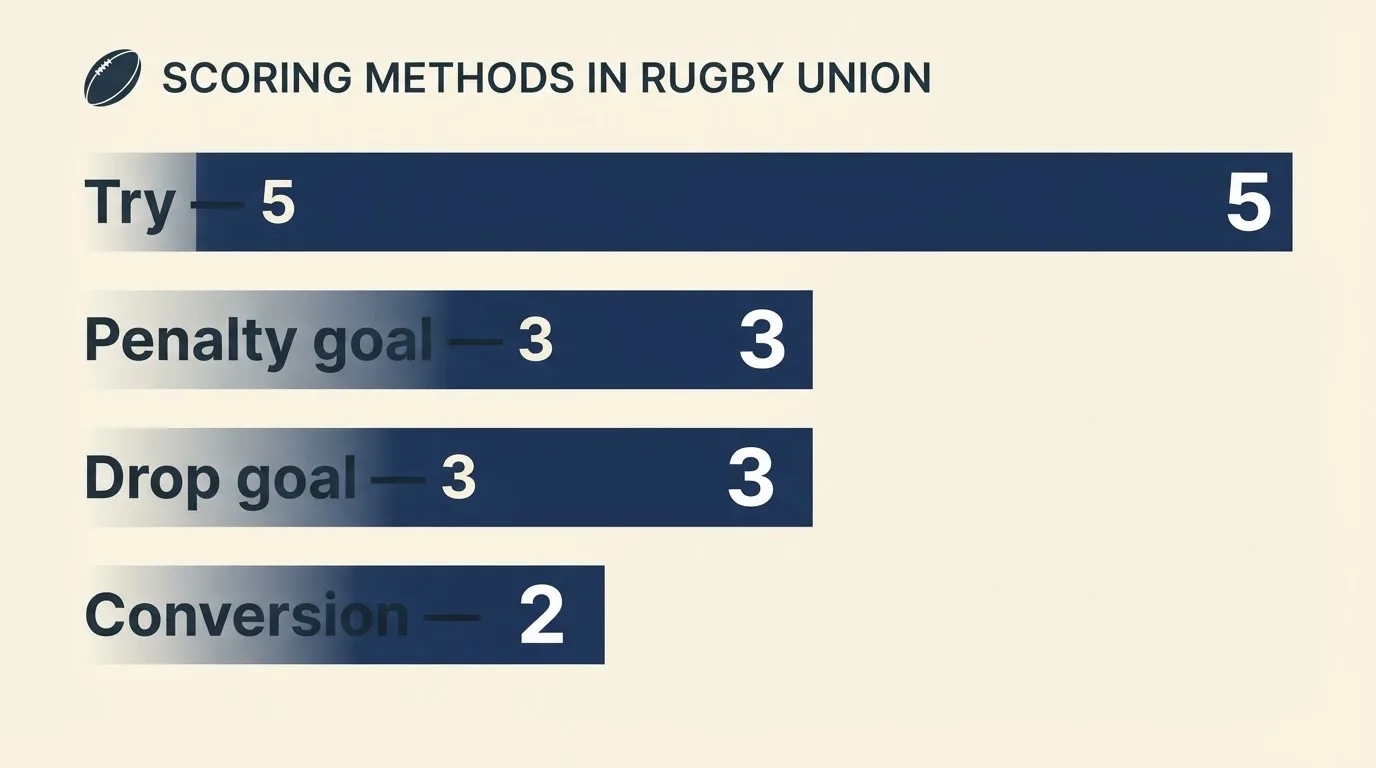
A rugby union team has 15 players on the field; a match is two 40-minute halves, and stoppages are not counted so games usually run longer than 80 minutes. World Rugby has governed the sport since 1886, and the scoring is straightforward: 5 points for a try, 2 for a conversion, 3 for a penalty and 3 for a drop goal. For the punter the consequence is that a match outcome is more volatile than association football — a single red card, a sin-binning, a sequence of penalties from a dominant scrum or a string of broken-field tries can swing a margin by 20 points in twenty minutes — and bookmakers price for that volatility with wider handicaps, higher margins on totals, and shorter suspensions of in-play markets after a score.
Two practical points follow. First, totals (over/under a set number of match points) are not an even-money market the way football totals can be; the margin is wider, and the line moves a lot in the build-up. Second, player markets — first tryscorer, anytime tryscorer, team tryscorer — have long lists because every back and many of the forwards can score, so each runner’s price is short and the field is wide. The bookmaker’s edge is harder to spot on a player market than on a match result, and a sharp punter watches the field length rather than the favourite’s price.
How Great Britain regulates rugby union betting
Great Britain has no statutory list of permitted sports or permitted markets. The Gambling Act 2005 created the Gambling Commission as the regulator of commercial gambling in Great Britain — England, Scotland and Wales; Northern Ireland sits outside the Act and follows its own older law — and since the Gambling (Licensing and Advertising) Act 2014 any operator whose remote facilities are used in Great Britain needs a Commission licence wherever the operator is based. Sections 33 and 36 of the 2005 Act, as amended, are the operative sections, and a Curaçao, Maltese or Gibraltar licence is not a substitute for the British one. The Commission’s public register can be searched by business name, trading name, domain or account number, and a match there is the whole test of whether a brand holds a GB licence.
What an operator is licensed to do is set out in the licence categories on the register. The relevant one for this page is remote general betting standard (real events) — the licence the ten operators in the ranking below hold. Remote general betting standard (virtual events), remote general betting limited, remote pool betting and remote betting intermediary (the exchange licence) are separate categories with their own rules and duties. There is no state monopoly on betting, no cap on the number of licences, and no statutory ceiling on stakes or winnings. Operators set their own maximum stakes, may restrict customers, and write their own terms.
The minimum age to bet is 18, and since 7 May 2019 every GB-licensed operator has had to verify the customer’s name, address and date of birth before the first deposit or bet, including where a free bet or bonus is being claimed. That is the practical meaning of “regulated” at the checkout: the identity check is the licence condition, and no GB-licensed site takes anonymous stakes. A second check — the financial vulnerability check under LCCP condition 3.4.4, in force from 30 August 2024 — applies once a customer’s deposits minus withdrawals exceed £150 in a rolling 30 days (since 28 February 2025) and is a public-record check, not an income check and not a credit reference check. Financial risk assessments, the press’s “affordability checks”, have been announced in a staged plan (a Commission article of 7 July 2026) with no start date, so the right description today is “announced, staged, no start date”.
Bonuses are also shaped by the licence. From 19 January 2026, wagering requirements on bonuses are capped at 10x — a £10 bonus at 50x wagering would need £500 of qualifying bets; under the cap no more than £100. Mixed-product promotions (an offer that requires gambling on two or more product types — betting, casino, bingo, lottery — for example “bet on football to get free spins”) are banned. Whether the cap applies to free bets that carry no wagering condition, and any cap on the money value of a bonus, are not established, so each operator’s terms are the only honest source. A bookmaker’s headline “100% up to £100” can no longer come with a 50x playthrough on the bonus alone.
Betting duty sits on the operator, not the punter. General Betting Duty is currently 15% on gross profits; from 1 April 2027 a new remote betting rate of 25% applies within it, while remote bets on UK horse racing, bets on self-service betting terminals in licensed premises, pool betting and in-person betting stay at 15% (HM Government policy paper of 26 November 2025). Until 1 April 2027 the remote rate stays at 15%. The punter pays no tax on betting winnings in Great Britain, and the duty is not added to the odds — operators absorb it in the margin they build into prices, though exactly how much of the margin is duty is not something any operator publishes.
Safer gambling and the duty of care
A GB-licensed remote betting site is required to take part in GAMSTOP, the national multi-operator online self-exclusion scheme. Self-exclusion periods are six months, one year, five years, or five years with auto-renewal; after the minimum period the exclusion stays in place for a further seven years unless the customer asks GAMSTOP to remove it. GAMSTOP covers online sites and apps; betting shops use a separate service. Beyond GAMSTOP, every operator offers deposit limits, timeouts and self-exclusion at the account level, and several of the brands below link directly to GamCare (the National Gambling Helpline), GambleAware, NHS gambling clinics and Gamblers Anonymous from a footer on every page. Help is to take it before the stake does.
A useful mental check before placing a bet on a busy weekend is to remember that the bookmaker’s edge is on the odds, the punter’s edge is on the bankroll, and the licence condition that matters most for the bankroll is the deposit limit. The first deposit limit phase under RTS 12 has applied since 31 October 2025; a second phase was postponed to 30 September 2026 and whether it is live today is not established, so the working rule is that limits remain a customer-set choice. Set one anyway. The bookmaker will not do it for the punter.
Rugby union bonuses and free bets — what they really cost
Bonuses on rugby union fall into three families: the welcome offer paid for signing up and placing a first bet, the recurring free-bet club paid for ongoing staking, and the price boost or enhanced odds that pops up around a televised fixture. Each one is shaped by its own small print, and the small print is where the cost of the offer lives. Three numbers do almost all the work: the wagering requirement (turnover multiple), the minimum price for a qualifying bet, and the deadline for using the credit.
A welcome offer on a sportsbook is typically structured as “Bet £X, get £Y in free bets”. The headline ignores three things. First, the qualifying bet is usually at minimum odds — fractional 1/2 (decimal 1.50) is common, EVS (decimal 2.00) is the higher threshold — so the stake has to go on a price the punter would not necessarily have chosen. Second, the free bet itself often has its own minimum price (frequently 1/2 again), an expiry (7 days is standard), and a stake-not-returned rule, so a winning £10 free bet at 5/1 returns £50 of profit, not £60. Third, the welcome offer is usually one per customer, one per household, one per payment method, and is forfeited if a withdrawal is requested before the qualifying bet settles. The marketing rewards the headline; the terms reward the punter who reads them.
The “free bet club” is a different shape. Betway’s Free Bet Club gives up to £10 in free bets every week after opt-in: spending £25 or more on sports earns 2 x £5 free bets, and the credit lands weekly. The credit is small, the requirement is moderate, and there is no wagering multiple — the free bet is the offer, not a multiplier on a bonus — so the expected value is cleaner than a welcome package but the headline is correspondingly modest. The arithmetic on a free-bet club is whether the qualifying stake (£25 at the prices the punter would have taken anyway) earns more in free-bet return than the same stake would have earned in profit, which it rarely does over a month — but the club is a way to keep the bankroll topped up, not a way to print money.
A price boost is the simplest of the three. The bookmaker names a selection, marks the price up from, say, 5/1 to 10/1, applies a maximum stake (often £10 or £25), and pays out at the boosted price. There is no wagering, no minimum qualifying bet and no expiry beyond the kick-off. The cost is the margin the bookmaker kept in the original price; the value is the extra return on the stake the punter would have taken anyway. A punter who bets the boosted price rather than the original is collecting the extra margin the bookmaker chose to leave on the table, and that is the cleanest use of a price boost.
The bet builder — combining markets from one event into a single price — is a different mechanism, and it earns its own caveat. Bet365 offers Bet Builder+, available pre-match and in-play, with the markets drawn from one match into one price; Betfair’s Bet Builder and NetBet’s Bet Builder do the same with dynamic odds that refresh as the markets change. The cost of a bet builder is the margin multiplied: combining two markets at a 5% margin each gives an effective margin on the combined bet that is wider than either single market, and combining three is wider still. A punter who likes the bet builder is paying for convenience, not for value, and the price on the combined bet is worse than the price on either single market in most cases.
A worked illustration helps. Take a £10 free bet, stake not returned, on a tryscorer at decimal odds 5.00 (fractional 4/1). If the bet wins, the punter receives £40 of profit, not £50, because the £10 stake was never returned. That is the standard free-bet settlement. The expected value of the free bet on a market where the bookmaker’s payout share is 95% (a 5% margin) is roughly £10 × (5.00 − 1) / 5.00 × 0.95 = £7.60. The “£10 free bet” the headline promises is on average worth about £7.60 in real money on a market of average margin, before minimum price and expiry are even counted. It is a small but useful credit, not a windfall.
Live betting, in-play and cash out on rugby union
Live betting on rugby union is now standard at every GB-licensed sportsbook. Midnite’s site shows in-play events alongside its acca builder and price boosts. Betfair offers in-play betting, a Bet Builder, free live streaming of events such as UK and Irish horse racing and football within the app, and a 90 Minute Payout market that pays out if the backed team goes two goals up in a football match. Fitzdares offers in-play live odds on horse racing, football, tennis, rugby, cricket, golf and American football via the app, alongside cash out, accumulators, Lucky 15s, specials and ante-post markets.
The in-play product on rugby union has a characteristic shape. After a try the market suspends for 15 to 30 seconds while the bookmaker reprices, because a try plus a likely conversion is worth 5 or 7 points, and the next market state depends on which team scored. After a red card the market suspends again — a 15-a-side sport becomes effectively 14-a-side, and the probability of a winning margin shifts sharply. Punters who trade in-play learn to wait for the suspension to lift before placing, because the first price after a suspension is rarely the sharpest. The bookmaker’s edge is the suspension; the punter’s edge is patience.
Cash out is a separate mechanism that lets a punter close a bet before the final whistle at a price set by the bookmaker on the current state of play. The cash-out price is always worse than the true odds the bookmaker is offering on the same selection at the same moment, because the cash-out price carries a spread the bookmaker keeps. The cash-out value is highest when a bet has gone well and the punter wants to bank the profit before the lead evaporates; it is lowest when the bet is going badly and the punter wants to cut the loss. The honest description of cash out is that it is a tool for managing emotion, not a tool for finding value. A punter who uses cash out on every bet is paying a toll on every bet; a punter who uses it on the bets that matter pays the toll only once.
Free live streaming of rugby union events is offered by some bookmakers, usually for horse racing, football and tennis, and less commonly for rugby union, where rights are fragmented across unions and broadcasters. Where streaming is available it is gated by account status — a funded account, a recent bet, or both — and the picture quality is functional rather than cinematic. The value of streaming to a punter is the in-play data feed that sits beside it: the score, the clock, the next stoppage, all of which feed the live markets.
Predictions, strategy and the bankroll
Search-engine queries for “rugby union betting tips” and “rugby union betting predictions” return thousands of pages, and not one of them can know who will win a given match. The honest framing is that tips are opinions priced as if they were forecasts, and the price of a tip is rarely worth more than the opinion it wraps. The use of a tip is to start a model, not to replace one. A punter who reads a tip and bets £10 on the tipster’s selection is paying the tipster for the convenience of an opinion; a punter who reads a tip and looks for the price the tipster missed is using the tip as a starting point for a value judgement, which is the only use of a tip that earns money over time.
A bankroll is the stake a punter sets aside for betting and refuses to exceed. The bankroll survives a bad week because it is sized to absorb variance — a 100/1 tryscorer lands about once a season, not once a week, and the punter who chases the long shot with an outsized stake learns the cost of outsized stakes within a month. A bankroll is sized in units (1 unit = 1 to 5% of the bankroll), and the unit stays the same whether the punter is backing a favourite or a long shot, because the unit is a measure of risk, not of confidence. The rugby union punter who keeps the unit steady through the Premiership and the international windows has a better chance of being in the game in 2027 than the punter who doubles the stake after a winner and halves it after a loser.
Strategy on rugby union narrows to four practical moves. First, look at the handicap line rather than the match result: a handicap of –8 on the favourite at evens is often better value than the favourite at 1/3 (decimal 1.33), because the handicap builds in a margin for a losing start and a come-back that the match result does not. Second, look at the totals market with the venue in mind: a Twickenham international in November is more likely to be a low-scoring arm-wrestle than a Hamilton test in July, and the totals line should be read against the conditions. Third, look at the team-tryscoring markets on form rather than reputation: a back three that has scored in three of the last four matches is a better each-way proposition than a famous name coming back from injury. Fourth, look at the outright market for the World Cup early: outright prices shorten as the tournament approaches, and a punt 12 months out is a punt on form that may not survive the season, but it is also a punt at a price the tournament itself will not return.
The honest constraint: every strategy ages. The team that won the Premiership last season may not make the play-offs this season, the player who scored 12 tries in 2024/25 may not be in the squad in 2025/26, and the bookmaker that offered the best odds on the World Cup outright in 2026 may not be the best in 2027. The strategy that holds is the one that reads the price, the venue, the form and the unit — not the strategy that bet on a name.
Rugby union bet types and odds
The market set on a Premiership match is wider than most punters use and narrower than the bookmakers offer. Standard markets: match result (home, draw, away — three-way), handicap (Asian or European), total match points, team total points, winning margin (1–12, 13+, etc.), first try-scorer, anytime try-scorer, first team to score, half-time/full-time, race to 10/20/30 points, and any-time tryscorer. Outright markets on the league, on the World Cup and on the player-of-the-year awards sit alongside the weekly coupon.
Odds on the three-way match result are written in fractional form on British books — 5/1, 11/4, evens — or in decimal form — 6.00, 3.75, 2.00. Conversion: a/b in fractional becomes (a ÷ b) + 1 in decimal, so 5/1 becomes 6.00, 11/4 becomes 3.75, and evens (1/1) becomes 2.00. “Odds-on” means shorter than evens (decimal less than 2.00), “odds-against” means longer (decimal more than 2.00). The two notations describe the same number; the British punter is comfortable with both, and a sportsbook that lets the punter choose the notation is a sportsbook that has done the easy part of customer service.
Settlement rules vary by market. A match result market settles on the final score after 80 minutes plus stoppages (extra time counts in knockout matches where the format includes it; the World Cup knockout matches go to extra time, and the final score includes extra-time points). Handicap markets settle on the handicap-adjusted score. Total points markets settle on the cumulative match points scored by both teams; a push (the total equals the line) returns the stake. First try-scorer markets void the bet if the named player does not start; anytime tryscorer markets usually void the bet if the player comes off the bench and does not score, settle as a loss otherwise. Each-way bets double the stake (one bet on the win, one on the place), and place terms vary by race, sport and operator.
A combination bet multiplies the odds of the legs into one price, and the multiplied price carries the multiplied margin. Two legs at a 5% margin each is not a 5% margin on the double — the effective margin is wider. A punter who likes accumulators (“accas”) is paying for the multiplier on the payout, not for the value of the price; Midnite’s acca builder, Betfair’s Bet Builder and Bet365’s Bet Builder+ are the modern versions, and each one tightens the margin further by combining markets from a single match into a single price. The acca insurance product — a refund as a free bet if one leg lets the punter down — is a separate mechanism, and the refund is a free bet whose stake is not returned.
The bookmaker’s margin is what makes every price worse than fair. A fair two-way market at 1.90 / 1.90 gives a payout share of 1 / (1/1.90 + 1/1.90) = 1 / 1.0526 = 0.9500, and a margin of 1 − 0.9500 = 0.0500, or 5%. That is the band a sharp sportsbook runs on a two-way market: a margin of 5% to 7% is ordinary, 8% to 10% is high but not unusual on totals, and anything wider than 10% on a match result is a price the punter should walk past. The illustrative market of 1.90 / 1.90 yields roughly 95 pence back for every pound staked across both outcomes, leaving the bookmaker 5 pence of margin per pound — and that is the band a competitive sportsbook runs. A three-way market (home, draw, away) carries a wider margin because there are three outcomes to price, and 7% to 10% is ordinary for a 1X2 on a Premiership match.
Rugby union competitions and tournaments
The club game runs on three main competitions in the British punter’s eye. The Gallagher Premiership is the English top flight, ten clubs, regular season and play-offs, running from September to June. The United Rugby Championship (URC) is the four-nation league (Ireland, Italy, Scotland, Wales) plus the South African franchises, running from September to June. The Top 14 is the French top flight, fourteen clubs, running from September to June. Below the top flights sit the English Championship, the Super Rugby Pacific competition (the southern hemisphere’s club competition), and the European Champions Cup and Challenge Cup, both of which are knockout-format European competitions that draw clubs from the Premiership, the URC and the Top 14.
The international game runs on a different calendar. The Six Nations (England, France, Ireland, Italy, Scotland, Wales) runs from February to March, with five rounds of fixtures. The Rugby Championship (Argentina, Australia, New Zealand, South Africa) runs from August to October. The autumn internationals are a series of test matches played in November, with the northern-hemisphere unions hosting southern-hemisphere opposition. The British & Irish Lions tour every four years between World Cups, taking a squad to one of the southern-hemisphere nations. The Rugby World Cup itself runs every four years, with the next edition in Australia in 2027.
Outright markets on these competitions open well before the first fixture and stay open until the final. The World Cup outright market opens more than a year ahead and settles on the tournament winner; ante-post bets settle on the named outcome, and a non-runner rule applies (the stake is returned if the selection does not take part). The Premiership outright opens before the season starts and settles on the team that lifts the trophy; the market has a long tail and the favourites shorten as the season progresses. A punt on the outright is a punt on a season, not a match, and the variance is wider than a single match — but the price at the start of the season is wider than the price at the end.
The ten reviewed bookmakers for rugby union
The ranking below is built on three filters: a GB-licensed operator in force on the public register, rugby union market depth across the Premiership, the URC, the Top 14, the Six Nations and the internationals, and the quality of the offer and the live product. Each brand sits in its own slot for a reason, and the verdict at the end of each block names the punter it suits.
The reading order below is also the order the page publishes the reviews. The Compliance Table beneath the reviews is the place to check a licence number, a licence holder or a stated term — it is not a second ranking and not a substitute for the Commission’s public register, which is the only source of standing for a licence.
Fitzdares
Fitzdares is authorized by the Gambling Commission under account 400 (Fitzdares Limited). The app offers cash out, accumulators, Lucky 15s, specials and ante-post markets on horse racing, football, tennis, rugby, cricket, golf and American football, with in-play live odds across the same sports. Rugby union is named in the list alongside the bigger sports, and the ante-post menu on the Premiership, the Six Nations and the World Cup is the feature a serious rugby punter tests first.
The product is closer to a traditional bookmaker than a modern sportsbook: the customer service line is staffed, the markets are wide on horse racing and football, and the rugby union menu covers the internationals and the Premiership at full depth. The cash-out product is standard, the bet builder is not the headline feature, and the welcome offer is modest compared with the value-focused brands lower in the ranking. It is the choice for the punter who prioritizes service and a high-touch traditional bookmaking style.
Bet Ahoy
Bet Ahoy is licensed by the Gambling Commission under account 100094 (Bet Ahoy Ltd). The welcome offer on the app is “Bet £10 & Get £10 in Free Bets”, made up of a £5 sports bet and a £5 acca. The headline is plain and the credit is paid in two parts, which means the qualifying stake and the minimum price apply to each credit separately. The credit is small but the offer is unencumbered by a wagering multiple on the free bet itself — the credit is the credit, not the start of a turnover requirement.
The product behind the offer is a focused modern sportsbook: the rugby union menu is deep across the Premiership, the URC, the Top 14 and the internationals. The acca builder is the headline bet builder feature, the price boosts are routine around televised fixtures, and the cash-out product settles at ordinary margins. Bet Ahoy is the operator for the punter who prefers a simple welcome offer paid in two small credits, a focused rugby union menu, and a sportsbook free of the usual wagering multiple on the free bet itself.
Betway
Betway operates under Gambling Commission account 39372 (Betway Limited). The Free Bet Club gives up to £10 in free bets every week after opt-in: spending £25 or more on sports earns 2 x £5 free bets. The club is a recurring credit rather than a one-off welcome, which is the kind of structure a regular punter values more than a large single offer, and the requirement (£25 of qualifying stakes) is moderate.
This operator provides a wide rugby union menu — the Premiership, the URC, the Top 14, the Six Nations, the autumn internationals and the World Cup all sit at full depth — and the in-play product is reliable. The bet builder is available, the price boosts are routine, and the cash-out product is functional. Betway is one of the better-known names in the British sportsbook market, and the brand recognition earns a place on a shortlist even where the headline numbers are not the highest. Betway is recommended for the regular punter who prefers a recurring free-bet club over a large one-off bonus.
Fafabet
Fafabet is registered with the Gambling Commission under account 57385 (Taichi Tech Limited). The headline offer on the app is Best Odds Guaranteed on UK and Irish horse racing win and each-way bets from 9am on race days: if the starting price is bigger than the original price, the bigger odds are paid. BOG is a horse-racing feature first and a rugby union feature second, but the rugby union coverage is deep and the in-play product is functional.
The product is a focused modern sportsbook with a horse-racing centre of gravity. The rugby union book covers the Premiership, the URC, the Top 14 and the internationals; the bet builder is available; the price boosts are routine around televised fixtures; the cash-out product is functional. Fafabet is the right choice for the punter who bets on horse racing as well as rugby union and wants the BOG on the racing book, a clean rugby union menu at full depth, and a sportsbook that is honest about which sport it is built around.
Betfair
Betfair holds a Gambling Commission remote licence, account number 39439 (PPB Counterparty Services Limited). Betfair Sportsbook — the fixed-odds book, distinct from the Betfair Exchange — offers in-play betting, a Bet Builder, free live streaming of events such as UK and Irish horse racing and football within the app, and a 90 Minute Payout market. The streaming offering is broader than most, and the 90 Minute Payout is a football-specific product that pays out if the backed team goes two goals up.
The rugby union menu on the Sportsbook is full at international, Premiership and URC level, and the Sportsbook sits beside the Exchange for punters who want both products. The Exchange is licensed as a separate betting intermediary licence category, and the rates and rules of the Exchange are stated in the Exchange’s terms rather than the Sportsbook’s. It is a destination for the punter who wants a fixed-odds sportsbook alongside a high-volume betting exchange.
NetBet
NetBet is a Gambling Commission licensee, account number 39170 (Netbet Enterprises Limited). The app offers Daily Boosts, Profit Boosts and free bet offers, a Bet Builder with instant dynamic odds, and sports stats for major leagues. The bet builder’s “instant dynamic odds” feature is the differentiator: the price updates as the markets combine, rather than only when the bet is placed, which is a small but useful product point for a punter who builds singles into multis.
This sportsbook is characterized by a deep rugby union menu and a functional in-play product. The price boosts and profit boosts are routine around televised fixtures, and the free bet offers sit alongside the welcome package. NetBet is a strong pick for the punter who values active boost programmes and dynamic odds updates.
Kwiff
Kwiff is a Gambling Commission licensee, account number 44448 (Eaton Gate Gaming Limited). The brand describes itself as a trademark operated by Spryme Ltd, and the app carries a 17+ age rating on the App Store. The headline differentiator is “kwiffed” prices — randomly boosted odds on selected selections — which adds a price-boost layer on top of the standard market, and the feature is the reason the brand is on the shortlist.
The rugby union coverage is comprehensive and the in-play product is reliable. The bet builder is available, the cash-out product is functional, and the welcome offer is on the modest side — the value is in the recurring price boosts rather than the welcome package. It serves the punter who prefers a gamified experience where randomly boosted prices are the standard.
Star Sports
Star Sports is licensed by the Gambling Commission, account number 9177 (Star Racing Limited). The app lets customers speak to a trader directly on 08000 521 321 to open an account, place bets or ask customer queries, and offers support at [email protected]. The phone-a-trader feature is the differentiator: a staffed phone line for account opening, betting and queries is a service that few modern sportsbooks offer, and it is the reason the brand is on the shortlist.
The rugby union coverage is full at Premiership, URC, Top 14 and international level, and the in-play product is efficient. The bet builder is available, the price boosts are routine around televised fixtures, and the cash-out product is functional. It is built for the traditionalist who values a direct line to a trader over the automated experience found elsewhere.
Dabble
Dabble holds Gambling Commission licence number 65677 (Dabble Sports UK Ltd). The welcome offer is “Bet £10, Get £10 in Free Bets” on a first deposit for new customers, with minimum odds applying, a 7-day free bet expiry and the stake not returned. The structure is plain — a £10 qualifying bet at the minimum odds earns a £10 free bet within 7 days, stake not returned on the free bet — and the offer is unencumbered by a wagering multiple on the free bet itself.
The rugby union coverage is extensive and the in-play product is functional. It is suited to the social punter who prefers a modern, streamlined interface without complex wagering requirements.
Midnite
Midnite is a Gambling Commission operator, account number 101839 (Midnite Limited). The site cites the licence on the home page and shows in-play events, an acca builder, popular accas and price boosts with maximum-stake limits. The sports welcome offer is structured for a £5+ qualifying bet at minimum odds EVS (decimal 2.00) or greater within 14 days of sign-up, paying £25 in free bets and 50 free spins valid for 7 days. The headline number is high; the qualifying odds and the 14-day window are the conditions.
The rugby union coverage is broad and the in-play product is solid. The acca builder is the headline bet builder feature, the price boosts are routine around televised fixtures, and the cash-out product is functional. It is an option for the punter looking for a high-value welcome bonus that balances headline appeal with manageable terms.
Compliance table
| Brand | Gambling Commission remote licence number and licence holder | What the operator’s own terms state on the key’s subject |
|---|---|---|
| Fitzdares | 000400-R-103839-030 — Fitzdares Limited | Cash out, accumulators, Lucky 15s, specials and ante-post markets on horse racing, football, tennis, rugby, cricket, golf and American football; in-play live odds across the same sports |
| Bet Ahoy | 100094-R-341742-003 — Bet Ahoy Ltd | Welcome offer of a £5 sports bet and a £5 acca for a £10 qualifying bet |
| Betway | 039372-R-319367-029 — Betway Limited | Free Bet Club gives up to £10 in free bets every week after opt-in; £25+ on sports earns 2 x £5 free bets |
| Fafabet | 057385-R-333191-006 — Taichi Tech Limited | Best Odds Guaranteed on UK and Irish horse racing win and each-way bets from 9am on race days; bigger SP over the original price is paid |
| Betfair | 039439-R-319330-013 — PPB Counterparty Services Limited | In-play betting, Bet Builder, free live streaming of UK and Irish horse racing and football in the app, and a 90 Minute Payout market |
| NetBet | 039170-R-319343-032 — Netbet Enterprises Limited | Daily Boosts, Profit Boosts and free bet offers; Bet Builder with instant dynamic odds; sports stats for major leagues |
| Kwiff | 044448-R-323408-017 — Eaton Gate Gaming Limited | Trademark operated by Spryme Ltd; randomly boosted odds on selected selections |
| Star Sports | 009177-R-104555-019 — Star Racing Limited | Speak to a trader on 08000 521 321 to open an account, place bets or ask customer queries; support at [email protected] |
| Dabble | 065677-R-340363-005 — Dabble Sports UK Ltd | Welcome offer of a £10 free bet for a £10 qualifying first deposit; 7-day free bet expiry; stake not returned |
| Midnite | 101839-R-342850-001 — Midnite Limited | Welcome offer of £25 in free bets and 50 free spins for a £5+ qualifying bet at EVS or greater within 14 days of sign-up; 7-day validity |
Frequently asked questions
How does rugby union betting work in Great Britain?
Rugby union betting in Great Britain works through online bookmakers licensed by the Gambling Commission under the Gambling Act 2005. A licensed operator verifies the customer’s name, address and date of birth before the first deposit, offers GAMSTOP self-exclusion and deposit limits, prices the match result, handicap, total points, try-scorer and outright markets with a margin built into the odds, settles bets on the final score and pays returns in pounds. The punter pays no tax on winnings.
How do you bet on rugby union?
Place a bet by choosing a licensed bookmaker, opening and verifying an account, depositing by debit card or bank transfer (credit cards are banned for gambling), selecting a rugby union match or outright market, choosing a market and a price, entering a stake and confirming the bet. The bet settles on the result of the match or the outright market; returns are paid back to the same payment method once settlement is complete.
How can it be checked that a bookmaker holds a Gambling Commission licence?
Check the Gambling Commission’s public register by business name, trading name, domain or account number. A match on the register under the remote general betting standard (real events) licence category is the whole test of whether a brand holds a GB licence; a Curaçao, Maltese or Gibraltar licence is not a substitute. The register is the only authoritative source, and operators sometimes hold more than one licence category.
How is the return on a bet worked out from the stake and the odds?
The return on a winning single bet is stake multiplied by decimal odds; net profit is stake multiplied by (odds − 1). A £10 bet at decimal odds 5.00 returns £50, of which £40 is profit and the £10 stake is returned. A combination bet multiplies the odds of the legs into one price, and the stake is multiplied by the combined price; the effective margin is wider than any single leg.
What is the bookmaker’s margin and how can it be seen in the odds?
The bookmaker’s margin is the share of every pound staked the bookmaker keeps on average across a market, and it shows up in the odds as the gap between fair prices and the prices offered. For a two-way market at 1.90 / 1.90 the payout share is roughly 95% and the margin is roughly 5%; at 1.85 / 1.85 the payout share is roughly 92.5% and the margin roughly 7.5%. A punter who compares the prices across two bookmakers on the same selection is comparing the margins directly.
How do fractional odds such as 5/1 convert to decimal odds such as 6.00?
Fractional odds a/b convert to decimal odds (a ÷ b) + 1. So 5/1 becomes (5 ÷ 1) + 1 = 6.00, 11/4 becomes (11 ÷ 4) + 1 = 3.75, evens (1/1) becomes (1 ÷ 1) + 1 = 2.00. “Odds-on” means shorter than evens (decimal less than 2.00) and “odds-against” means longer (decimal more than 2.00). The two notations describe the same number.
Rugby, cricket & Gaelic – Basketball betting
Content created by the «Basketball betting» team
